


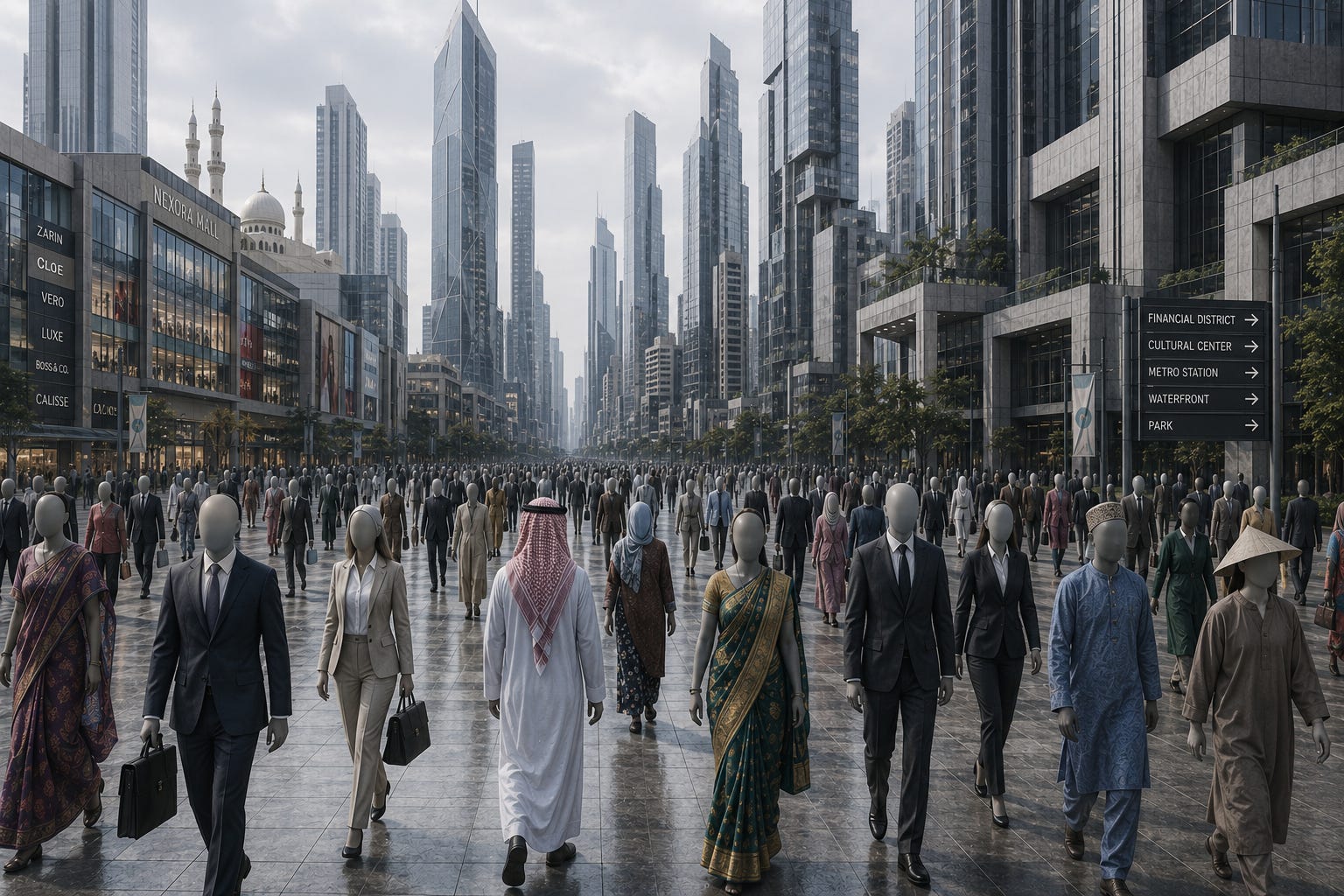
From a ‘post-modern’ liberal perspective, sovereign individuals must be able to construct themselves in complete autonomy. Social order thus no longer serves any other purpose but to guarantee the exercise of such free will. This doxa applies to the domain of sexual identity, where it becomes possible to postulate the existence of ‘gender’ categories completely independent of any biological realities. It also extends to the domain of the very identity of peoples and nations, both of which are thus reduced to an arbitrary construct whose nature is purely contractual, one in which the feeling of belonging to a single ethno-cultural community no longer has any place.
This ideology represents the ultimate stage of the individualistic and contractual conception of society developed by certain Enlightenment thinkers. Such an evolution could undoubtedly not have been imagined in the 18th century by the ‘founding fathers’ of philosophical liberalism, convinced as they were of allowing themselves to be wisely guided by Reason alone. The fact remains, however, that the fracture caused by their ‘rationalist’ system of thought enabled the subsequent emergence of political and social upheavals whose scope and violence have been considerable. Indeed, even in its early days, liberal thought, which now asserts itself as intrinsically ‘moderate’ in contrast with all kinds of ‘extremism’, all of which it rejects with equal good conscience, embodied a profound break with earlier conceptions of human nature—although Chesterton did define these new ideas as ‘Christian virtues gone mad’, and certain concepts of modern state theory do transpose secularised theological concepts into the non-religious sphere, as clearly demonstrated by Carl Schmitt.
READ MORE:
This article is an excerpt from Henri Levavasseur’s Identity: The Foundation of the City, brought to you in English by Arktos.
According to the liberal way of thinking, which Alain de Benoist flawlessly analysed in one of his recent works, man is not defined primarily as a member of a community anchored in a specific historical reality (family, ‘order’, fatherland), but mainly as an abstract, autonomous individual detached from the contingent identity inherited from his predecessors, and as someone who enters into a contract with society with the intention of guaranteeing the exercise of his own ‘natural’ rights. In the 8th chapter of his Second Treatise of Government, published in 1690, John Locke states that a child ‘is not born a subject of any government or country’.
The ideological construct on which the idea of a social contract is based takes of course little account of the historical existence of organic communities. Here, one encounters the old contrast between the notions of community (Gemeinschaft) and society (Gesellschaft), a contrast well highlighted by the German sociologist Ferdinand Tönnies in a famous work published in 1887. Having reached the ‘post-modern’ stage of its evolution, the extension of the liberal model sanctifies the disunion between polis and ethnos, that is, between sovereignty and identity. This model represents the culmination of the system of the ‘republican homeland’, one that is based on a purely contractual and ideological conception of the fatherland: it thus constitutes both its apogee and its final phase.
Although the republican homeland has never completely merged with the actual and physical fatherland, content instead with using the latter as ‘its support and instrument’ over a period of two centuries, as stated by Jean de Viguerie, the republic is now in grave danger of collapsing upon the ruins of France, akin to a parasite that would not long survive the organism whose substance it has drained.
Once all ties between sovereignty and identity have been severed, sovereignty inevitably escapes the body of the nation and ends up becoming the expression of a mosaic of individual demands . At the same time, since nature abhors a vacuum, the weakening of the nation logically ends up paving the way for the emergence of various forms of supra-national sovereignty, forms which, as predicted by Ernest Renan, would not necessarily be inclined to respect our genuine freedoms, which had hitherto been guaranteed through the exercise of national sovereignty In this domain, a systematic recourse to the universal morality of ‘human rights’ ultimately serves to undermine the very foundations of traditional political order, with the latter linked to the sovereignty of a people over its own territory.
This critical situation is obviously complicated by the massive presence of populations of non-European origin: by gradually imposing their customs, traditions and unique identity, these people are logically occupying the civilisational space left vacant by Europeans. And who could blame them? It is hardly possible, in fact, to identify, whether individually or collectively, with a homeland whose identity is reduced to abstract and universal principles. Brandishing ‘values’ whose expression appears increasingly outdated and using them as the sole instrument of their convictions, the republican authorities have nothing solid in the face of those who reject their model, nor anything to offer, especially to those who would like to assimilate into what remains of the French nation.
Through long-term and sometimes painful efforts, it is undoubtedly possible, over the generations, for an expatriate community to blend into the melting pot of the host nation, provided that this community does not constitute a mass large enough to suddenly upset the demographic balance of the host country and that the cultures of the two populations in question share certain affinities from the very outset. History provides us with numerous examples of successful assimilation processes, most often involving human groups and peoples from the same civilisational space, as was the case during the settlement of French Huguenots in Prussia after the Revocation of the Edict of Nantes.
Economic considerations also play a role in the process of assimilation of a foreign population. The Huguenots were an industrious and learned elite group, whose arrival contributed to strengthening the dynamism of the Prussian society into which they integrated; a situation that is, of course, different from that of most contemporary waves of migration.
Is collapse therefore inevitable? Well, it is likely that we have now entered a ‘long civilisational winter’, a process that will display all the aspects of gradual and slow death throes, as our country is shaken by some rather violent convulsive spasms. It is not impossible that the political entity called the ‘French Republic’ will continue to exist throughout this time, and that it will still be worth devoting some energy to in order to keep it as functional as possible, while ensuring above all else that we avoid relinquishing control to elements that are completely foreign to our desire to guarantee the sustainability of our ethno-cultural identity.
However, it would be futile to continue placing our hopes in the ability of this entity to embody ‘what we are’ . Our duty dictates that we do not give in to such blameworthy blindness through intellectual laziness, conformism or cowardice. Our generation must now accept a decisive historical responsibility, without losing sight of the fact that it is faced with the necessity to defend, one inch at a time, the ramparts of an already occupied citadel whose command no longer belongs to us, while simultaneously preparing other positions from which future generations can reclaim our civilisational space and grant it a new form once kairos (or the ‘right moment’) arrives; a moment that none of us can predict or situate. In the meantime, we must form a vanguard, without ceasing to wage a rearguard battle.
The same requirement is already imposed on the youth of other European nations, with whom unprecedented solidarity must be forged, thus allowing us all to preserve the identities of our peoples in full awareness of what unites us through each of them . It is impossible to engage in such a struggle without first reverting to a clear vision of the world, which, along with courage, constitutes the primary condition for our freedom of action. This approach is necessarily based on a mental return to one’s perennial sources, in harmony with a realistic anthropology that is free of all biases imposed upon us by two centuries of liberal ‘humanism’.
Henri Levavasseur’s Identity: The Foundation of the City — a call to the peoples of Europe to rebuild the City — is available from Arktos and on Amazon

More from Henri Levavasseur:
Five thousand years ago, communities of herders, warriors, and poets hailing from the Pontic Steppes set in motion one of the most consequential expansions in human history. These people, known as the Indo-Europeans, spread the languages, myths, and institutions that would define many of the ethnocultural groups of ancient and modern Europe and parts of Asia. Despite their distinct histories, European peoples continue to bear the imprints of this shared inheritance.
Drawing upon the latest discoveries in linguistics, archaeology, anthropology, and genetics, Henri Levavasseur introduces readers to the reconstruction of the Indo-Europeans’ origins, language, culture, and worldview. At a time of cultural amnesia and the erasure of identities, Indo-European Echoes invites readers to reconnect with the shared “long memory” that anchors the identity of European peoples in their awareness of a common origin and ancient traditions.
Good article, and I read and would definitely recommend your book on the Indo-Europeans.
Interesting, but I think the rise of common classes, particularly the bourgeoise in commercial wealth and state bureaucracy, had a lot more to do with this identity" thingy in replacing the traditional hereditary feudal standestaat with a transactional business and its "social contract" i.e. the hierarchical feudal system of priveldge and responsibilities beginning with clergy and divine revelation became negotiable and money the deciding factor. No surprise, this developed as commercial wealth and manufacture over took that of agricultural land with novel notions of sovereignty, military power and, of course, identity. If divine lineage is no longer necessary to rule, that anything is possible, so long as you "deliver the goods", whatever that might be.