


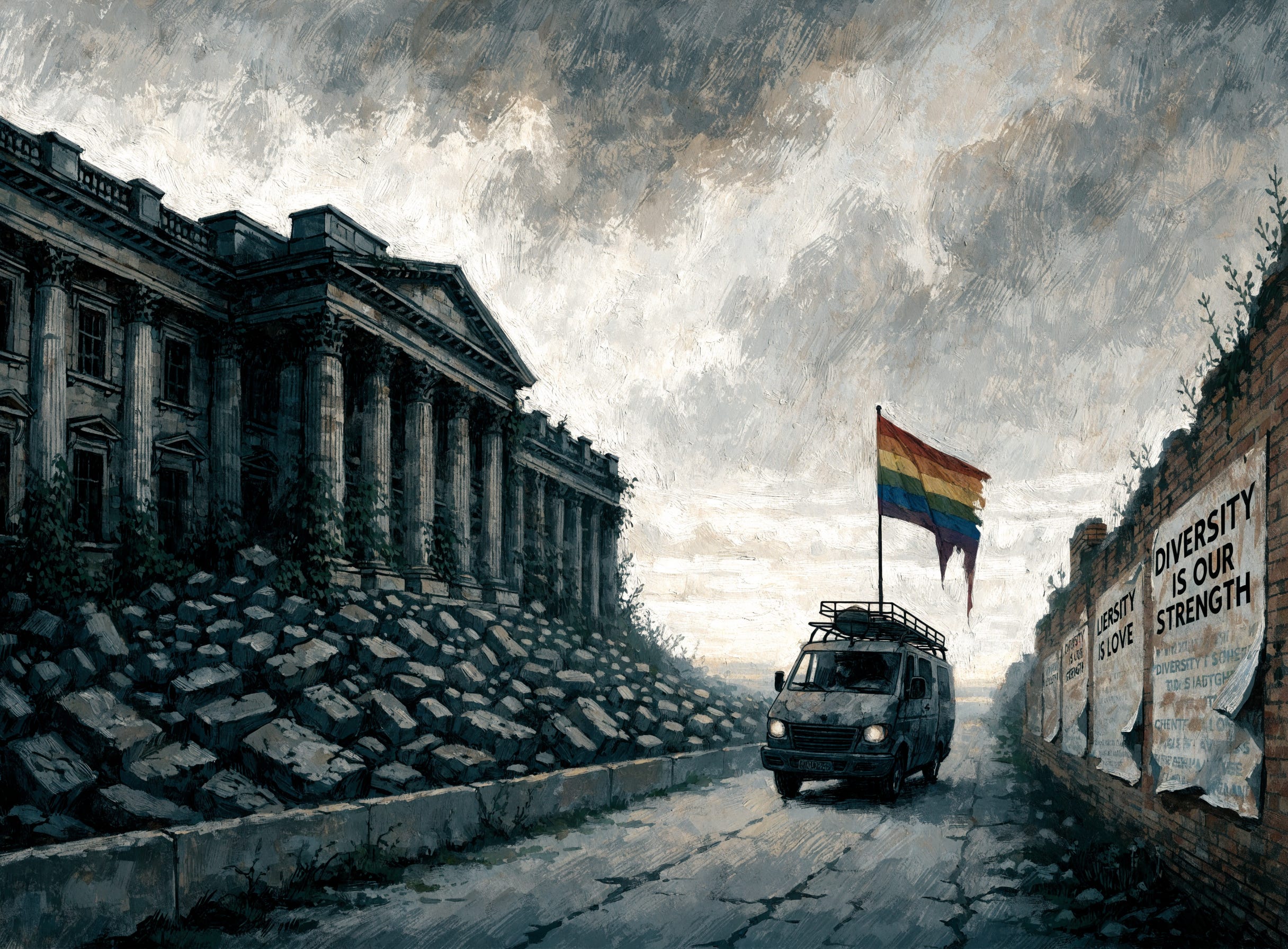
The right believes it is winning the culture war, but Alain de Benoist argues it has won nothing at all: the progressive left simply collapsed under its own exhaustion, leaving the same dominant class still setting the tone. What looks like victory is a landscape of ruins, and the only way out runs through a populism willing to break with liberalism rather than merely inherit its machinery.
Today there is talk of a “rightward turn of the world,” or of a “global neo-reactionary wave,” or even of a “return of the dark years.” These are never anything more than polemical shorthand. Many on the right nonetheless draw from them the conclusion that they are on the verge of winning the “culture war.” What a strange idea! What war are we talking about? What battle has been won when the authoritative media-political system continues to refer solely to “incontestable authorities” who think the opposite of what most people think?
The truth is that the culture war has, at best, been won only by default. The progressive left has lost; the conservative right has not won. The adversary was not defeated; it collapsed of its own accord. But it has not, for all that, lost power. The intellectuals of the dominant class have nothing left to say; they content themselves with repeating the same mantras, yet it is still they who set the tone. Progressivism is dead, and gender theory and wokeism are merely its broom wagons1, yet they still hold center stage.
Getting Out of Liberalism
In an age of the willfully blind and the deaf on principle, of the media circus and its parish newsletters, in which communities — for want of any great collective project — are reduced to identitarian impulses or victimhood narratives, the few intellectual centers that remain have lost all grip on events. The great authors, the “guiding minds of the young” who once held authority, have died without being replaced. A certain number of talents are left here and there, but they remain ostracized, confined to the margins. For the rest, we have passed from the age of statesmen to that of experts in expertise — from Jaurès to Olivier Faure, from Édith Piaf to Aya Nakamura. Hardly progress.
All the classic political forces are at the stage of decomposition. The socialist left has been replaced by an indigestible, synthetic, “societal”2 product ever since it gave up the defense of workers and the critique of the relations of production, confining itself to expanding subjective rights within the framework of the dominant regime of alienation.
The right remains busy preserving its profits, even at the cost of lowering the general standard of living — all of it against the backdrop of the sordid bankruptcy of the bourgeois state and of a swelling public debt whose sole aim is to prop up consumption artificially.
There is a rout of the system, a rout of the progressive intellectuals, and a rout of a right that has not reformed itself and believes it has won victory all the while as it produces nothing historically capable of nourishing a coherent civilizational project. There is a landscape of ruins.
Who seriously contests the dominant ideology’s control over the world of culture? How is one to launch into a cultural battle without even knowing what the cultural signifier is the name of? In the name of what anthropological model? Of what symbolic imaginary? How is one to defend the singularity (of peoples and cultures) without thinking of the singular? What too often prevails is intellectual laziness and a timidity about looking beyond comfortable labels.
Alain de Benoist: "The culture war has only been won by default"

While progressive hegemony wavers across the media, Alain de Benoist analyzes the fury unleashed by the slightest breach in their system. In his view, progressive dominance has collapsed on its own — but the conservative right has won nothing. Faced with this, he argues for producing content of real quality.
The populist wave has mainly given birth to liberal-conservative parties or regimes whose ideas are very often merely the resurgence of outdated notions or of accepted banalities that in no way herald a path of thought equal to the challenges of the moment. In economics or foreign policy, for example, they confine themselves to repeating the vulgate.
These movements and regimes that claim to defend the people still have not understood that liberalism is an ideology which knows only individuals and grants no particular status to collective entities — beginning with peoples and cultures — which sees in immigration nothing but the displacement of some number x of individuals from one country to another, and which, moreover, has always campaigned for the free movement of people, capital, and goods. Liberal populism is a contradiction in terms.
There is a great difference between coming to power because one has won an election and putting an end to the dominant hegemony. Replacing a left-wing man of the system with a right-wing man of the system does not get one out of the system. The recent controversy between the current Italian Minister of Culture, Alessandro Giuli, and the essayist Marcello Veneziani — who reproached Giorgia Meloni’s right for having fundamentally changed nothing in Italian society (solo fuffa, “just smoke and mirrors”) — was revealing in this respect. One can get out of the system only by adopting a position of rupture. To have at one’s disposal a strategy of rupture aimed at weighing upon the historical moment, one needs minds structured by one and the same conception of the world, of man, and of society. That is precisely what is lacking.
Populist leaders would do well to reflect on the fact that it is the popular classes who have the greatest interest in a radical transformation of society (and the bourgeois classes the greatest interest in its preservation). One might even be tempted to say that, faced with the three great ideologies of the modern world — conservatism, liberalism, and socialism — populism will be able truly to serve the people only by resolutely opposing the second and by seeking to forge an original synthesis of the other two. This means that populisms need a program that is at once conservative and revolutionary, one allowing them to found a new historical subject in the struggle for hegemony.
The idea of another society is, nowadays, difficult to envision: “Here we are, condemned to live in the world in which we live,” said François Furet. And yet, history is open. One needs only to step back a little to see it. One will then see, by the same token, that today something is ending and something is (re)beginning. And that everything remains to be done.
READ MORE from Alain de Benoist:
The classic and still cutting-edge essay Orientations for Decisive Years is hot off the press from Arktos and available on Amazon.

Originally published in Éléments no. 220, June-July 2026
Translated by Alexander Raynor
TN: voitures-balais — the support vehicles that trail a cycling race to collect riders who have dropped out exhausted; the image is that gender theory and wokeism bring up the rear of a race that is already over.
TN: « sociétal » — French distinguishes social (class, labor, material conditions) from sociétal (society’s mores and lifestyle/identity questions); de Benoist’s charge is that the left traded the former for the latter.
The Multi-polar World is the only theory which i found really profound and new. It's now about left and right, it's not about modernism or postmodernism, it's about letting different cultures with different worldview flourish. Which one will prevail without military confrontation. By letting the ocean of humanity build its own fragments of life in an vast universe aiming to find peace.