


Laurent Guyénot, the author of The Papal Curse: The Medieval Origin of the European Syndrome, uncovers the Crusade archetype in European culture, tracing its disastrous consequences from the Middle Ages to the present-day Middle East.
At the end of the 11th century, the popes instilled a revolutionary idea in the ruling caste: the Crusade. It was a revelation, a new road to salvation, as well as a paradoxical attempt to unify Europe around Jerusalem. It brought the best and the worst out of the warrior class, it was embraced by the kings as well as by the masses, and it gave the pope unprecedented spiritual and political domination.
The Crusade was such a potent experience that its influence on Western civilization outlasted the fall of papal autocracy, and is still felt today. The Crusade became part of the West’s DNA. Dressed in new clothes, it remains the West’s defining Big Idea: redeeming the world—and itself—through wars in the name of lofty principles. Most recent American military adventures fit Christopher Tyerman’s definition of the medieval Crusades as “wars justified by faith conducted against real or imagined enemies defined by religious and political elites as perceived threats to the Christian faithful.”1 That today crusades are launched in the name of Democracy rather than Christianity is the only difference.
The Impact of the Crusades
Every historian agrees today, notes Norman Housley, that “the crusades played a central rather than a peripheral role in the development of medieval Europe.”2 More than anything else, of course, as Michael Mitterauer insists, “The crusading movement produced a radical change in Western Christendom’s attitude toward war, marking a turning point in the history of Western thinking.” It also set the pattern for European expansionism, which “is a fundamental feature of Europe’s special path.”3
The First Crusade (1095-97) was a success, and it was celebrated by the earliest massive propaganda. It became for Europeans what the Trojan War was for the ancient Greeks.4 Christopher Tyerman writes:
“The scale and rapid production of histories of the First Crusade by eyewitnesses and others eager to interpret the startling events didactically finds no parallel in medieval historiography. Within a dozen years of Jerusalem’s capture, at least four full eyewitness accounts, three major western histories and part of the great Lorraine version by Albert of Aachen were being circulated along with a bevy of other accounts, more or less derivative, imaginative or polemic. … Most of the histories sculpted stirring tales of faith, bravery, suffering, danger, tenacity and triumph. The theologians distilled the message of God’s immanence and Christian duty; the no less artful eyewitnesses provided accessible tales of miracles and butchery. One of the very earliest, the Gesta Francorum, included elaborate scenes with stereotype exotic Orientals declaiming extravagant, bombastic nonsense much in the style of the verse chanson de geste. Naturalistic representation, especially of the enemy, did not feature.”5
A New Religion of Salvation
The impact of these tales was such that, when the Second Crusade was preached in 1145, the response was again overwhelming. “I opened my mouth, I spoke, and at once the Crusaders have multiplied to infinity,” Bernard of Clairvaux bragged to the pope. “Villages and towns are now deserted. You will scarcely find one man for every seven women. Everywhere you see widows whose husbands are still alive.”6 Bernard elaborated the soteriological doctrine the Crusade. He wrote in In Praise of the New Knighthood:
“the knights of Christ may safely fight the battles of their Lord, fearing neither sin if they smite the enemy, nor danger at their own death; since to inflict death or to die for Christ is no sin, but rather, an abundant claim to glory. In the first case one gains for Christ, and in the second one gains Christ himself.”
Blessed if you kill, blessed if you die.
The Crusade was indeed a new religion of salvation. Guibert of Nogent, an enthusiastic chronicler of the First Crusade, noted that before, knights could only attain salvation by giving up their way of life and becoming monks, but “God has instituted in our time holy wars, so that the order of knights and the crowd running in their wake … might find a new way of gaining salvation.”7
While the Roman Church had sought to repress private wars by the movement of the Peace of God in the 10th century, it now declared that the only authorized war was in the Holy Land. The Church which had decreed that even tournaments—“execrable fairs” according to saint Bernard—were a mortal sin, and that finding death there sent you directly to Hell, invented the Holy War which propels each soldier who dies there directly to Paradise.
Blood vengeance, a supreme value of barbarian and feudal ethics, also found its Christian redemption in the Crusade. For Raymond of Aguilers, the First Crusade, in which he participated, was “the enterprise which aimed to avenge our Lord Jesus Christ, on those who had unworthily seized the native land of the Lord and his apostles.”8 Vengez Jésus became a war cry of the French crusaders.9
Making Jerusalem the Capital of Europe
It has been said that the Crusades were “the first unifying event in Europe.”10 The crusades “so stirred and united Europe that we may count them as the beginning of modern history,” wrote Halford Mackinder in his seminal 1904 article on “The Geographical Pivot of History.”11 He was not puzzled by the utter absurdity of aiming to unite Europe around Jerusalem. The popes convinced Europeans that the cradle of their civilization was a city at the eastern end of the Mediterranean, already coveted by two other civilizations (the Byzantine and the Islamic) and asked them to fight for it as if the salvation of Europe depended on it. There could not be a project more contrary to the interests of Europe.

From the time they “liberated” Jerusalem, Westerners saw themselves as the guardians of the center of the world. It became part of their identity. Their obsession only grew after Jerusalem was recaptured by Salah al-Din (Saladin) in 1187, and with every new failed attempt to reverse this fatal development. When the pious king Louis IX died of dysentery during the Eighth Crusade in 1270, his last words were for the city he never saw: “Jerusalem! Jerusalem!”
All Europe, it seems, has been weeping over Jerusalem ever since. Tyerman writes:
“The clerical and lay elites of western Europe found it almost impossible to let go of the Holy Land as a political ambition or vision of perfection. Throughout the fourteenth and fifteenth centuries, governments, moralists, preachers and lobbyists returned again and again to a subject in which practical and moral objectives were fused together.”12
When British General Edmund Allenby entered the city in a solemn procession in 1917, he proclaimed “the end of the Crusades,” and the London Punch published an illustration showing Richard I looking down on Jerusalem, and nodding contentedly, “My dream comes true!”13
That fascination with Jerusalem is, of course, not unrelated to the British and French support for Zionism at the beginning of the 20th century. The sacralization of biblical Israel in Christian culture obviously constituted a key factor in the support given by Christian nations to the “rebirth” of Israel between 1917 and 1948. But it was the Crusade and the memory of it in European culture that played the major role in sealing the sacred bond between Western Christendom and Israel, which has overdetermined world history ever since.
Crusaders saw themselves as imitating the genocidal people of Moses. According to an account by Robert of Reims, Urban II said, in his sermon at Clermont: “Take the road to the Holy Sepulchre, rescue that land from a dreadful race and rule over it yourselves, for that land that, as scripture says, flows with milk and honey was given by God as a possession to the children of Israel.”14 In the version of his speech recorded by Baldric of Dol, Urban II referred to the Arabs as the Amalekites that Yahweh ordered King Saul to slaughter entirely, “man and woman, babe and suckling, ox and sheep, camel and donkey” (1Samuel 15:3). “It is our duty to pray, yours to fight against the Amalekites,” Urban said, “With Moses, we shall extend unwearied hands in prayer to Heaven, while you go forth and brandish the sword, like dauntless warriors, against Amalek.”15
As you know, the Iranians have now been officially declared by Netanyahu to be the new Amalek.
A Disastrous Failure Through and Through
As a matter of fact, the unity of the Islamic world did not suffer from the Crusades — quite the opposite. Before the First Crusade, it had fragmented into two rival caliphates (Baghdad and Cairo) and a number of independent emirates and city-states. The Frankish aggression stimulated the reunification. Archbishop William of Tyre complained about this in the early 1180s:
“In former times almost every city had its own ruler … not dependent on one another … who feared their own allies not less than the Christians [and] could not or would not readily unite to repulse the common danger or arm themselves for our destruction. But now … all the kingdoms adjacent to us have been brought under the power of one man [Nur ed-Din].”16
Moreover, before the First Crusade, the Byzantines had been living in good terms with the Shiite Fatimid caliphate, of which Cairo was the capital. “In the middle of the eleventh century the tranquility of the east Mediterranean world seemed assured for many years to come. Its two great powers, Fatimid Egypt and Byzantium, were on good terms with each other.”17 Christians worshiped freely in Jerusalem, and Muslims had their mosque just outside the walls of Constantinople (it was burned by the Franks, and the fire spread to a third of the city). The Seljuks invaders from the East were the common foes of the Fatimids and the Byzantines. But for the unsophisticated crusaders, all Muslims were the same. The Franks’ policy of “normative hostility” against Muslims disrupted the policy of the Byzantines, which was “to play off the various Moslem princes against each other and thus to isolate each of them in turn.”18
As a whole, the Crusades not only dealt a mortal blow to the eastern Christian empire that they pretended to be rescuing (the crusaders sacked Constantinople during the Fourth Crusade in 1205, and the city never recovered). They also ruined the diplomatic relations between Byzantium and the the Shiite caliphate of Egypt, and indirectly caused the fall of this long-standing ally, absorbed by Saladin under the Sunni banner in 1171. They therefore strengthened the Sunni power that they were supposed to fight.
Ultimately, the Crusades dug a trench of incomprehension and hostility between Christian and Islamic civilizations, thus doubly harming Eastern Christians of all denominations (Orthodox, Copts, Nestorians, Armenians, Jacobites, etc.), who had up until then enjoyed freedom of worship under most Muslim rulers.
Ultimately, the Crusades, with their inherent hypocrisy, harmed the West by corrupting its very soul, and harmed the rest of the world by making the West a dangerous, unrestrained predator.
The Beginning of Colonization
In The Latin Kingdom of Jerusalem: European Colonialism in the Middle Ages, Joshua Prawer presents medieval crusading as a foreshadowing of later European colonialism. He contends that the institutions and economy of the Latin states are best understood in the light of their colonial status:
“Though colonization is not a new phenomenon in European history, only since the Crusades is there continuity and filiation between colonial movements. … it is justified to regard the Crusader kingdom as the first European colonial society.”19
The Northern Crusades in the Baltic regions, launched in the early 13th century with the full benefit of papal indulgences and privileges, also fit modern definitions of colonization very well. The appeal of Archbishop Adalgot of Magdeburg in 1108 makes this clear:
“These gentiles are most wicked, but their land is the best, rich in meat, honey, corn and birds, and if it were well cultivated none could be compared to it for wealth of its produce … And so, most renowned Saxons, French, Lorrainers and Flemings and conquerors of the world, this is an occasion for you to save your souls and, if you wish it, acquire the best land in which to live. May He who with the strength of his arm led the men of Gaul on their march from the far West in triumph against his enemies in the farthest East give you the will and power to conquer those most inhuman gentiles who are nearby and to prosper well in all things.”20
The filiation between the Crusades and the colonization is clear in the Americas. In Columbus and the Quest for Jerusalem, Carol Delaney reveals a little known fact:
“The quest for Jerusalem was Columbus’s grand passion; it was the vision that sustained him through all the trials and tribulations he felt, like Job, that he endured … He had dedicated his life to the liberation of Jerusalem; on his deathbed, realizing he would never see his project fulfilled, he ratified his will that left money to support the crusade he hoped would be taken up by his successors.”
With the gold he hoped to plunder in the Americas, Columbus hoped that a new crusade could be financed. He wrote in his diary, December 26, 1492, that he wanted to find gold “in such quantity that the sovereigns … will undertake and prepare to go conquer the Holy Sepulchre.”21
The Spanish and Portuguese conquistadors that followed on Columbus’s trail had been immersed all their lives in the ideology of the Reconquista, a series of crusades against the Muslims of Iberia. As Norman Cantor explains:
“The Reconquista was the dominant, almost the exclusive, theme of medieval Christian Spanish history, and some historians have seen it as the determining factor in the molding of the peculiar Spanish character. All Iberian society originated in a grim war of five centuries against Islam, and the Spanish institutional structure was organized around the warlord and the necessities of aggressive warfare.”22
No wonder, then, that the conquistadors saw themselves as crusaders and behaved as such.
Conclusion
In the 19th century, after having accomplished its “Manifest Destiny” and pushed its Frontier to the Pacific Ocean at the expense of the Mexican Empire, the U.S. remained overflowing with crusading spirit. President Woodrow Wilson declared in 1912: “We are chosen, and prominently chosen, to show the way to the nations of the world how they shall walk in the path of liberty.”23
Dwight Eisenhower titled his WWII memoirs Crusade in Europe, which is ironic if we think that Europe, which had launched so many crusades to the East, now became the target of a crusade from the new West, to be “liberated” from Germany and thereby turned into an American colony.
NATO’s destruction of Yugoslavia in 1999 also fits the crusading pattern, as Diana Johnstone remarks in her book Fools’ Crusade.24 And it was not innocently that, coming from church on the Sunday following September 11, 2001, George W. Bush made this televised declaration, broadcast worldwide: “This crusade, this war on terrorism, is going to take a while.”
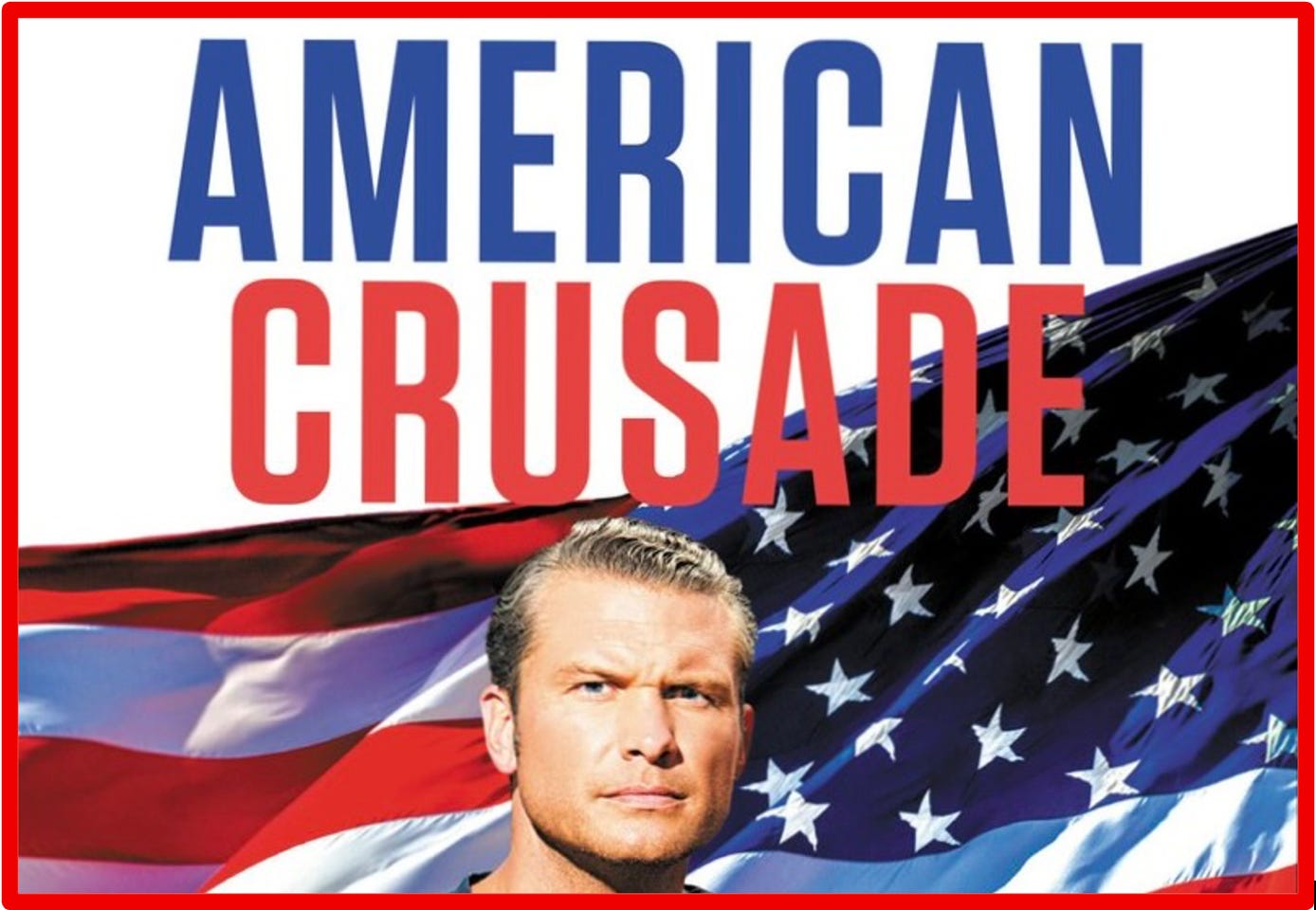
And now we have the author of a book titled American Crusade as the warmonger in chief.
Laurent Guyénot’s The Papal Curse: The Medieval Origin of the European Syndrome, fresh off the press from Arktos, is available to order from Arktos and on Amazon.

Why has Europe remained divided, restless, and often at war with itself? In The Papal Curse: The Medieval Origin of the European Syndrome, Laurent Guyénot argues that the root cause lies in the transformative — and destructive — role of the medieval papacy.
From the Crusades and the struggle with emperors to the shaping of Western individualism and global ambitions, Guyénot draws on history, theology, and geopolitics to explore how the popes’ religious and political projects have intertwined to prevent the rise of a unified European Empire.
Provocative, deeply researched, and featuring an original foreword by Alain de Benoist, The Papal Curse challenges readers to confront the hidden origins of Europe’s modern crises.
Christopher Tyerman, God’s War: A New History of the Crusades, Penguin, 2006, p. xiii.
Norman Housley, Contesting the Crusades, Blackwell, 2006, p. 144.
Michael Mitterauer, Why Europe?: The Medieval Origins of Its Special Path, University of Chicago Press, 2010, pp. 153, 194.
As noted by Oswald Spengler, The Decline of the West, vol. 1, George Allen & Unwin Ltd, 1926, pp. 10, 27.
Tyerman, God’s War, op. cit., p. 244.
Steven Runciman, A History of the Crusades, vol. 2: The Kingdom of Jerusalem and the Frankish East, 1100-1187, Cambridge UP, 1951, p. 253.
Tyerman, God’s War, op. cit., p. 827.
Raymond d’Aguilers, Histoire des Francs qui prirent Jérusalem. Chronique de la première croisade, Les Perséides, 2004, p. 140.
Laurent Guyénot, La Lance qui saigne, Honoré Champion, 2014, p. 198.
François Guizot, General History of Civilization in Europe, 1896, on oll.libertyfund.org
Halford Mackinder, “The Geographical Pivot of History,” The Geographical Journal, April 1904, on www.jstor.org.
Tyerman, God’s War, op. cit., pp. 812, 827.
It is reproduced on the cover of Eitan Bar-Yosef’s book, The Holy Land in English Culture 1799-1917, Clarendon Press, 2005.
Tyerman, God’s War, op. cit., p. 84.
August Charles Krey, The First Crusade; the Accounts of Eyewitnesses and Participants, Princeton UP, 1921, p. 36.
Tyerman, God’s War, op. cit., p. 343.
Steven Runciman, A History of the Crusades, vol. 1: The First Crusade and the Foundation of the Kingdom of Jerusalem, Cambridge UP, 1994, p. 42.
Norman Housley, Contesting the Crusades, Blackwell, 2006, p. 158; Runciman, A History of the Crusades, vol. 2, op. cit., pp. 274-275.
Joshua Prawer, The Latin Kingdom of Jerusalem: European Colonialism in the Middle Ages, Weidenfeld & Nicolson, 1972, p. ix. See also George Demacopoulos, Colonizing Christianity: Greek and Latin Religious Identity in the Era of the Fourth Crusade, Fordham UP, 2019.
Tyerman, God’s War, op. cit., p. 676.
Carol Delaney, Columbus and the Quest for Jerusalem, Free Press, 2012, pp. 27, 10.
Norman Cantor, The Civilization of the Middle Ages, HarperPerennial, 1994, p. 290.
Wilson Center, www.wilsoncenter.org/about-woodrow-wilson
Diana Johnstone, Fools’ Crusade: Yugoslavia, NATO and Western Delusions, Pluto Press, 2002, p. 11.
Why no mention of the 400 plus years of the Islamic conquest of Europe that led to the Crusades? Right or wrong, the Crusades were a reaction.
A most coherent explanation of the historic basis of the madness now afflicting many nations.
My deal is that the perpetrators will bankrupt themselves and that Western "Civilisation" shall fall on its own sword, leaving the rest of the world in peace. They will not go quietly, that is true, so the nations that fight their own existential battles are to be admired.
And, really, Israel now is no more than the Ben-Gurion Canal wrapped in the Smallpox Blanket of the imaginary propaganda of the Second Coming.
That's my 2p. Thanks for the electrons ...