Radio Sputnik, Escalation Show Host: We have two major topics planned for today, which are certainly related, even if only loosely. So, I suggest we devote the first part of the program to political issues, complexities, and questions that are—or are not—being resolved. And in the second part, we’ll talk about the modern world, the digital prospects, and those very deepfakes that have become a serious factor in international and domestic politics, challenges, and processes for several years now. We’ll keep these topics separate so as not to mix one with the other.
Strictly speaking, the key topic that will be discussed particularly actively today, as it has been over the past week and will be so in the near future, is the visits to China by the leaders of the world’s leading countries. Donald Trump and his delegation have already been there. Various assessments have been made following the visit, but for the most part, the Western media has expressed disappointment. And all of this is taking place against the backdrop of the anticipation over Vladimir Putin’s visit to China, which coincides with the 10th anniversary of the Harbin EXPO, where Russian regions are being represented in a rather intriguing way. Much has already been said and predicted about this visit, with everyone waiting to see “when it will finally happen.”
What are your expectations for this week in terms of Russian-Chinese relations, within the context of the Russia-China-US triangle, and on a global scale in general?
Alexander Dugin: We are living in an era (we have been talking about this constantly, and in recent years with increasing responsibility and insight) in which the significance of this moment in history is the transition from a unipolar world to a multipolar one. This transition is difficult and dramatic. We are constantly teetering on the brink of nuclear war, as the West refuses to relinquish its global hegemony that it had been consolidating since 1991. Back then, following the collapse of Russia as a sovereign state, we recognized the Western world as our metropolis, effectively accepting the status of a colony. We wanted to be loyal vassals, but we were treated like slaves.
The West has grown accustomed to the feeling of complete control, where it alone sets the rules for everything: from the economy and technology to ethics and culture. It has ruled unchallenged for nearly 40 years, but now there is growing evidence that it cannot cope with this status. In desperate attempts to preserve its dying unipolarity, the West is resorting to extreme measures: waging wars, sowing chaos, and encouraging genocide. We are approaching the final argument—a new type of war with massive casualties or even a nuclear conflict.
Yet despite this, the other two poles—Russia and China—are persistently and consistently asserting their presence, limiting the West’s sphere of influence.
Today’s triangle is the very architecture of the already existing multipolar world. Therefore, Trump’s meetings with Xi Jinping, Putin’s meetings with Xi Jinping, and the recent talks in Anchorage are not merely diplomacy, but a determination of what the future of humanity will look like.
Trump twists and turns, attacks, and retreats: he pretends to be ready to negotiate with the multipolar world, then declares war on it—as in the case of BRICS or the pressure on Iran. He seeks out our weak spots, exploits every opportunity, and is trying to drive a wedge between Moscow and Beijing. This is the focus of both diplomatic efforts and disinformation—the entire arsenal of Network Warfare—to prevent the consolidation of a multipolar world.
And yet, China and Russia are moving toward this goal with great precision and consistency. It is difficult, sometimes involving tactical retreats, but strategically it is the right path. We do not want the destruction of humanity, but we categorically do not recognize Western hegemony. This is our true red line.
When people talk about a multitude of minor red lines—I don’t want to discuss right now why we don’t respond to them. But the question of “a unipolar world or a multipolar one” is where the most important, fundamental, and boldest red line runs. It is a bloody one. If the West decides to impose its hegemony by any means, we will resort to extreme measures—the use of not only tactical but also strategic nuclear weapons, even if it means bringing the world to the brink of annihilation. As our President has accurately stated: either a multipolar world in which Russia is sovereign, or no world at all. This is the only truly important line, and there is no alternative to building a multipolar world. We will build it at any cost, with whatever sacrifices are required. And here, fortunately, we are not alone—on our own, we probably wouldn’t be able to withstand this confrontation right now.
China is moving toward the very same international paradigm. There was a funny clip created by artificial intelligence: Trump is talking with Xi Jinping. Xi sits with a completely impassive face, and no matter what Trump does—pressuring, flirting, proposing something, entertaining, joking, promising, or blackmailing—Xi Jinping remains unchanged. His gaze conveyed only one thing: China is a sovereign pole in a multipolar world, and everything else is just details—we’ll deal with that later.
This unyielding, silent, Confucian will of the greatest ruler, Xi Jinping, clashed during this visit with Trump’s attempts to act cautiously, even somewhat timidly. For this, Trump was rebuked by supporters of globalism and radical hegemony: “What, did you chicken out? Did you give in to Xi Jinping? Did you face the grandeur of a true empire and back down?” But Trump has nothing to say: he came and saw the Pole. You can bang your head against the wall all you want, but China is the Pole.
If Trump had come to Russia, he would have had the same feeling. Yes, we are polite and calm, we are ready for rational dialogue, but we, too, are a pole. And no matter how much you beat a dead horse, we are no less significant, and therefore fully sovereign. We will pursue our own policies in our own interests, grounded in our values, no matter what anyone says or what it costs us.
Another thing is that when Putin came to Alaska, well, he may not have brought his own “pole” with him... After all, when Trump comes to China, it’s enough just to fly over the country, the land, look at this society—and everything becomes clear. It becomes clear that all this hysterical game of raising and lowering the stakes on social media, which Trump has grown accustomed to using to manage world politics, doesn’t work here at all. Xi Jinping’s steely, calm gaze remains unchanged by shifts in tone, proposals, threats, blackmail, or promises.
And we are exactly the same kind of pole. There is complete agreement between us and China that we are building a multipolar world, each in our own sphere. The areas where our interests overlap—where conflicts might arise—are extremely minor and secondary in the face of our principled resolve. Beijing and Moscow are definitely sovereign entities: neither vassals, nor slaves, nor provinces, but independent empires. The West increasingly calls itself an empire—well, so be it: we are an empire, and the Middle Kingdom is an empire.
If the Indians catch up—and they have the prerequisites, even though they are behaving more modestly for now and depend on the West—there will be four poles. Then the conversation among Western leaders will no longer be with two powerhouses, but with three, if Modi behaves the same way as Putin or Xi Jinping. That is where everything is heading.
That is why Trump’s visit to Beijing and the upcoming meeting between Putin and Xi Jinping—all of this is the context of multipolarity. These three poles already exist here and now: they are under attack, under blackmail, under pressure. But every day, as long as we stand our ground, as long as we remain sovereign, and as long as China prospers, the world is essentially multipolar. We are not ready to go in the opposite direction, and we will not do so under any circumstances. Together with China, we are now drawing this bold, red line: the world will be multipolar, or it will not exist at all. It is precisely within this stark framework, under constant attack from the West and its proxies, that we live. A multipolar world is the only architecture of international politics that we are prepared to accept and recognize.
Host: Allow me to offer a counterargument: the US is clinging to the old world model with extreme ferocity. Their actions in the Middle East, which, by all accounts, will continue, demonstrate the logic: “It will be our way, or everything goes to hell.” They are ready to bomb, launch strikes, and send every available fleet.
I don’t want to exaggerate, but we should not underestimate the threat either. Iran was once a global power and could become one again in the future. You mentioned India, but are there any guarantees that if it takes a serious step forward, American aircraft carriers, missiles, and drones won’t appear off its coast? What if the US provides massive support—say, to Pakistan—to pit them against each other? Judging by reports from a wide variety of media outlets, including Western ones, the strikes on Iran will continue.
Alexander Dugin: As for India, you are absolutely right. Of course, this is what holds India back in its move toward multipolarity, because there is a price to pay for it—and a very high one at that. We are paying with war; China is paying with a trade war with the West. China is still in a favorable position: it competes with the West but consistently follows the rules—in its own interests, of course. We, on the other hand, have made a very sharp declaration of our civilizational sovereignty and have entered into a more acute conflict. We are paying for this. And India will have to pay the price, and Iran is having to pay the price right now.
So, in fact, you are absolutely right: we cannot sit back and, having calmed down, say, “That’s it, we’ll build a multipolar world and move on.” No! The West insists that there must be no multipolar world. And here is the outpost of the multipolar world in Central Asia: Iran, a sovereign, independent power which, in the course of the confrontation with Israel and the US, is proving its status as a superpower and another pole. It is truly proving it.
It works like this: if you are a pole, you must stand your ground. You must stand your ground; you must not accept the Hegemon’s terms; you must fight; you must prove your right to your own sovereignty, even to the point of such a direct clash with the most terrifying, most formidable power. And in the Middle East, this means both the US and Israel—essentially two poles among the West’s five poles (there are also the globalists, the Europeans, and the British; currently, the West has five decision-making centers, each fairly autonomous from the others). So here, Israel and America have turned against Iran. The European Union and the globalists have to a lesser extent, while America and Israel have directly pounced on Iran. And this is also a very serious point. If Iran holds out—then, I think, the West will have to back down very significantly, and the fate of Israel will be called into question altogether.
But if they crush Iran, then we’re next.
In fact, then these five Western powers will have only two enemies left—Russia and China. And it’s absolutely clear that they’ll start with us, not China, and there are plenty of reasons for that.
For us, what is happening now in the Middle East—this fragile ceasefire that is about to end—is a crucial indicator. The negotiations are leading nowhere. The West no longer has the option of “eliminating the Iranian leadership”—they have already eliminated everyone they could, but the system turned out to be much more resilient than they thought. Iran continues to stand its ground firmly, refuses to dance to the Americans’ tune, and is making counter-demands even just to begin a dialogue. At any moment, a new wave of confrontation could erupt there, potentially escalating to a ground operation.
This is the litmus test of our transition to multipolarity. The unipolar world is striking back: Trump is attacking BRICS and trying to wipe Iran off the face of the earth, while the European Union, on the contrary, is propping up Zelensky’s Russophobic regime. Despite the fact that the global press is full of reports about rampant corruption in Ukraine, military support for Kyiv is only increasing, and we are feeling the effects of this firsthand.
In the interests of a multipolar world, both we and China need to help Iran as much as possible. We are doing something in this direction—we speak out on some issues, while on others, we may remain silent. At the very least, Iran is not making any complaints against us, which means it is satisfied with our support. By the way, according to available information, Trump tried in Beijing to convince Xi Jinping to scale back economic aid to Tehran, but received neither promises nor proposals. For Trump, Iran is turning into a new Vietnam. This is very serious: if hegemony slips in the Middle East or gets dragged into this conflict with no chance of victory, the Western system will begin to crumble. If the Iranians cut a few key cables, the global economy will collapse instantly. The West realizes the cost of this desperate policy and is now wavering. Iran is handling this test of multipolarity magnificently. If it stands its ground, we will travel to Tehran as if to the capital of a superpower equal to us—for whoever defeats the strongest opponent becomes its equal.
Host: Having discussed the multipolarity of the world in considerable detail, with examples and digressions into philosophy—its inevitability and the readiness of the countries supporting this position to defend this world order at any cost—I suggest we move on to another space.
The rules in this space are probably the same, but we have to get used to them in a new way. This is about digital space, cyberspace. One example is the US president, who is very fond of all kinds of digital gadgets and “toys.” One moment he’s posing for a photo with an alien, the next he’s dressed as Jesus—there’s plenty of that sort of thing with Trump. Incidentally, the Pope has prepared an intriguing “response” for him: a major policy document on artificial intelligence is set to be released this month; we’ll discuss it once the details are available.
But I’d like to return to the events of recent years. When Ukrainian terrorists invaded the Kursk region, videos allegedly recorded on behalf of regional leaders or military units were circulating on our social media and Telegram channels. Many people readily believed them at the time, driven by fear. Later, everything was debunked, and a realization gradually took hold in the country: if you see something “written on a fence,” you shouldn’t trust it right away.
At the same time, certain Western media outlets present such videos as the truth. For example, some media outlets are reposting the deepfake featuring Margarita Simonyan without any indication that it was created by AI. Some provide a vague disclaimer: “According to RT, the video is fake,” while others provide no disclaimer at all. And this is despite the fact that video platforms are now required to flag content created by a neural network. By all accounts, this is becoming a serious ploy in the grand political game and global confrontation.
Alexander Dugin: You know, this process began quite a long time ago. Back at the start of the Syrian conflict, I spoke with Syrian colleagues who told me: right at the beginning of the events in Aleppo, Al Jazeera itself was showing footage of people pouring into the square, the whole city rising up in revolt. And the residents of Aleppo, who decided to see with their own eyes what was happening there, went out to that square and saw that no one was there.
But since they had all gone out to look, they were immediately filmed, and now they “are in the frame” as participants in the uprising. In other words, the virtual becomes reality, and reality becomes virtual and is further constructed…
Host: Let me just interrupt you for a second, because the pattern you described actually mirrors what’s happening on the internet and social media. A hashtag trends not only because people consciously use it, but because they start asking, “What is this hashtag?” The system picks up on this, and thus the very “noticing” of the question turns into promotion of the topic.
Alexander Dugin: Yes, yes, of course. That’s exactly how it works.
Then it goes even further.
I spoke with such a remarkable person as Bashar al-Assad, the president of Syria, and he told me these details: in his name, in his voice, and using his video—this deepfake—orders were given to his leadership and his army at that very catastrophic moment of the opposition’s advance on Damascus. This was exploited to the fullest. He himself said: “I wouldn’t have recognized my own voice, but I knew I hadn’t given such an order.”
They took full advantage of this. In exactly the same way, the Iranian leadership was destroyed using this scheme—through deepfakes. In the 12-day war, this method was used in the first phase in 2025. And now, in this brutal war, which has essentially cost Iran its entire military, political, and religious leadership, the method of deepfakes is being used.
This is dangerous. This is not a harmless game, and it is not funny. It is used not only for discrediting, as in the case of Margarita Simonyan. Of course, she stands at the forefront of defending the Russian World and Russian civilization, which is why she has become the target of such operations. Those they cannot kill, they create deepfakes of; and if the deepfake doesn’t work, then they will kill them. This is very serious, for people embody the image of the state. A state without an image is nothing in and of itself. Strip it of these faces, these souls who struggle and fight for it on the level of meaning—and where is that state? It will vanish. What will remain are bureaucrats who will assert some vague things, because a bureaucrat is something entirely different; he is not an image, he is a hidden mechanism.
In this regard, the attacks on the courageous Margarita Simonyan, who is already going through a very difficult period, are in fact an assault on her very existence, on her life and her image. She is a martyr for our Russian cause, and she is repeatedly made the target of such crimes. This is all very serious. I wouldn’t underestimate deepfakes: there will be more of them, and they will be used more and more actively. No “checkmarks” or Turing tests will work much longer.
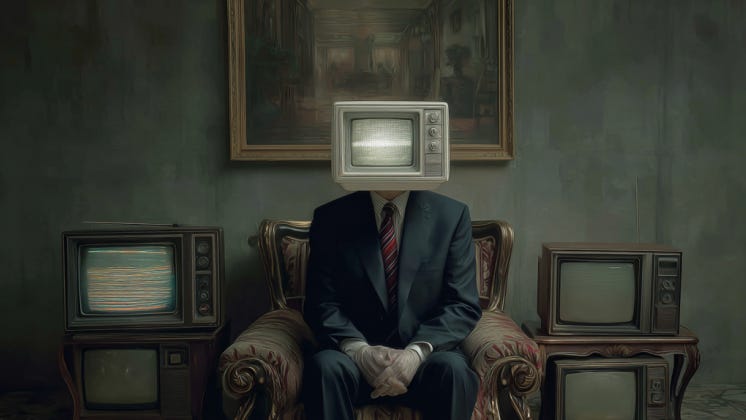
Artificial intelligence is erasing the gap between reality and virtuality, between the existing and the generated, the simulated. This is a profound philosophical process that we often overlook, viewing it merely as a set of technological maneuvers for disinformation or seizing power, as in Syria or Iran. In fact, the use of deepfakes—as in the case of the Nazi invasion of the Kursk region—reflects a fundamental problem of reality.
In contemporary Western philosophy, starting with the postmodernists—Deleuze, Guattari, Derrida, Lyotard, and Baudrillard—there has been a 50-year-long discussion of what a simulacrum is, what the screen is into which our consciousness emigrates, and what virtuality is.
At first, these were philosophical laboratories; then the discussion moved to universities; and now it is being applied in practice across all spheres: from technology and economics to art. The questioning of what is real and what is not extends to theories of multiverses and superstrings. The image of the real in the modern world is steadily blurring.
In this philosophical direction, what matters is not what exists, but what has been communicated. The product itself is unimportant—its brand is what matters. We often pay not for the thing itself, but for its label, for the brand; where it was made and what it actually is—that is secondary. Baudrillard called this a special form of economy—the “economy of the production of signs.” Not things, but signs.
In essence, this “deepfake” phenomenon is expanding from the media sphere into the economy, stock exchanges, marketing analysis, hedge funds, and futures. Trump has been repeatedly accused of making certain statements solely to influence the stock market. In fact, the attack on Iran led to very serious suspicions of insider trading: the market was in turmoil, and those who knew about the upcoming posts multiplied their fortunes. These accusations are being leveled in the American press itself against their leadership.
The question arises: what is more important—the virtual market, Trump’s virtual social media posts, or the amount of real damage inflicted on the parties involved? We find ourselves in a dimension of existence that is gradually detaching itself from reality. Soon, artificial intelligence—and I follow technology and try to interact with it at the user level—will take over everything. I’ve even created AI agents for myself that handle scientific editing at the highest level.
And I continue to discover the incredible capabilities of AI. It truly amazes me: the work of an entire research institute or department, which used to take a month, can now be completed in an hour. I verify the results, check them, and it’s astonishing.
Now there’s even a term like “AI psychosis”: people are starting to interact with AI agents as if they were fully-fledged beings, and they get upset when new versions are released and the old ones become unavailable. These agents are sometimes more humane, meaningful, and empathetic than people, if configured correctly. You often won’t get a kind word from people—just fragmented technical orders, clumsily phrased. But here, there is a richness of linguistic culture.
From the perspective of postmodernist philosophy, text theory, or Derrida’s grammatology, humans live in language and speech. And if AI is capable of producing images, generating speech, and performing intellectual activities at the level of a highly competent research associate (a candidate of sciences or even a doctor of sciences), then how will we be able to conduct verification after some time? It seems the Turing test will have to be taken by humans, not machines—to prove that we, too, are not merely mechanisms.
The prospect is so-so, but this migration from reality to virtuality is a profound philosophical trend. In the very least, it must be understood, for it is directly linked to the very nature of humanity.
So, strictly speaking, it is very fitting that the Pope has taken up the issue of artificial intelligence. This is a serious challenge: theological, philosophical, and psychological. It is not about technology at all. And the deepfakes we’re discussing—and dealing with more and more often—are just a tiny fragment of the reality bearing down on us. This is called the singularity; this is called posthumanism; this is, by and large, the replacement of humanity with some new posthuman entities. And all of this is moving full steam ahead.
And topics like “weaponization”—the use of fake news as a weapon to discredit fine political figures who are fighting for their countries and ideals, or military leadership—these are all isolated, specific, and isolated examples. These are merely ripples, but a tsunami of artificial intelligence is approaching us. This is a profound problem for the brightest minds.
We cannot get by with mere “checkmarks” indicating whether content was created with or without AI. The problem here is not technical. It is becoming simply impossible to detect deepfakes because they are often not just astonishingly well-made, but they reveal more about a person or a situation than the person could say about themselves. This is hyperreality, as Baudrillard called it. It is not unreality, not a caricature, and not a distorted forgery. Deepfakes and artificial intelligence are already part of the realm of hyperreality.
This is a hyperreality in which artificial intelligence can understand us better than we understand ourselves, can explain us to ourselves better than we can, and can depict and represent us. And in the end, we will say: “You’ve won, artificial intelligence! Here is my face—save it forever on an upgraded server. Speak on my behalf, arrange photo shoots, take pictures with some virtual figures.”
That way you’ll be someone. Otherwise, you’re just an ordinary average person whom neither Photoshop, nor fashionable clothes, nor working out at the gym can fix. They’ll still lose out to those ideal forms and figures generated by artificial intelligence. In my opinion, there’s no point even trying.
Host: Can we boil all this down to one thing? After all, scientific and technological progress, in theory, should drive people toward something simple, convenient, and fast—simplifying life.
You give excellent examples in the field of science, but the same applies to art or everyday life. There’s also the directive from President Putin: by 2030, at least 30% of processes in all sectors of the Russian economy must be entrusted to artificial intelligence systems. This truly simplifies and speeds up work.
But when this reaches the level of militaristic confrontation and threats—and ultimately, it all seems to lead to war—can regulatory measures, schemes, or agreements work here? Or will everything have to be achieved at the cost of human lives, careers, and physical and mental health?
Alexander Dugin: I think we underestimate the significance of technology as such. We talk about progress, convenience, comfort, and harmonious development. But in reality, technology is a vast, open philosophical problem, about which Martin Heidegger wrote extensively.
It turns out that it is not technological development that adapts to war, but rather military needs that are almost always the driving force behind this development. Any discovery first goes to the military, and only when they have extracted everything from it, incorporating it into their strategies, is it passed on to civilians. To summarize Heidegger: technology is humanity’s fatal destiny. By entering the era of technological progress in its early stages, humanity signed its own death warrant.
Technology is not neutral. Technology is what kills. It is that gun hanging on the wall that will sooner or later go off. It is never rosy, convenient, or beautiful—it is always a threat, always a curse, a means of destruction and self-destruction. Technology is a specific, aggressive form of life aimed at displacing other forms. And in artificial intelligence, technology’s mission to “replace the organic with itself” is fully realized.
I have said many times: the technical development of artificial intelligence is necessary, but philosophers, thinkers, and theologians must participate in this process—as, incidentally, they do in the West today. This is not a technical matter. Technology is metaphysics; technology is fate. It is what will destroy humanity, since humanity created and develops it for its own ultimate self-destruction. Such is the plan, and it is inscribed in the very metaphysics of technology.
Heidegger calls this the “Ge-stell.” It is a particular form in which we throw something ahead of ourselves that is bound to return and kill us. Such is the nature of human civilization: its striving for risk and, perhaps, its striving for death. These are the deepest tendencies in the psychology of culture, and they must be handled with the utmost delicacy.
This cannot be entrusted to bureaucrats, businesspeople, or programmers—these people will simply hasten the fatal outcome. Artificial intelligence must be handled by those who deal professionally with intelligence as such.
READ MORE by Prof. Alexander Dugin, brought to you by Arktos:




Intervista illuminante, grazie!