


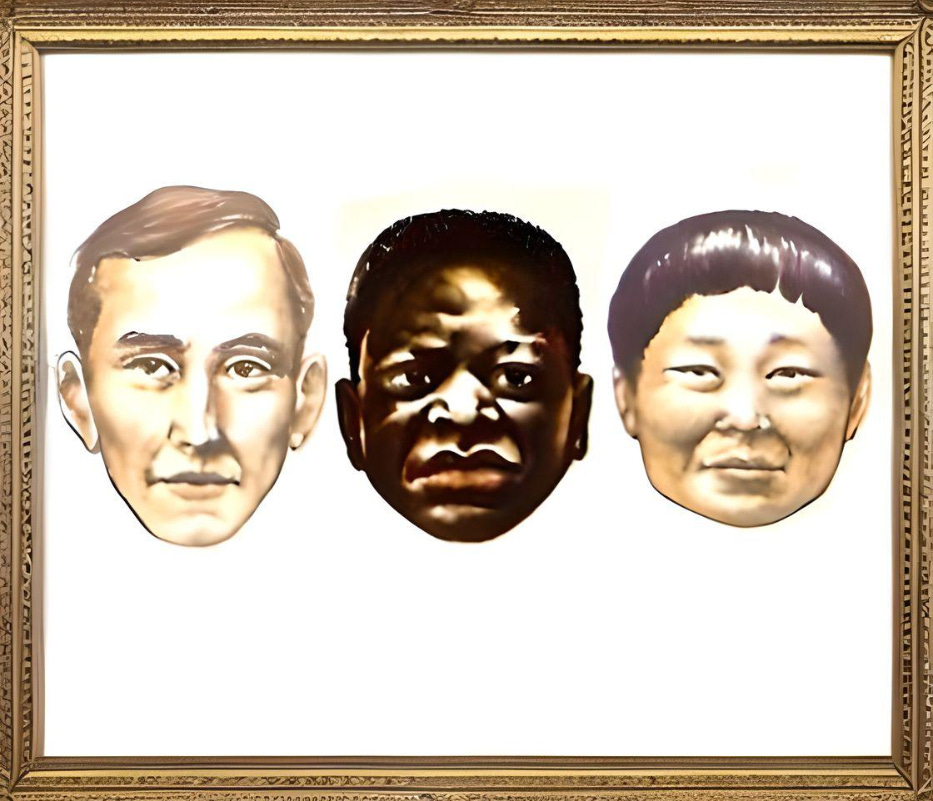
Sietze Bosman challenges modern views on race, exploring historical and mythological sources, including those suggesting extraterrestrial origins, to argue for the significance of distinct human races.
Every masterful race of the world’s history has its epic. It is the tale of the fathers told to the sons. But side by side with the spoken epic is another, unspoken, yet truer and deeper. It is the tale of the race life, not told in words, but lived in deeds done. And the epic lived is always more wonderful than the epic told. The true epic is found, not in the story of the battles or of the deeds of the rulers, but in the race life.
— Joseph P. Widney, Race Life of the Aryan Peoples
Race arguably is the most contentious subject to write about. That is if you choose to affirm it. Scores of papers and articles have been written decrying that “muh, race is a construct.” Or the ever-recurring flaccid platitude, “There is only one race, the human race.” The idea that the human family does not have subspecies, taxonomically called races, is patently absurd. So absurd, in fact, that the features that differentiate the different races of chimps, for instance, are far more subtle than the features that separate the races of man, yet the dogmatic psalms of unity are recited over and over again.
The position that human races do not exist is such a weird one for science to have, as science as an institution has universally accepted Darwinism as their atheist-flavored outlook on the world. Well, Darwin wrote the book Origin of Species, of which the full title reads:
On the Origin of Species by Means of Natural Selection, or the Preservation of Favoured Races in the Struggle for Life
According to Darwin’s theory, species continually specialize to fit their environment and this means the continual development of new races. It is quite remarkable that science today can hold the paradoxical view that species develop into subspecies and, at the same time, hold that from an ancestor shared with monkeys, man as a monogenetic and monoracial species developed, without suffering ridicule. Darwinism means monogenesis, or “one origin,” the theory that all of terrestrial life originated from one species of very simple single-celled organism.
Science, as it so often does, demands the suspension of the immediate observation of the world through our senses, and asks us not to notice the obvious: that there are huge differences between the human races. Not just in appearance, but in many domains, like musical taste, food preference, sexual preference, preference for certain cultural institutions, etc.
Monogenesis is such an implausible theory, not least because supposedly hundreds of thousands of years have passed since “out of Africa,” but none of the races that live in isolation show any sign of further specialization into more diverse subspecies. And as always, science makes the wild claim that our ancestors were a bunch of thick, superstitious oafs that held a childish worldview. But it is exactly our ancient forebears that penned down a lot of their stories for us to learn from. And none of them speak of a primordial soup, from which emerged complex cellular life.
Counter to the modern scientific worldview, our forebears from all over the world have left us tales of their origin. The oldest of which are the Sumerian clay tablets. These tell us a story of beings who came to earth and built a very advanced society. These ancient beings mined the earth for gold, among other elements, but there was a revolt because the beings found the work to be too arduous. So they found a primitive being here on earth and upgraded this being with DNA of their own. These tablets specifically mention the creation of different races of man. One could speculate that the beings created multiple species of slaves to find out which one suited them best. But this is not clear from the Sumerian texts.
The beings created us sterile, so we would not breed out of control. Eventually, one of the beings, called Enki, felt sympathy for the human races and gave us the capacity to reproduce. This is just a short summary, but the Sumerian epos is very elaborate and detailed. One thing stands out: If we were created, monogenesis is out the window.
The Oera Linda Book also lays out a creation myth, in which W’ralda, the oldest and supreme god, had three daughters, who in turn were the mothers of the three races on earth: black, yellow, and white.
The Norse pantheon speaks of Askr and Embla, the first human male and female, created by three gods: Hœnir, Lóðurr, and Odin. Askr and Embla first were dull creatures, and the gods bestowed them with gifts. Stanza 17 of the Poetic Edda describes this as follows:
Spirit they possessed not, sense they had not,
blood nor motive powers, nor goodly color.
Spirit gave Odin, sense gave Hœnir,
blood gave Lodur, and goodly color.
There is another bizarre source of information, albeit a very controversial one, namely the Talmud of Jmannuel. It was found and translated by Billy Meier, a well-known UFO contactee. And because he is a well-known UFO enthusiast, the document has been discarded by science as a fraud. However, James W. Deardorff, research professor emeritus at Oregon State University, has done twenty years of study on the subject and has found that it is genuine and, in fact, predates the biblical scriptures and amends them in crucial areas.
The Talmud of Jmannuel also specifically speaks about the creation of human-god hybrids, called Nephilim, and the creation of man. The document opens with a genealogy of gods and offspring, in which it states:
… David was a descendant of Abraham, whose genealogy can be traced back to Adam, the father of a lineage of terrestrial humans.
Semjase, the celestial son and guardian angel of god, the great ruler of the voyagers who traveled here through vast expanses of the universe, took a terrestrial woman and begot Adam, the father of the white human population.
God deserves the honor of the people of earth, for behold; He is the true originator of the white and of the colored earth humans, and to him honor should be given.
Another very interesting document is The Emerald Tablets of Thoth the Atlantean. This is a document that describes an immortal man called Thoth. The tables give us the story of a very old and advanced race from Atlantis that, after a cataclysm, settled among the primitive Egyptians. The document mentions race quite often, and, according to the document itself, it describes a history dating back to 36,000 BCE. This means that already in extreme antiquity, the races were thus already races and therefore distinguishable.
Many such sources exist that mention the arrival of extraterrestrial beings that created a species to serve them. And dismissing them as infantile, fanciful explanations for things our forebears just not understood is arrogant in the extreme.
The origin of the separate races seems to be polygenic, if we follow the great many creation myths. Our existence is therefore not necessarily the will of a divine Creator; we might not have an origin birthed of noble intent. But wait just a minute before jumping on the nihilism train; the Creator speaks to us through nature. It is clear from the entire workings of nature that the Creator values fighting for your race’s existence. He shows us that the only right way to live, and therefore the only true religious life, is by struggling as hard as your race can muster to remain extant. Only a vitalistic life is according to the wishes of the Creator.
The races have their own separate origin and therefore should be allowed to struggle in the way that suits them best. The races should live apart so each of the races can strive for its highest fulfillment of the divine imperative of fighting for life.
Wilmot Robertson writes in The Ethnostate:
The principal theme of this study has been the need to create what the author has chosen to call ethnostates and to reap the many benefits that would derive therefrom. Among many other advantages, ethnostates would serve as lifeboats to keep whites alive until they recover their spirits and morale and again take their place in the vanguard of the Great Evolutionary Trek.
Whites, in conclusion, have their own distinct origin, their own history, their own destiny. Only in an ethnostate can the white race truly fulfill its trajectory toward the “Great Evolutionary Trek.” Whites who still believe in our own greatness have already become our vanguard and must, at this crucial hour, not flinch to openly talk about our race and our needs and demands. Not just White Lives Matter, but “the existence of our people is not negotiable.”
