


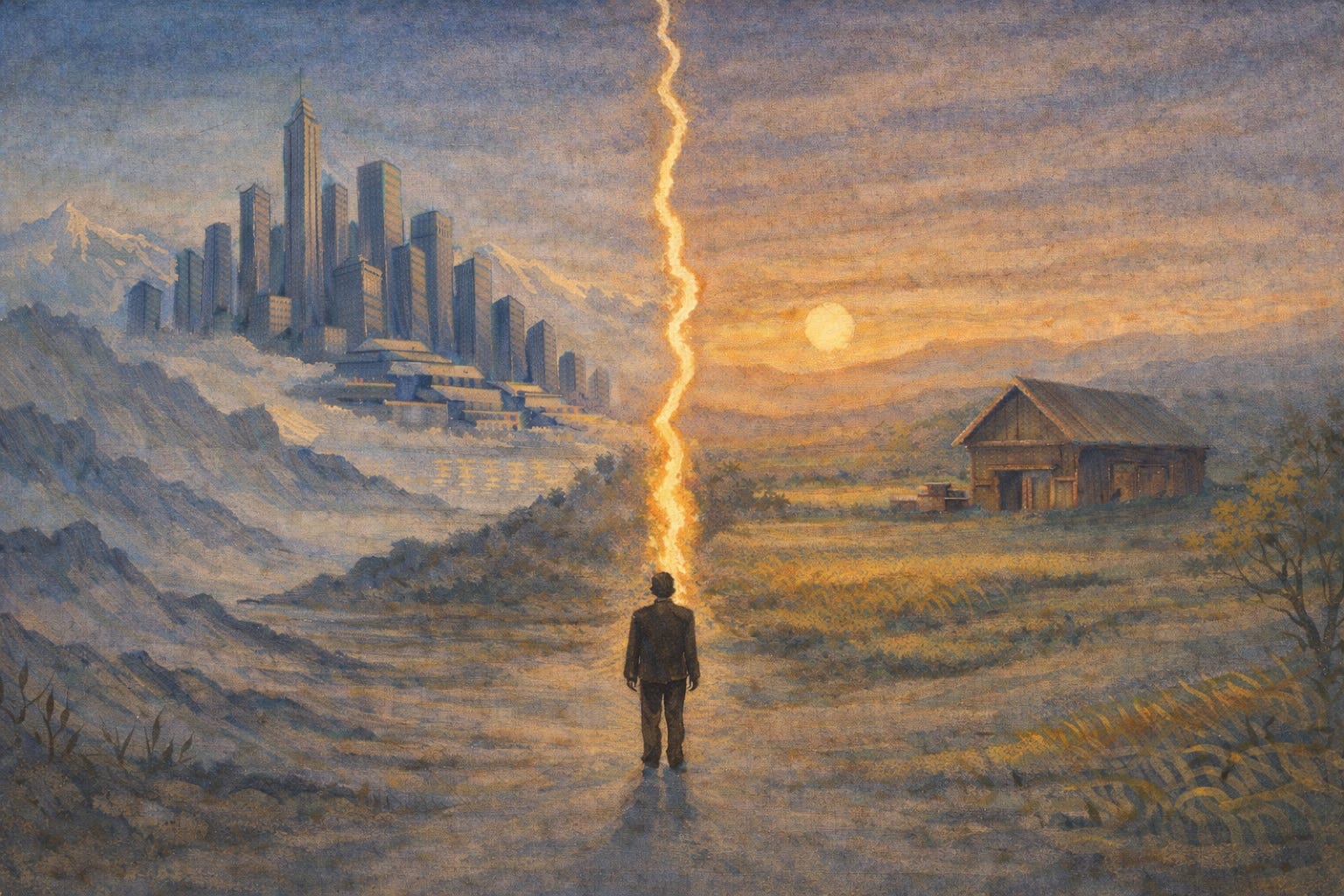
Drawing on the ancient legacy of the city-state, Sietze Bosman addresses how the modern democratic system forces the fundamentally different interests and lifestyle of city and countryside into a single system, generating imbalance and ultimately conflict.
Modern democracy forces fundamentally incompatible populations — dense urban centers and dispersed rural regions — into a single decision-making system, despite their opposed material interests, incentives, and environments. Because cities are numerically dominant, rural interests are systematically overridden. The result is not harmony, but permanent internal conflict.
The logical solution is political decoupling: the transformation of major cities into autonomous city-states, while surrounding rural regions govern themselves independently.
Due to their very nature, cities are demographically dominant. In any given nation, only a handful of urban areas are home to around 30-60% of the population. This means that, in a democratic system, cities outvote rural areas, as democracy simply counts votes, not stakes. Anyone with any understanding of the fundamental mechanics of urban versus rural life knows that they have opposing needs and, under democracy, are effectively “at war” with each other. Even though there is a majority in votes, the minority can never hope to become the majority and shall forever endure the misguided policies of urban political classes.
The whole concept of democracy rests on a foundation of “the people,” but the people have been divided into very distinct groups by urbanization. To force these two communities into one democratic system is as misguided as enforcing a single monetary policy on countries with radically different economic profiles—much like the eurozone experiment, where interest rates suited to Germany’s export-driven economy proved disastrous for Southern European countries dependent on domestic demand and imports. A policy that fits one structure breaks the other.
Urban and rural populations exhibit structurally divergent interests rooted in fundamentally different modes of life. Urban centers tend to favor high immigration to sustain labor-intensive service economies, centralized regulation to manage dense and complex systems, and large-scale infrastructure spending geared toward transport, housing, and digital connectivity. They are typically oriented toward global economic and cultural integration, endorse abstract environmental policies formulated through regulatory targets rather than direct land stewardship, and prioritize post-material values such as lifestyle, identity, and symbolic politics.
Rural populations, by contrast, tend to prefer low immigration to protect wages, cohesion, and continuity; local autonomy to accommodate place-specific realities; and land-use freedom essential for agriculture and resource management. Their priorities include energy independence, food production and supply security, and material survival concerns grounded in physical labor, family continuity, and long-term stewardship of land. These differences are not merely political disagreements but reflect opposing structural incentives that become increasingly incompatible when governed under a single, uniform democratic framework.
These opposing interests are often a zero-sum game. Immigration, for instance, helps cities fill jobs but tends to suppress wages in rural areas. Urban life is far removed from nature and from the real-world effects of misguided policies. Bureaucrats making policy based on abstract “modeling” have hampered European farmers greatly. Urban environmentalism is largely a form of collective virtue signalling, a luxury made possible only because farmers continue to put food in city supermarkets. Urban areas are vastly more culturally diverse than rural areas, and urban policy must account for this reality.
Rural areas, however, are generally more culturally homogeneous and pursue policies oriented toward tradition and the family. Urban environmental fantasies such as solar farms and wind farms require space—something cities lack. These projects are therefore exported to rural areas, where they scar the landscape and destroy horizons.
Democracy, when imposed upon fundamentally incompatible populations, functions less as a mechanism of representation and more as a kind of forced marriage. It presumes that numerical aggregation can reconcile irreconcilable interests, as well as that periodic voting can harmonize ways of life with opposing material needs, values, and temporal horizons. In practice, this does not produce mutual accommodation, but rather permanent domination: one bloc consistently outvotes the other, converting democratic procedure into a tool of structural coercion.
READ MORE from Arktos:

Like a marriage entered into without shared aims, habits, or loyalties—and from which exit is forbidden—the relationship becomes parasitic rather than cooperative. Stability is maintained not through consent, but through legal compulsion and moral rhetoric, while resentment accumulates beneath the surface. Democracy in such a context ceases to be a means of self-rule and becomes an administrative device for enforcing coexistence where organic unity does not, and perhaps cannot, exist.
The rational solution is to grant large cities the status of city-states. Cities would then govern according to their own needs, while rural areas regain sovereignty over land, food, and energy. This would dissolve the permanence of internal rivalry. Cities would be forced to bear the consequences of their own policies, as they could no longer rely on rural areas to provide for them despite policies hostile to rural life.
If cities insist on high demographic density, mass immigration, financialization, and technocratic governance, they should also accept infrastructure strain, housing inflation, social fragmentation, and dependency risks. Accountability would increase significantly, as the failures of city governments could no longer be concealed by extracting wealth from the countryside.
Such a separation would, of course, involve considerable logistical, economic, and legal complexities. Questions of trade, energy exchange, food supply, currency arrangements, border administration, and transitional governance would all require careful negotiation. Existing infrastructure and economic interdependence would necessitate treaties and cooperative frameworks rather than abrupt severance.
None of these challenges are trivial, but complexity alone is not an argument against separation. Historically, political systems are most unstable not where boundaries are clear and negotiated, but where incompatible populations are indefinitely forced to coexist under a single authority without meaningful consent. Managed separation, though complex, is often less dangerous than prolonged internal antagonism.
Historically, the city-state is not a novelty. Athens and Sparta, Venice and Florence, among others, were city-states. They were economically productive and culturally coherent. There is ample evidence to support the feasibility of city-states even in the modern age. Historically speaking, the city-state was the norm, not the nation-state as it exists today.
The separation of city and countryside should not be viewed as an act of retribution or vengeance. It can be achieved entirely peacefully. Cities would be free from conservative constraints that frustrate their liberal priorities, while the countryside could live in a tradition-oriented way, connected to the landscape as countless generations before did.
A marriage that binds two incompatible spouses should be ended through divorce rather than prolonged abuse. All too often, such relationships become increasingly hostile when dragged on indefinitely. The city–countryside relationship is no exception. Eventually, one side will attempt to impose itself through force. In Europe, this has already been the case for some time, as Brussels imposes ideologies on rural populations that, if fully implemented, negate their way of life entirely.
Urban–rural polarization is accelerating globally, as cities increasingly demand radical alterations to rural ways of life. The city has become a fully synthetic environment, where any relation to the “real” is increasingly lost. It has become a self-referential feedback loop, mistaking its own liberal abstractions for lived reality. Rural areas, by contrast, are compelled by their very nature to live according to natural rhythms and seasons. They remain entwined with landscapes shaped by the hands of their forebears, allowing tradition to flow organically through generations. This divergence generates deep animosity.
Under the current system, rural populations feel culturally alienated and electorally hollowed out. Rural discontent is already nearing a boiling point, with farmers across Europe marching on capitals to protest destructive policies. When millions of people are forced to defend their way of life against ideologies wholly alien to them, no satisfying compromise remains possible. It is akin to attempting reconciliation between irreconcilable moral positions: alignment cannot be achieved. As a rural inhabitant myself, I can attest that anti-city and anti-government sentiment is growing rapidly. If a peaceful path toward separation is not found, the likelihood of escalating conflict will only increase.
READ MORE from Arktos:

This is why democracy is used as a covert tyrannical tool by the narcissistic elites at every level in our extremely toxic society. There is no peaceful or «democratic» way out of this other than dismissing the power in the system and changing the system. How is this possible when the majority of the population are brainwashed and loyal to the perpetrators and parasites at the top of the food chain? By a power outside of and greater than those evil ruling our society and the brainwashed masses.
Excellent perspective! But perhaps there is another which could remove the dichotomy: back to living within land carrying capacity, organised into self-governing bioregions. The city is not a self-contained space, and what if our industrial era conglomerates are no longer the real blueprints for our future? There is already a rich literature on the topic, John Thackera's Bioregioning, Ulrike Guérot's Europe a Republic of Regions, etc. We need to look beyond and engage in dialogue.