


The text you’ll find below is a speech by Dominique Venner from the 28th Conference of GRECE (“Research and Study Group for European Civilization”) held on November 27th, 1994.
Following the collapse of the Soviet Union in 1991, the left suffered a massive loss of ideological legitimacy. The American political scientist Francis Fukuyama even proclaimed in his book The End of History and The Last Man (1992) that liberalism has triumphed and that we have reached ‘the end of history.’ With the left in disarray, Nouvelle Droite thinkers began pushing the idea that dissident thinkers of all political stripes should unite to combat the final enemy: liberalism. To some, this became known as a “red-brown” scare, a threat that some say persists today. As per the theme of this conference, Gauche-Droite: La Fin d’un Système (Left-Right: The End of a System), there was a belief that, with the failures of communism, the left-right delineation in politics was beginning to fade.
In 1993, the Nouvelle Droite experienced its second “hot summer” as the mainstream media began ramping up attacks against the movement once again. On July 13th, 1993, the well-known French newspaper Le Monde published “The Appeal to Vigilance by Forty Intellectuals” in order to fight the “resurgence of anti-democratic currents of far Right thought in French and European intellectual life” (Le Monde July 13th, 1993). This “appeal” was signed by many prominent French intellectuals. Exactly one year to the date, Le Monde published a second “Appeal to Vigilance” (Le Monde July 13th, 1994). It called for a “perpetual vigilance” against a sinister and insidious “new fascism” aided by the far right’s clever “strategy of legitimation.” More than 1500 intellectuals throughout Europe signed the Second Appeal.
The Nouvelle Droite denounced these media attacks as the work of an Old Left McCarthyism designed to assure the continued existence of the established ideological powers.
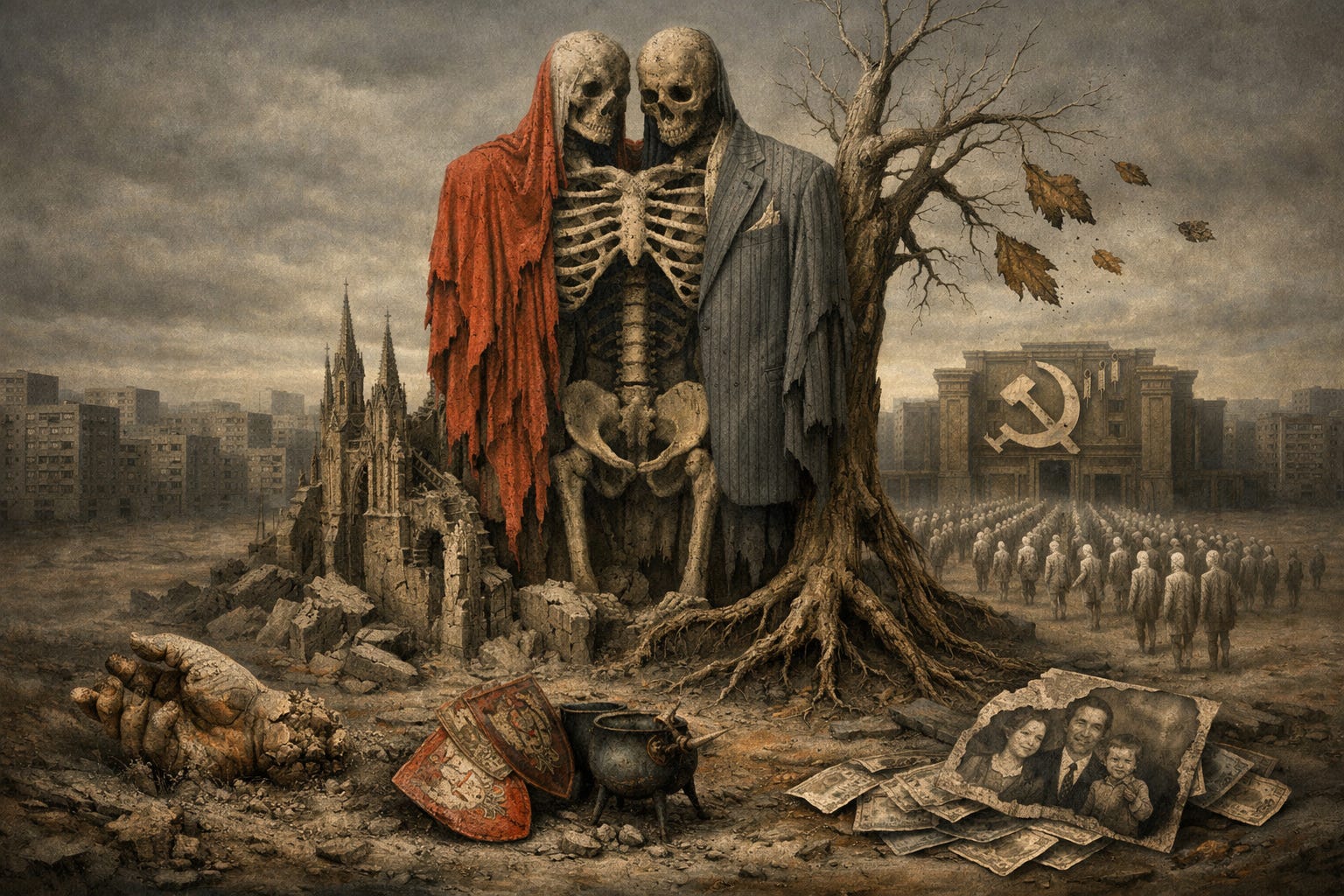
In this speech, Venner argues that the collapse of Soviet communism did not represent a victory for the “free world” but rather revealed that bourgeois liberal democracy and communism share the same modernizing, destructive logic, both dissolving traditional communities, identities, and sacred bonds in favor of atomized individualism and market relations. He contends that the old left-right distinction has become meaningless, as both camps now serve the same “liberal-socialist” system, and that the 1968 generation’s supposed rebellion actually accelerated the commodification and homogenization they claimed to oppose. Drawing on Marx’s own critique of the bourgeoisie, Venner presents bourgeois society as the ironic final destination of the communist project itself.
The Bourgeoisie: The Supreme Stage of Communism
by Dominique Venner
Symbolically opened in the bicentenary year of another revolution, the implosion of the Soviet regime in Russia was initially interpreted as a resounding and lasting victory for the other incarnation of modernity—market democracy—of which the United States of America is both the symbol and the dominant power. Already, during the period of maturation of the Soviet communist crisis, numerous intellectuals, once disciples of one variety or another of Marxism-Leninism, had rallied with great fanfare or on the sly to the ideology of human rights and celebrated the benefits of “business” as the only true answers to the questions posed by modernity.
In living memory, the absolute bankruptcy of the regime born of the 1917 revolution is without equivalent. There is nothing comparable, for example, with the disappearance of German National Socialism, which was not destroyed from within, but following its military defeat after five years of a dreadful war, the occupation of its territory, the crushing of its armies, and the death of its leaders at the hands of the victorious powers allied against it.
In the USSR, the pitiful collapse of communism has but one cause: its inability to survive. To understand the significance of the death certificate authenticated by the General Secretary of the party of the Soviet Union and the Parliament of Russia assembled in Moscow, one must imagine a pope announcing in Rome, before the Sacred College of Cardinals, the death of God and the dissolution of the Church. What died in Moscow, along with its sacerdotal party, was indeed the very idea of communism, which had survived in the past all failures, all horrors, and even the admission of Stalinist crimes.

The death of the communist idea does not affect only those who were its avowed partisans. By destroying the foundation upon which rested the promise of universal happiness founded on the transformation of social relations, it also strikes the entire non-communist left. Even the most cynical and hardened politicians, the party apparatchiks, the prebendary intellectuals, and the beneficiaries of social monopolies retained in their hearts, in fossilized vestige, the soothing justification of the old faith in Progress, History, and the Proletariat—the holy trinity of the defunct religion.
From the moment the death of communism was announced in its land of election, as if by the wave of a magic wand, the attributes of bourgeois society were instantly substituted for those of communism. Private ownership of the means of production and the outward forms of pluralist democracy spontaneously replaced collectivism and the Party-State. After seventy-five years of Soviet experience, torrents of blood, destruction, and untold misery, history in its tribunal had rendered its verdict. Peacefully, capitalism had triumphed over communism. Inverting all the predictions of Marxism, here was the bourgeoisie imposing itself quite naturally as the final stage of communism.
After such a debacle, what remains of Marxist “science” and its pretensions to interpret history? What remains of a mountain of sacred texts once hailed by Jean-Paul Sartre as the unsurpassable horizon of thought? Nothing remains.
Swept away by the shipwreck of communism, there disappears the “meaning of history,” that belief born of the Enlightenment, inseparable from democratic optimism. For all those who believed they could decipher the future thanks to a faith guaranteed by science, the sky has become empty, mute, and opaque. In the name of what, henceforth, could one imagine “changing life,” as a famous slogan of triumphant progressivism demanded ten years earlier?

Born in the 1930s and becoming by 1950 the ideological matrix of the left, progressivism had succeeded in triumphing, seizing intellectual power in most industrial societies of the West. Schematically, it was characterized by a goal: revolution (that of October 1917) and by privileged agents: the “left-wing intellectuals.” In France, these provided the Communist Party with its most faithful fellow travelers and the Socialist Party with a buzzing swarm of active sympathizers.
Struck head-on by the shockwave of the great collapse, their disarray is immense, as is their anguish about a henceforth unpredictable future.
While admitting themselves powerless to discover the founding principle of the post-communist world, they know and sense that it cannot be reduced either to the triumph of the market economy or to the American imperium.
This is what one of them summarized, among the most representative, in an interview given to a major evening daily where he counts only friends: “Imagine a laboratory,” he said.
“In this laboratory, a primordial soup, a big bang. And, within this big bang, a whole chain of chemical reactions of extraordinary violence. Molecules breaking apart... Molecules reforming... A formidable process, yes, of fission, combustion, corpuscular reconstitution, at the end of which will appear unprecedented synthetic products... There is nationalism here, of course. And bits of populism. And debris of antisemitism. And a little of that good old communism, less dead than it appeared. But all of this churned together. Put to the test of the big bang. With, at the heart of the tumult, as formidably improbable as the fascist synthesis was in its time, a monster that the new Europe is giving birth to before our eyes. It does not yet have a name, this monster. Nor a face. The hypothesis is merely that it exists. Or that it must one day exist. And that we must already, by estimation, strike the first blows against it...”
Making allowance for a native feverishness to which their author is accustomed, these somewhat disheveled remarks are not uninteresting. They show notably how “left-wing intellectuals” who have remained so seek in the fantasy of an imaginary threat a substitute for their need to frighten themselves and to hate.
Jünger’s Journey: A Visionary Voice for Europe’s Destiny

In his review of Dominique Venner’s biography of Ernst Jünger, Alexander Raynor traces Jünger’s extraordinary journey from the trenches of World War I to the intellectual battlegrounds of the 20th century, highlighting how Jünger’s prophetic vision offers a roadmap for European cultural renewal.
Not all have remained at this infantile stage of thought. Take Milan Kundera, a Czech writer working in French, a former communist who has returned from his illusions, a man of unquestionable intellectual probity and great culture. Having lived in the Czechoslovak communist universe, he emigrated to France, discovering the mode of existence of a Western democracy. A precious experience for a critical mind, eager for comparisons. His conclusions have undermined several received ideas. What does he say? He says that the opposition between the communist world and the democratic world is an illusion, and that they have more resemblances than differences between them.
“When I saw the first housing projects in Czechoslovakia, I thought I was seeing the very manifestation of communist horror. Only later did I understand that communism was showing me, in a hyperbolized or caricatured version, the common features of the modern world. The same omnipresent bureaucratization. Class struggle replaced by the arrogance of institutions toward the user. The degradation of artisanal know-how. The idiotic juvenophilia of official discourse. Holidays organized in herds. The ugliness of the countryside from which the traces of the peasant’s hand are disappearing. Uniformity. And, of these common denominators, the worst of all: disrespect for the individual and for his private life...”
Iconoclastic to the end, Kundera concludes:
“The experience of communism appears to me as an excellent introduction to the modern world in general; it has made me more sensitive to the absurd phenomena that people here are ready to perceive as innocent banality or as a necessary attribute of Holy Democracy.”
Nothing better underscores how the old left-right division no longer corresponds to any reality other than semantic inertias and personal interpretations. As political notions, left and right mean nothing if they are not translated into political practice. Now, what does this practice show? It shows parties and politicians apparently opposed, but speaking an identical language, referring to the same ideological themes—human rights, egalitarianism, formal democracy, anti-racism—while everything that might escape this soft consensus is erased. And behind the conventional discourse of single thought, the reality of corrupted societies gradually bursts forth.
A world where the wealth of speculators is paid for by the distress of those who work and by the misery of victims in concrete housing projects and desertified countryside. Remnants of nation-states having abdicated their sovereignty before the blind and planetary power of financial predators. European nations subjected to the foreseeable consequences of a foreign invasion prompted by idiotic economic calculations and justified by an intellectual class inhabited by hatred of the natives. Shattered societies within which all common rules of behavior have been destroyed and which hold together only through the fragile power of the bureaucrat, the judge, and the policeman.
For a long time, the years of the Cold War and the fear of military aggression partly masked the morbid evolution of Western societies. By giving credence to the myth of the “free world” against communist tyranny, the era of the Cold War had rooted the idea that, if the “free world” was often hard to defend, this was not due to its nature, to the nature of liberal society, but to its penetration by “subversion.” In this, one was gravely mistaken. Rather than striving to detect the ideas or agents of “subversion” and to denounce the pernicious influence of Karl Marx, one would have gained by reading him, since in the Manifest der Kommunistischen Partei (The Communist Manifesto), published in 1848, the fellow had taken the trouble to describe the ills that were wrongly attributed to his disciples:
“Wherever it has taken power,” he already observed, “the bourgeoisie has trampled underfoot feudal, patriarchal, and idyllic relations. All the complex and varied bonds that united feudal man to his natural superiors, it has broken without mercy, leaving no other bond between man and man than naked self-interest, the callous demands of ‘cash payment.’ It has drowned the sacred shivers of religious ecstasy, of chivalric enthusiasm, of traditional sentimentality, in the icy waters of egotistical calculation. It has reduced personal dignity to a mere exchange value... The bourgeoisie has stripped of their halo all the occupations that were hitherto held venerable and regarded with pious awe. The physician, the lawyer, the priest, the poet, the scientist—it has turned into its paid wage laborers. The bourgeoisie has torn away from the family its sentimental veil, reducing it to a mere money relation... The bourgeoisie cannot exist without constantly revolutionizing the instruments of production, which means the conditions of production, that is to say, all social relations... This continual upheaval of production, this constant shaking of the entire social system, this perpetual agitation and insecurity distinguish the bourgeois epoch from all preceding ones... All that was solid and permanent goes up in smoke, all that was sacred is profaned, and men are finally forced to face their conditions of existence and their mutual relations with sober eyes... The bourgeoisie has subordinated the countryside to the city, it has made peasant peoples dependent on bourgeois peoples...”
A remarkable tableau, still current one hundred and fifty years later. With this difference: that in the era when the Manifesto of 1848 was drafted, there still remained traces of the old European world, of “our world,” whereas one hundred and fifty years later, nothing remains of it except in history books.
Karl Marx, naturally, rejoiced at this destruction of traditional European society. It heralded for him the subsequent advent of post-bourgeois society, of communist society, radical materialism, worldwide homogenization, and the end of history. He was not far wrong. What he wished for did indeed come about in part—in part only. But the resistances were stronger and deeper than he imagined while observing the world from the library of the British Museum. One should moreover ask whether the great revolution he described and announced was the effect of the “bourgeoisie” alone, or rather that of the universe of rationality and technology as a whole.
Tocqueville, in his time, had announced the perfect accomplishment of bourgeois society in American democracy, the work of Puritan bourgeois. He defined it as the despotism of mediocrity and conformism. In the following century, Sombart and Jünger meticulously prosecuted the case against a society embodied in their eyes by the French society born of 1789. On the other side of the Rhine and in a different register, the same accusations were brought by Drumont and Bernanos in the grand French pamphleteering style—a style quite unbourgeois. This fact draws attention to the resistances within French society itself, bourgeois society par excellence. After 1789, no other country, except Germany, was the site of such energetic intellectual, political, and social resistance to the power of the bourgeoisie, as the Vendean uprising of 1793 and the constellation of French counter-revolutionary thinkers remind us.
What are called the “ideas of 1789” were moreover most often English ideas. This had not escaped Spengler, who drew this conclusion: “England has rendered powerless all the States to which it has administered, as medicine, the poison of its own form.” The observation is transposable today to America, daughter of England. The manners and social behaviors proper to it and perhaps suited to it are deadly for other nations.
Liberalism and Marxism: Two Paths, One Dead End

Liberalism certainly had its charms—or appeared to—with its veneer of generosity. A veneer soon shattered by the hard truths of reality. This broken ideology serves as camouflage for the hypocritical dictatorship of international capitalism that rules over Western democracies.
Bourgeoisie—that is quickly said. What relation exists between this word, this category, and bourgeois in flesh and blood, these mangy wretches, pointed at, denounced, sometimes massacred, as in Russia and in the Eastern countries after 1917 and after 1945? Do they even still exist? What relation between the concept of “bourgeois society,” that of bourgeois spirit (”thinking basely”), and each individual bourgeois? Numerous aristocrats, in the eighteenth or nineteenth century, had already unconsciously embraced the bourgeois mentality (individualism, the religion of money, reason, and law, submission to fashion). Likewise, there were many bourgeois in the nineteenth and twentieth centuries who practiced and upheld aristocratic virtues (prowess, generosity and loyalty, sense of lineage, military honor). However, despite all individual exceptions, bourgeois society exists. The French, since 1789 and the Civil Code, know something about it. To be more exact and more current, one should now speak of “bourgeois-socialist” society, seat of that provisionally dominant hybrid that is “liberal-socialism.”
Far from being a danger to this system, progressivism has helped destroy in customs and even in law everything that could still check its expansion, everything that remained of the old communal forms, accelerating in lightning fashion the process of “commodification” of human beings, destruction of identities, disintegration of community bonds, and manipulation of nature.
It is striking to see how the former protesters of 1968, once freed from their revolutionary phraseology, became the docile employees and greedy profiteers of the Western consumer system. The error of these good young people in their youth had been to identify the traditional ways of being that they hated with capitalism. They had been very poor readers of Karl Marx. They had not understood that advanced capitalist society had a destructive power far superior to that of the rhetoricians of protest. When they discovered that the liberal world was working in the same direction as they were, but with means ultimately much more effective and pleasant than those of revolutionary asceticism, they asked only to rally. Far from harming market society, progressivism had helped blow away the last obstacles limiting its excesses.
Translated by Alexander Raynor
READ MORE by Dominique Venner, brought to you by Arktos:

I don’get it. I mean, I get you wanna be cooler than Clouscard and sound smarter than Derrida and Foucault combined but what’s your actual point? Karl Marx was selling justice with the ever- fashionable rhetoric of luddites and this somehow makes Soviet urbanization without favelas equivalent with Dickensian horrors of ‘industrial revolution’ because... both end in modernity? Even if you believe the 100 quadrillion victims of communism - like you seem to do - it still doesn’t make sense. What’s your end game here, Pol-Pot, Year Zero? And the existentialism stuff... Kundera went to France and saw a Jacques Tati movie - great for him, what’s then your take on Eduard Limonov? Yeah… as I said, I don’t get it
The two forms of social organization, Soviet Communism and German National Socialism, have much in common, but the aspect that I would like to highlight is that both died of external causes. This should not allow anybody to conclude their respective social systems are not viable and that liberalism has marched victoriously over their bodies.
Both systems demonstrated a colossal power of unearthing resources of their societies and rebuilding them from the depths of a profound disaster. Their powerful propaganda was so effective that their leaders fell prey to it, unable to protect and further the successes of their initial power grab.
Born closer to the Anglo-American imperial system, still eager and capable of controlling the world, German National Socialism quickly fell prey to the machinations of the former. For this social organization to survive, it would have been enough to
(a) avoid the drive to unify the German-speaking peoples,
(b) take seriously their pact with the Soviet Union, which was an essential supplier of much-needed primary materials, and
(c) behave correctly with their minorities and avoid the national supremacist discourse.
There were enough social forces within German society that could have been attracted to participate in its construction (communists, social democrats, Catholics, and others) under the leadership of the NSDAP.
It is easy to imagine how their original leaders would have changed, or been changed, once their society had reached a higher level of development and their relationships with their neighboring countries were brought to a normal and friendly state. A key role in this would have been played by a gradual redirection of the nation's attention to future development rather than revenge and recuperation of territories.
Socialism within their own borders is the most suitable form of social organization for the European countries.
Soviet Communism demonstrated its initial vitality by winning the civil war, fending off foreign interventions, and reintegrating most of czarist Russia's territories into the Soviet Union. The immense material resources as well as the high quality of their human resources allowed the Soviet system to develop on the industrial base of czarist Russia and further it to respectable levels even before the 2nd WW. It would have been there today if the requirement of an international communism had been dropped from their propaganda at an early stage. Soviet Communism demonstrated its capacity to change; however, it was tricked into believing that change meant a friendly integration into the (dying) Anglo-American economic system (otherwise referred to as “liberalism”).
Actual Russia is a living illustration of how Soviet communism could have transformed itself. Likewise, China.