


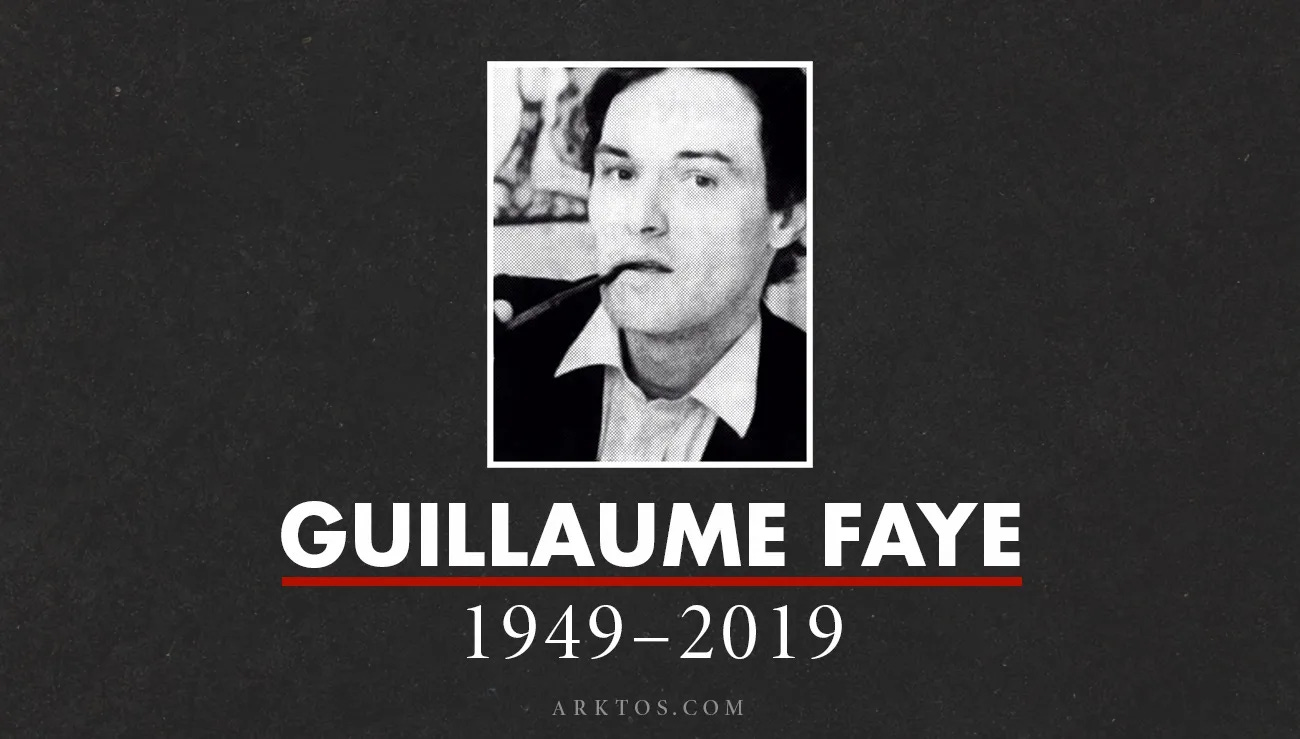
The text you’ll find below is a speech by Guillaume Faye from the 15th Conference of GRECE (“Research and Study Group for European Civilization”) held on May 17th, 1981.
At the time of this speech, what came to be known as the French Nouvelle Droite (“New Right”), centered around GRECE, was at the height of its popularity, and many of its most prominent thinkers, such as Alain de Benoist, Pierre Vial, and Guillaume Faye, were leading members of GRECE, contributing to its journals, organizing seminars and conferences, and authoring some of the movement’s most important and influential ideas. Rereading this speech today, one has a unique window into the pioneering origins of the European New Right.
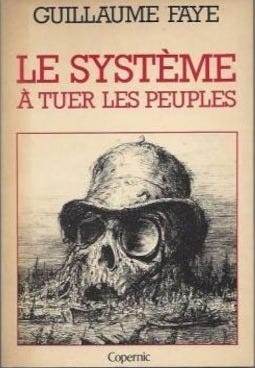
This speech would be expanded upon and evolve into one of the most important works ever written by Guillaume Faye, his (first) magnum opus, Le Système à tuer les peuples. The latter book is extremely rare, difficult to find, and has remained untranslated… until now:
Arktos is pleased to announce that we will be releasing the first ever English translation of this work under the title The Genocide System, translated by our resident Nouvelle Droite specialist, Alexander Raynor. This will be the 12th installment in Arktos’s ever-growing Guillaume Faye collection, our latest release being Against Russophobia.
Systems Against Peoples
by Guillaume Faye
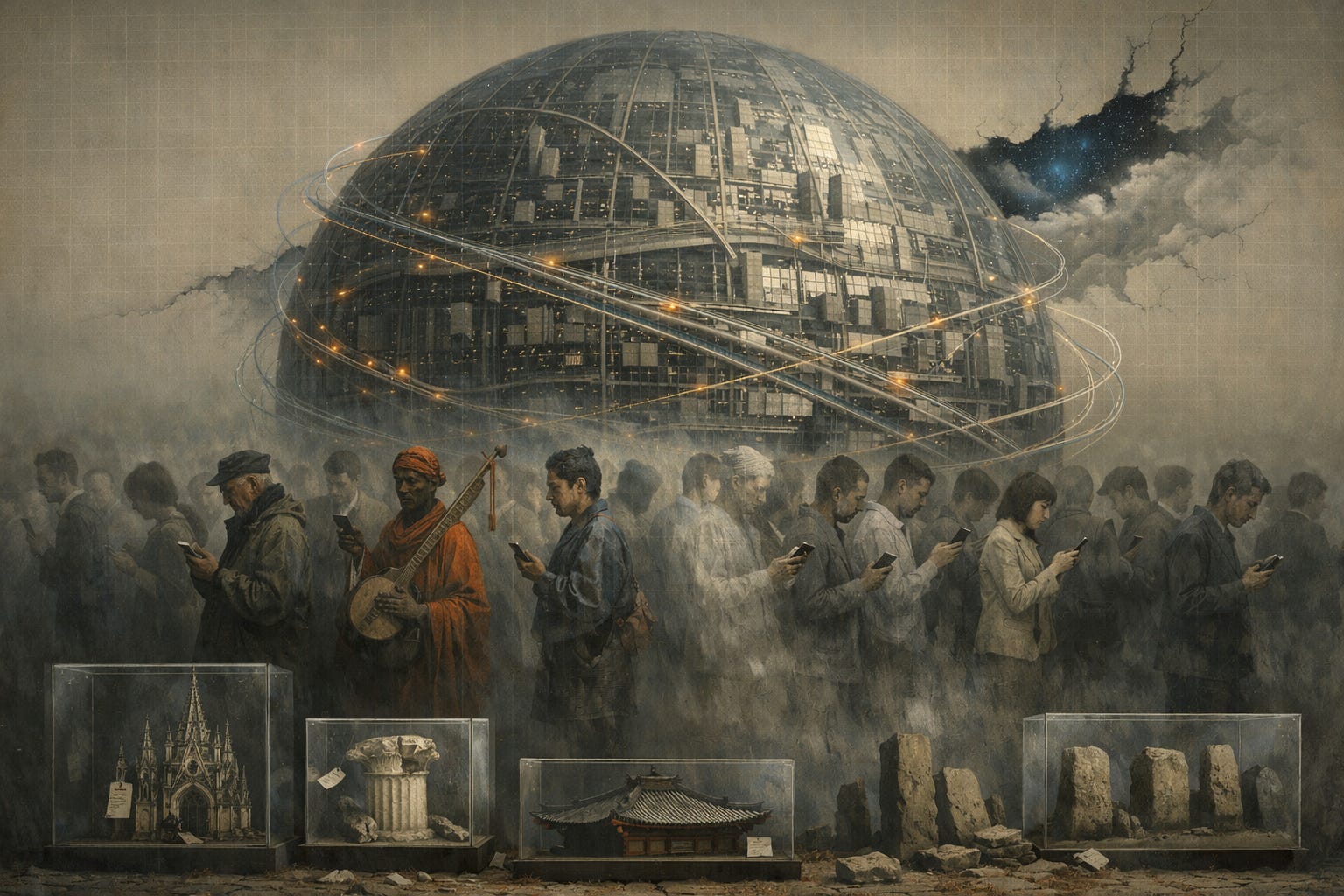
A considerable event is taking place in our world, an event that is slow, silent, invisible: cultures, civilizations, nations, countries are melting into a lukewarm structure that transcends the left/right, East/West, North/South divides, that absorbs political and ideological distinctions, that levels geographies, that petrifies histories. This structure is the planetary System.
“System,” and not “civilization.” There is no world civilization, despite the reveries of Léopold Senghor, for a civilization remains on a human scale. The System, for its part, appears as the monstrous metamorphosis of Western civilization into a gigantic technical and economic mechanism.
The great conflict of times to come will no longer pit capitalism against socialism, but rather all national, cultural, and ethnic forces against the cosmopolitan machine of the Western System, which substitutes “zones” for territories, economic regulations for sovereignties, mass conditioning for cultures.
The Earth is becoming a great circus that the System tames. This System is nothing like a world empire, since it does not emerge from a political power, but from the cancerous spread of consumer society spilling across the entire globe. It has no sovereign other than an abstract individual—homo universalis, born of the encounter between natural law and the ideology of the Enlightenment—with homogeneous and universal needs. It has no government other than a convergence of transnational economic and bureaucratic networks, which relegate princes and the will of peoples to the prop room. It has accomplished this revolution: having dismembered the fabric of societies, once formed of organic wholes, institutions, traditions, trades, plural groups and rhythms, only to recast their weave according to the homogeneous logic of technical and economic sectors, fragmented in relation to one another, organized into aggregates, like the gears of a masterless engine.
The growth of the System is all the more formidable because its agents claim to be invested with a mission—that of world humanism, mercantile pacifism, or socialism as a corrector of injustices. These ideals appear more dangerous and alienating in their saccharine amiability than traditional imperialisms. The System forms a “totality” devoid of a center, but whose focal point is American society, its firms, its market, and its customs. It spreads, after Western Europe and the Far East, into socialist countries and into the industrialized parts of the third world. This expansion, which is no more “capitalist” than it is “socialist,” uses firms, international institutions, and national bureaucracies as equivalent economic agents, charged with spreading the same merchandise and the same mental structures everywhere.
The nightmare that the glacial optimism of liberal technocrats and the naive globalism of the old left attempt to dispel is gradually taking shape: it is the “brave new world.” The alchemy of its tentacular growth is always composed of the same ingredients: supranational techno-economic structures, universalist and egalitarian ideology, and mass world subculture.
The ongoing unification of customs and needs establishes a hegemonic human type: the reign of the soft figure of the universal petty bourgeois has begun. A world bourgeoisie is settling over the Westernized world, rallied by the wealthy classes of poor countries and the nomenklatura of socialist nations. To align ways of life with the model of the American middle class—such is the implicit wish of political parties, business circles, and that by-product of the media called “public opinion.” The latter invokes, with a clear conscience, the argument of the rising standard of living—a manifest imposture, which passes over in silence the destruction of traditional economies and the pauperization of immense crowds of men. This often unconscious racism, which accepts that the “Western” economic model of development is superior and preferable to the traditional cultures of peoples, risks producing a single human psyche. Our species, then deprived of the plurality of its mental structures, would bring to the global challenges of the world to come only a single type of response—and probably not the best one.
In this singular mentality, Western man no longer defines himself by his origin, but by his techno-economic mode of existence. A banking executive in Singapore is more “Western” than a rooted Corsican or Breton. The earth is being transformed into a sectorized ensemble of networks and circuits, leaving dead spaces gaping open. Depoeticized, our planet is being put into exploitation; it is no longer being put to conquest. Without mastery over their space, peoples no longer control their geopolitics. Their geography—that of habitat or political territory—fades before the commercial and administrative zoning of the System. We are no longer inhabitants, but residents. The System has not destroyed our homelands; it has fossilized them by superimposing itself upon them. The national idea is no longer condemned; it has been neutralized, not in spite of, but because of the academic reverence cynically paid to it by political speeches. Every notion of territorial origin withers in this universe of mass tourism, food and clothing uniformity, American degrees, and international films.
It seems Ford is going to build a “global car,” manufactured in ten different countries, destined for all the world’s motorists. Like men, objects no longer come from anywhere. “I think,” declared Gilbert Trigano, CEO of Club Méditerranée, “that the future of the Club lies in the advent of a truly cosmopolitan atmosphere” (Le Monde, July 5, 1980). But the future of Club Méditerranée is not that of peoples of culture: the advent of this cosmopolitanism will not be an opening for them, as Guy Scarpetta imagines, but a suffocation.
The System, which does not “live” but “functions,” removes peoples from historical time. Founded on fashions, consumer movements, economic flows, and currents of opinion, it inscribes itself in pure eventfulness. A people, in contrast, is going somewhere and coming from somewhere. For the System, historical consciousness is subversive, for it does not make good customers or good television viewers. If the nature of history is to metamorphose the meaning of things, the System desires only to change forms: forms of products, forms of fashions. What it fears above all are the perturbations of history, those of the Caesars or the Bonapartes. The System is a stabilizer. In the stable world order, the microvariations of novelties and innovations contrast with the macrofixity of the whole. Customs, artistic styles, labels, and political ideologies no longer evolve. The Walkman is not an “innovation,” but an aggravation of an already well-established form-of-life: technological narcissism. We have entered flat history, into the closed cycle of the eternal return of the “retro.” The media accentuate the conservative fixity of the System by transforming ideas into merchandise, positioned on stable markets of opinion.

Evacuated, the history of peoples leaves behind a great silence, which the hollow babble of the media attempts to cover. Set aside, the world of peoples—that of continental strategies, religious revolts, great political designs—gives way to small programs of individual life, at the end of which there is only retirement. Under these conditions, the Western system will leave no traces of civilization. It is without memory; no memory of it will be kept. In the line of Lockean ideology and secularized Calvinism, it believes it has already accomplished its revolution. Its “progress” is merely the continuation, the perfection of its expansion. This explains why Marxists are disarmed in the face of contemporary societies, which are, at bottom, “post-revolutionary.”
The System has had a historical precedent: Christendom. It too intended to construct—a project it has not, moreover, abandoned—a globalism above the singularities of peoples. The homogenization of cultures in the name of salvation has simply metamorphosed into homogenization in the name of the right to bourgeois happiness. In other words, monotheism has changed form. Today, it has taken that of the economic-cultural complex.
This means that the installation of transnational economic structures and the diffusion of a single world culture constitute two globally linked processes. The imposition of the Western “system of objects” presupposes the adoption of a simplistic and pragmatic culture that marks an involution and psychic impoverishment. The System must acculturate peoples to the customs of an international consumer man, presumed to possess the same needs everywhere. The economy and the infraculture of the System have been constituted into a “reciprocal ensemble.” Merchandise carries cultural lineaments, and, conversely, the American-Western subculture prepares minds for the consumption of unified merchandise.
There are three cultural phases of entry into the System.
First phase: spectacle. Cultured populations are brought into the presence of the model through the intermediary of Westernized elites, who function as “shop windows.”
Second phase: normalization. It is a matter of eliminating “indigenous” cultural slag, by relegating it to “underdeveloped” or “backward” zones that have been previously helped into existence. The humanitarian ideology of the supposed fight against pauperism serves here as an instrument of penetration.
Third phase: consolidation. This is at work in industrial countries. The dominant culture is then completely incorporated into the economy. Mass fashions constitute the weapons of this depersonalization of individuals into a narcissistic and hyper-pragmatic existence. They compensate for the boredom of a homogeneous mode of existence (which would risk leading to revolts, to demands for a return to history) through the stupefaction of pseudo-novelties. In this obsolescent culture, no “new cultural generation” appears, despite the dreams of the magazine Actuel, which is merely a cog in the ideology of the System. There is now only a gigantic cultural product, subjected to the mercantile function, a simple accounting sector in the columns of figures of the global hypermarket.
Don’t forget to check out the latest Guillaume Faye release: Against Russophobia, a collection of Faye’s writings on the Soviet Union, Russia, and Ukraine, equipped with forewords by Robert Steuckers and Stefano Vaj:

The traditions of peoples — they, too, have become sectors of an economic and technical system. In dead museums, we celebrate our past without living it. A souvenir, but no longer a memory, the past is visited and no longer inhabited. A true people internalizes its past and transforms it into modernity. The System has made it an ornament, neutralized and sanitized, which one consumes as one also consumes the exotic. The past and traditions have become planets in the galaxy of leisure.
This universal product-culture is more “Western” than American. Today, America is everywhere. The System derives as much from the domination of the United States as a nation as from the extension to the whole earth of American society. The ideological foundations of the System are the same as those of the founding fathers of the United States: mercantilism and humanitarianism. But strictly American hegemony is destined to decline; Goldorak is Japanese and the hit parades are produced in Europe. Americanomorphism succeeds Americanism and represents, at bottom, the essence of the West. This is the greatest peril. Will we still be capable of rejecting what now comes from ourselves? America is within us: a terrible formula, which, if it became completely true, would mean that we are already living dead.
It is no more America than a political power that directs the System. The latter has no chief; it has only regulators. The staffs of firms, national or international bureaucracies, media networks, interweave their decisions above political sovereignties. Carl Schmitt and Jürgen Habermas have well grasped the totalitarian nature of this technical self-regulation, which depoliticizes peoples. This totalitarianism “justifies” itself through an anti-authoritarian practice and ideology, which substitutes for decisions, for destinies, for visible powers, the regimentation into the placenta of organizations where the subjected, self-alienated, live within the System as if beside a “fraternal mother.”
Sectoral purposes have replaced politics; opinions are depoliticized and political ideologies become ornamental. The Internationale is no longer sung when the left wins elections; instead, people sway to the sound of American rock. No more need for political legitimacy for the System: the American multinational, the English bank, or the French bureaucracy see their strategies converge of their own accord thanks to the cement of the same implicit program that inhabits them all: to realize the world merchant society. The only politics still practiced in the System obeys what Claus Offe qualified as “submission to avoidance imperatives”: avoiding upheavals, avoiding major crises, the better to manage small ones.
In this desert of politics, the world no longer has a destiny. This end of the twentieth century sees the paralysis of peoples setting in. The status quo resulting from Yalta globally maintains its equilibrium. Political Europe has still not been realized; Islam remains disunited; decolonization remains a word; revolutionary projects end in the blood of medieval tyrannies or in bureaucratic society. On the other hand, wheat exports to the USSR or transfers of labor and industries are doing well. The history of the world becomes that of its consumer markets. This false history, depoliticized, proceeds from a self-perpetuating machinery, barely troubled by the bombs of furious desperados whose revolutionary utopia—increasingly in the minority—no longer finds an echo among their former companions, won over by the mortal lukewarmness of the System.
Depoliticization provokes an alienation of a new type. The System no longer resorts to coercion or ideological persuasion, because its behavioral structures are internalized by populations. Hence the vanity of any form of political contestation. Politics is organized as spectacle by the media of the System, and public opinion, falsely politicized—”politicized” one might say—constitutes a simulacrum of popular sentiment. Contrary to the views of the Frankfurt School, there is no “clandestine orchestra conductor” hidden behind the rationality of economic practices. The essential thing is not that you contest the government, but that you find nothing to object to when you make your purchases at the drugstore, that you implicitly adhere to the practical values of material hedonism. This is the reason why the only contestatory path is ours, the one that globally calls into question, from a metapolitical and cultural point of view, the worldview of the System in which individualism, hedonism, rationalism, and humanitarian globalism are indissolubly linked by an implacable logic.
The trap into which Marcuse and Habermas fell is not having perceived that the System rested on a worldview that was also their own. Hence the total recuperation of their discourse and the historical failure of the Frankfurt School. By breaking with the rationalism of individual happiness, with humanitarian globalism, to situate ourselves on the side of peoples, of their will to affirmation, to difference, and to destiny, we claim, on the contrary, to constitute the true alternative. We claim to be the only ones, in the uniform ideological landscape of today, normalized by a “low-profile” totalitarianism, not to compromise ourselves with the values—or the non-values—of egalitarian and merchant Westernism, not to make our own this postulate of the System: “The economic happiness of the individual must be rationally realized.”
Aurelio Peccei, president and founder of the Club of Rome, has well summarized the nihilistic program we intend to combat by the only means effective today—that is, theoretical and cultural work—when he declared: “We must arrive at a governable world system that should use the highly effective techniques of marketing.” An insane dream, shared, on the left and on the right, by liberals and socialists alike, by all the objective allies of the death of peoples, who want to transform the planet into a bric-a-brac of petty happiness, where peoples, “subsidiarized” like the departments of a multinational, would live in the perpetual peace of an asylum for the insane, disciplined by the ten commandments of human rights ideology. Big Brother reigning over the “brave new world”!
READ MORE groundbreaking works by Guillaume Faye, brought to you by Arktos:


This ideology of human rights — let us speak of it. By preparing minds for the idea of the uniformity of needs, by placing the secured and abstract individual above communities of belonging, it develops a Western-centric racism that fulfills a precise function: to legitimize the world merchant system. Human rights ideology is the poor discourse of the System, toward which all egalitarian ideologies return as to a lowest common denominator, from Marxism to conservatism. Egalitarianism, no longer needing to be validated by a theoretical discourse, contents itself with the old bourgeois philosophy of the seventeenth and eighteenth centuries. It contents itself all the more willingly because this philosophy took form, in its current shape, in nascent American society, where it conjugated biblical postulates with the philosophy of nascent capitalism.
But a formidable contradiction arises between, on the one hand, the System, entirely devoted to this philosophy of massified happiness, and technology, which carries in its essence the temptation of power and adventure, but which, nonetheless, apparently constitutes the armature of universalism. Contradiction between the drama of technology and the de-dramatization of ideology. Contradiction between the cybernetic fantasy of a technology that one would like to be neutral and the forces of mobilization and commandeering of the world that it conceals.
The System does not understand the nature of this technology. It does not grasp, as Heidegger writes, the “mystery of its essence.” From orthodox Marxists to management-development technicians at MIT, the same naive and pacified interpretation of technology reigns, in the lineage of the Saint-Simonian rationalism of progress. Thanks to technology, we would one day, according to the old biblical theme, be “delivered from work.” Moreover, today it is significant to see a contestation of work as such developing, even in socialist circles. One must see in this another consequence of bourgeoisism: the System also experiences as a contradiction the values of well-being and the necessity of social work.
The current interpretation of technology does not grasp its Faustian dimension. Like work, it is banalized, instrumentalized in the service of comfort, without seeing its grandeur or its danger. Yet modern technology, disturbing and risky, is a call to the self-affirmation of peoples, a demiurgic and pagan call to the creative power of men. Only the adversaries of technology inspired by certain currents of the Frankfurt School are consistent with themselves, that is, with the irenic and humanitarian ideology they share with the System. They have understood that hedonism was contradictory with the “rise in power” of a culture founded on modern technology. Between them and us, there is conformity of analysis, but divergence of values. The theorists of the Frankfurt School have grasped that the ideal-type of the peaceful bourgeois—and not of the revolutionary—was indeed their own, whereas ours can only be the man of culture who belongs first to his people. To belong to the European cultural area is to accept modern technology, not as an instrument of domestication and alienation, but of creation. Habermas said that one could not conceive of a nuclear poetry. Unfortunately for him, yes, one can.
A system that claims to eliminate all risk by relying on technology, which is the riskiest activity: therein lies the supreme risk. The ambiguity of the current techno-economic universe will only be lifted when the values presiding over the use of science and technology assume and master their risk and incorporate it into the historical project of a people, instead of enslaving it to massified comfort. Technology presupposes not only collective creativity, contradictory with the ideals of the System, but also the rehabilitation of work rethought under the noble category of a spiritual mobilization of the community. We must be done with this punitive and demeaning conception of work, stemming from biblicism, mercantile hedonism, and our industrial past, where liberal capitalism made work an instrument of self-dispossession.
Schizophrenic, the System represses the type of the Worker as the dominant figure, because at bottom, it despises the work of the people, of all peoples (and consequently their culture, insofar as work seems to us to be the essence of culture). To rethink peoples as creative communities, according to their own will; to be done with this dispossession that deprives men of their culture and inflicts upon them a mediatized spectacle, fabricated by buffoons from nowhere: this is what a new worldview could achieve, one that would reconcile technical work and respect for roots.
The future belongs to cultural, spiritual, national revolutions. The future belongs to the destruction of the international economic order and to the pursuit of an idea that is already making its way: the recentering of autonomous economic spaces around the great cultural areas. But, in Europe as in the third world, these ideas will be defeated if they do not go to the end of their approach, that is, if they do not decide to break with Western ideology, whether Marxist, technocratic, Christian, or liberal. As for the peoples of Europe, they must know how to progressively carry out a revision, obvious to some, heart-wrenching for others: to dissociate themselves from the West, that West in which we no longer recognize ourselves, that West which is but a pluriversum of merchandise, that West which mutilates before our eyes our millennial culture into a stress where nothing but practical consciousness reigns anymore.
The reason for being of a people is to leave its mark in history, in continental space and in the space of time, which is also that of the spirit. We want to leave a trace. We want all peoples to leave traces. We no longer want to continue living in a cosmopolis without joy, without desires, without adventures, without peoples.
As noted above, this speech developed into Faye’s first major book, The Genocide System — coming soon, for the first time in English, from Arktos.
To read more by and about Guillaume Faye and the New Right, subscribe to Arktos Journal and take the leap into the Arktos catalogue — the leading English-language library of the European New Right since 2009.
For beginners as well as veterans in the fields of Faye’s thought and works, we recommend this unique tribute volume:

Here’s an excerpt:
Guillaume Faye: Awakener of the Twenty-First Century

Pierre-Émile Blairon commemorates the works and legacy of Guillaume Faye as a visionary, frontline awakener, comparing Faye’s life to a meteor: a radiant cosmic rock flying through the heavens which serves as an omen and burns up before ever falling.
Every time I read an article or speech of Faye’s, I love him more. This one is complete fire and the only few places I disagree with in prescriptions are explained by the different context of the time. The best possible outcome now is America overcoming itself and its former form, that’s the only place we diverge here.
I have to read one of his full books soon. I have a few PDFs just never do and I’m being silly.
Everything about this is absolutely brilliant and spot-on, except that he refuses to name a certain very real enemy. Perhaps a tactical decision (given the time of writing), but by now it's high time to let the cat out of the bag and let the Noticing proceed; surely he must know better than to put the entire critique on an absolutely impersonal "System."
This is the same error the "dark enlightenment" people made. It sounds clever and cool, but is the System really all that impersonal, or have its parts and pieces been gradually and deliberately nudged into place by identifiable people since the end of WW2, and are they not basically in control of it (as per the Wizard of OZ?).
(I'm reminded here of the proper counter argument to the usual libertarian stuff about the impossibility of central direction of the economy: some judicious level of central planning MUST be possible, because the elites very obviously plan the economy centrally for themselves to some extent, so in that case why can't the same thing be done by patriotic elites for the sake of their peoples?)