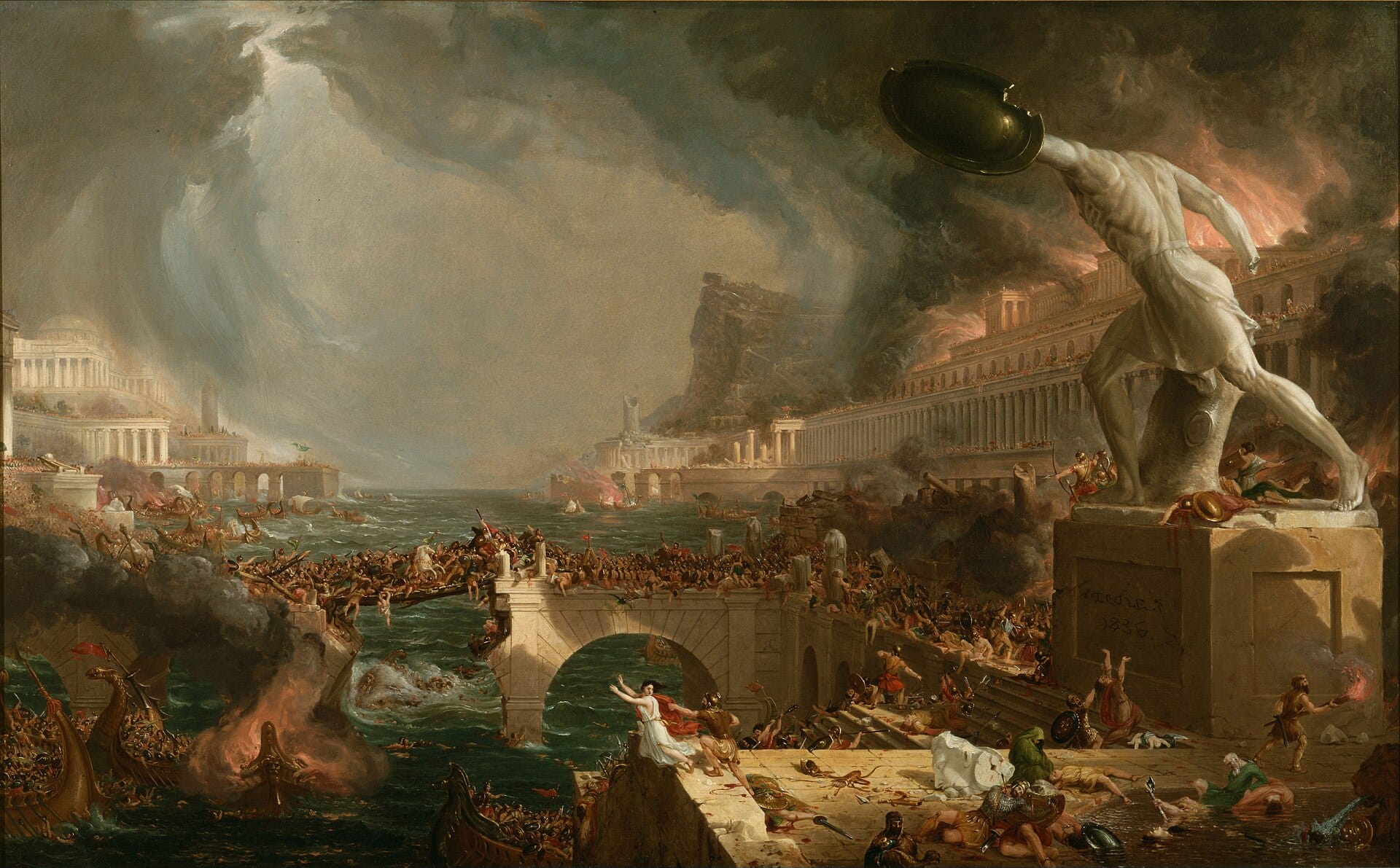
“Destruction,” from The Course of Empire by Thomas Cole, 1836.
The Decline of the West (Oswald Spengler), Civilisation and Its Discontents (Sigmund Freud), In the Shadow of Tomorrow (Johan Huizinga), The Crisis of the Modern World (René Guénon), The Crisis of European Sciences and Transcendental Phenomenology (Edmund Husserl)…
The “literature of crisis” from the early 20th century — along with its extensive “history of effects” (Wirkungsgeschichte) — calls for detailed examination, to which numerous scholars have already devoted themselves, body and soul, recognising the urgent need for such reflection. Indeed, this reflection is no mere matter of philology, but of destiny.
It is plain for all to see that we have not yet emerged from this transitional phase. We are still in the interregnum, in that Zwischenreich which the authors of the Conservative Revolution skilfully identified and brought to light in their convergent dissonance.
Without delving into the conceptual and metaphorical debate surrounding the imagery of “sunset” (“decline”) and “crisis”, with all its similarities and differences, it is clear that the notion of a “great” and “tragic” transformation in the way we humans inhabit and interpret the world prevails. As early as Ecce Homo, Nietzsche proclaimed the advent of
“a crisis the like of which has never been known on earth, the memory of the most profound clash of consciences, and the passing of a sentence upon all that which theretofore had been believed, exacted, and hallowed.”
His words have proven prophetic.
On this journey towards nothingness, blind faith in progress accompanied the development of our Zivilisation for a considerable period of time, until it plummeted to the level of its ultimate outcomes: the “culture of narcissism” (Christopher Lasch) and the “culture of complaint” (Robert Hughes).
This utopian cult is rooted in a naïve Rousseauian anthropology and is driven by technocratic politics, which is the political theology of New Age techno-spirituality. This led to the famous concept of the “end of history”, which was developed by Francis Fukuyama in his celebrated and much-debated 1992 essay, The End of History and the Last Man. In this essay, Fukuyama asserts that liberal-capitalist modernisation and the teleology of historical development are one and the same.
In this context, the end of history does not represent the death, disappearance, or erasure of the historical dimension, but rather its fulfilment. However, the realisation that historical development can no longer be perfected logically leads to its cessation. Humankind is cast out of the flow of historical time, having tragically lost the means to access the ritualised time of myth. Demythologisation rises from the depths of theology (Rudolf Bultmann) to the plane of common sense. The “disenchantment of the world” (Max Weber) nihilistically crushes any system of values. Alexander Dugin says in TheFourth Political Theory:
“At this stage, liberalism ceases to be the first political theory and becomes the only post-political practice. Fukuyama’s ‘end of history’ arrives, economics in the form of the global capitalist market replaces politics, and states and nations are dissolved in themelting pot of world globalisation. Having triumphed, liberalism disappears and turns into adifferent entity — into postliberalism […] This is the source of the thesis about post-industrial society: ‘economicsas destiny.’”
Once its dynamic, processual, and metamorphic nature has been stripped away, what is history if not the immanentisation of the eschatological moment and the realisation of the end of time? Here, all is silent and motionless. The polemical essence of living organisms, in the sense of the Heraclitean polemos, is reduced to the stillness of the inorganic. Once stripped of its metaphysical dimension, Kairos becomes the postmodern eternal present, establishing an experience of nonsense and temporal deprivation — “the absolute present” theorised by François Hartog. A similar process occurs in relation to space, resulting in the experience of non-places, to use Marc Augé’s term, or “hyper-places”, to use Michel Lussault’s term.
While classical liberalism has long been identified, since Max Weber’s seminal writings, as the political ideology of modernity, the rise of neo-capitalism in its various forms — ranging from neoliberalism to ‘surveillance capitalism’ (Shoshana Zuboff) and ‘ordoliberalism’ — appears to be an inevitable consequence of Western postmodernity.
Yet, in his book The Clash of Civilisations (1997), Samuel Huntington effectively demonstrated that liberal democracy — the political institution that has survived in the West through the transition from the modern to the postmodern era, despite reforms, crises, and re-evaluations — is neither necessary nor eternal. Political and economic paradigms are historically determined and always depend on the cultures to which they refer. Fortunately, even in the age of “planetarisation” (Heidegger), these cultures remain diverse. As Huntington explains, there are multiple forms of modernity. And, by extension, there will be multiple forms of postmodernity.
Recent years have offered us nothing but an illusion of harmony, one that has historically recurred on several occasions and has always faded away: in Europe, we saw such during the Belle Époque, after the First World War, after the Second World War, and finally, as Fukuyama noted, after the end of the Cold War. The empirical evidence, which each time undoes this “perpetual peace” (to use Immanuel Kant’s phrase) and restores the polemos, nevertheless resolutely denies the ‘end of history’. For polemos, as Massimo Cacciari has explored in his extensive philosophical work, The Geo-Philosophy of Europe, is the very mode in which unity comes about; that is to say, it is the inevitable structure of differentiation which alone affords heterogeneous parts the possibility of recognising their own original harmony “in accordance with the necessity of strife.”
In defence of the plural, labyrinthine, and, above all, organic dimension of history, and of its radical, ceaseless, and eternally renewing developments, the ideas of Oswald Spengler and his The Decline of the West are more relevant than ever.
While Spengler’s work does indeed observe a decline and an end, in a sense it refers only to a particular type of civilisation: Western Zivilisation (no longer Kultur). History, the bedrock in which human existence flows, remains the indisputable backdrop. It is within this history that the decline of the West will take place. Perhaps a hundred years on, we will be able to imagine that it has already happened. The death of a history — that of a paradigm now drained of life and devoid of vital force whose cultural power has faded — is the death of a branch, not the tree itself. In this metaphor, the tree is the indivisible organism of historical totality. Stefano Zecchi made this very clear in his valuable essay The Armed Artist: Against the Crimes of Modernity (L’artista armato. Contro i crimini della modernità):
“To be within history means becoming aware that the actions and forces of the history that has unfolded over the centuries lie within ourselves, and that our destiny is to become a symbolic truth for the future.”
The West’s decline certainly signals the end of an era, contrary to Fukuyama’s prediction: tragedy replaces the vision of prosperity and modernisation. However, even Spengler, whose judgement of values is the opposite of Fukuyama’s, suggests that the West is at risk of entering a post-historical phase characterised by a purely biological realm. Here, “many things happen, but ultimately, in a higher sense, nothing happens.” This is history stripped of its meaning. Nature becomes the realm of the inert and the already-become, a blind and anonymous causal necessity. The crisis of modern Western politics — the crisis of the Political (Carl Schmitt) — appears to be heading in this direction. Neoliberalism resists the onslaught of history, but this model’s crisis is evident in numerous and substantial geopolitical, cultural, social, and anthropological setbacks.
Perhaps this outcome could open up new avenues for experimentation with freedom. The fortunes of the liberal tradition have hinged precisely on this concept; despite its numerous variations, which political science has rightly studied with great interest, a common thread can be found in the anthropological principle of the individual. This provides every liberal doctrine with a genuine metaphysical foundation. According to Schmitt, this foundation is linked to radical indecision. Liberalism would thus exist, in the words of the German jurist, “in the short interim period in which it was possible to answer the question ‘Christ or Barabbas?’ with a proposal to adjourn or appoint a commission of investigation” (Political Theology). Thus, for liberals, freedom is constitutionally apolitical or pre-political in that it is not shaped by the historical struggle (agon), but is instead considered an abstract, universal existential value.
Today, liberalism — both as a philosophical doctrine and as the core of the Western imaginary — remains fixated on unlimited individual freedom, a materialist and immanent perspective, a free-market capitalist economic system and a sober, Protestant-rooted petty-bourgeois hedonism. All of these perspectives have been worn thin by time and have now reached their setting sun, their point of decline. Neoliberalism is the mainstream’s superficial doctrine, yet its foundations are in stark contrast to the Zeitgeist.
Indeed, liberalism is no longer capable of serving as a narrative or leading image for younger generations. In the era of the “post-human”, how can liberalism exist other than by betraying its original principles and moving towards a technocratic and accelerationist direction that is neither “free” nor “libertarian”? As Fabrice Hadjadj put it in his scathing essay, The Depth of the Sexes: For a Mysticism of the Flesh (La profondeur des sexes: Pour une mystique de la chair):
“We believed in liberation. All we got was liberalism.”
And yet, European tradition offers a variety of different forms of freedom, as evidenced by the work of Ernst Jünger, among others. Among his many incisive quotations, we present one of the most evocative:
“Freedom appears to us as a primal element that we can only foresee, but which surrounds Europe with better and more solid boundaries than the seas, mountains, and fortifications. In Europe, we have the capacity to respect something beyond humanity that determines our dignity. When one no longer perceives these boundaries and no longer feels their absence, despotism begins.” (The Gordian Knot).
The freedom of which Jünger speaks is an elemental and primordial force. It is an impersonal axis of integration that links the individual to both the horizontal plane of the historical community of destiny and the vertical vector of transcendent continuity, connecting earth and sky.
“If the struggle against nihilism is to succeed, it must be fought out in the heart of each one of us. Everyone shared in the guilt, and there is no one who did not stand in need of the healing powers which are to be found in the realms of suffering.”
Jünger wrote this in Peace, distinguishing himself as the solitary Contemplator of that “short century” — one which nevertheless carried a heavy burden of ideologies and narratives that our contemporary world struggles to shake off, and instead merely reworks in postmodern forms in the likes of pastiche and collage.
Jünger sets the substance of the individual against this: the differentiated man who is capable of overcoming nihilism by shaping and subjecting it to his own inner disposition. However, this project is only possible “if men strengthen themselves from a metaphysical point of view.” This is why Jünger’s merciless critique of “red” and “black” totalitarianisms does not leave the liberal perspective unscathed:
“In the polemics which the old Liberals sustain against the nihilists, they behave like fathers bewailing their misguided children without seeing that the real fault lies in their inadequate upbringing.”
In short, no political form of modernity is immune to nihilism. Similarly, the French sociologist Michel Maffesoli refers to the liberal ideology of progress as a form of “soft totalitarianism”: the mechanism of subjugation to political power operates through a renunciation of independent thought.
This bears similarities — albeit less brutal ones — to 20th-century totalitarianisms. Hannah Arendt had already noted that the defining feature of totalitarianism is not the tyrant, but rather the ideology in power. This is all the more pervasive when the rulers are complicit pawns who “let things happen” without any particular conviction. In the era of post-ideologies, this mechanism can only function more effectively. All the forms of the sclerotisation of the Enlightenment ideology of reason have been criticised by thinkers such as Adorno and Horkheimer in their famous Dialectic of Enlightenment.
According to Jünger, the defeat of Europe’s “disturbing guest” will therefore come about only through harmony between the sovereign decision of the individual and the emergence of a “New Theology”, capable of organically resymbolising reality. Only in the “spirits that dwell in the totality of creation” can there be peace. Peace imposed by law, coercion, or threats is merely superficial; authentic peace is an “inner” effort requiring more courage than war. Jünger prophesies that it will be achieved only if “we are able to free ourselves from hatred and its divisions. The individual is like light, which forces the darkness to recede as it blazes forth.”
In Jünger’s Weltanschauung, the supra-personal flame at the heart of the individual’s personality burns away the solipsism of the liberal self. In the Worker, this flame emanates from the titanic landscapes laid bare by the nihilistic interregnum. The Rebel intuits it as he enters the “forest” of his inner self, and the Anarch discovers it in the “great encounter” with the Ineffable — the irruption of the Absolute into time, a veritable initiatory death.
Without the elemental force that flows metamorphically through history and mirrors the radiations of that which transcends history, there is no subject — certainly not a free and autonomous one in the likes of the protagonist of the “spiritualisation of the earth” advocated by Jünger. Thus, Jünger is able to allude:
“At the same time the figure of the Worker, losing its titanic cast, will reveal new aspects of itself — then it will be seen what relation it bears to tradition, creation, happiness, and religion.” (The Peace)
Here, the tragic understanding of the decline of the West, and of the necessity of history, may reach a turning point: a dynamic movement towards suprasensible dimension that could perhaps overturn the status quo of our time.
***
About the Author: Luca Siniscalco has a PhD in Transcultural Humanistic Studies, specializing in philosophical hermeneutics, contemporary art, and religious studies. Previously an Adjunct Professor of Aesthetics at the University of Milan and eCampus University, he currently lectures at the European School of Economics (Milan Campus) and Accademia Galli (Como). He has collaborated with the Julius Evola Foundation and curated the Italian editions of Evola’s works, as well as those of other major 20th-century thinkers for various publishing houses. Serving as an editor of the journal Antarès: Prospettive Antimoderne and as the director of Informazione Filosofica, he has also curated numerous solo and group exhibitions featuring contemporary Italian artists. Siniscalco is a member of the editorial board of PRAV Publishing’s Passages: Studies in Traditionalism and Traditions.
Kineuropa — from the German Kino, “cinema”, and the ancient Greek kinesis, “motion” — reflects the profound, dynamic relationship between film and the European spirit.
In this unique collection of essays by authors from diverse backgrounds and six different countries, the Seventh Art of film is explored beyond the planes of entertainment and propaganda, rediscovered as a civilisational force for identity and creativity.
From the mythic roots of storytelling to the philosophical and symbolic dimensions of modern film, Kineuropa revisits how European cinema has emerged from an ancient continuum of theatre, literature, religion, and visual art, shaping collective imagination over the centuries and ever endeavouring to seize the Zeitgeist.
In the “Netflix era” of globalised media’s dissolution of culture and banalisation of film, Kineuropa calls for reviving cinema to foster authentic European visions of the past, present, and future.
(Available in hardcover, paperback, and ebook from Arktos and on Amazon)
A new understanding of the human condition appears necessary to overcome the naive Rousseauian anthropology, as you mentioned. And our other present dilemmas.
I believe a deep study of trust as a phenomenon can be central to this effort. Trust can connect a variety of phenomena from individual development to the importance of upbringing and family all the way to the creation of shared knowledge and the functioning of the economy. It also provides deep implications for the organisation of society (and what has gone wrong). There is plenty of academic research on the topic, but it is all quite disparate so far, people have not quite connected the dots yet.
This understanding built on the connective concept of trust does not provide for our metaphysical needs, but can definitely form a secular plank of the new understanding needed.




Excellent article Luca, thank you.
A new understanding of the human condition appears necessary to overcome the naive Rousseauian anthropology, as you mentioned. And our other present dilemmas.
I believe a deep study of trust as a phenomenon can be central to this effort. Trust can connect a variety of phenomena from individual development to the importance of upbringing and family all the way to the creation of shared knowledge and the functioning of the economy. It also provides deep implications for the organisation of society (and what has gone wrong). There is plenty of academic research on the topic, but it is all quite disparate so far, people have not quite connected the dots yet.
This understanding built on the connective concept of trust does not provide for our metaphysical needs, but can definitely form a secular plank of the new understanding needed.