


In the age of virtual communities, which should always be complementary and subordinate to real ones — with Plato’s “myth of the cave” always in the background — the space of identity acts as a true beacon of what the militant community wishes to project to the outside world.
Furthermore, it makes the community visible, manifesting its influence or marginality, and acts as a hub for important social networks. Identity spaces are the “forest” of the Waldgänger in the 21st century, which can return one day to the real forest.
Nevertheless, fewer and fewer places offer genuine living spaces, and it is crucial to reverse this trend, which reflects the individualistic and appearance-obsessed characteristics of contemporary society. Yet, maintaining these meeting points is complex not only in economic terms, but also in terms of organization, operation and commitment.
Therefore, opening new spaces and maintaining existing ones is a goal that should be considered in the short and medium term. In our case, the Instituto Carlos V intends to open at least one physical headquarters within a few years.
However, in terms of aesthetics, which is what really interests us here, quantity often seems to dominate quality. This is evident in the abundance of flags, stickers, portraits of historical figures and posters depicting symbolic actions. There is a certain horror vacui at play, and a visual disorder where it seems that plastering the walls with more or less tasteful decorations, with generally unfortunate results, is enough. Furthermore, one absence in particular is constantly and acutely felt: Art. Even more so, contemporary art. If there is anything that defines Europeans, it is their artistic sensibility and creativity.
Europe has demonstrated enormous and unparalleled potential in art and culture. This potential must be urgently recognized and valued. Both the artistic masterpieces of the past and the present are equally important. When it comes to the latter, it is enough to be selective and have certain criteria, seeking harmony between the various elements. By doing so, we can bring art back to the center of our lives and incorporate it into our community spaces.
After all, the beauty of an environment lies in its ability to inspire and transform those who inhabit it. If an identity space is bland, poorly furnished, and poorly decorated, this will also be reflected in those who work there. As the denigrated Gustavo Adolfo Bécquer said: “The spectacle of beauty, in whatever form it appears, elevates the mind to noble aspirations” (The Poetics of Gustavo Adolfo Becquer, 1968)
Once the multifaceted and multiform problem has been identified, there is a need to move from verbalizing the meaning of art, which is usually developed through the written medium, to mobilizing art itself in the various forms and ways in which it manifests, thus giving rise to innovative and cutting-edge dynamics.
READ MORE:
Join the initiative to rediscover and revive European art! Check out Kineuropa: Cinema as a Reflection of European Identity, fresh off the press from Arktos:

To this end, the Instituto Carlos V has developed two operational guidelines.
Firstly, we donate works — originals or reproductions, usually masterpieces of European art — to organizations with limited financial resources but a similar worldview to ours.
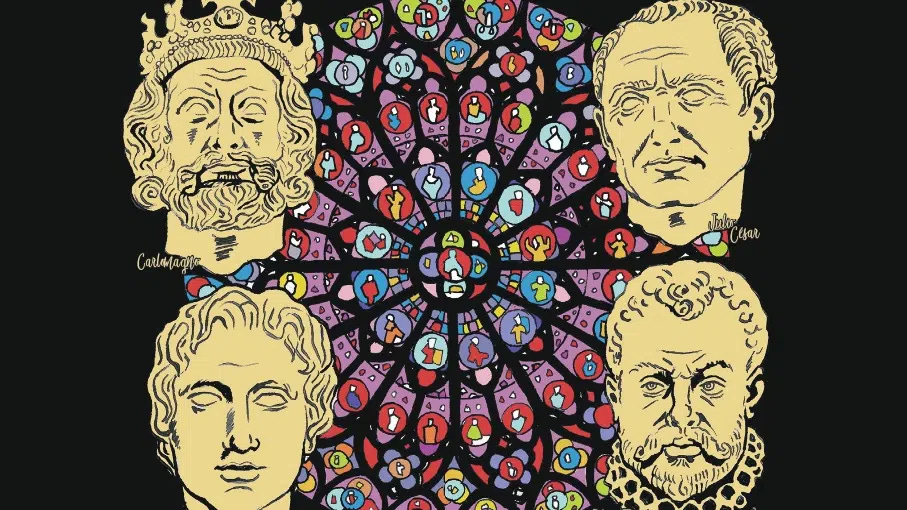
Secondly, we create new artistic pieces on timeless themes to be distributed at a symbolic price (see the postcards we have already produced for an example of this).
Additionally, we are considering dedicating ourselves to the publication of prints and graphics, as well as exploring other visual media. In any case, we are keen to support new artists and/or local European businesses. We have also decided to donate books on local and national heritage.
This is just the beginning of a more ambitious project that we will develop in the short and medium term without ruling out other possibilities.
In summary, if we aspire to transform the aesthetics of a nation or a continent, we must first implement this paradigm shift in our immediate surroundings, both militant and familiar.
Let us take advice from those who know best: beauty should be our goal and something to strive for.
“Nature as foundation, excellence as goal, beauty as horizon.”
— Dominique Venner, Samurai of the West
