


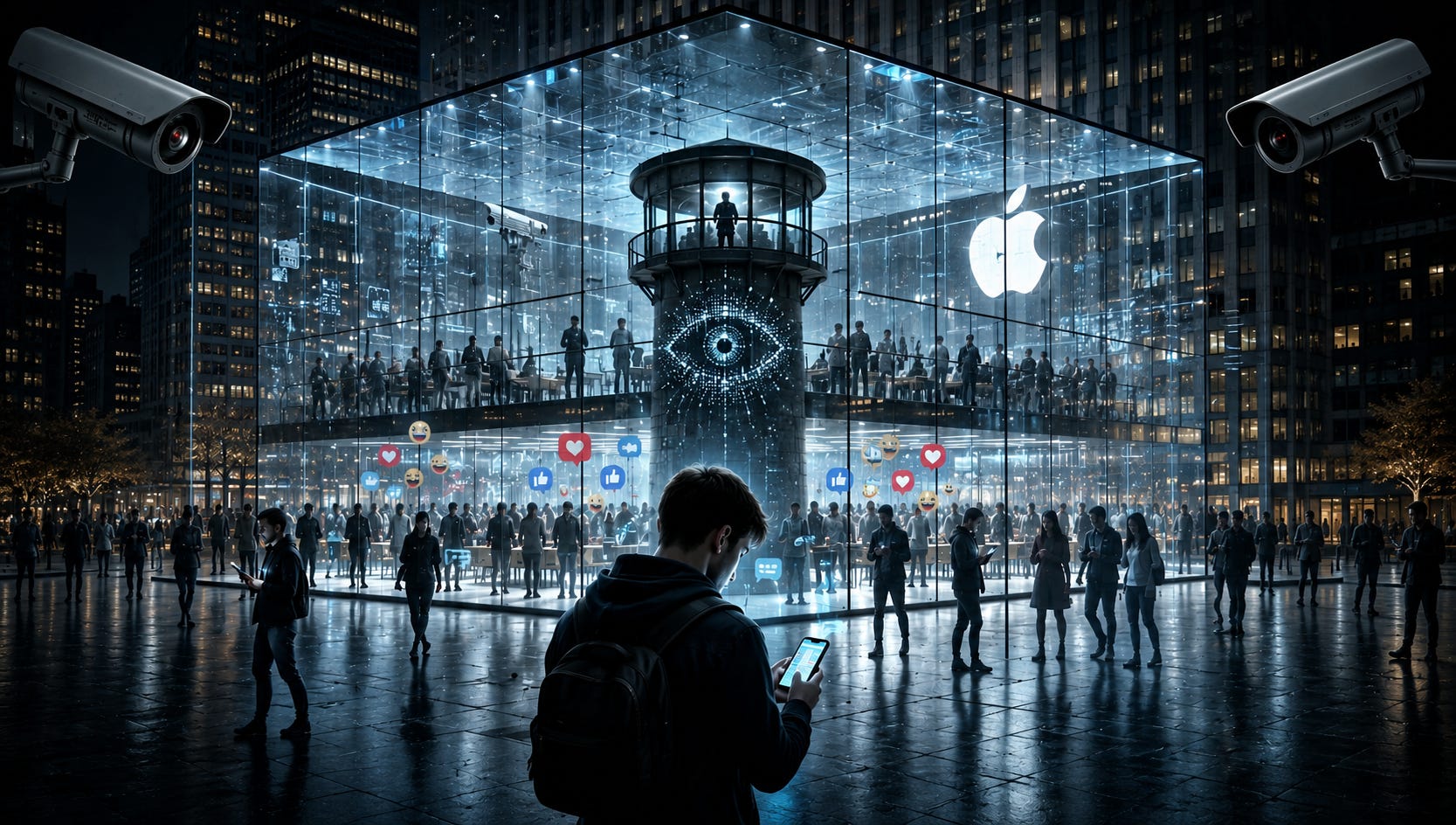
“The presently existing society is the only possible one, as it always has been and always will be” — this refrain, ceaselessly repeated by the society of the spectacle across all media and presented in various figures and ostensibly polyphonic ways, ultimately undermines theoretical critique and practical subversion at the level of the collective imagination. It persuades us of the non-existence of any “outside the cave” and, ultimately, of the cave itself, which confines us on a global scale.
In each of its performances, the spectacle aims to transform the cave, from which an exodus might be possible, either into an inescapable cage or into a place where the prisoners seeking liberation become passive admirers, oblivious to their chains.
This is the prevailing condition in the bleak age of Facebook, Twitter, and all the other postmodern egospheres — digital and strictly solitary variations on Plato’s cave.
This model appears to lead to the “perfect cave” of digital solitude in a technomorphic civilisation, where surveillance capitalism exploits pleasure-seeking servants on a daily basis through smart slavery. While the totalitarian systems of the “short century” oppressed freedom, surveillance neoliberalism exploits it and turns it into a profit-making enterprise, thereby presenting itself as the ultimate cool regime. The opposing Hegelian figures of the Servant and the Master converge to form the single figure of the homo neoliberalis, who, as an “entrepreneur of the self”, relentlessly exploits themselves to perform at the highest level. Each one, acting as Master, demands maximum productivity from their inner Servant, taking capitalist exploitation to its hyperbolic extreme.
Homo digitalis is increasingly assuming the guise of a subject of the fully technicised “cyber empire”, inhabited by vast numbers of internet-connected loners devoted to the posthuman language of emoticons in a society of likes. As a political system centred on the dyad of freedom and equality, socialism is reduced to the status of a mere individual activity on social media. Indeed, real socialism is being replaced by the “digital socialism” of social media and cyber platforms — the new smart prisons that trap individuals within the mechanisms of connected solitude and ceaseless value extraction.
The digitised, polished and seemingly free digital space is starting to resemble an immense smart concentration camp: a community that is anything but communal. Here, subjects are monitored and tracked, exploited yet content. They are deluded into believing that they are engaging in playful and entertaining experiences, when in reality they are labouring ceaselessly — and without any equivalent exchange — for the neoliberal order.
In this digital bubble, where connection supplants contact and social media loneliness replaces social interaction, users are alone and under surveillance. Almost every action generates profit for capital and is monitored and tracked in a panoptic way. The ludification made possible by emoticons and the whirlwind of likes conceals the fact that unsuspecting social media users, under the illusion of communicating and having fun, are working for capital without any equivalent exchange — and are therefore experiencing the most extreme form of exploitation.
Digitalisation and the infosphere contribute to the decline of the material world, thereby creating the paradox of a hyper-materialist society within an increasingly dematerialised order of things. They also promise exponential growth in freedom, which invariably turns into a regime of total surveillance: a smart prison whose invisible bars are made of the same material as the tracking and data-collection apps scattered across our technical devices. Consider the smartphone: “the mobile labour camp in which we voluntarily intern ourselves”, as defined by Byung-Chul Han. It de-realises the world, while simultaneously acting as a porthole onto reality that ceaselessly monitors its owner. This owner is controlled and happy to be so, voluntarily surrendering data and information on virtually every aspect of their life.
In the sub specie speleologica history of humanity, the latest cave – pending any that may come in the future – is made of glass. The new digital and smart prisons of our technomorphic civilisation are transparent and made of glass, much like Apple’s flagship store in New York. As described by Byung-Chul Han, it is a glass cube, a veritable temple of transparency which renders human beings — or rather, consumers — entirely transparent and viewable, eliminating every hidden corner and shadow. Everything must be seen and put on display. Moreover, individuals must desire nothing other than their own spectacularised display as a commodity.
The ideal slave of the glass cave, reduced to an identity-less silhouette, ceaselessly communicates and shares data and information, occupying every space with their presence and working at every moment for informational capitalism. This new “surveillance capitalism”, the realm of infocracy and “dataism”, not only exploits bodies and energy, but also information and data. Thanks to the total transparency of the new glass cave, access to information is used not only for psychopolitical surveillance and biopolitical control, but also to predict behaviour and generate profit.
Like Plato’s prisoners in the dark, the unsuspecting captives of the smart glass cave believe themselves to be free and creative in their constant performance and uninterrupted self-display in the shop windows of the virtual community. Inhabited solely by consumers, this community is nothing more than a commodified version of society. The more data these digital subjects generate, and the more actively they communicate their tastes, activities, passions and pursuits, the more efficient the surveillance becomes. Indeed, the smartphone itself appears as a smart prison — a surveillance and subjugation apparatus that does not repress freedom, but rather relentlessly exploits it in pursuit of control and profit.
Byung-Chul Han has written that the history of domination can be described as the domination of various screens. In Plato’s cave as he imagined it, we find the prototype of all screens: the archaic screen of the wall that projects shadows mistaken for reality. In Orwell’s 1984, we encounter a more advanced screen called a telescreen, which broadcasts propaganda ceaselessly and meticulously records everything that the subjects say and think in their homes.
The latest form of domination via screens seems to be realised through touchscreens on mobile phones. The smartphone has become the new medium of subjugation: an individualised, glass-walled cave in which people are no longer passive spectators, but active transmitters who produce and consume information without interruption. They are not forced to remain silent, but rather to speak and transmit incessantly, “selling” their stories and lives, their data and behavioural patterns to capital (storytelling is turned into storyselling). In short, communication is not prohibited as in the old caves, but promoted and encouraged on the condition that it always serves capital, its preservation and progress.
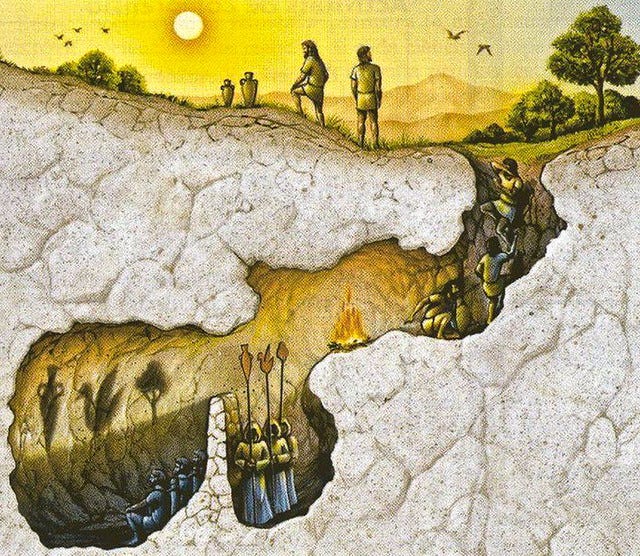
In the old caves, from Plato’s Republic to Bentham’s Panopticon, inmates were watched over and punished. In the new glass caves of the digital age, with their touchscreen walls, inmates are motivated and high-performing, encouraged to show off and communicate. Consider the postmodern paradigm of the smart home, for example, with its sophisticated devices zealously installed by the owner that transform the flat into a digital prison where every action and utterance is meticulously monitored and recorded.
In this way, control, surveillance and tracking are perceived and experienced as conveniences and expressions of the coolness of the technologised world rather than as tools of convenient, comfortable and polished captivity for homo globalis. The perfect cave is glass-walled, not only so that its lifelong prisoner can be observed at every moment and in every corner of their consciousness, but also because the walls are invisible, so one is not even aware of their existence to begin with.
On this basis, the narrative so beloved of proponents of neoliberal discourse, which invariably portrays East Germany and the Soviet Union as grey empires controlling “the lives of others”, as the title of a successful film on the subject puts it, should be re-examined. The aim is, of course, to contrast these totalitarian regimes with the neoliberal ideal of freedom as a commodity. While it is true that citizens in Berlin on the other side of the Wall or in Stalinist Moscow were indeed spied on and monitored ceaselessly, we do not know to what extent or in what ways they were spied on in West Germany or the USA by the CIA. After all, both survived the fall of the Wall and the USSR’s inglorious demise.
However, it is equally true that inhabitants of the boundless glass cave are spied on, tracked and monitored to an immeasurably greater degree, made possible by techno-scientific progress which, as should now be clear, coincides with humanity’s subjugation to the techno-capitalist apparatus. Compared to Alexa, the “voice assistant” and “smart speaker” of today’s smart homes, the Stasi of the GDR appears archaic and amateurish in every respect. Homo neoliberalis, a prisoner of yet another manifestation of necessary false consciousness, condemns surveillance in East Germany and the Moscow of actually existing socialism as oppressive, yet experiences the incredibly more radical and pervasive domination he endures daily as “convenience” and “progress” with foolish glee.
Thus, mutatis mutandis, we see a model that was originally explored by modern thinkers and has now been updated in a digitally enhanced form. The new concept of the perfect cave coincides with one in which prisoners are subject to total control, and, the decisive novelty in the age of techno-narcotised masses being that they are happy to be so and actively collaborate in their own imprisonment.
This paradigm was originally explored by Jeremy Bentham and embodied in his design for a high-security prison in 1791, the Panopticon, which isolates prisoners and exercises total control over them. Perfect surveillance, characteristic of the ideal fortress from which escape is impossible, is entrusted to a single guard hidden in the central tower. Surrounded by a circular structure housing the prisoners’ cells, which are illuminated from the outside and separated by thick walls, the mysterious warden can observe everything and everyone without being seen himself (this is alluded to by the combination of the Greek pan [πᾶν] and optikos [ὀπτικός]). The inmates never know whether they are being observed. The inmates are potentially under surveillance at all times, since they can never see the observer: the gaze is one-way, as the observer is not observed and the observed are not observers.
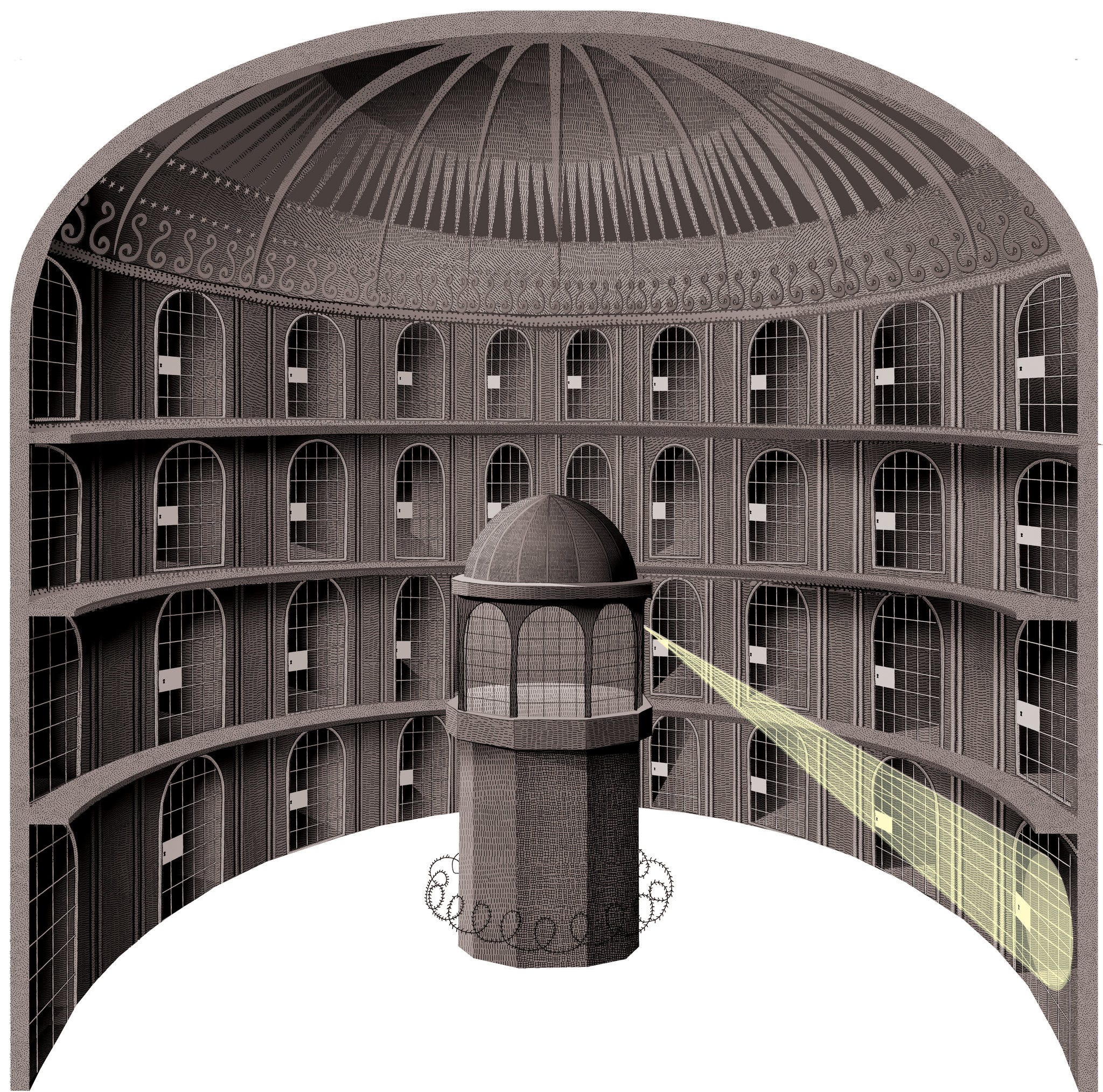
This asymmetrical relationship, in which the bond of domination and servitude is crystallised within the Benthamite “cave” – a concept analysed by Foucault in Discipline and Punish (1975) – means that prisoners must behave as if they are under constant surveillance, even if this is not the case in reality. The tower may be unmanned, for example, but the prisoners would still have to behave as if the guard were in his post, as they would not know otherwise. They would have to adopt disciplined and almost automatic behaviours as if they were under total surveillance. This paradigm, revived by Bentham, was first outlined by the Sophist Critias — one of the Thirty Tyrants — who argued that the invention of “all-seeing” gods promoted moral behaviour by making individuals feel as if they were always being observed from above.
In the age of the new technomorphic order, control is total and its problematic nature is generally not even perceived; on the contrary, it is sought after and desired by the techno-narcoticised subjects of this new age. According to Adorno’s theorem, the omnipotence and invisibility of repression are mutually interdependent. In the digital age’s glass panopticon, inmates are unaware of their confinement and reveal everything about themselves without respite. In none of the previous caverns of historical adventure have subjects so willingly registered their details and provided authorities with information about their lives.
READ MORE from Arktos:
