
The Italian philosopher Giorgio Agamben, born in 1942, was one of those thinkers to whom broadly speaking left-wing intellectuals readily referred in the early 2000s; whereas Emmanuel Levinas was associated with the period’s endlessly repeated concept of “the Other,” homo sacer was Agamben’s term. Both were, unsurprisingly, used to delegitimize opposition to immigration and national sovereignty, a lazy habit which always entailed the instrumental trivialization of thinkers who were valuable in certain respects.
Agamben was, and remains, a rewarding observer of history and society, not least through his interest in sovereignty and the dichotomy between zoe and bios. He is a continental philosopher; the influence of, among others, Dumézil, Heidegger, and Schmitt is obvious, and among his friends over the years we find names such as Debord, Pasolini, and Negri.

Although the pro-immigration left made use of Agamben and attempted to connect immigration to homo sacer, he has also at times come closer to both the genuine and the more populist right. His thoughts on Europe and the EU were an example of the former, his criticism of the handling of the pandemic an example of the latter. This was, not least, a logical consequence precisely of homo sacer, the human being reduced to the purely biological, as well as of Agamben’s interest in sovereignty and biopolitics. Agamben’s blog Una voce contains several worthwhile articles (the internet has several translation tools for those who do not speak Italian).
We recognize the gloomy, pessimist perspective from Adorno; it recurs frequently in Agamben, which should hardly be surprising. The world in which he grew up no longer exists—neither its culture, its demography, its nature, nor its morality—and he has explicitly written that we live “among the ruins.”
In The Failure of Humanity, Agamben compares our species to an insolvent debtor, unable to
“repay the debts it has successively incurred with regard to the earth on which it lives (including the atmosphere, which is no less polluted than the earth). The creditors’ committee would, in addition to representatives of all aspects of the earth and air, include living species that have disappeared or are threatened with extinction.”
This is humanity in “a state of complete spiritual collapse.” Further, Agamben describes
“the real problem with artificial intelligence as being that it was made possible by a general loss of the capacity for imagination, almost as if its emergence had been preceded by the establishment of an all-encompassing artificial imagination.”
He interprets Trump and Netanyahu through Christian, eschatological concepts, writing about them that “anomos, the lawless, is not an external principle, but the form that the institution itself assumes in its decline.” His pessimism about history is almost devastating: he speaks not only of the end of the West, but also of the end of Judaism through Zionism, the coming downfall of Ukraine and the EU, the disappearance of the Italian people, and the last days of humanity.
All of this is intellectually stimulating and at times brilliant, including the attempt to interpret the history of the West through Indo-European grammar, but the absence of a historical subject makes it all rather unedifying. In a certain sense, this suggests the limitations of continental philosophy.
Agamben and Imperium Europa
“…if Europe is to acquire an autonomous political reality, this will only be possible through the creation of a European empire similar to the Austro-Hungarian Empire or the Imperium described by Dante in De Monarchia.”
The historical subject that at times can be glimpsed in Agamben after all is Europe, though not in its present Eurocratic form. He does not hesitate to call Italy a protectorate: “
According to international law, a nation that has as many bases (some of them secret and equipped with atomic bombs) on its territory as the United States has in Italy does not have sovereignty over its foreign policy, but only over its domestic policy; that is, technically speaking, it is a protectorate.”
Agamben has wrestled with the question of European unity for a long time. In a text on Kojève and the Latin Empire, among other things, he wrote that
“a Europe that claims to exist exclusively on an economic basis and ignores real affinities in lifestyle, culture, and religion is today displaying all its fragility, particularly at the economic level.”
Although he lacks Evola’s crystal clarity, there is an edge directed against the American empire’s occupation of Europe. Agamben writes in this regard:
“the only appearance of unity is achieved when Europe acts as a vassal under the United States and participates in wars that in no way correspond to common interests, still less to the will of the people.”
Agamben and continental philosophy thus readily end up close to some form of European federalism, which also entails an affinity with the New Right:
“the idea of a European constituent power is the specter haunting Europe today, a specter that no one dares to invoke.”
READ MORE about Europe’s imperial potential — hot off the press from Arktos:

Agamben and the Pandemic
“It seems that, now that terrorism has exhausted its role as a cause of emergency measures, the emergence of an epidemic could offer the ideal pretext for extending them beyond all boundaries.”
Agamben’s thoughts on the pandemic clearly connect to his broader perspective; concepts such as the state of emergency, homo sacer, and biopolitics permeate his texts.
In the days of COVID-19, he also carried out a more explicit political intervention than usual. At the same time, he skillfully balanced between conspiracy theory and razor-sharp social analysis. Agamben wrote, among other things, concerning the lockdown of societies:
“it is difficult not to think that the situation they are creating is precisely what those who govern us have repeatedly tried to achieve: that universities and schools should finally be closed and teaching conducted exclusively online; that people should stop meeting and talking for political or cultural reasons and instead exchange only digital messages; that machines should, wherever possible, replace all contact—all contagion—between human beings.”
Thus, he interpreted social distancing through the lens of Canetti’s theory of the masses:
“what social distancing and panic have created is certainly a mass—but an inverted mass, so to speak, consisting of individuals who keep their distance from one another at all costs.”
The essay “Medicine as Religion” compared medicine to both Christianity and capitalism, while the vaccine was interpreted against the background of homo sacer.
Overall, Agamben is an interesting and rewarding thinker, hardly surprising given his use of thinkers such as Dumézil, Schmitt, and Heidegger. Attacking the consensus during the pandemic was not entirely without risk, but Agamben’s thoughts on geopolitics are also controversial in places. His pessimism is something best consumed in limited portions.
EXPLORE MORE Continental philosophy with Arktos:
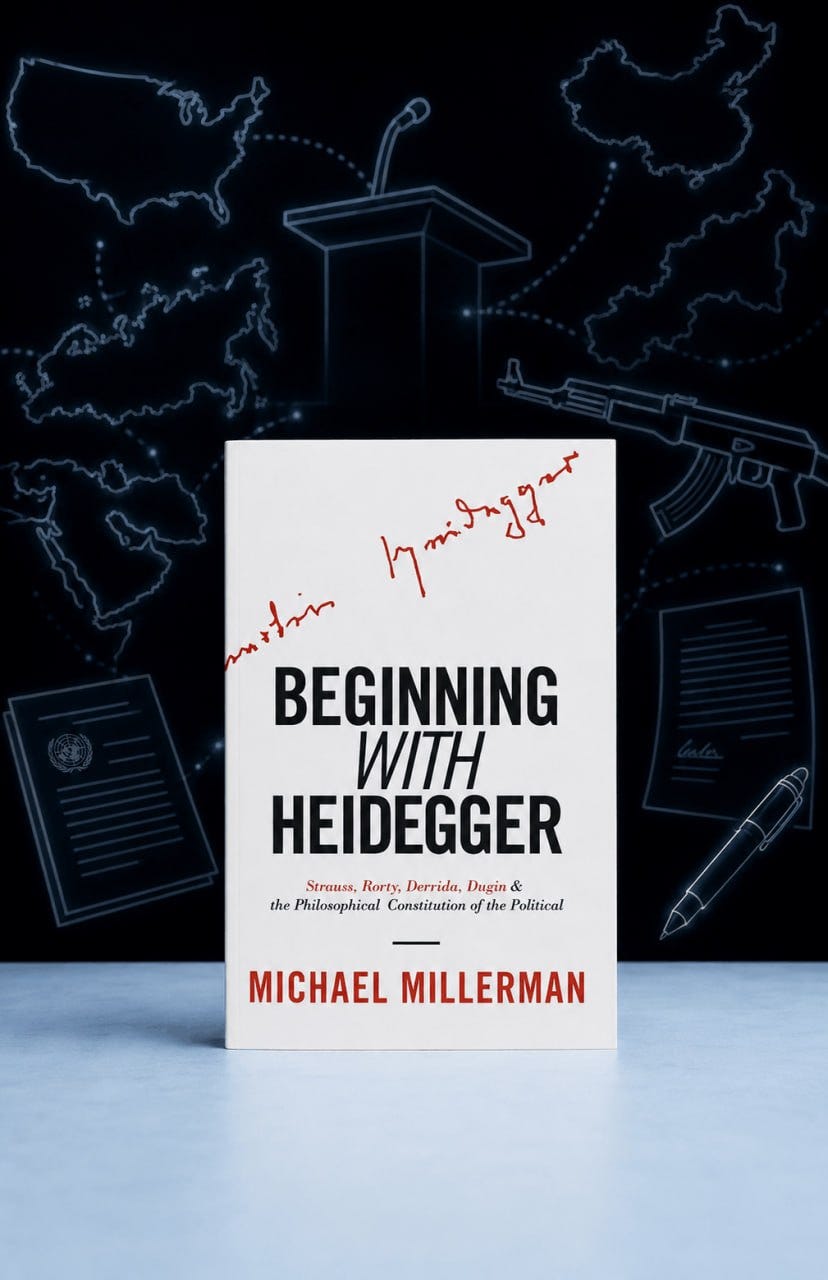
Michael Millerman’s Beginning with Heidegger: Strauss, Rorty, Derrida, Dugin and the Philosophical Constitution of the Political is essential reading.