


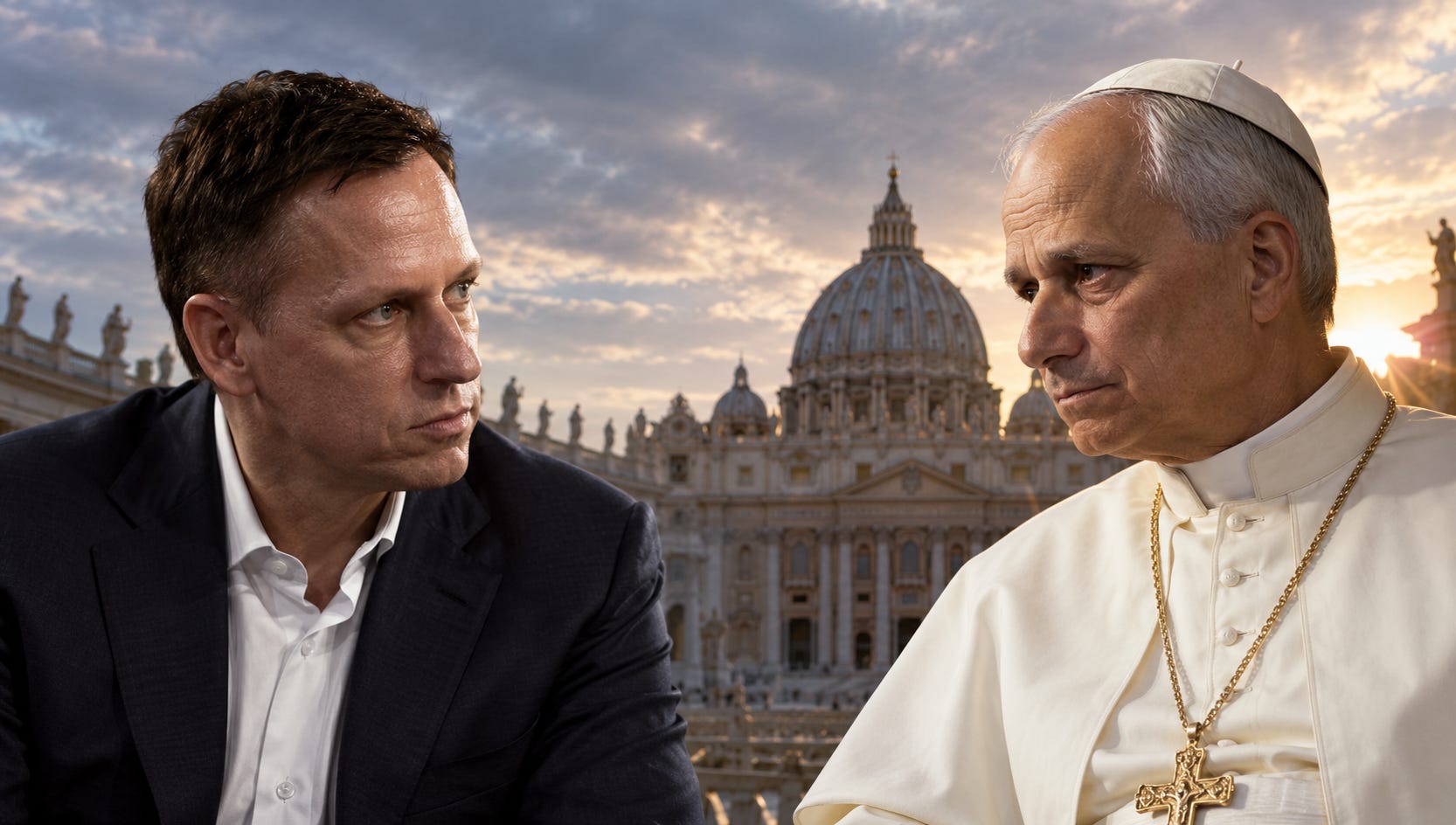
Two men hold the field on what technology is for, and they cannot both be right.
On 25 May, Pope Leo XIV, the first American pope, published his first encyclical, Magnifica humanitas, signed on the 135th anniversary of his namesake’s Rerum novarum. Technology, he insists, is neither hostile nor inherently evil, but it is ‘never neutral’ because it takes on the character of whoever devises, funds, regulates and uses it. The opening image is a fork in the road: a new Tower of Babel or St Augustine’s city where God and man dwell together.
Just this week, that tension has escalated: At the Élysée on Friday, the Pope reiterated that we avoid ‘losing our humanity amid a “paradise of machines”’; this comes the day after Peter Thiel called the Pope a useful idiot for the Chinese Communist Party.
Thiel, co-founder of PayPal and Palantir, early patron of J. D. Vance, student of René Girard and not a Catholic, has spent the past year telling rooms of very rich people that the men who want guardrails on AI are the unwitting infantry of the Antichrist, that is, his particular view of the Antichrist.
For me, this recalls Zoltan Istvan’s cringeworthy 2013 fantasy, The Transhumanist Wager, whose Randian entrepreneur triumphs over a villainous Reverend’s anti-tech, Christian coalition. One is tempted to imagine Thiel larping as the protagonist, but the impasse is very real, and I want to say where Thiel has gone wrong (and what most critics miss).
Thiel’s Growing Animus
The escalation is well-documented. Four off-the-record lectures at San Francisco’s Commonwealth Club in the autumn of 2025; leaked audio published by the Washington Post that October, seven hours of it reviewed by Reason; then a First Things essay with Sam Wolfe, a researcher at Thiel Capital, “Voyages to the End of the World”.
In the leaked lectures, Thiel called Leo XIV ‘the woke American pope’, named Greta Thunberg among the ‘legionnaires of the Antichrist’, said of his friend Vice President Vance ‘I don’t like his popeism’, and warned of a ‘Caesaro-Papist fusion’ of temporal and spiritual power welded into one.
He repeated the series in Rome in mid-March, invitation-only, venues shifting, no recordings. The Angelicum, where a young Robert Prevost wrote his canon law doctorate, publicly denied hosting it; Fr Paolo Benanti called the teaching a sustained act of heresy.
As a point of fact, Thiel’s July essay, “The Pope and the Antichrist”, is not actually about Leo. The pope of the title is Benedict XVI, whom Thiel admires warmly. Rather, the Antichrist candidate he floats is Hans Küng, dead since 2021, whose pan-religious Weltethos he sets beside Solovyov’s Antichrist and his slogan of ‘peace and safety’ (1 Thess. 5:3). Leo is not named once, suggesting Thiel is, oddly, a better reader of Ratzinger than most Catholics.
For a time, one could say that the insult was for the room and the theology for the record; however, that time has passed. At the Aspen Ideas Festival on 30 June, on an unrecorded panel, but before note-taking reporters, Thiel called Leo an inadvertent ‘Chinese communist agent...working for the Chinese Communists’. The audience laughed, but, on 24 September, collecting the Axel Springer Award in Berlin, Thiel sharpened it for Mathias Döpfner: Leo’s encyclical ‘was working for the Communist Party’ and ‘he was at least acting as a useful idiot for the CCP.’ He admitted that ‘maybe it was too harsh’, but then he said it anyway.
The Restrainer Inverted
Thiel’s own Rome invitation listed Carl Schmitt among the thinkers he would draw upon, which is where the scheme comes apart.
Schmitt is the modern theorist of the katechon, the restrainer of 2 Thessalonians 2:6–7, ‘he who now holds back’ the arrival of the Antichrist and the end times, which tradition read as the Roman Imperium and then Christendom itself, the order delaying the ‘man of lawlessness’. Take up Schmitt’s apparatus and you inherit his polarity: the restrainer is what stands between us and the collapse of Western civilisation.
Thiel inverts the doctrine. In his telling, the restraining institutions, whether treaties, regulators, the Church’s teaching office, any body that says not that, not yet, are not what holds the Antichrist back but, rather, his heralds. Stagnation becomes the eschatological threat, acceleration the deliverance. Catholic teaching says the opposite of course: the Antichrist is a man who rules in defiance of God while promising to resolve every global problem, establishing an order, artificial and mammonistic. He is not the brake but the accelerator who comes with a smile.
Notice what this does to the argument at hand. If the people drafting the EU’s AI Act are the Antichrist’s legionnaires, no version of AI regulation can be discussed in good faith. A dispute over model weights becomes a dispute over your soul; disagree about compliance thresholds and you are no longer mistaken, you are complicit. That is not theology, it is a moat running around Palantir, so named after Tolkien’s seeing-stones which showed their users true things yet ruined them all the same. Perhaps Thiel named it better than he realised.
The Man in the Middle
Thiel’s warning about a Caesaro-Papist fusion should not slide under the radar; after all, it appears he has spent a decade assembling his very own.
Current US Vice President Vance is not merely an ally; he heard Thiel lecture at Yale Law School, took a partnership at Thiel’s Mithril Capital, and credits him with an introduction to René Girard and with the discovery that Christians could be thinking people. (Note, however, Girard’s mimetic theory has done real damage to Catholic theology, recasting the Cross as an unmasking of scapegoating, rather than a true sacrifice, and supplying, incidentally, the victim-centred moralism Thiel elsewhere denounces as woke). Vance was received into the Church in August 2019, at a Dominican priory in Cincinnati, and wrote it up the following Easter in The Lamp. Thiel then spent some $15 million, the largest sum ever given to a single Senate candidate, putting him in the Senate.
So, the man who led Vance to Rome and now tells audiences, ‘I don’t like his popeism’, frets that his protégé may grow ‘too close to the pope’ and says of reported frictions between the two, ‘I hope there are a lot more.’ Vance, for his part, told the Paris AI summit that excessive regulation could kill the industry, just a couple of weeks after he conveniently attacked the USCCB over their excessive funding for the resettlement of migrants. If one were cynical, one could speculate that Vance is framed as Thiel’s foil to buff his bona fides but is, in fact, intended to shield the presidential office from papal counsel. It wouldn’t be the first time this administration and Thiel have tag teamed the Pope (wittingly or unwittingly).
Note the timing of the attacks against Leo, on the heels of Thiel’s closed-door meetings in Rome. Eastertide, in his first Urbi et Orbi on 5 April, Leo asked that ‘those who have the power to unleash wars choose peace’. On Easter Tuesday, Trump warned that ‘a whole civilization will die tonight’ if Iran missed the deadline over the Strait of Hormuz. Leo called the threat against an entire people ‘truly unacceptable’, observed that attacks on civilian infrastructure violate international law and asked Americans to tell their representatives to reject war; hours later, Trump announced a two-week delay. Then, on Divine Mercy Sunday, when the Pope spent the morning praying the Regina Coeli in St. Peter’s Square, Trump pronounced him ‘weak on Nuclear Weapons’, adding ‘I don’t want a Pope who thinks it’s OK for Iran to have a Nuclear Weapon.’ PolitiFact rated it “Pants on Fire,” Leo having called for disarmament throughout.
So, Thiel supplies the theological “woke pope, useful idiot for commies” frame and Trump comes in with the political smear. Between them, a pope who opposed a war becomes soft on Iran, neutralising Catholic moral authority at precisely the moment it might have carried weight. Neither needed to coordinate with the other. Both drew on the same deep reservoir of Protestant and TradCath suspicion of Rome for which there is precedent; for example, Justice Department files released in February show Bannon telling Jeffrey Epstein in June 2019 that he would ‘take down’ Pope Francis, Epstein sharing an article titled “Pope Francis or Steve Bannon? Catholics must choose’”. So clear was the politicised anti-Francis drive that Cardinal Burke cut ties with Bannon’s Italian academy rather than join the project.
Most inconspicuously, however, J.D. stands between the Pope and Thiel, just trying to be a Catholic whilst also protecting America and her allies. What a convenient setup for 2028.
I do not allege a plot. I observe an arrangement, precisely the one Thiel says he dreads, which is a spiritual disposition married to a temporal office. He fears the very fusion he is attempting, blinded by pride, pride in the supposed superiority of his own foresight and doctrine.
In Pope Leo’s Defence
The woke and leftie charges rest mostly on migration, where TradCaths and right-wing figures like Keith Woods have led the fire. It does not survive reading him for oneself. Leo has plainly reaffirmed the Catholic social teaching that ‘a state has a right to set rules at its borders’ and has rejected the charge of open borders; what he adds is the doctrine’s other half, the right to remain, which is the now-standard papal position of placing the burden primarily on countries of origin for not creating the conditions for migrants to remain (the international community having duties also).
Catholics can criticise liberalised Catholic bodies that profit from mass immigration; they can also criticise the wars we underwrite as manufacturing the migrants we then complain about; they can discern the potentially ulterior motives of many migrants and the legitimacy of their refugee status; they might also be genuinely ignorant of such things in boomerish bliss. Catholic social teaching remains.
All in all, Pope Leo XIV is to the right of both Trump and Thiel, opposing abortion, euthanasia, the death penalty and gender ideology in schools. Thiel is a married gay man who funds life-extension ventures and, asked by Ross Douthat whether the human race should survive, produced what Douthat had to call ‘a long hesitation’. Trump declines a federal abortion limit and campaigns on expanding IVF. The charge of leftism is not a finding but a tactic, intended to make moral opposition to an ongoing war look like partisanship. The same goes for Catholic opposition to libertarian accelerationism for Big and Little Tech.
A People or a Mass
Which brings me to the elite question, on which I would rather quote Pius XII than argue. In his 1944 Christmas message, Pius drew the distinction our age has forgotten. A people lives by its own energy, each man in it conscious of his responsibility and his own mind. A mass is inert, moved only from outside, an easy plaything for whoever knows how to work its instincts, and is therefore, he says, the capital enemy of true liberty. The difference is not numbers but whether men are persons or economic units, subjects or inputs.
A people, Pius went on, requires an elite: select men, ‘spiritually eminent and of strong character’, who take themselves for representatives of the whole and not the mandatories of a mob. His warning to us is, where such men are lacking, others arrive to take their place, making politics serve their ambition and a quick road to profit for themselves, their transnational caste and their class. Plinio Corrêa de Oliveira later extended this to countries without formal nobility, analogous elites who we must nevertheless hold to the same standard.
We have such elites, men like Thiel. The most powerful in history, but not apparently spiritually eminent; they are, on their own account, betting on stagnation as the only real sin. But, an order that treats men as interchangeable units to be optimised, displaced and eventually surpassed does not produce a people; it produces exactly the mass Pius described, complaining that the mass is decadent yet profiting from that decadence just the same.
Which is what makes the Berlin insult so revealing. It is the people degenerated into a manipulable mass who are the useful idiots; the mass is inert of itself but plastic for anyone who exploits its whims. Thiel reached for that vocabulary to describe the one man here acting from his own conscience against an administration that has spent the past year attacking him for it. At UNESCO, Leo named the spiritual disease of the Western masses: lives are now ‘judged according to the criterion of efficiency and, when deemed no longer productive, are rejected and discarded.’ Ask instead who is moved by outside forces and the honest answer is the room that laughed in Aspen.
The City of God and the City of Man
Several years ago, I argued we had reached an axial hour. Two systems are on offer and we will be consumed by one: the soulless beast system, Ellul’s technique run to its conclusion, where technocratic forces feed souls to an endless growth until catabolic collapse; or the truly corporate Body of Christ, where elite incentives and technological purposes are harmonised toward the common good.
Peter Thiel and Pope Leo XIV are just the visible elites representing, not just rival visions of the Antichrist, but these two politically ambitious systems. I predict this flashpoint is only going to intensify.
Solovyov’s story, which Thiel quotes at length, ends with Elder John asking the Antichrist one question: What do you believe about Christ? He cannot answer and so the silence unmasks him. Ask the accelerationists the equivalent, not will you succeed, but what is success or even what is a man for, and listen for the pause.
With the fork in the road before us, we must choose our leaders wisely; their language could not be clearer that the choice we make could spell the very end.
The deciding factor is this: in pursuing survival, elites like Thiel act under a spirit of fear, whereas Catholics are filled with a spirit of hope. Believing Christ rose, and that God intends to redeem the whole world, does not stop us seeking a better future; it is the only thing that makes the project intelligible. Far from apathy, the task of building God’s kingdom is as daily as our daily bread and, yes, that involves putting excellence before efficiency.
READ MORE by Richard Storey, brought to you by Arktos:

"...The Antichrist is to appear as one whom we may call, according to the language of the Hindu tradition, "Chakravarti inside out."" — René Guénon
The Antichrist is AI, and Thiel is its willful advocate