The Overton window is currently shifting in a process of historical significance. Foucault once defined the order of discourse as both what may be said and who is permitted to say it, and both of these aspects are now changing rapidly. The negative consequences of immigration policy are no longer taboo, the concept of remigration is spreading, and voices that were demonized and silenced are now being interviewed and heard.
At the same time, this is a complex and contradictory process. Concepts and perspectives from the New Right or the Dissident Right are being adopted by parts of the liberal and conservative right, sometimes—but not always—without “crediting the sources,” while the old taboos remain in parts of the left and the established public sphere. Those who were demonized 10 years ago sometimes remain demonized even though what was then taboo to say has now become acceptable.
Tucker Carlson is interesting in this context. Carlson became extremely popular during his time at Fox News, but his populism and criticism of BLM, mass immigration, and military interventionism appear to have ultimately been too much for the network’s owners. He has instead gone independent and today has his own show on X, formerly Twitter. Tucker has a large audience and has, among others, interviewed Putin and Nicholas Fuentes, the latter long a definitive persona non grata—someone one talks about, but not with.
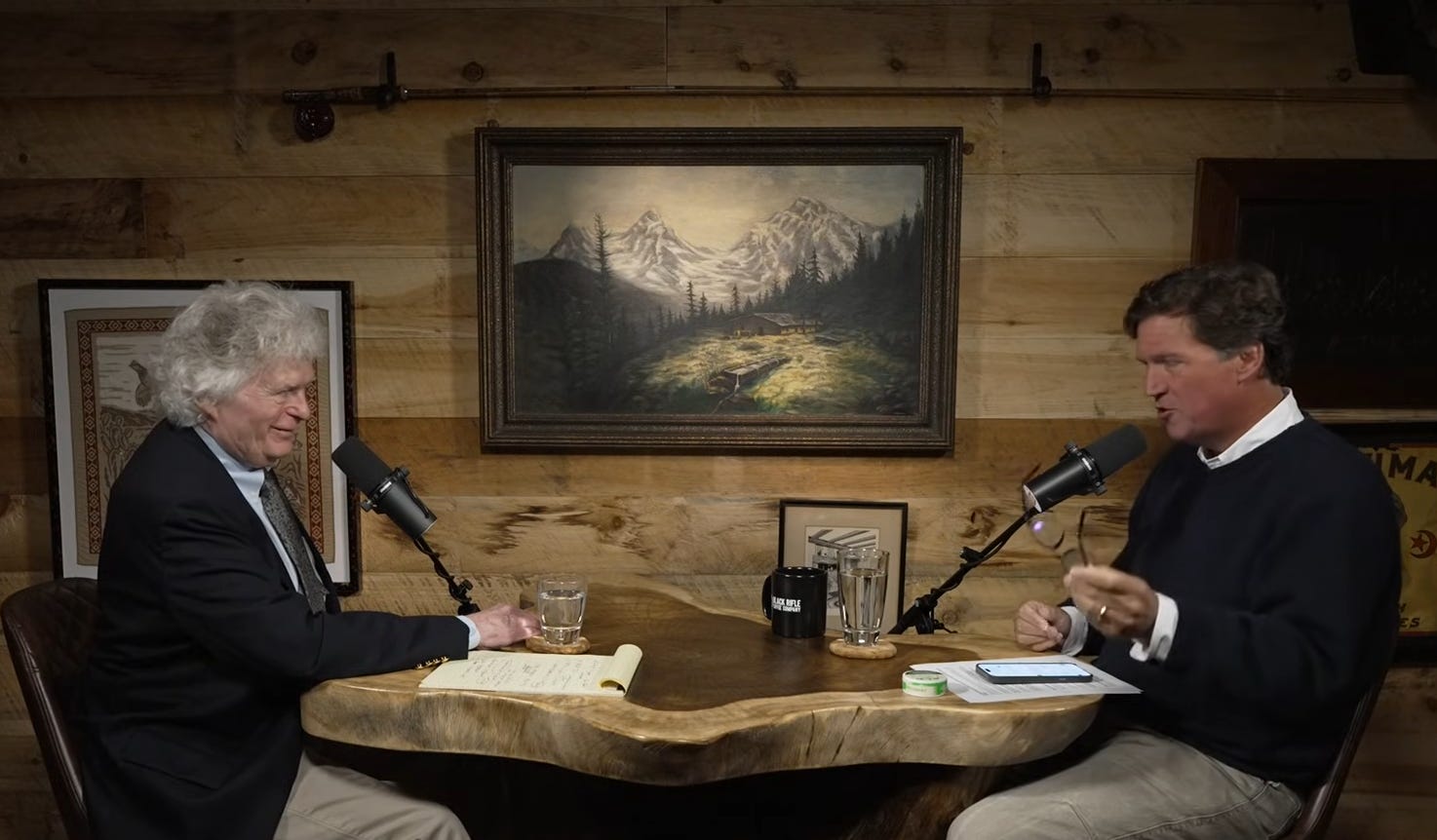
Carlson’s most recent interview with Peter Brimelow is also relevant in this context. Brimelow has a long background as a conservative writer; in 1999, he founded VDARE. VDARE was a valuable resource for critics of immigration, with well-written, knowledgeable, and useful articles (a quick search shows that I’ve linked to VDARE 17 times over the years, including to articles about South Africa and Mayer Schiller). Prominent writers such as Steve Sailer contributed, and in several respects VDARE served as a bridge between immigration criticism/populism and parts of the establishment/managerial class. This was not least due to Brimelow’s background and network of contacts.
To bring the project down, what is known as “lawfare” was initiated—lawsuits and protracted, costly legal proceedings—which led Brimelow to shut down VDARE in 2024. The split between the “conservative” establishment that James Kirkpatrick has termed Conservatism Inc., and immigration critics was then complete, and Brimelow became persona non grata in established circles. He was labeled a “white supremacist,” and support from establishment conservatives was fairly limited. It is not least against this background that the interview with Tucker Carlson becomes interesting.
The interview is thus more interesting as a phenomenon than for its content. That said, the content is not uninteresting. Brimelow describes, among other things, how on the one hand issues he and VDARE have raised for nearly three decades are now being taken up by Elon Musk and others, while on the other hand he and VDARE have been crushed: “the things that we were talking about 25 years ago on vdare.com, which was my website, like birthright citizenship and so on, are now in the public debate.” Friends of Paul Gottfried, among others, will recognize the depiction of how William Buckley purged immigration critics and paleoconservatives from the “conservative” movement in favor of neoconservatives.
Also interesting are Brimelow’s and Carlson’s reflections on the factors behind mass immigration and anti-white policy, where Brimelow’s theory is that it is primarily driven by emotions (“I think a lot of it is deeply emotional and can’t be analyzed intellectually. There’s just a whole series of reflexes or spiritual”). The interested reader may compare similar explanations from Nietzsche, D. H. Lawrence, and Guillaume Faye. There are actors with real-political and economic interests in mass immigration and anti-white practice, but for many of those driving it, it is not actually rational. In their conversation, Tucker and Peter also address the Jewish element in immigration policy, where, among other things, the neoconservatives were afraid of a self-aware white majority. The result of the immigration policy pursued has instead been increased, imported antisemitism. Brimelow notes that he is not antisemitic; on the contrary, VDARE had several Jewish donors and writers.
Arktos Journal survives because readers choose to sustain it. This enables us taking risks on new authors, translating neglected thinkers, and publishing work that would never make it to you through institutional or commercial frameworks.
We publish work rooted in archaic values, civilizational memory, and long-form thought, and have been doing so since 2009.
The editors do this work pro bono, driven by conviction rather than careerism. If you value independent intellectual production that is willing to publish what others will not, support this project and make its continuation possible.
The discussions of “lawfare” and the radicalization of the judiciary are also rewarding. Brimelow relates that “over a period of about 25 years, we built up into quite a force until about two years ago, it was destroyed by the New York Attorney General, Letitia James, who just basically subpoenaed us to death and has in fact now sued us personally, as in the foundation, through the foundation.” The connections between James and the ADL are discussed, as well as how, at an ADL conference, it was explicitly described how one can “get around” freedom of speech in order to crush dissenters like VDARE.
“The wonderful thing that has happened within the last year is that a very enterprising journalist actually dug up a speech made to the ADL. They had a conference called ‘Taking Hate to Court’ by Rick Sawyer, who is one of Letitia James’ operatives, and he is the one who’s leading the charge against us.
And he said to this conference that hate speech — that’s us — is protected by the First Amendment, but there are ways around that. All you have to do, if it’s a charity and you have jurisdiction, is subpoenas. He said it sucks to be sued. Just subpoena him to death.”
This means, among other things, that right-wing governments can expect resistance from judges in several countries, not least the United States. Brimelow comments on this with the words: “in many respects, you know, we’re looking at slow motion civil war here. I mean, New York essentially seceded, Minnesota essentially seceded from the union. The whole legal systems are opposed to what the federal government is doing.” Carlson observes that when Trump takes this on, he will be accused of destroying the judiciary, but that it has already been destroyed (“Trump will be attacked as destroying the third branch of government. But it’s been completely destroyed long before Trump”).
Alain de Benoist examines recent judicial interventions in electoral processes across multiple countries, arguing that such judicial actions represent a fundamental assault on popular sovereignty, where unelected judges effectively decide who citizens can vote for. The problem, de Benoist contends, is the concept of the “rule of law”, a liberal ideologi…
Brimelow describes Trump as a political miracle, given his immigration policy, even if it leaves something to be desired in other respects; he also predicts that Stephen Miller will become the United States’ first Jewish president. The conversation between Carlson and Brimelow is also interesting in that it shows how much is happening outside the Trump administration—something that is positive when Trump shows hesitant tendencies and, moreover, is approaching 80.
All in all, it is an interesting interview. Tucker confirms that population replacement is a reality rather than a “theory”:
“It’s the biggest fact of this or any generation in a thousand years. The replacement is real.”
Brimelow brings up the contradiction between capitalists’ short-term interest in mass immigration and capitalism’s long-term incompatibility with the society it leads to. Among other things, he mentions an interview he did with Milton Friedman about the cultural prerequisites of capitalism: “he said capitalism has really only ever worked in English-speaking countries. I don’t know why this is so. But the fact has to be admitted that there’s some kind of a cultural underpinning for capitalism. What economists call a meta-market, a framework.” We are also offered glimpses into American media and politics, with descriptions of media moguls such as Rupert Murdoch and various figures like Laura Loomer, Ben Shapiro, and Yoram Hazony.
“The connections between James and the ADL are discussed, as well as how, at an ADL conference, it was explicitly described how one can “get around” freedom of speech in order to crush dissenters like VDARE.”





Parrhesia!
“The connections between James and the ADL are discussed, as well as how, at an ADL conference, it was explicitly described how one can “get around” freedom of speech in order to crush dissenters like VDARE.”
https://www.givesendgo.com/brimelow