


In this interview with Écrits de Rome, Romain Petitjean of the Institut Iliade discusses the relationship between the European New Right, paganism, and Christianity today.
Écrits de Rome: First of all, you declare yourself a “pagan.” Could you go back over the meaning of such a term, which may seem obscure to some of our readers? Is it a matter of fidelity to certain family traditions, or the outcome of a personal journey?
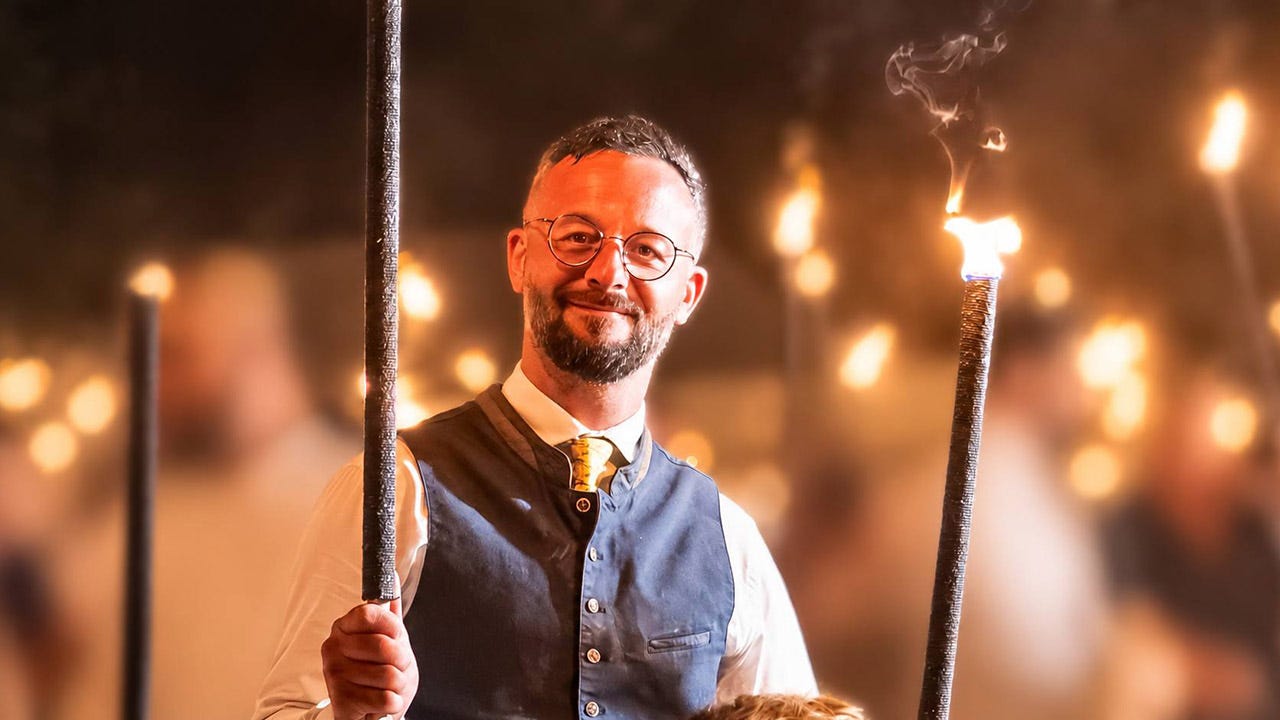
Romain Petitjean: It is a way of being in the world: rooted, pluralist, active, and intrinsically bound to a people and a land. It is not a doctrine or a dogma. It is a spirituality in which fidelity, meaning loyalty to one’s ancestors, to one’s land, and to one’s people is paramount.
It is rather difficult to speak about paganism because we are so dependent on categories imposed by Christianity. Notions such as revelation, orthodoxy, heresy, holy scripture, dogma, and conversion are proper to Christianity and foreign to paganism. The greatest difficulty is that Christianity regards religion as a matter of faith, of inner conviction. Paganism, by contrast, is above all an orthopraxy, a practice. A gesture, a word, or an action in keeping with the order of the world is often enough; the rightness of acts matters more than the correctness of beliefs. The urbanization of our lives and the lack of places of worship of our own somewhat hinder this daily practice. Even so, at the solstices, the seasonal festivals, and family rites, I perform the gestures and speak the words that seem right to me.
That said, if one had to define paganism, I would say it is above all a religion, a spirituality, of the here and now, in which the divine is emanated through the world rather than standing outside it. What counts is the immanence of the sacred more than some hypothetical transcendence or a consoling hereafter. In fact, it is a matter of confronting the reality of the world, facing destiny, and saying “yes” to life. Pindar told us: “O my soul, do not aspire to immortal life, but exhaust the field of the possible.” It is action and the sensory gaze that allow us to give form to the world and to reveal the divine. I love this line of Ernst Jünger’s:
“When the world seems to be tottering on its foundations, a glance at a flower can restore order.”
This is the same world that structures Greek philosophy and justifies the image of the gods.
Moreover, there is a contrast with the linear and eschatological vision which belongs to Christianity and also to the desacralized modern West. For a pagan, life is cyclical: time turns, and everything returns eternally to the source.
“The beginning and the end are one and the same, and where you stand is the hinge of the ages.” — Hugo von Hofmannsthal
Finally, the pagan vision is fundamentally plural and non-universalist: there are as many paganisms as there are lands and peoples. Each paganism, with its own pantheon, is born of the unique and “magical” union between a people and its land. They are not interchangeable, and attempts to compare them with the universalisms of revealed truth often fall flat.
EdR: It must be acknowledged, as a Catholic, that the Church of the twenty-first century is not always very attractive to anyone who cares even a little about the destiny of Europe. The clergy seem scarcely interested in that destiny. A Catholic author such as Laurent Dandrieu even gave one of his recent books this eloquent subtitle: Le pape et le suicide de la civilisation européenne (The Pope and the Suicide of European Civilization). We are indeed a long way from a St. Pius V calling for a halt to Ottoman expansion… How do you view the Church today?
RP: I know little of its inner workings. I note that the number of practicing faithful keeps collapsing (only 5% of adults attend Mass at least once a month), and so does the number of priests. At the same time, there is a certain revival among the trads. On the countrywide scale, however, this remains marginal. As a political institution, the Church carries less and less weight and is becoming above all symbolic, like the King of England. Even so, the Pope’s encyclical on artificial intelligence did manage to show a thoroughly European sense of measure in the face of the prevailing hysteria.
Within the Church, moreover, the clashes are many, in keeping with the history of this ancient institution.
As a pagan, I observe that the Christian Church is endlessly torn between two pulls. One is a return to the biblical sources of the texts. The other is the decisive European contribution, brought about notably through medieval syncretism (the Marian cult, the cult of the saints, and so on), which allowed Christianity to reveal its genius.
But Christianity largely drove out the gods; that is Nietzsche’s well-known critique. It created such a distance between a single God, Alpha and Omega, and His creatures that the creatures forgot God. Driven out of the world and confined to the private conscience of believers, the Christian religion is in difficulty. All the more so because a great many Christian virtues have seeped into society, which has largely become a dechristianized society (the egalitarian utopia, the monotheism of values, and so on), and this mechanically weakens the original vehicle. And Christians today face the emergence of new churches imposed by the market and consumer society. The high masses of Apple product launches are the best-known and most caricatural example.
Logically, and in keeping with its universal vocation, the institutional Church of the twenty-first century has largely ceased to think of itself as the guardian of a particular civilization. It now speaks the language of abstract humanity and of undifferentiated welcome. Its universalism no longer distinguishes between peoples, lands, and heritages. We are indeed a long way from Pius V, from Lepanto, or even from the Christendom that for centuries gave form to Europe. This does not mean that Christianity is foreign to our destiny. The European soul expressed itself through it: in the cathedrals, in chivalry, in the cult of the saints, and in Marian devotion. All of this is a pagan and Roman sedimentation that the Church of former times knew how to embrace.
It was this Europe that magnified Christianity, and not the reverse. The present institution is turning away from this synthesis to return to a disembodied, globalized Abrahamism. In doing so, it betrays both Europe and what was highest in its own tradition. That is why many young Europeans today find in Christianity a form of identitarian assertion. This assertion not only dispenses with obedience to the Church’s official authorities. Even more significantly, faith does not necessarily occupy a central place in it.
To sum up, today’s Church is not “unattractive” by accident. It has chosen to stop being the religious expression of a well-defined civilization and to become the instrument of a proselytism without borders.
Europeans who still care about their destiny need not wait for the Church to produce a new Pius V. It is up to them to reconquer for themselves the sense of the sacred, of transmission, and of continuity. With or without it.
EdR: You are the coordinator of the Institut Iliade. It has never concealed its closeness to the ideas of the New Right, yet it welcomes a not insignificant number of Catholics. That may surprise Catholics as much as pagans of the older generations. Why such openness on the part of your institute?
RP: The Institut Iliade counts Catholic comrades among its cadres. It stands at the crossroads of several ideological and political schools, but the legacy of the New Right (Nouvelle Droite) is clearly preponderant. Indeed, we have just published a history of the New Right with Éditions de la Nouvelle Librairie1. Beyond paganism properly speaking, all of our themes fit together and are consistent with a pagan worldview:
Europe as a civilization
political realism and geopolitics
the importance of the sacred
the critique of philosophical liberalism
the struggle against the monotheism of values
the defense of identity
Now, many Catholics share several of these themes, so collaboration becomes natural. Others, obviously, such as ethno-differentialist advocacy, they share less.
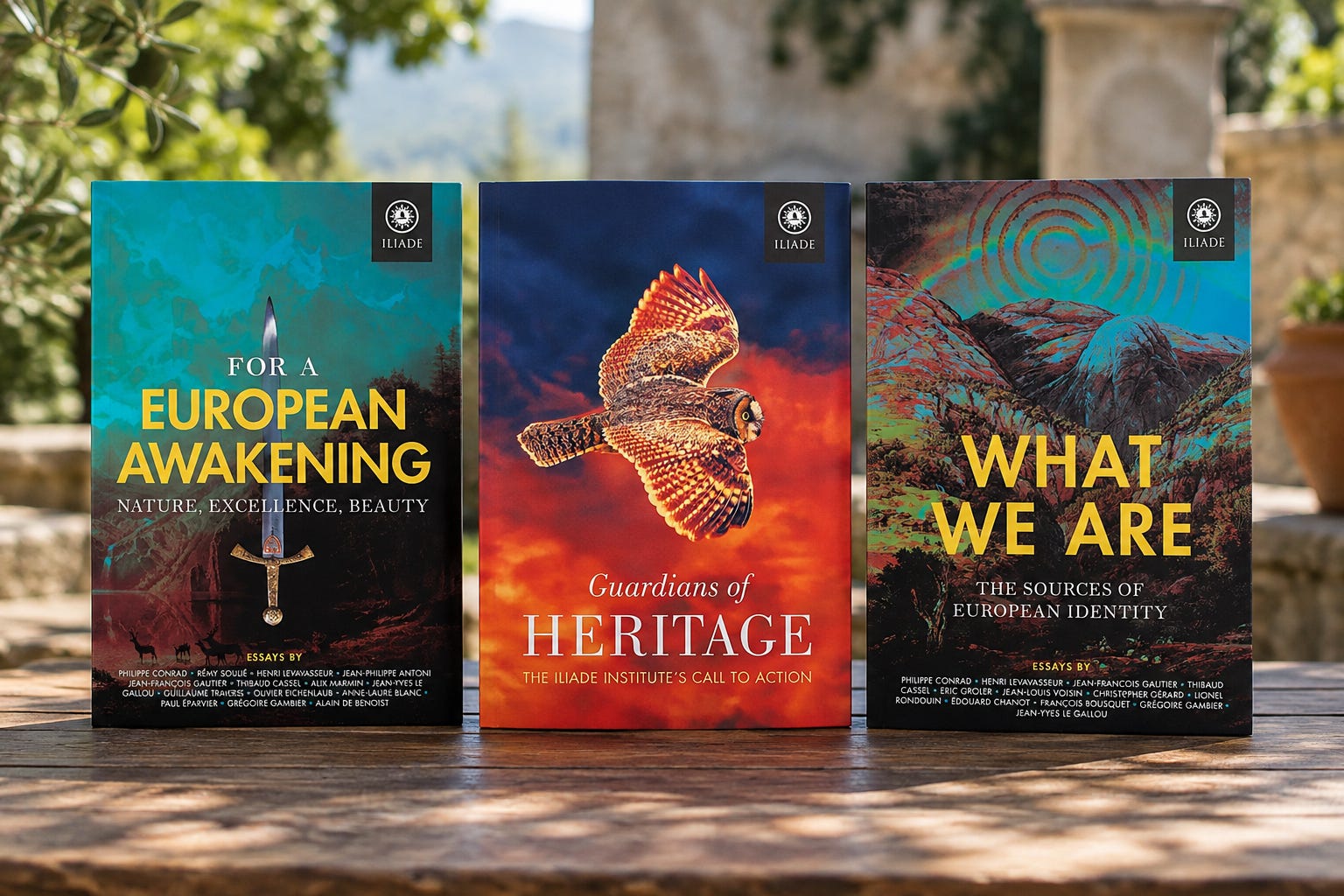
This program and our ideological positions are known to all. You can find them notably in our Manifesto (Guardians of Heritage), or in our collective books What We Are and For a European Awakening.
On this basis, Catholics apply to our training programs knowing exactly what they are getting into, and so do Protestants, atheists, and Orthodox. They are strongly drawn to this corpus and, it must be said, guided by an intelligence and an intellectual curiosity that otherwise tend to be disappearing.
So we are open, for two reasons. On the one hand, pagans are known for their tolerance, which is partly the cause of their weakness. On the other, openness is the very principle of training. To train only people who are already convinced is to condemn oneself to staying in a phone booth.
That said, it is not our purpose at the Institut Iliade to settle a theological score. We simply observe that the fight for the permanence of the European peoples today brings together several groups:
identitarian Catholics
traditionalists
beyond them, all those who, like us, remain faithful to a spirituality rooted in the old European tradition and share a common collective history and memory
For now, the divide is not so much between Christians and pagans as between those who accept the demographic and cultural suicide of Europe and those who refuse it. Catholics who sincerely wish to wage this fight often do so intelligently. That presupposes self-criticism, since the Church bears its share of responsibility for the collapse of our world, as Laurent Dandrieu reminds us.
EdR: Within Catholicism, the traditionalist current (not the integrist one) has embraced a number of “identitarian” themes. How do you view this current? Does the Tridentine liturgy, with its Latin, its Gregorian or polyphonic chant, and its verticality, speak to you, even if you do not share the faith that animates it?
RP: Yes, I have understood that this aspiration exists, though it may seem contradictory at first sight. How can one legitimately defend a specific land if we all end up in paradise afterward? And how can one defend a specific people if we are all brothers in Christ beyond borders? I am caricaturing. But this debate agitates Catholics first and foremost and creates many dissensions among them, which clearly shows that being Christian and identitarian is far from natural.
As for the liturgy, I have attended very beautiful Orthodox ceremonies in Romania. And it is true that the traditionalist Catholic liturgy is magnificent; one would need a heart of stone not to be moved by the beauty of the chant, the decorum, and so on. Personally, I regularly enter Christian places of worship, which my ancestors built on ancient pagan sites of worship, without any problem and with pleasure. That said, the pleasure generally ends when I hear the parish priest telling home-grown Gauls Oriental stories whose place names and spirit are utterly foreign to us. No doubt Latin, incomprehensible to ordinary mortals, makes it possible to avoid such ruptures by offering the faithful an encounter with God through grandeur and mystery.
But fundamentally, one must be able to distinguish what derives from the Book from what emanates from Tradition, which is sometimes very far removed from the biblical verses.
And to strike a positive and syncretic note, I like to recall that polyphony was born on the site of Notre-Dame de Paris. Several voices, each singular and each bearing its own complex universe, manage to sound together while being opposed, even contradictory. They do not merge into one single voice. They form a harmony in which the “general voice,” if I may say so, makes itself heard without extinguishing the voices that compose it.
Let us not forget the Council of Trent, which fixed the Catholic liturgy until Vatican II. It initially wanted to proscribe Renaissance polyphony in favor of a return to Gregorian monody, because polyphony risked rendering the text unintelligible: the one Word, the sole truth, should be carried by a single voice. This regression was prevented by the prelates of the day. They were steeped in the humanism of their century, and for them theology did not erase the teaching of the Ancients. We owe them our thanks.
In music as in philosophy, there is nothing more pagan than polyphony.
EdR: It must be admitted that the ultimate aims of pagans and Christians are not the same, including on the political plane. Pagans intend above all to defend certain “natural laws” relating to family and homeland (to borrow Dominique Venner’s words). Catholics respect these natural laws in principle, but they ultimately aim at the establishment of Christendom. How are these differences approached at the Institut Iliade, and how would you define the collaboration that prevails there despite the divergences?
RP: One must not misunderstand the historical vocation of paganism, that is, its political dimension. Here, the comparison with Christianity naturally tends to create a misunderstanding. The sacred nature of power, and of the institutions inherited from the ancestors, is deeply anchored in the pagan conception of the world. It innervates society, it sanctifies its bonds, and it makes public action the expression of the assembled community. However, in ancient societies it was strictly unthinkable to place politics in the service of a mission dictated by spiritual imperatives. Thus the Ghibelline tradition, particularly vigorous during the Middle Ages, never ceased to oppose any primacy of the divine city over the human city. So paganism follows no missionary plan. Nor is it its vocation to turn into a program the conservation of a certain social order, or of a worldview governed by eternally fixed laws. It does not claim an immutable truth that would be the truth of “Man,” in the singular, with a capital M.
If paganism has a goal, it is that of the law of the ancestors, the mos majorum. A good pagan perpetuates the best of the heritage he has received. He devotes his life to creating new things worthy of being inherited by his own heirs. Far from being a conservatory of the past world, his life is a conquest of the world to come. But his creativity alone cannot suffice for this conquest. So in his adventure he must draw on all the experience accumulated by those who came before him. Experience is another word for heritage, for tradition.
This principle, however, is not merely individual. It must also be inscribed in collective action, that is, in politics. That is why the orientation we have given our fight is the defense of our civilizational heritage. It is not the definition of an ideal society, a programmatic ideology, or an eschatology. This heritage is particular to us, because our horizon is European civilization. It predated Christianity, and the odds are good that it will outlive it. But this does not mean that it necessarily excludes Christianity. The various manifestations of Christianity can also take part in the mos majorum, at least in part, provided they constitute powerful elements of collective identity.
EdR: Finally, if we place ourselves on a civilizational rather than a theological plane, do you think there is a certain continuity between the pagan and Christian heritages? In particular, do you identify a certain type of European man, an anthropological ideal, that runs through the ages from Antiquity to Christendom and to which we could all refer today?
RP: Humanism has found appreciably different expressions over the centuries. The term itself refers only imperfectly to a certain conception of man exalted through the successive ages of our civilization. But there is a continuous thread:
Greece: the Greek ideal of kalos kagathos, the “beautiful and good” man, celebrates man in his fullness.
Rome: Ciceronian humanitas is its Roman extension. It expresses the profound unity of the Greco-Roman ancient world, which the Renaissance would rediscover.
The Middle Ages: the medieval millennium is the age of feudalism and chivalry. Across these centuries, the figure of the knight corresponds, with obvious variations, to that of the ancient citizen.
The modern era: the ideal of the honnête homme2 renews this same human ideal.
It is difficult to deny that the passage from a pluralist religious logic to an exclusive one constitutes one of the fault lines of European cultural history. But the syncretism that took place in Europe left deep traces, and Catholicism in particular is today one of the vehicles of our old paganism. Vincenot, Thibon, Giono, and many anthropologists and historians of religion bear excellent witness to this.
The temples that sheltered the old gods are in ruins or covered over by new churches. The oracles have fallen silent, and the processions belong to the past. But the experience they expressed has not been entirely erased. We still speak of the genius of a place, the silence of a forest, the majesty of a landscape, or the soul of a work of art.
Fundamentally, and especially in these times of identitarian drift, paganism is a religious, philosophical, and political recourse for Europeans. Of that I am convinced.
As for the pagan type of man, he is the one who fights as an heir for what transcends him and for what will outlive him. He is attached to his land, to his people, and to God, or to the Gods, as you prefer. He was partly sacrificed in the great European civil wars of the twentieth century, and he is ceaselessly attacked by the little men of the twenty-first.
That is why, beyond our differing religious choices, we try to rally into the same cohort those who do not lower their eyes and do not bend the knee. This is in keeping with our vocation of training the cadres of the European awakening.
These are my comrades.
Originally published in Écrits de Rome issue no. 35 (October 2026)
Interview by Louis Furiet
Translated by Alexander Raynor
READ MORE:
The masterpiece of the godfather of the Institut Iliade, Dominique Venner, is now available from Arktos:

“Our world will not be saved by blind scholars or jaded erudites. It will be saved by poets and warriors, by those who will have forged the ‘magic sword’ of which Ernst Jünger spoke — the spiritual sword that makes monsters and tyrants turn pale.”
30,000 Years of Identity lays out the reflections of a historian who witnessed the defining events of Europe’s new dark age. Through an exploration of thirty millennia of history, it poses the questions Europeans are now compelled to ask themselves: What is Europe? Who are we, and where are we headed?
For Dominique Venner, Europe did not begin with markets, treaties, or ideologies. It arose from a cultural community whose roots stretch back into the depths of prehistory. It is an ancient civilization, enriched by its many peoples, a common spiritual heritage, and a noble ethos that has often had to be defended.
Returning to these roots and restoring long European memory is the purpose of this book, which presents nothing less than a metaphysics of history. Here, readers rediscover what is uniquely our own: from the cave art of the Stone Age, the Homeric epics, Celtic and Norse legends, and the Greek and Roman legacy to the medieval imagination and the ideals of courtly love. Venner masterfully uncovers the depths and continuity of European identity, encouraging us to rediscover authentic European tradition’s distinctive way of confronting life, death, love, and destiny.

TN: Referring to Un panorama historique et métapolitique (The New Right: A Historical and Metapolitical Panorama) by François Dambelin. An English translation of this work is coming in 2027 from Arktos.
TN: The seventeenth-century ideal of the cultivated, sociable gentleman.