


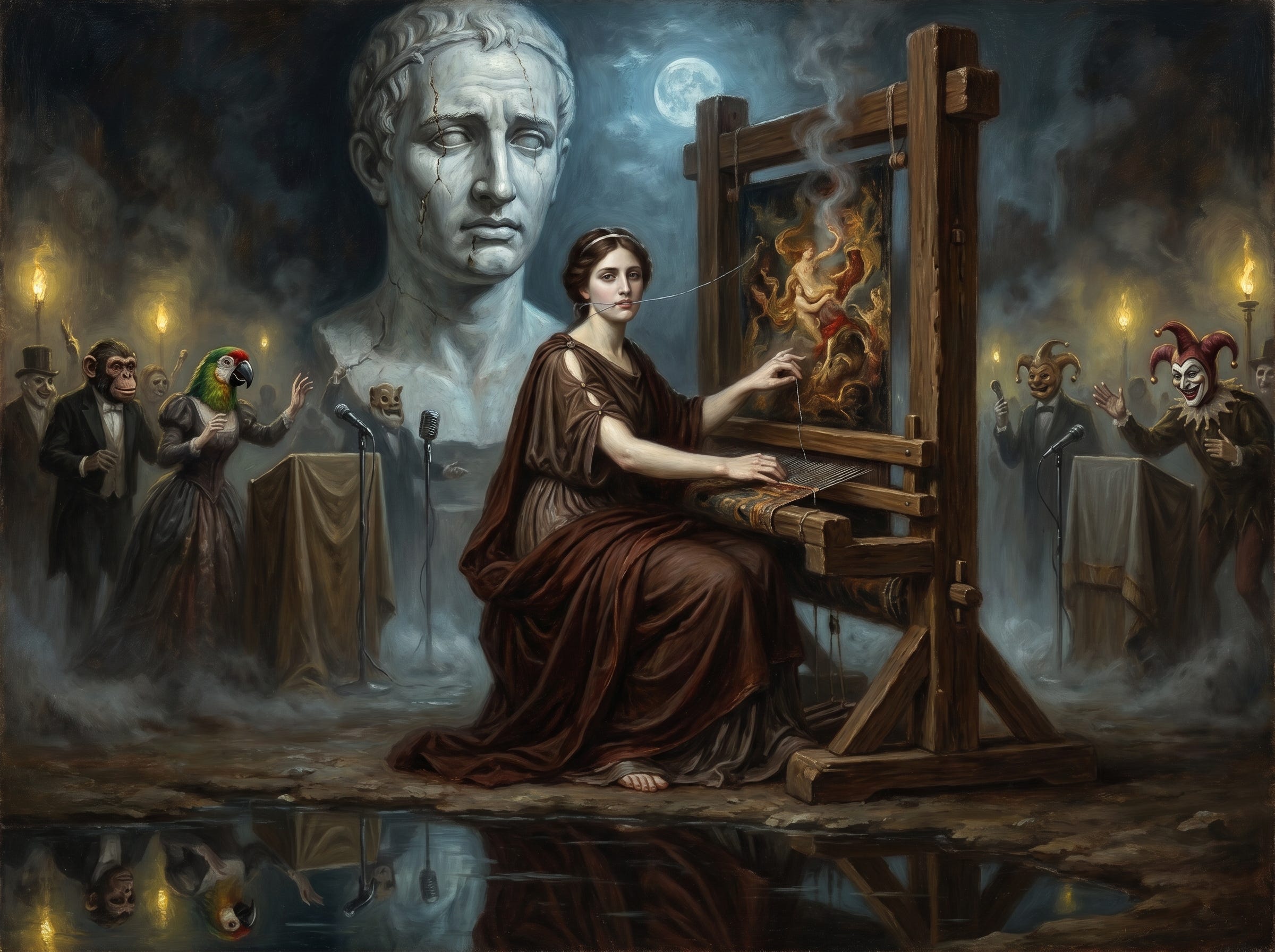
Tomislav Sunic turns to Ovid's Metamorphoses to argue that the ancient myths diagnose our political present with uncanny precision, exposing the censorship and ritualized self-hatred of the contemporary System.
Marked for two thousand years by Christianity and its linear conception of time, we find it difficult to grasp the sense of myth as our ancestors understood it. The same goes for the secular apostles of Christianity — the communists and the liberals — who reject any mythic interpretation in politics. And yet it is likely that our ancestors, through their myths, understood the meaning of being and non-being better than we do. One need only read the mythic figures in Ovid’s poem Metamorphoses to grasp the behavior of our shape-shifting politicians.
European legends and tales likewise carry such mythic elements within them. They also help shape our national identities. A classic example is the Nibelungenlied (Song of the Nibelungs) and the Chanson de Roland (Song of Roland), whose central motifs are the willingness to make absolute sacrifice for one’s own community. This is one of the reasons why myths and legends remain so popular among us, whether we call ourselves believers or atheists. We read Homer, the Brothers Grimm, and even Tolkien’s The Hobbit, because these tales awaken a part of our pagan imagination.
Though it boasts of rejecting all mythic discourse, the liberal System has developed its own founding myths: the myth of Progress, the myth of multiculturalism, and certain strange postwar myths of victimhood whose surreal character would surely have set the ancient Greeks laughing. Yet any critique of these new myths of the System is immediately perceived by its bien-pensants1 as a far-right imposture, even as a direct attack on liberal democracy itself. In the eyes of the System, anyone who dares to call liberal mythology into question exposes himself to exclusion, defamation, or professional and media proscription.
The ancient Greek and Roman myths — like the old European myths, legends, fables, and tales — had, and still have, regardless of their fantastical content, a powerful didactic function. They offer the community a moral orientation, and at the same time a clear warning: do not transgress the rules of the community, do not measure yourself against the gods, and do not let yourself be duped by the palaver of the Other — the foreigner — which works against the Self.
The ancient myths show clearly how hubris (excess), arrogance, and self-negation are punished by the gods, most often through drastic transformations into animals, stones, or other miscreants. By contrast, one need only glance at our political present: the liberal myths we now endure — together with the manipulations of language and the submission of the political class to these new mythic narratives — have already done considerable damage.

The Echo Chamber and the Wooden Tongue
The censorship currently in force and the new “wooden tongue” of the System can be traced back to several ancient Greek myths. These ancient myths correspond with astonishing precision to the present-day system of language control and thought control. The nymph Echo offers a perfect example of an “echo chamber” in which our politicians seem to be confined. Echo’s misfortune was orchestrated by the goddess Hera, the jealous wife of Zeus, who could not bear that Echo cover for her husband’s amorous escapades. Hera punished her by stripping her of her own voice and condemning her to repeat only the last syllables of the words spoken to her — a mere echo, in effect a wooden tongue stripped of all personal weight. The situation grows worse still when Echo falls in love with the narcissistic Narcissus, who does not return her affection. The result is a total breakdown of communication: Echo loses herself entirely, until nothing remains of her but her echo.
The fate of the nymph Echo applies with striking pertinence to the novlangue [Newspeak] that dominates the political and media communications of the clownish figures of the EU. Their litanies and incantations, borrowed from the Soviet idiom, are reduced to a few monosyllabic, demonological formulas: “hate speech,” “racism,” “the danger of fascism.”
Another example of censorship by the System is furnished to us by the myth of King Tereus. Although Tereus is married to Procne, he becomes obsessed with his sister-in-law Philomela. In an act of extreme violence, he rapes her and then cuts out her tongue so that she cannot reveal his crime. Deprived of speech, Philomela has no recourse but to weave a mute tapestry in order to communicate to her sister Procne the horror of her plight. This scene from Ovid’s Metamorphoses dramatically illustrates the aberrant metamorphoses that media language is undergoing today. We today, like Philomela, are obliged to weave our samizdats and to use coded language in order to express ourselves and circumvent the censorship of the System.
For two thousand years, the European has oscillated between two contradictory drives that verge on the neurotic: on one hand, a powerful will to self-affirmation, of the kind seen in Homer and throughout our ancestral mythology and legends; on the other, a pathological mimicry of theological and ideological commissars, the mouthpieces of strange and chimerical myths. This profound rupture took hold with the advent of Christianity, and was perpetuated thereafter in its secular versions — liberal and communist — down to our own time. To be sure, the ancient myths feature many figures endowed with a powerful will, yet without their seeking to blindly imitate discourses coming from elsewhere. In our contemporary period, things are no longer that way. The people who govern us are fascinated by external narratives and by exotic myths bound up with racial mixing and the end of times.
Among the French and German classics, we already encounter this kind of grotesque mimicry of the Other. A famous example is to be found in Molière’s Le Bourgeois gentilhomme (The Bourgeois Gentleman). Monsieur Jourdain seeks to imitate the nobility in his language, his manners, and his habits, and ends up making himself ridiculous through the unrelenting overreach of his social mimicry. The French language has a fine expression that applies to the Europeanist politicians and that is untranslatable into other European languages: « Il pète plus haut que son cul »2. Another, more radical example of aping the Other is found in a tale by the German writer Wilhelm Hauff, Der Affe als Mensch (”The Ape as Man”). In this story, a foreign confidence man arrives in a German village and brings with him a trained ape. The villagers, unable to recognize the animal for what it is, take it for a true gentleman and treat it as a model worthy of imitation.

The imitation of the mythology of the Other and the denial of self are not new phenomena in Europe. Today they appear with particular clarity in Germany. The most striking example of this blind imitation is found in the conduct of numerous German politicians who bow down before the “refugees” in order to publicly exhibit the white European man’s repentance. To this is added a foreign policy in which Israel occupies the place of the new European Superego [Surmoi]. Former chancellor Angela Merkel declared several years ago before the Israeli parliament, the Knesset: “Israel’s security is part of Germany’s reason of state and is never negotiable.” This German obsession with perpetual repentance hides itself today behind more presentable terms: the “myth of the welcome culture” [Willkommenskultur]3. In German, more honest expressions would be: the myth of eternal guilt, or the myth of self-hatred. This so-called “myth of welcome” is nothing other than a substitute for the now-defunct communism. What the communist regimes of Eastern Europe could not obtain by force, the System today seeks to impose through the permanent culpabilization of the white man.
Ovid’s myths, by contrast, are marked by a deeper wisdom: they are timeless and ahistorical. They can be recounted and transmitted in any age and in any place. This is why the ancient myths and legends of Europe can never be dogmatic: they require neither thought police nor Grand Inquisitor.
If today we observe the ancient European myths through the prism of the linear conception of historical time — a vision marked by Judaism and Christianity — this inevitably leads to a false self-perception. More precisely, the application of Christian temporal categories, along with their secular liberal or communist extensions (such as the idea of “the end of history”), constitutes a faulty approach to understanding the Greco-Roman myths, including the very notion of being.
Put simply: the ancient myths explain to us how to understand the world, while political and monotheistic myths invite us to change it — often with catastrophic consequences. The myth of European guilt, broadcast by the System on every wavelength, feeds on the Christian dogma of self-negation, which has already inflicted enormous damage on the peoples of Europe over the past two millennia. Indeed, it is all too easy and comfortable to mock the Jewish myths and their narratives of victimhood. But why criticize the Judaic myths while embracing without the slightest critical spirit the myth of the Immaculate Conception of the Virgin Mary, or the spectacular conversion of Saul, become Saint Paul, who passed from the status of persecutor of Christians to that of fervent apostle of the mixing of peoples and of the policy of open borders? Saint Paul, this North African4, still serves today as the symbolic rampart of Western civilization for many Christian Europeans. The great connoisseur of the Homeric gods and myths, Walter F. Otto, who remains for us to this day the indispensable reference in mythological studies, wrote already in his major work Der Geist der Antike und die christliche Welt (The Spirit of Antiquity and the Christian World), which has unfortunately not been translated into French:
The sickness of the soul that inspired this new judgment upon man had its origin in Judaism. There reigned fear, accompanied by its terrible companions: contrition and self-hatred. Belief in a despot God — the exact opposite of the living and realistic religion of Homer — was deeply rooted in the spirit of the Jews, a spirit foreign to real life and devoid of imagination. (p. 44)
When one projects these mythic analogies onto our own time and confronts them with the grotesque buffooneries of our politicians, the political future of Europeans seems particularly bleak.
Originally published on Terre et Peuple
Translated by Alexander Raynor
READ MORE by Dr. Tomislav Sunic, brought to you by Arktos:

Against Democracy and Equality was the first book ever published in the English language on the European New Right, and it remains an indispensable introduction to a school of thought which remains a vibrant force in the understanding of European politics.
Dr. Sunic examines the principal themes which have concerned the thinkers of the New Right since its inception by Alain de Benoist in 1968, such as the problematic nature of the label ‘New Right’ for a school which sees itself as being beyond traditional concepts of both the left and the right; its revolutionary political philosophy; its conception of history in terms of cycles; its attitude toward democracy, capitalism and socialism; and its endorsement of ‘pagan’ spirituality. He also discusses the significance of some of the older authors who have been particularly influential on the development of the movement, such as Oswald Spengler, Carl Schmitt and Vilfredo Pareto.
This new edition of Against Democracy and Equality has been completely re-edited, and offers new prefaces by both Dr. Sunic and the principal theorist of the European New Right, Alain de Benoist. Also included for the first time is the Manifesto for a European Renaissance, which highlights the positions of the New Right as it enters a new millennium.
bien-pensants — Literally “right-thinkers.” A term of mild derision, with no exact English equivalent; roughly the “respectable opinion” or to be “politically correct.”
« Il pète plus haut que son cul » — Literally “He farts higher than his arse.” French idiom for someone who puts on airs above his station.
Willkommenskultur — The German neologism behind the French culture d’accueil. Refers to the discourse of welcoming refugees and migrants associated especially with the 2015 European migration crisis.
“Saint Paul, this North African” — Source: “St Paul, ce Nord-Africain...” This appears to be a factual error in the source. Paul of Tarsus was from Cilicia (modern-day southeastern Turkey), a Hellenized Jew with Roman citizenship — not a North African.
Ovid is a favorite of mine because he combines the mythological style of ancient literature with the form of the short story.