


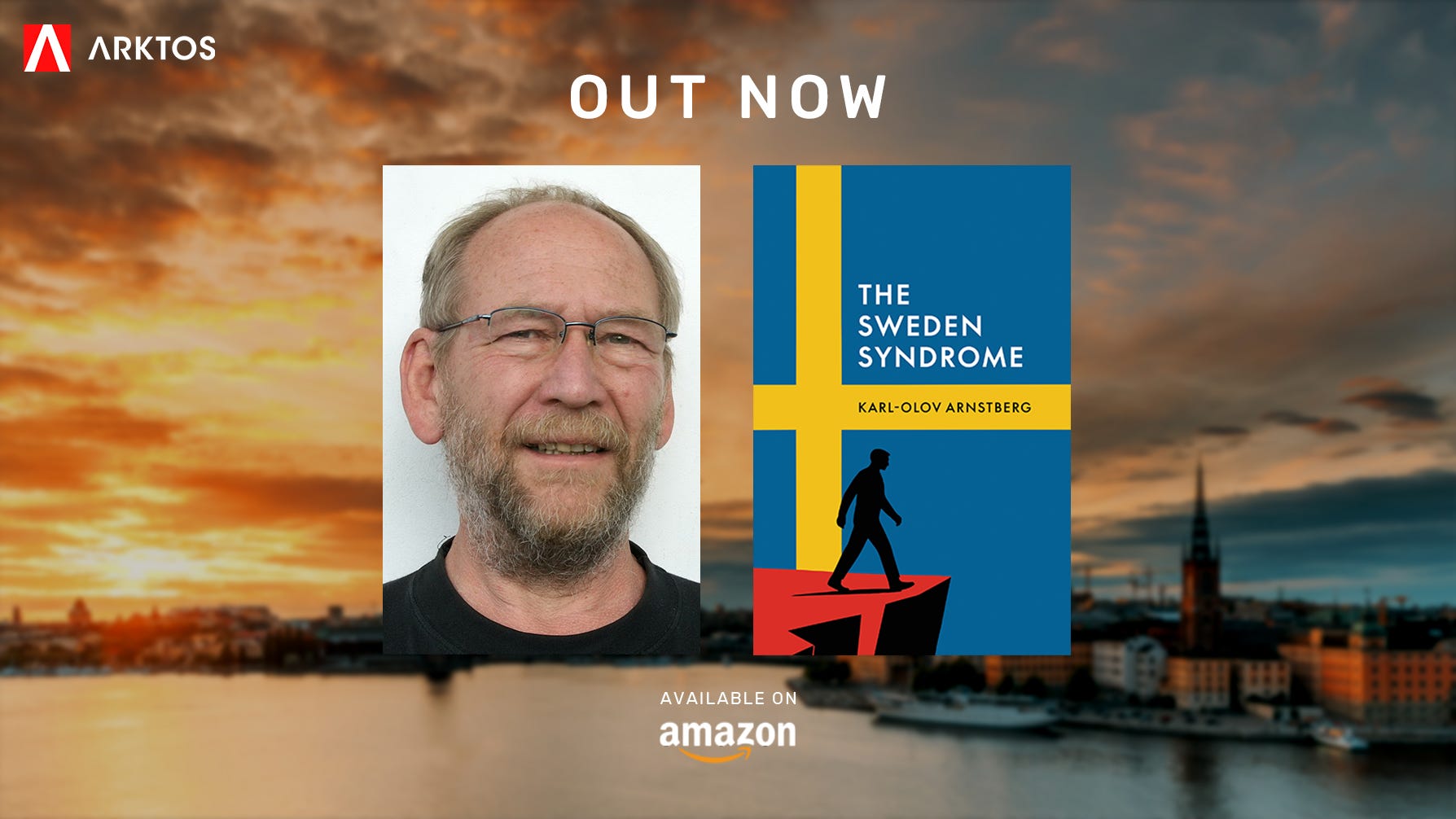
“The present work is a thorough, clinical description of the symptoms and etiology of what the author calls ‘the Sweden syndrome’. Arnstberg traces the historical process that converted Sweden from a nationalistic Folkhemmet which treated the country like a family into a multicultural administrative zone that perversely prides itself on privileging the foreigner over the native. The book is called The Sweden Syndrome, but the broad stokes of the disease that Arnstberg describes can be seen in practically every Western country. Arnstberg’s concise analysis of this complex mass psychosis is a service not only to the present, but to future generations.”
— John Carter, Postcards from Barsoom

“Arnstberg does not shy away from exploring the more gruesome consequences of Swedish multiculturalism; there are a few passages which detail truly horrific and senseless crimes committed against innocent Swedes. Having said this, he does not resort to hyperbole, either. What Arnstberg does provide is a measured and informed view of the social and political transformations which have made Sweden the country we know it as today. For non-Swedish readers around the world, Arnstberg has done a tremendous job of relaying just what has happened, and still is happening, to the Swedish people. While Arnstberg is not the only academic in the arena, so to speak, I believe that The Sweden Syndrome will usher in a new era of Swedish conservative intellectualism.”
— Josh Neal
From Chapter 1 - “Describing the Disease”:
The Sweden syndrome is an identity-based social psychosis, an illness that takes the form of cultural self-harm. It is predominately found in Western countries. The worst affected are the 14% of the world’s population who live in what we call ‘liberal democracies.’ Occasional outbreaks occur in other territories, but there the contagion rate is considerably lower or non-existent.
Among the infected, the capacity for reality testing is severely impaired; they claim that reality is a social construct and advocate for a linguistically and normatively imaginary world to which only ‘the good ones’ have access. What reality should look like takes precedence over what meets our senses. The distinction between fact and fiction—between right and wrong—is relativised. For the infected, empirical observations and well-founded perceptions also appear as opinions. One consequence of this is that what matters is not what is said, but who says it. The opinions of certain important people are particularly valuable, no matter how ill-founded they may be. The disease is highly contagious, and those citizens who have the capacity to build up an intellectualised view of reality are more likely to be infected.
Affected individuals and groups perceive their own Western communities, especially those of their men, as the oppressors of humanity. Members of other communities (which in Sweden are national minorities, ethnic groups, cultures and religions) are understood as victims. This also applies to perpetrators of various kinds. Supporters of the Sweden syndrome explain their destructive behaviour as due to society failing to educate them into empathetic and good individuals. As a result, interest is focused on helping the wrongdoers, instead of — as is normal for healthy people — helping the victims of crime.
Explanations for crime, violence, and other destructive actions are brought back to the oppressors. In particular, white men, with their cynical, capitalist, patriarchal and exploitative social ideals, are blamed for various shortcomings. This is also true of relations between men and women; the latter are axiomatically perceived as oppressed by men. This perception is bolstered by notions of egalitarianism and multicultural superiority (the infected themselves fail to perceive the transparent contradiction of such).
Those groups to whom representatives of the Sweden syndrome assign victim status are usually considered incapable of discriminating or committing other destructive acts, and if they do, it is always someone else’s fault (usually society’s).
The infected person has an individualised view of humanity and sees those who distinguish differences between different groups, such as between men and women, as evil. They are described in all too familiar derogatory terms like Nazi, racist, xenophobe, misogynist, etc.
The infected clamour for a language that makes no distinction between people. For example, in Swedish, they call both men and women hen rather than han (him) or hon (her). One of the surest symptoms is that the infected emphasise the importance of not distinguishing between we and them. Those who do so are deemed racists or Nazis.
Those affected have little or no awareness of the disease; they see themselves as good and describe healthy people as evil and morally defective. Nations that prioritise their own populations and defend their people against mass immigration — such as Hungary, the Czech Republic, Australia, and Switzerland — are criticised by those suffering from Sweden syndrome. Politicians in these countries are considered undemocratic because, by protecting their borders, they do not want to “take responsibility” for the world’s refugee situation.
When those affected by this psychosis are criticised for not prioritising the interests of their own communities, they call their opponents fact-resistant, xenophobic, and right-wing extremists. They do so in spite of the fact that they are unable to defend their emotionally driven views with rational arguments. The infected see themselves as a balancing counter-movement to save all the world’s people from the evil and fundamentally racist white culture.
The sick are prone to feeling disgraced. This has led to demands for trigger warnings and safe spaces, particularly in higher education settings. Any lecturer who intends to say something that may be perceived as offensive is expected to give advance warning of what is to come (safe spaces refer to the need for environments where those who are ill can avoid being criticised or questioned for their habitually extreme views).
Since the recognition of illness is tantamount to recovery, all criticism is fought on the principle of “when arguments are weak, raise your voice and look angry.” Those who oppose the Sweden syndrome are sadly at the mercy of the infected, placed by them on a right-left political scale where any criticism that threatens to change the perception of reality is classified as right-wing. In more benign cases, they are labelled as ‘populists’ (also meant as a derogatory term). The sufferers do not apply the same politically biased scale of values to themselves. They consider themselves to be the bearers of an objective social morality.
For those affected by the Sweden syndrome, the world is populated by bad and good people. The bad must be fought on all fronts, which means that only the good can be granted access to the public arena. The Sweden syndrome is a socially destructive disease in which the infected do not understand that, in the name of humanism and empathy, they are eroding Western civilisation. The most seriously ill advocate social suicide, but without understanding it themselves.
The Sweden syndrome affects the welfare democracies of the West in particular. You might ask, why should this policy of national suicide be named after Sweden? The answer is that Sweden is the European country that has gone furthest in its ambition to become multicultural. Back in the 1960s, Sweden was still one of Europe’s most ethnically homogeneous countries. Our national minorities were small and did not politically challenge the Swedish majority. Today, Sweden is recognised for having taken in the most immigrants per capita out of all the other European nations. Approximately 30% of those with Swedish citizenship were born in another country or are children of parents who were not born in Sweden. We should therefore set a warning example to the rest of the world: See, this is how bad it can get!
ORDER NOW

Anche in Italia questo fenomeno è molto presente e pervade tutte le istituzioni soprattutto la magistratura, l'istruzione.
Your very interesting article reminds me of the perversion of moral values condemned at Isaiah 5:20-23. In fact, I think those verses characterize all of the modern day West. The little child is raped & murdered by a low IQ Muslim invader & welfare parasite - yet there are no consequences to the perpetrator. And the multiculturalists are happy about this. They don't want distinctions made between "Good" & "Evil" [those are mere social constructs]. Why are they like this? I suggest it's because they hate the idea of moral absolutes - and they hate God for establishing moral absolutes. I remember speaking with a person who insisted there were no moral absolutes - "morality" was merely a matter of personal "feelings". And thus she would not say that "raping & murdering children is wrong". They don't want any such distinctions made.
So evil takes over. And they like that because they hate God who sets the moral standards. They want to spit in His Face.
The Bible says over & over "God created man - male & female He made them." Those who assert that "gender is malleable and a person can be any gender s/he/it wants" are spitting in God's Face.