


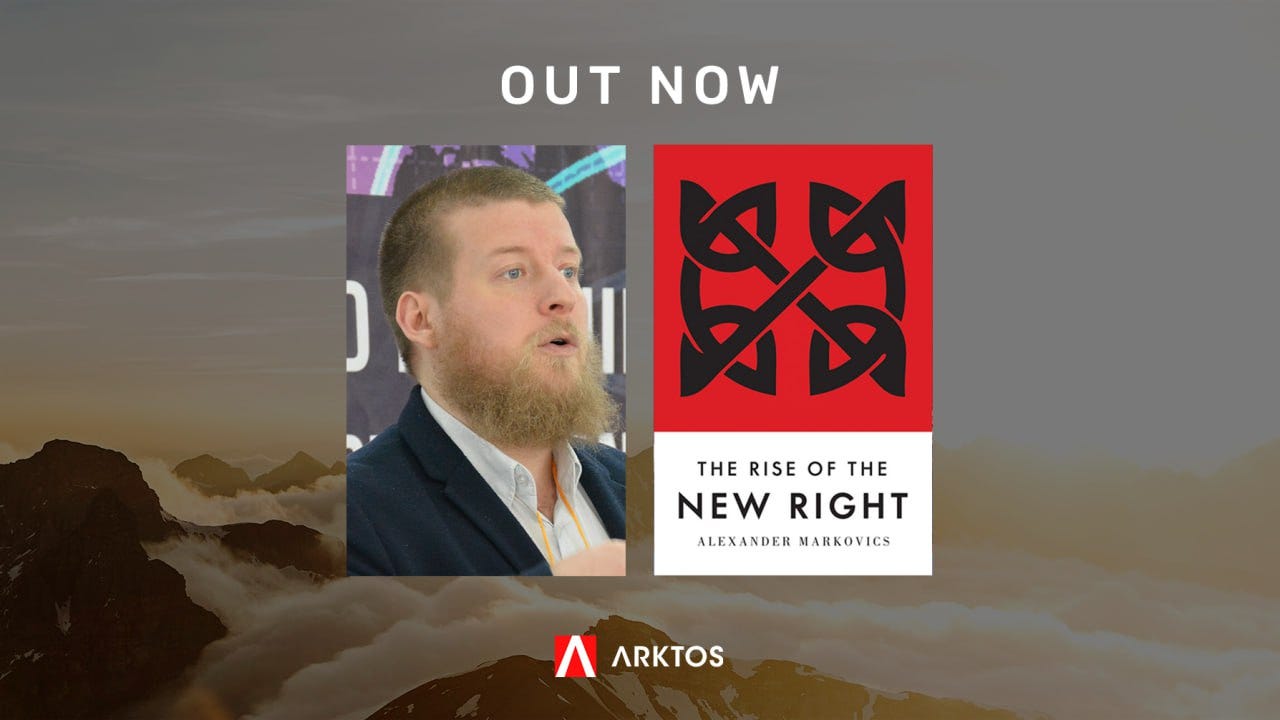
“A specter is haunting Europe” — this time not the pretenses of communism, but a whole constellation of thinkers, movements, and cultural initiatives that have been cast together under the label of the “New Right.” In The Rise of the New Right, Alexander Markovics cuts through misunderstandings and caricatures in order to map the New Right’s origins, key ideas, and wide-ranging figures and fronts from postwar France to the contemporary landscape.
Combining an updated historical overview with an in-depth exploration of concepts, Markovics examines themes such as metapolitics, ethnopluralism, geopolitics, ecology, and the Fourth Political Theory, drawing attention to how the New Right’s leading lights and offshoots have changed as well as remained consistent in aspiring to critically rethink the crisis of liberal modernity and cultivate a European renaissance.
The Rise of the New Right provides an accessible introduction for newcomers as well as a creative synthesis for scholars, including excursions into the often overlooked chapters of the German New Right and the ideas of the Russian philosopher Alexander Dugin.

Alexander Markovics’ book is fittingly equipped with a foreword by Alexander Raynor of the European New Right Revue:

Excerpt:
Since the birth of the New Right in France, even before that of the New Left in the Summer of 1968, a revolutionary pan- European school of thought has come into being, one that has explicitly articulated itself as a rejection of the Old Right. From the very beginning, it has identified liberalism as the main enemy and has striven for a cultural revolution from the Right to overcome it. Its intellectual roots can be traced back to the Conservative Revolution, which emerged towards the end of the 19th century as a reaction to liberalism, and also to the writings of two national-revolutionaries: Dominique Venner and Jean Thiriart.
The most important idea of this revolution is that it does not view parliamentarism as the intended purpose of metapolitics. Rather, it sees in parliamentarism nothing more than the implementation of shifts in thinking which have already taken place in the mind. Thus, the real purpose of action consists in articulating and disseminating new thoughts and concepts which enable an intellectual revolution and the overcoming of liberalism.
In the spirit of ethnopluralism initially imported from Germany, the New Right advocates for the diversity of peoples and the preservation of different ethnic groups, religions, and civilizations. By the same token, it opposes racism, colonialism, and the Western superiority complex, all of which were present in the Old Right and which are currently aspects of liberalism in its universalist pretensions. Originally designated as Nouvelle Culture (New Culture), the New Right follows in the spirit of Oswald Spengler in seeking a new beginning for Europe, opposing the old Western civilization that has ossified in its materialism and the artificial culture of the Enlightenment.
By rejecting the West’s claim to universality, the New Right understands European civilization to be only one among many civilizations, and believes that Europeans share a common struggle with Africa and Asia against Americanization and globalization. In doing so, the New Right does not stop at the anti-imperialism of the Left, but strives to establish an intellectual “cross-front” (Querfront) that engages numerous left-wing subjects from right-wing perspectives. This includes not only the reception of Antonio Gramsci and his theory of cultural hegemony, but also a fundamental critique of capitalism. By orienting itself towards the esoteric Karl Marx and his understanding of capitalism as a system aimed at the domination of things (as well as Aristotle’s critique of money), the New Right not only questions particular aspects of capitalism, such as the the interest-debt system, but is against the whole essence of the economic system in its aiming for infinite growth. The New Right sees a possible alternative in the critique of growth, which not only questions the capitalistic drive, but also the calls for infinite extension, expansion, and destruction (of human communities and the environment) that are inherent in any growth-based economy.
While today’s globalist Left calls for an end to the nation-state in order to aid the dawning of an all-levelling world state, the New Right recognizes the need for a European Imperium that preserves diverse identities, be they regional, national, or civilizational (in the sense of a culture group), and safeguards them from globalization. In this regard, today’s nation-state is rendered helpless, incapable of asserting the multiple levels of identity or preserving the people, and instead slated to further serve the agenda of globalization and contributing to the levelling process. This applies to both natives and immigrants. In bourgeois society, the New Right sees nothing worth preserving, only a problem, because such a society insidiously destroys all communities through its unrelenting propaganda of individualism and assaults on personality, transforming all personal and collective ties into one sellable and negotiable value. In contrast, the New Right calls for the restoration of historically developed communities and the replacement of the modern individual by the premodern person.
Since its inception, the New Right has continued to develop and sharpen its profile. Not all actors and intellectuals associated with it have followed this path; some have gone their own way. Guillaume Faye, a prodigious alumnus of the New Right, is one such figure. Starting with his book Archeofuturism, Faye critiqued the New Right for its solidarity with the Third World, its ethnopluralism, and its aversion to the United States and modernity. Such “right-wingers” do not live up to the tradition of the New Right, but rather are, at best, a “new Right” in the sense of a newly emerging direction on the Right which sees Islam and mass immigration, rather than liberalism, as Europe’s main enemies. In a step backwards to the Old Right, they assert the supremacy of Western civilization above all other civilizations and spread the fairy-tale of their “Judeo-Christian” heritage, obliging Europeans to stand in unconditional solidarity with Zionism. Through this mechanism, the correlations with Western wars and coups in the Middle East are elided, and the logic of the Cold War is being revived. In the most extreme cases, Russia and China are designated as totalitarian enemies of Western freedom to be ruthlessly fought.
Although Faye’s notion of “archeofuturism” proposes a union of tradition and modernity, it becomes clear upon closer inspection that his ultimate goal is a hypermodernity leading to phenomena such as human cloning and cyborgs. In these circles, the necessary solidarity of all “White” peoples is invoked in contrast to Islam, which in turn is depicted with the most demonic traits, accused of civilizational “backwardness” and of belonging to a unified bloc. Taking up such a view, one turns a blind eye to the major differences within Islam (Shiites, Sunnis, Sufis, Wahhabis) and completely negates the Western support for Islamists in the likes of the Islamic State or al-Qaeda. To paraphrase Alain Soral, we are dealing with people who shout, “Don’t Islamicize our Americanization!” Unlike Renaud Camus, these people do not bear in mind the fact that demographic replacement is only possible when a people has been entirely decomposed by individualism and no longer possesses any awareness of its roots, religion, or culture. Accordingly, the liberal decomposition of feminism, LGBT rights, and individualism are defended tooth and nail as if part of European culture against supposed Islamization.
In the words of Daniel Friberg, one can describe these people as representatives of the “false Right” or “imposter Right,” representing nothing more than a convenient pseudo-alternative to the ideas of the New Right. Serving their function as gatekeepers for the liberal system and critiquing the lines of argumentation is their order of the day. According to Huntington’s Clash of Civilizations, this logic leads to the illusion that Europe is trapped on the geopolitical chessboard between a liberal right-wing of the Donald Trump variety — pro-capitalist, anti-Islamic, pro-Zionist, and pro-American — and a liberal left-wing which advocates globalism and wishes to bulldoze all peoples and religions on its way towards a liberal world-state.
At the present moment, representatives of the Clash of Civilizations and right-wing liberalism still dominate the discussion on the Right, but the ideas of the New Right are gaining in circulation and enjoying engagement from increasingly more followers. This is critical: given the illusory choice between neo-Western right-wing liberalism and globalist left-wing Liberalism, neither of these sides is correct, and neither side offers a geopolitical vision for Europe.
A solution for Europe can be found in Alexander Dugin’s concept of the Fourth Political Theory, which synthesizes the ideas of the New Right with his own Eurasian project, within which Russia and Western Europe are to become intimately linked. By returning to its own tradition and Christian roots, Eurasia will open the door to a positive future. Meanwhile, the West faces the prospect of being reduced to a US-centered civilization confined within the precepts of the original Monroe Doctrine and incapable of enforcing the doctrines of human rights, capitalism, and liberalism in Europe, Africa, or China.
Will the emerging multipolar world be without conflicts or clashes?
No. But, by finally recollecting our identity and refraining from
imposing it on others, we Europeans will finally be able to channel
our energies not only in drafting our own legislation and reviving our
traditions, but also in permitting other nations to define their own
destiny. Only then can we understand that the multiplicity of Daseins
and the fascinating pluriverse, with its myriad languages, tribes, and
ways of life, is the true treasure of mankind — not the cold, utterly
rationalized Western civilization with its worldview centered around
profits, lack of limitations, and violence. Alexander Dugin’s ethnosociology
as well as his studies in the War of Ideas (Noomakhia) present
a first attempt at truly understanding the peoples of the world, a
chance to reach an understanding between peoples on a more equal
footing. In the end, it is up to each and every one of us to bring this
about, whether we as Europeans succeed in becoming masters of ourselves
once more, or whether we press on into the abyss of Western
postmodernism…

It's actually mentioned in connection to Liberalism and it's quest for the destruction of all forms of collective identity which include of course also male and female sex and traditional gender relations.
Have a look on www.Nordlandia.nl = Hanseatic Conservative Revolution from Bruges to Novgorod. confederal & Neutral. Based ao on my experience within the G.R.E.C.E. My eBook THE NORDLANDIA PROJECT is now available on Amazon.com in English AND German. Best Regards from Flanders. Andre-Hans.