


Why has Europe remained divided, restless, and often at war with itself?
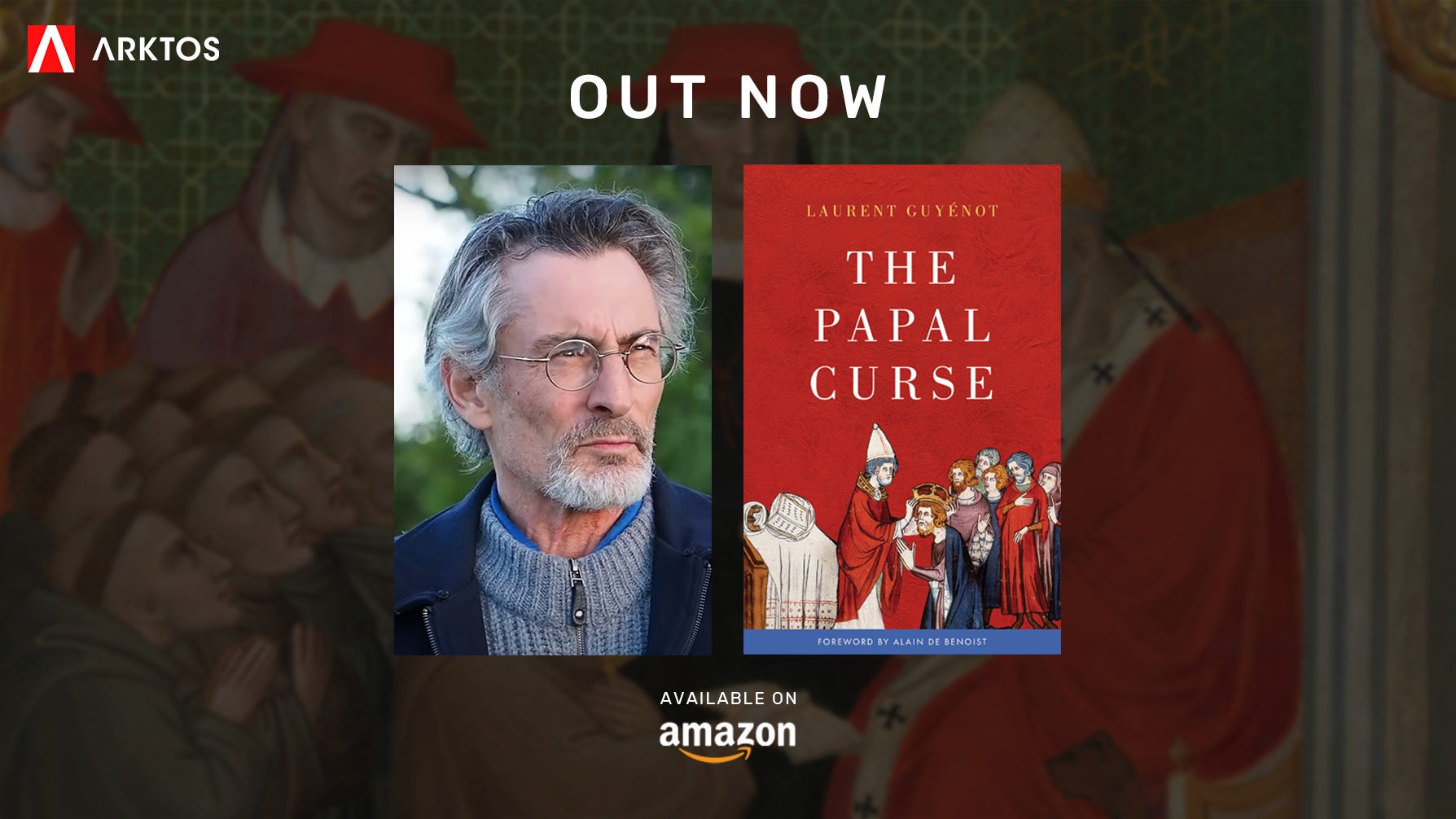
In The Papal Curse: The Medieval Origin of the European Syndrome, Laurent Guyénot argues that the root cause lies in the transformative — and destructive — role of the medieval papacy.
From the Crusades and the struggle with emperors to the shaping of Western individualism and global ambitions, Guyénot draws on history, theology, and geopolitics to explore how the popes’ religious and political projects have intertwined to prevent the rise of a unified European Empire.
Provocative, deeply researched, and featuring an original foreword by Alain de Benoist, The Papal Curse challenges readers to confront the hidden origins of Europe’s modern crises.

From the Foreword by Alain de Benoist:
In this book, which explains why Europe has never been able to structure itself politically in the form of an empire, Laurent Guyénot writes that “the empire, and not the nation, was the ultimate and unanimous ideal of political thinkers and of peoples throughout the Middle Ages.” This is definitely the key sentence. It immediately raises the question: why was this ideal never achieved? Why did this “unanimous” desire never come to fruition? To understand the question, we obviously must bear in mind what an empire is in relation to other political forms (ancient cities, city-states, nation-states, etc.) attested in European history.
When we examine its political history, we quickly see that Europe has been the place where two major models of polity, or political society, have developed, evolved, and clashed: the nation, preceded by the kingdom, and the empire. At first glance, the concept of empire is not easy to define, given the often contradictory uses to which it has been put. Therefore, the best way to understand its true nature is undoubtedly to compare it to that of the nation or nation-state.
In the current sense of the term, that is, in the political sense, the nation appears to be an essentially modern phenomenon. In the Middle Ages, the word “nation” (from natio, “birth”) had an exclusively ethnic meaning, not a political one: the nationes of the Sorbonne were simply groups of students who spoke different languages. The political idea of nation only fully took shape in the 18th century, particularly during the French Revolution. Originally, it referred to a concept of sovereignty professed by the opponents of royal absolutism. It brought together those who shared the same political and philosophical views, namely that “the nation,” and no longer the king, should embody the political unity of the country. Article 3 of the 1789 Declaration of the Rights of Man and of the Citizen proclaimed this unequivocally: “The principle of all sovereignty resides essentially in the nation.”
What fundamentally distinguishes the Empire from the nation? First, the Empire is not primarily a territory, but fundamentally a principle or an idea. The political order is determined not by material factors or the possession of a geographical area, but by a spiritual or political-legal idea. It would therefore be a mistake to imagine that the Empire differs from the nation primarily in size, that it is in some way “a nation larger than the others.” “The Empire is more than an enlarged state,” writes Carl Schmitt. Certainly, by definition, an empire covers a large area. But that is not the essential point. In the Middle Ages, a distinction was commonly made between the concept of auctoritas, or moral and spiritual superiority, and that of potestas, or simple public political power exercised by legal means. In the Carolingian Empire, as in the later Holy Roman Empire, this distinction underlies the dissociation between the authority specific to the imperial function and the authority held by the emperor as sovereign of a particular people. Charlemagne, for example, was both emperor and king of the Lombards and Franks. Allegiance to the emperor was therefore not a matter of submission to a particular people or country. In the Austro-Hungarian Empire, loyalty to the Habsburg dynasty still took precedence over national or religious ties. Empires, Carl Schmitt further explains, are “the leading powers carrying a political idea radiating in a large determined space, from which they exclude in principle the interventions of foreign powers.”
The nation, on the contrary, finds its origin in the kingdom’s will to claim prerogatives of sovereignty, relating them not to a principle but to a territory. The starting point for this can be traced back to the division of the Carolingian Empire by the Treaty of Verdun. It was at this point that France and Germany began to follow separate paths. The latter remained within the imperial tradition, while the Kingdom of the Franks (regnum Francorum) slowly evolved toward the modern nation through the royal state. In the 16th century, the formula that the king is “emperor in his kingdom” was directly associated with the new concept of sovereignty theorized by Jean Bodin.
But the opposition between spiritual principle and territorial power is not the only one that needs to be taken into account. Another essential difference lies in the way the Empire and the nation conceive of political unity. The unity of the Empire, whose earliest theorists were Marsilius of Padua, Dante, and Nicholas of Cusa, is a composite, organic unity that transcends the boundaries of states. Insofar as it embodies a principle, the Empire envisages unity only at the level of that principle. While the nation either generates its own culture or relies on a pre-existing culture to form itself, the Empire encompasses a variety of cultures. While the nation seeks to bring the people and the state into alignment, the Empire brings together different peoples. Its general law is that of autonomy and respect for diversity. The Empire seeks to unify at a higher level without suppressing the diversity of cultures, ethnic groups, and peoples. Its main characteristic is that it aims above all to articulate differences. Sovereignty is distributed, and ethnic, cultural, religious, and customary particularities are legally recognized as long as they do not contradict common law. As in Johannes Althusius’ view, the application of the principle of subsidiarity is the rule. Since nationality is not synonymous with citizenship, the political people (demos) is not to be confused with the ethnic people (ethnos), but one does not stand in the way of the other. In other words, the imperial principle aims to reconcile the one and the many, the universal and the particular.
At the height of the Roman Empire, Rome itself was first and foremost an idea, a principle, one that enabled different peoples to be brought together without converting them or erasing their identity. The principle of imperium, which was already at work in Republican Rome, led to the acceptance of foreign cults and diverse legal codes. Roman law (jus) prevailed only in relations between individuals of different peoples or in relations between cities. One could call oneself a Roman citizen (civis romanus sum) without renouncing one’s nationality.
As a supranational institution, the medieval Reich was fundamentally pluralistic. It allowed peoples to live their own national lives and retain their particular laws. The Austro-Hungarian Empire, to name but one example, functioned very effectively for several centuries, even though minorities made up the majority of its population (60 percent of the total), including Italians and Romanians as well as Jews, Serbs, Ruthenians, Germans, Poles, Czechs, Croats, and Hungarians.
What characterizes the national kingdom, on the contrary, is its irresistible tendency toward centralization and homogenization. The nation-state’s investment in space was first manifested in the delimitation of a territory over which it exercised homogeneous political sovereignty. This homogeneity can first be grasped in the domain of law: territorial unity results from the uniformity of legal norms. The 14th and 15th centuries marked a turning point in this regard. It was during this period that the state emerged victorious from its struggle against the feudal aristocracies and sealed its alliance with the bourgeoisie, while at the same time establishing a centralized legal order.
There is no doubt that monarchical absolutism paved the way for the national bourgeois revolutions. The Revolution was inevitable once Louis XIV had broken the last resistance of the nobility, and the bourgeoisie could in turn conquer its autonomy. But there is also no doubt that, in many respects, the Revolution merely continued and accentuated trends that were already at work in the Ancient Régime. This is what Tocqueville observed when he wrote: “The French Revolution created a multitude of incidental and secondary things, but it only developed the seeds of the main things which existed before it… Among the French, the central government had already taken control of local administration more than in any other country in the world. The Revolution merely made this power more proficient, more compelling, and more resourceful.”
Under both monarchy and republic, the logic of the nation-state tends to eliminate anything that might stand in the way between the central state and individuals. It aims to uniformly integrate individuals under the same laws, not to bring together communities preserving their language, culture, and traditions. The power of the state is exercised over individual subjects, which is why it consistently attempts to destroy or limit the prerogatives of all intermediate forms of socialization. With the Revolution, of course, the movement accelerated. The remodeling of the territory into roughly equal departments, the fight against “provincialism,” the suppression of local particularities, the offensive against regional languages and “patois,” and the standardization of weights and measures, all reflect a real obsession with alignment.
It should also be added that, unlike the nation, which over the centuries has become increasingly defined by tangible borders, the Empire never presented itself as a closed entity. Its borders were by nature shifting and provisional. It was during the Revolution that the idea of France’s “natural borders” came to be asserted systematically. It was also during the Revolution that the idea began to spread throughout Europe that the borders of a state must correspond to those of a language, a political authority, and a nation.
Universal in principle and purpose, the Empire was not, however, universalist in the sense commonly given to the term. Its universality never meant that it was destined to extend to the entire world. Rather, it referred to the idea of a fair order aimed at uniting peoples within a given area of civilization, on the basis of a concrete political organization, without any prospect of leveling. From this point of view, the Empire is quite distinct from a hypothetical world state or the idea that there are legal and political principles that are universally valid at all times and in all places.
In our time, when “great spaces” and “civilizational states” are once again becoming essential concepts for thinking about international relations, when the Russian Empire and NATO forces are clashing in Ukraine, when Russia is ruled by a new Tsar, Turkey by a new Sultan, and China by a new Emperor, Empire might not have said its last word.
Wonderful to see this release. The first book changed my understanding of the political formation of medieval Europe.
Might we see a second release or more work related to the book and premise of Anno Domini as well? It is one of the few books I have bought multiple copies and shared them with friends.
Your insights and willingness to dig into research outside the accepted norms are incredibly valuable, Dr. Guyenot!
Since the papacy is as much a political entity as it is a religious one, is it possible the empire was already established in Europe in the form of a Church? Except that it wasn’t just Europe that was the empire, but any city or country with a diocese. After all, Constantine did organize the church administration the same way the Roman Empire was organized. Just a thought.