


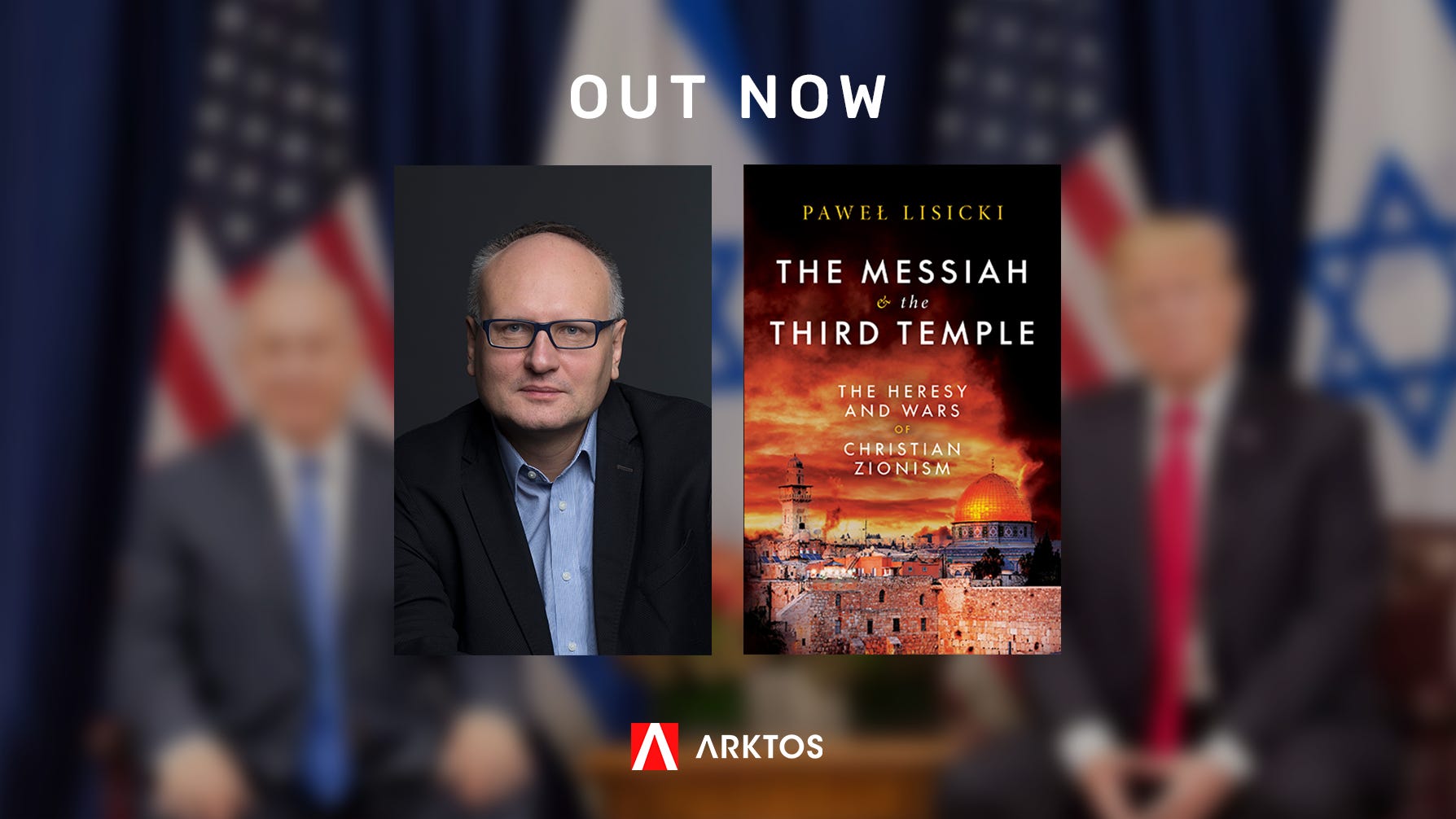
From churches and politics in America to wars in the Middle East, Christian Zionism is one of the most influential, powerful, and organized religious and political forces of the 21st century.
In The Messiah and the Third Temple, Paweł Lisicki presents a sweeping overview of Christian Zionist ideology and networks, revisiting the ancient controversies between Christians and Jews and shedding much-needed light on the apocalyptic storm clouds of the present-day Third Temple movement.
Weaving together ancient scripture, historical sources, current events, and theological analysis, this highly informative study uncovers how a complex alliance of religious extremism and ethno-political ambitions has become a deadly driving force in global geopolitics.
Provocative and meticulously argued, The Messiah and the Third Temple challenges readers to reconsider the relationship between religion, land, and the future of Western civilization.

Excerpt from the Introduction:
There is perhaps no other enigma — or mystery, to speak in more classical terms — as extraordinary as the bizarre emergence and ensuing spread of the new theology of Christian Zionism. Unlike many other currents in contemporary religious thought, its significance is not restricted merely to narrow circles of intellectuals, but is a matter of import for the whole world. Furthermore, Christian Zionism, or the belief that it is Christians’ duty to support the State of Israel as if its success were a necessary condition for the coming of the Messiah — preceded by the coming of the Antichrist and a great cataclysm, the true Armageddon — seems to be the only politically significant form of Christianity at present. Christian Zionists currently have at least as much influence on world politics as papal Rome had on medieval states. Going so far as to determine the outcome of who becomes president of the United States, the world’s largest empire, Christian Zionists wield indirect influence over the most important political decisions not only in the Middle East, but throughout the world.
I know that readers might now be shaking their heads in astonishment and thinking that the author has become feverish or fallen into a strange state of excitement about his own topic. Indeed, the matter seems rather peculiar: how could an ideology — and that is exactly what Christian Zionism should be called — be so significant when the broader public doesn’t even know about it? Particularly in Poland, it seems to be completely unknown to Poles, and I say this on the basis of many conversations in which, upon mentioning the power of Christian Zionists in the US, I was met with surprise as if my interlocutors wanted to say, “Is the person telling us this sober?” How is this possible? After all, this ideology’s followers in the US, some 50 million Protestants, are nothing compared to well over a billion Catholics. However, let us not be misled by numbers. A smaller but well-organized community with its own agenda is incomparably more powerful than an amorphous, internally paralyzed community.
So, yes: without a doubt, Christian Zionism has become, whether one likes it or not, the most important, let’s say Christian, ideology of the Western world. Surprise at this — as if we’ve never heard of this beast — can only be resultant of ignorance. Anyone who has read my previous book, The Myth of the Elder Brothers in Faith (in Polish: Mit starszych braci w wierze), will notice that the views I am describing here, and attributing to the majority of American Protestants, are related to the new Catholic, post-Vatican II understanding of Judaism.
In this sense, John Paul II can be considered a precursor of Catholic Zionism, and his gestures and speeches were a Catholic version of what a significant part of Protestants in the US had already been preaching for a long time. The Polish pope introduced key points into the Church’s teaching that were important to Christian Zionists. Firstly, he indicated, albeit not always explicitly, that Israel remains the chosen people; secondly, he maintained quite clearly that the Old Covenant is still valid; thirdly, he repeatedly condemned all forms of antisemitism, without ever attempting to define it, and in the final period of his pontificate he equated antisemitism with anti- Judaism. It bears acknowledging that the pope did not go so far as to draw another equivalence that was so important to his Jewish dialogue partners, namely, to state that contemporary anti-Zionism, i.e., aversion to and criticism of Israel’s state policy, is synonymous with antisemitism; nevertheless, it is easy to interpret some of his gestures in this vein, such as his frequent reference to contemporary Jews as elder brothers in faith.
I did not come up with this myself. Gavin D’Costa, the author of an essay with the highly significant title “The New Catholic Zionism,” published in September 2019, came to exactly the same conclusion that John Paul II was the precursor of Catholic Zionism. In his opinion, the time has come for Zionism to become part of the official teaching of the Church. The author points out that the most important breakthrough for the development of the ideology of Catholic Zionism was the Polish pope’s speech in Mainz in November 1980. I completely agree. I wrote about this a few years ago in Dogma and Tiara: An Essay on the Collapse of Roman Catholicism (in Polish: Dogmat i tiara. Esej o upadku rzymskiego katolicyzmu), where I pointed out that John Paul II’s theological revolution went completely unnoticed in Poland. The recognition that the Mosaic covenant has never been broken, that it is still in force, has been incorporated into the Catechism of the Catholic Church, but it constitutes the most radical denial of the teachings of the New Testament (in particular the Epistle to the Hebrews) in centuries. It has also been upheld by the Polish pope’s successors.
In 2006, Benedict XVI said in a Roman synagogue that “the favor of the God of the Covenant has always accompanied the Jews, giving them the strength to overcome trials.” It is difficult to disagree with D’Costa that Benedict’s words imply that contemporary rabbinical Judaism is a continuation of the faith of the biblical people of Israel. Francis taught the same thing in Evangelii gaudium, proclaiming that the Covenant of the Jewish people with God has never ended. Thus, John Paul II’s error became firmly established in the official doctrine of Rome and became the basis for the construction of Catholic Zionism.
To this should be added many other vague, ambiguous, but always “appropriately” interpretable declarations by various Vatican bodies. All of them, according to D’Costa, suggest that the Church is on the verge of accepting the thesis that Jews have an eternal right to the Land of Israel based on biblical promises, and that it is the role of Catholics, indeed their moral obligation and duty, to give Jews and the State of Israel all possible support. Any criticism of such behavior is a form of anti-Zionism, and therefore anti-Judaism, and therefore antisemitism, which is the greatest (and perhaps the only) sin in history.
The key to understanding this constant submission to the Jewish vision of history — where the history of Christian civilization is a record of constant persecution, oppression, discrimination, injustice, and the oppression of innocent Jews by Christians — was papal meaculpism. There is no doubt that the Polish pope, in the very least, paved the way for a kind of synthesis of post-conciliar Catholicism and Zionism: if the moral task of Christians is to combat all forms of antisemitism, and since it is the Jews themselves who decide what it consists of, and since most of them claim that antisemitism today is expressed in criticism of the State of Israel, then it is easy to see that this would also be the practical effect of the great papal change. By undermining the necessity of conversion — as I have written, in none of the pope’s publicly known statements can a single statement be found that could be interpreted as a call for Jews to convert to Catholicism — and by teaching that Jews are still bound to God by the Covenant of Moses, John Paul (and later his venerable successors on the throne of St. Peter) seemed to actually accept the concept of two parallel paths to salvation. Indirectly, this could lead, as can be seen in many Catholic authors, to the recognition of Zionism. This is logical. If the State of Israel has become the only and most important form of existence for the Jewish people in today’s world, then the dialogue with Judaism, which the Pope strongly and unequivocally called for, has to entail not only recognition of this statehood, but also, in the event of a conflict between Israel and other states, taking its side.
The most important difference between John Paul’s nascent Catholic Zionism and its developed evangelical version is theological in nature. Firstly, the Polish pope did not recognize the bizarre evangelical doctrine of the “rapture” of Christians just before the coming of Armageddon, when the unbelievers and Jews will remain on earth. Secondly, it is impossible to find him expressing any recognition of the salvific function of the present State of Israel. Thirdly, the Polish pope did not comment on the coming of the Antichrist, a topic that is so crucial for Evangelicals, and there is no trace in his statements of the Protestant belief in chiliasm, i.e., the belief that after defeating the Antichrist, Christ will establish a thousand-year kingdom. Fourthly, he did not preach that Israel was fulfilling God’s promise by occupying the land of Palestine. But the last point is unclear. By claiming that the Covenant with the Jews is still valid, does one not then have to accept that they have a right to the land promised to Abraham?
In practice, therefore, the differences between the new theology of Judaism of the post-conciliar popes and the Christian Zionism of American Evangelicals are not so great. Both reject the old belief that the Church is the only true Israel, that the killing of the Messiah deprived the Jews of their right to be the chosen people, that they therefore have no right to the Land of Israel, and that Judaism is therefore a false religion, and its followers, unless they are in a state of insurmountable ignorance, which only God knows, are subject to condemnation. Both Catholic followers of dialogism (or neomodernists) and evangelical supporters of Zionism repeat at every turn what has already been put into words by Matt Schlapp, one of the organizers of CPAC, the largest conservative congress in the US, which Donald Trump regularly attends (the same conference at which the US president found only eight minutes for a meeting with Polish President Andrzej Duda in March 2025): “We are on the side of Israel and the Jewish people.” Schlapp himself, along with his wife Mercedes Schlapp, are the founders of a center for combating antisemitism alongside Israeli Minister Amichai Chikli.
In this regard, there can be no ambiguity: American support for Israel is not based on pragmatic reasons. It is not the result of a cost-benefit analysis, but a true profession of faith. This is what Jewish partners in dialogue expect from contemporary Christians, and that is why the former must constantly make the appropriate profession of faith. Recognition of Israel and taking its side is not a mere political declaration and does not merely describe sympathy, but has become, in the true sense of the word, a profession of faith, reminiscent of either the Muslim shahada (“There is no god but God, and Muhammad is His prophet”) or the Jewish Shema Yisrael (“Hear, O Israel: Hashem is our God, Hashem is One”). Christian Zionists profess: Let us bless the State of Israel, for thus we gather treasure for ourselves in heaven and on earth.
In his interesting and detailed book describing the history of Christian Zionism, On the Road to Armageddon: How Evangelicals Became Israel’s Best Friend, Timothy P. Weber writes: “over onethird of those Americans who support Israel report that they do so because they believe the Bible teaches that the Jews must possess their own country in the Holy Land before Jesus can return.” This amounts to tens of millions of people which, it is important to note, are not passive sympathizers, but passionate, active supporters. Many of them — and this certainly applies to pastors — live in a state of messianic ecstasy.
Weber sees what all other observers see: “after the founding of Israel in 1948 and its expansion after the Six-Day War, dispensationalists promoted their ideas with the confidence that Bible prophecy was being fulfilled for all to see. Starting in the 1970s, dispensationalists broke into the popular culture with runaway best-sellers, plenty of media visibility, and a well-networked political campaign to promote and protect the interests of Israel.” Here we encounter the first puzzling word, which sounds exotic to readers: dispensationalists. In short, this refers to a branch of Protestantism that originated in 19th-century Great Britain, which is distinguished by its literal interpretation of the Bible and, most importantly from the point of view of the present book, considers the Church and Israel to be two completely separate, independent entities. The name comes from the word “dispensation,” or a period in which God acts in a certain characteristic, separate way. Well, these mysterious dispensationalists are all Christian Zionists and, as most readers will find hard to believe, they have the greatest influence on current American policy with respect to Israel and, more broadly, the entire Middle East.
Their importance has grown immeasurably since the 1970s. On the one hand, Israel’s power has strengthened the political position of Christian Zionists, and on the other hand, it was Israel that benefited most from their growing influence. This has been an almost perfect symbiosis. Although Christian Zionists, as Protestants, were still conducting missions among Jews at the beginning of the 20th century, they have practically abandoned this activity in recent years. Christian Zionists not only defend the State of Israel, but are also supporters of Greater Israel, which makes their closest allies representatives of the Jewish extreme religious right….
It is not easy to understand all this. Many readers will probably be surprised after reading this book. Let us summarize.
Firstly, readers will ask whether it is possible that, in today’s world, which they believe to be undergoing radical secularization, de-Christianization, etc., religion can play such a significant role as I am trying to show. Even if they agree that it is of great importance to societies that are, to put it nicely, developing, how can one claim, as I am doing, that it determines the policy of the largest and most modern superpower of the 21st century? Well, I can’t help it if that’s exactly how it is. Christian Zionists, who are tens of millions of American voters and constitute one of the pillars of Donald Trump’s victory, really exist and really have enormous influence. How can this be reconciled with the disastrous concept of the radical separation of politics and religion adopted at the Second Vatican Council? Could it be that in its persistent pursuit of aggiornamento (“updating”), the Catholic Church is chasing a chimera? Could it be that the whole concept of the radical autonomy of politics from religion, so praised by most Catholic theologians and bishops, was just a humbug, a clever slogan effectively eliminating Catholics from participating in political life? Unfortunately, it looks like this has been the case.
Secondly, how can we understand that a small group of Jews from Chabad-Lubavitch (statistically speaking, 0.29 percent of the US population), who profess extreme racial theories, wield such powerful influence over the most important American politicians? What is the significance of this group and its doctrine? Why does Donald Trump regularly attend their meetings, and how is it possible that Ronald Reagan was their supporter? I have already written about the latter’s special relationship with the sect. As for the current president, nothing demonstrates the importance of the Jewish community better than the fact that on October 24, 2024, just before the election, Donald Trump visited the grave of Menachem Mendel Schneerson, the so-called Ofel, where he met with rabbis, prayed with them wearing a kippah on his head, and asked for their blessing. As reported by the New York newspaper The Forward, Trump received 65 percent of the vote in the Crown Heights district, home to the global center of Chabad-Lubavitch.
Thirdly, who are the completely unknown Christian Zionists in Poland, i.e., Christians whose main goal is to support Israel’s policies? What is the source of their doctrine? Where did it come from?
Fourthly, how should Zionism itself be understood? After all, it is not simply a movement that previously sought to establish the State of Israel and now focuses on its survival and expansion. What is religious Zionism and, in particular, messianic Zionism? How is it possible that many Israeli politicians, as well as Jewish rabbis, call Palestinians animals and praise the killing of women and children? Why is a conflict over which opinions and arguments are otherwise divided portrayed by most Israeli and American politicians as a clash between, to quote the words of the new Israeli ambassador to the US, Yechiel Leiter, “light and darkness, truth and lies, civilization against murderous barbarism?”
Fifthly, why are the end times, apocalyptic visions, and obscure biblical metaphors so important to these various movements and sects? After all, in our rationalist society, there should be no place for them anymore. Or perhaps we are deluding ourselves? Perhaps what often seems to us to be overcome and irrelevant is the real driving force of history, and we, Western Christians, have allowed ourselves to be fooled and blinded by those who predicted the end of history and the victory of global liberalism. Perhaps it is ideas about the Antichrist that fuel the deepest global conflicts?
Sixthly, what is the movement for the Third Temple, and why has what was once considered a curiosity and oddity become such an ideologically significant factor in Jewish life over the past few decades? The Temple Mount, on which two mosques stand, is therefore beginning to resemble a veritable powder keg, with someone repeatedly lighting the fuse. What would such a temple be?
Seventhly, who are the Noahides, the non-Jews who have abandoned Christianity and placed themselves under the care of Jewish rabbis, messianic Zionists? There is no denying that this is one of the fastest growing religious communities in recent times. How does the increasingly frequent search for the Jewish roots of Christianity in Protestant sects and the dialogue with Judaism in the Catholic Church influence its development?
All of these, I believe, are important questions. I will try to answer them one by one. To do so, we need to refer to the sources, statements, and books of various protagonists of the events. In addition, it is necessary to show how different, separate movements and communities cooperate with each other and how ideas born in one place fertilize the minds of members of other groups. Furthermore, it should be remembered that what often might seem to us to be naturally separate — politics and theology, for example — is closely intertwined in the minds of the protagonists of this book. I realize that many of the issues I’m raising might seem exotic, especially in Poland, but this does not change the fact that they are extremely important — not only for politics, but also for religion, especially for the Catholic Church.
How did it come about that, as a result of an unusual and, one might even say, almost alchemical experiment, so many Christians came to preach the cult of secular Israel? Is such an attitude even compatible with faith in Christ as Lord and King? What is the source of this unusual fusion of Christianity and Zionism? Perhaps a good starting point for understanding this new approach would be to describe Jewish expectations of the new Christianity. These are, as one might expect, varied. In the most radical, let’s say traditional, version, these expectations simply boil down to hope for annihilation: the best Christianity is one that will not exist…
ORDER Paweł Lisicki’s The Messiah and the Third Temple: The Heresy and Wars of Christian Zionism, fresh off the press from Arktos:

Looks to be a great book. The Torah has no business being a Christian book. Marcion had it right in 150 AD.