


Kineuropa — from the German Kino, “cinema”, and the ancient Greek kinesis, “motion” — reflects the profound, dynamic relationship between film and the European spirit.
In this unique collection of essays by authors from diverse backgrounds and six different countries, the Seventh Art of film is explored beyond the planes of entertainment and propaganda, rediscovered as a civilisational force for identity and creativity.
From the mythic roots of storytelling to the philosophical and symbolic dimensions of modern film, Kineuropa revisits how European cinema has emerged from an ancient continuum of theatre, literature, religion, and visual art, shaping collective imagination over the centuries and ever endeavouring to seize the Zeitgeist.
In the “Netflix era” of globalised media’s dissolution of culture and banalisation of film, Kineuropa calls for reviving cinema to foster authentic European visions of the past, present, and future.

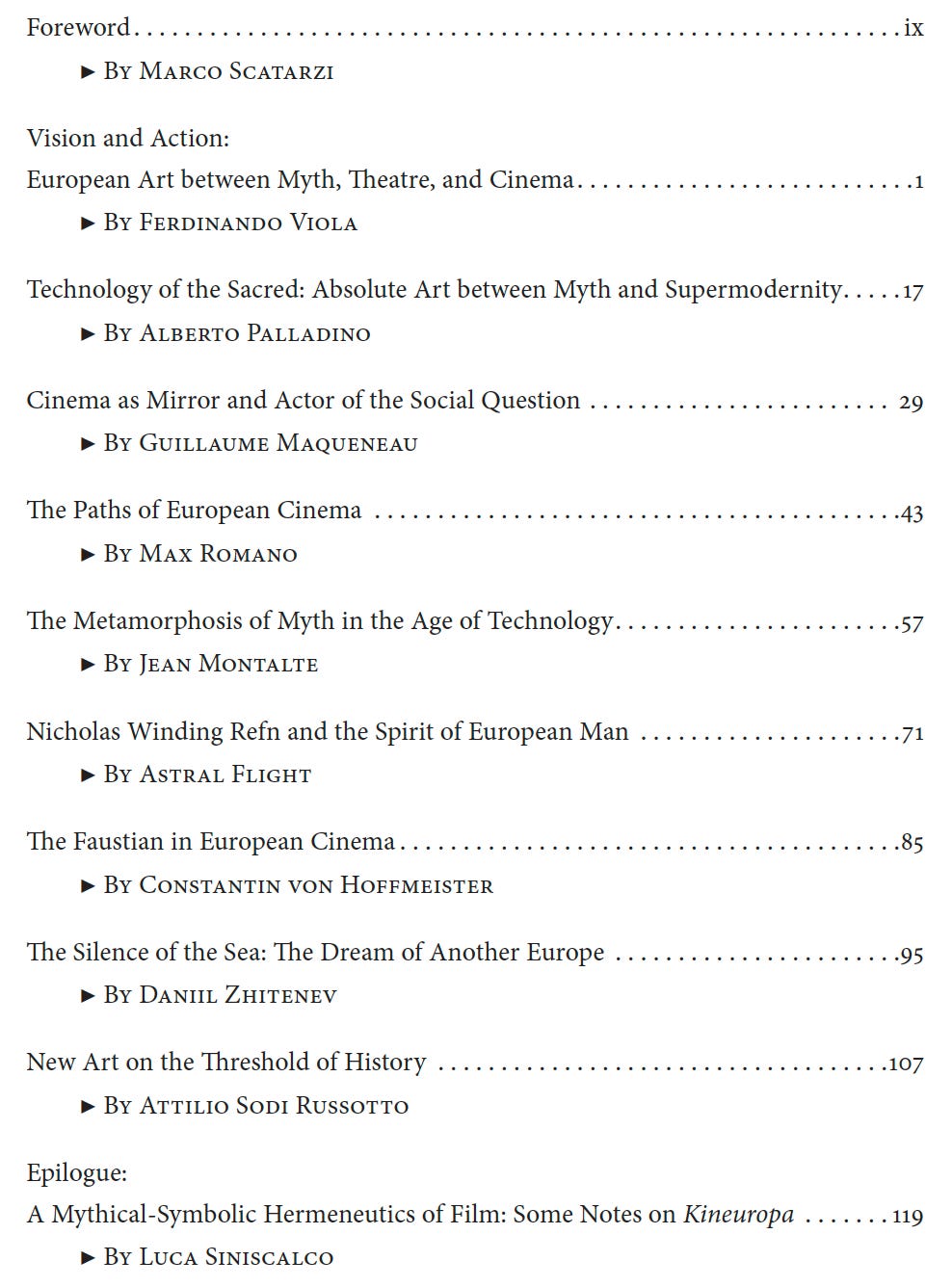
From the Foreword by Marco Scatarzi:
When we think of cinema, our minds more or less consciously turn to Hollywood. There is no conceptual superstructure that can prevent us from associating cinema with Californian studios; it is an automatic fact, corroborated by the decades-long global domination of the entertainment and show business industries, and it occurs regardless of our will, tastes, and inclinations. The American industry has been able to ride the wave of the Seventh Art to spread its way of life to every corner of the globe, permanently moulding that which some understood on the Old Continent long ago: “Cinema is the strongest weapon.”
On a trip to the United States, I had the pleasure of visiting Warner Bros. Studios and experiencing firsthand the technical prowess of this system, which combines professionalism and vision to forge narratives that serve as the soft power of American primacy throughout the world. The visit was impressive: we entered a vast space containing dozens of pavilions used as sets against the backdrop of a real city that had been meticulously recreated. Among the neighbourhoods of this “cardboard metropolis,” which was actually built at great expense, there were specially cultivated green spaces, ready to serve as the backdrop for any kind of film. In fact, I came across a corner of feudal Japan, built for The Last Samurai, which had the power to immediately transport me to the Land of the Rising Sun while I was still a stone’s throw from downtown Los Angeles. In one of the many warehouses, we watched the creation of a film set on California’s white beaches: entire truckloads of sand had been brought inside the hangar and powerful, state-of-the-art lights faithfully reproduced the sun’s effect, allowing the actors to film in comfort, free from the strong coastal winds.
This perfect fiction – a characteristic which is intrinsic to cinema – has replaced reality, creating an image of the planet for use and consumption: a genuine product, exported with meticulous precision and used to conquer souls. After all, we must admit with regret that not a single European generation in the last half-century has escaped imagining themselves as a Hollywood star or rock star across the Atlantic. German director Wim Wenders put it bluntly: “The United States has colonised our souls.” From yellow school buses loaded with students to long beaches populated by surfers; wide avenues lined with palm trees; fast-food restaurants with colourful signs; huge pickup trucks; and terraced houses with well-kept lawns and white picket fences – when visiting California for the first time, everything seems familiar. Rather than being a discovery, the trip is a confirmation: you experience firsthand what your mind has already absorbed over the course of your life, to the point of feeling a sort of latent “proximity” that leaves you bewildered and confused.
The infamous “American Dream” – which appears grotesque and hypocritical to the attentive observer, much like the society that created it – has imposed itself under this modus operandi. This exaggerated cult of the “self-made individual,” with its myriad petty-bourgeois confirmations, has effectively contaminated our horizon of meaning to such an extent that certain Europeans – perhaps more royalist than the King himself – now plead its cause with a vehemence that would make even the Yankees pale. Marco Tarchi explains this well in Contro l’americanismo (“Against Americanism”):
The idea of a global market promoted and pursued by the supporters of that model of mercantile society of which the United States of America is the most perfect and refined embodiment cannot, in fact, be separated from the uniformity in attitudes and behaviours of its potential customers and consumers. This automatically promoted the American way of life to the status of a paradigm to which every conception of collective life would have to conform in order to appear acceptable, as has indeed happened.
Werner Herzog said something similar to this effect, yet in less suspicious times, when justifying the setting of Where the Green Ants Dream among Australian Aboriginals threatened by rampant standardisation: “I fear that, in a few years, nothing will remain on this Earth but the culture of McDonald’s.”
However, the purpose of the excellent publication before you now, whose message is of fundamental importance in the battle for the rebirth of Europe currently being undertaken by certain cultural avant-gardes, goes beyond much-worn criticism of US supremacy, which, while unpleasant, is part of normal power dynamics. Our task, rather, is to promote a European resurgence in all areas, including cinema. This process may seem unrealistic, but it is nonetheless vital and necessary for the future of our continent. After all, many around the world have recognised this, and cinema often acts as a vehicle for the changes taking place. China invests vast sums in blockbuster productions celebrating its imperial past, reviving what Mao’s “Cultural Revolution” had erased. Turkey uses film to promote renewed Ottoman influences, rediscovering its deep identity against the grain of the secularisation process initiated by Atatürk. Russia celebrates its grandeur and attempts to present itself as strong and unified on screen. South Korea, like Japan, maintains a significant presence in the industry and is developing its own unique style. Therefore, cinema is the antechamber and megaphone of a historical phase; it has the power to spread a mindset much more effectively than social networks and the many technological tools that have emerged since its inception. Because, today as yesterday, making films means, above all else, wielding a narrative. As the founding European poems teach us, those who narrate set the course of history: they recount an experience, express meanings, and spread a message. Possessing this power undoubtedly shapes the present and makes one a protagonist in ongoing processes.
Although Europe still has enormous cinematic potential, it has also experienced a decline that has rendered it subordinate in other areas: the Old Continent, once a beacon of civilisation to the rest of the world and therefore the main actor of every upheaval and conquest, is now merely a passive observer of other people’s stories, often forgetting its own origins and destiny. One of these omissions concerns the birth of cinema itself: not only its creation by the Lumière brothers and Georges Méliès, but also the historical and cultural conditions that led to this discovery through the evolution of oral tradition, literature, art, technology and theatre over the centuries. If it is true that the Seventh Art is a creative act, it is also true that it needs a spark to unfold: a vocation for conquest and a vision of the world. Europeans have lacked that spark for the last eighty years. Dominique Venner recognised this when, through his sacrificial act in the shadow of Notre-Dame’s vaults, above the remains of ancient Gallic temples, he urged Europeans to “rise up against fatalism,” to awaken from the spiritual lethargy that has left Europeans weak, masochistic and resigned.
The crux of the matter is this: we must rise again, with nature as our foundation, excellence as our goal and beauty as our horizon, through the reaffirmation of an empowering myth that can invigorate our instincts, actions, processes and arts. In their original meaning, now distorted by globalist subversion, the arts always embody an ascetic path, because they elevate those who create and enjoy them. They link the real and the ideal in an organised cosmos that projects upwards and connects with the sacred. Understood in this way, cinema’s meaning also changes: rather than being a banal vehicle of entertainment, such as it has been reduced to by an industry primarily devoted to profit, it must return to being a source of verticality and beauty. This “doing” is not only “technical reproducibility,” but also and above all “the search for truth.” This revolutionary process, in which the term “revolution” returns to its original meaning of a “return to the origin,” can only manifest itself in Europe. It is here that the immovable source of this immortal heritage resides. It is no coincidence that the iconoclastic fury of cancel culture – whose woke excesses have primarily affected cinema, distorting its parameters and asserting a grotesque and psychotic aesthetic – has targeted European identity: behind the delirious accusations of “patriarchy,” “slavery,” and “racism” lies the fear of a much more complex legacy. This is the only legacy that has truly transformed humanity and survived even in the absence of its former global domination and real continental political unity.
This mystical force, which continues to flow like a karst river despite the forced uprooting of its “sacred citadels,” must be the driving force behind a new Renaissance. It is a long memory that turns into action, transforming heritage into commitment, suggestion into process, and will into power. Only in this way can we ultimately return to history. In our era, this return presupposes a coherent cinematic reaffirmation, for the Seventh Art has always been the vehicle, stimulus and confirmation of every change.
The pages that follow, being the first to address the issue head on, offer the ideas needed to inspire a radical reimagining of our culture and the practical revival of our arts. The enemies of our civilisation, both internal and external, would like to relegate our cinema to permanent sterility and passive, standardised entertainment. On the contrary, we envisage it like Albrecht Dürer’s knight, as described by Jean Cau: “Alone, at the steady pace of his destiny, with his sword at his side, the most famous rebel in Western art rides towards his destiny through forests and our thoughts, without fear or prayer. The embodiment of an eternal figure in this part of the world called Europe.”
Let the reconquest begin.
ORDER NOW

I just got this on Kindle and I'm reading the essays in it now. It's very interesting, and I'd recommend it.