In his own lifetime and in ours, Julius Evola stands out as many lives in one. Philosopher and magician, scholar and warrior, writer and mountaineer, avant-garde artist and political visionary — Evola’s words and deeds defy all the boundaries of the modern landscape. In Julius Evola: An Adventurous Life, Andrea Scarabelli presents the first comprehensive biography of the legendary Italian Traditionalist, drawing on archival documents, correspondences, and testimonies from across Europe and beyond.
Undermining long-standing clichés and bringing to light previously unknown materials, Scarabelli’s chronicle of Evola’s adventures weaves together a dual geography: Evola’s ‘inner landscape’ of militant political and cultural undertakings guided by his quest for reviving sacred Tradition, and the ‘outer landscape’ of the 20th century’s turbulent transformations. This unprecedented biography traces Evola’s many paths — through newspaper offices and silent cloisters, Dionysian nightlife and Apollonian ascent, the frontlines of wars and the behind-the-scenes of political regimes and dissident movements.
Evola’s life resurfaces in all its complexity and vibrancy at the intersection of action and transcendence, confronting readers with the challenges of a life lived in pursuit of higher meaning against the grain of the modern world, yet in the very thick of it.
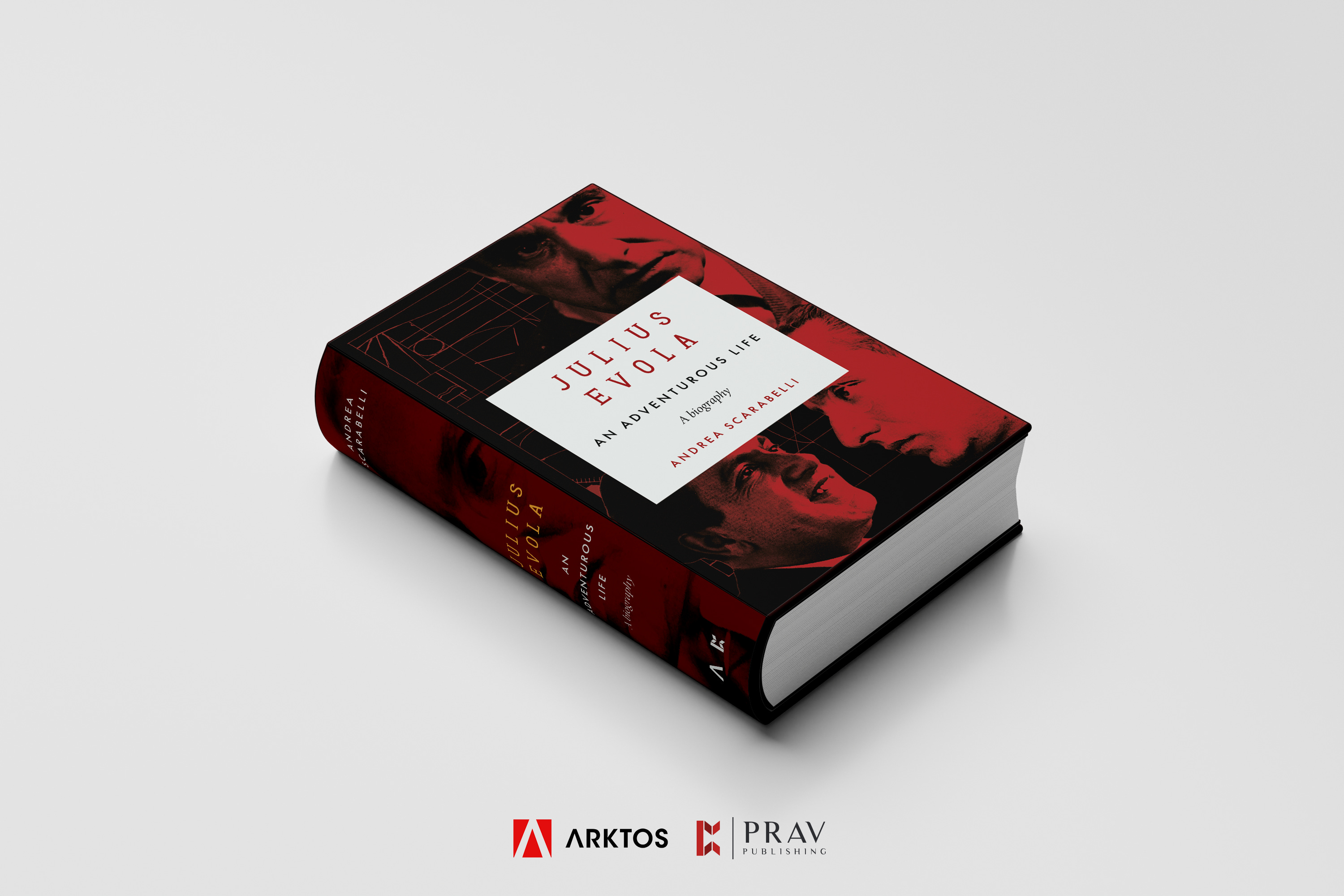
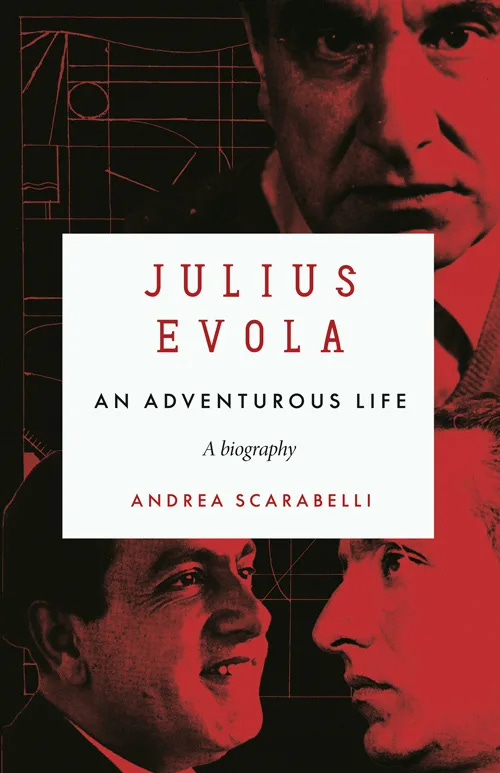
Julius Evola: An Adventurous Life is fresh off the press from Arktos and PRAV Publishing.
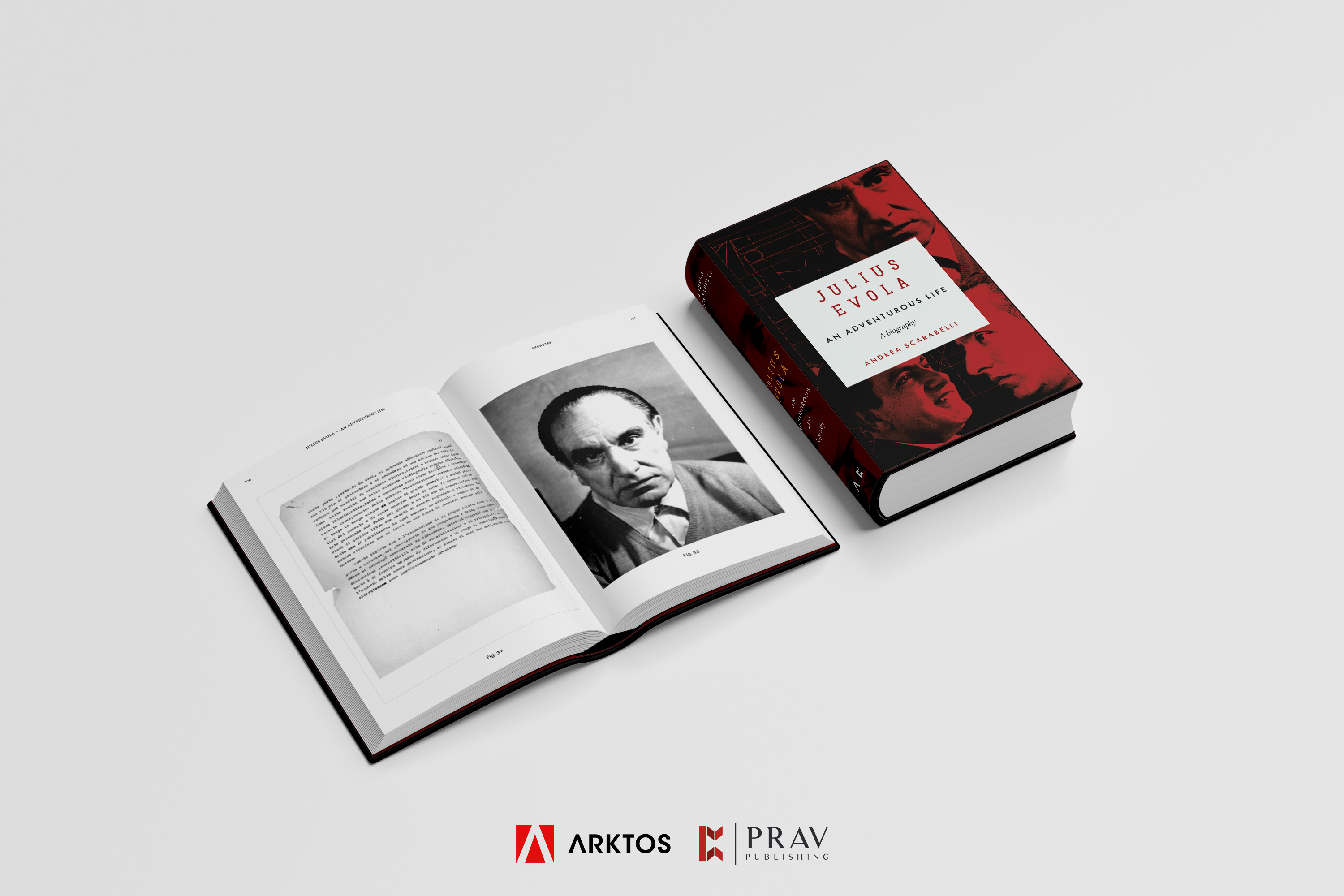
This massive, historic volume numbers 768 pages, includes 83 pages of archival images and documents, and features forewords by Alain de Benoist and Jafe Arnold.
Now available in the Arktos Shop (hardcover and paperback) and on Amazon (paperback and ebook).
From the Prologue:
21 January 1945
‘Where’s my monocle?’ asks a man on a hospital bed, waking up in the bombed-out Innere Stadt of Vienna after what seems like forever. The question is not a random one: he has been wearing a monocle ever since he was a young Dadaist in a tuxedo with green-painted nails, incensing the Futurists with blue flashes and alabaster, bringing the alchemy of the Dada gospel to the trendiest bars of the Italian capital. He also wears a monocle in the famous photographs featured in the books by race theorist Ludwig Ferdinand Clauss, some of which would attract criticism from readers of the journal La difesa della razza (“The Defence of Race”). Those were the years of the Fascist regime, and wearing a monocle had a special meaning. The people on the editorial board of Il Secolo Fascista (“The Fascist Century”), one of the many he frequented, all wore them: ‘If an intellectual wore a monocle, it meant he had an aristocratic view of life. It was the sign of an anti-democratic, anti-populist attitude’, and it equally meant that he was intolerant ‘of certain directions and certain orientations of Fascism.’
Let us go back to that cold Viennese hospital in January of 1945, the last act of the European War. Everybody knows the patient as Karl von Bracorens. He was on a mission to Austria to study documents on Freemasonry and to translate other ‘hidden’ ones, when he was caught in a bombing raid at Schwarzenbergplatz. After the impact, he woke up for only a few moments, just long enough to feel a burning sensation in his chest and to lose feeling in his legs. The sensation of falling, as if in an orgasmic embrace, accompanied the Buddhist vision of a diamond on a white sheet...
His memory returns slowly, in a steady stream of places: Italy, Germany, Austria and Tyrol, but also Capri and Anacapri, then Bucharest, Paris, Budapest, Amsterdam. A string of names: Arp, Mussolini, Reghini, Guénon, Tzara (who also wore a monocle). A cerebral machine-gun salvo, as the young Futurists might have called it in another age.
But now there is another problem. He does not know where his monocle is—which means that he does not remember that he has willed everything that has happened to him. Tracing the biography of a man—a real man, that is—always means answering this question. The more a man asks himself this question, the more worthy of interest he is. If not, it is better to consign his life to the oblivion of time. Julius Evola certainly asked it: that is the reason for the book you are about to read.
On that Viennese bed, Evola does not yet know it, but he will indeed find his monocle, and he will always wear it on a necklace — at court, or in his Roman apartment, where he will receive dozens of young people interested in his work. Only rarely will he wear it on one eye, often paired with a mysterious Viennese black onyx ring that some will identify as a ‘magic mirror’, to punctuate a pithy remark or a cutting joke.
As for the question — the meaning of that bombing — it will not be easy to answer, and he will spend the rest of his days pondering it. This question is the ‘mystery’ of Julius Evola, as Enzo Erra once put it; it is the nocturnal heart of his solar worldview, from which the various aspects of his work and cultural action stem.
This is the question — what follows is his story…
The release of Andrea Scarabelli’s biography of Evola is part of Arktos’s Monumental May — a month packed with releases by and about the legendary Italian Traditionalist, to be followed by many more.