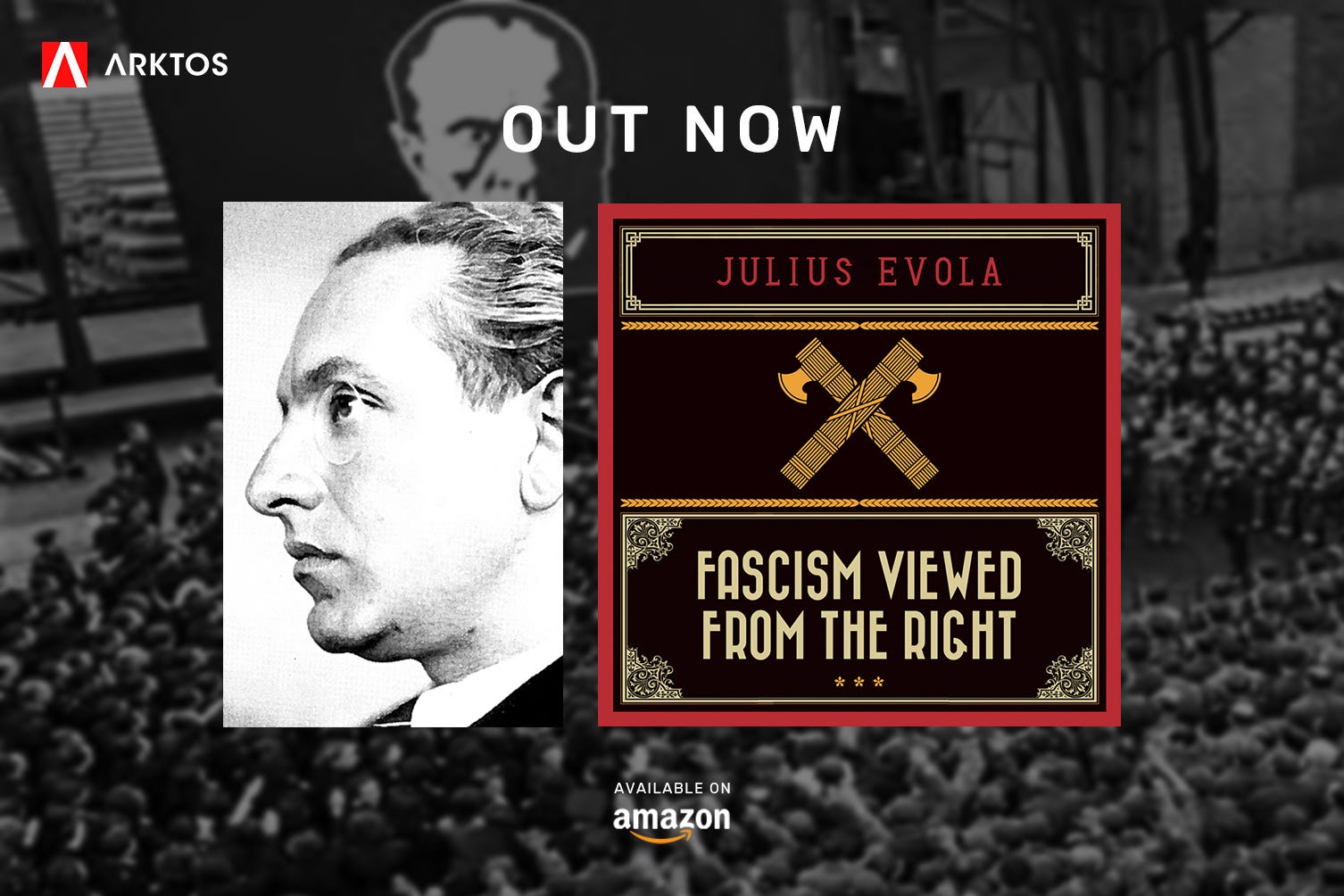
In Fascism Viewed from the Right, Julius Evola analyses the Fascist movement of Italy, which he himself had experienced first-hand, often as a vocal critic, throughout its entire history from 1922 until 1945. Discussing — and dismissing — the misuse of the term ‘fascism’ that has gained widespread acceptance, Evola asks readers not to allow the fact of Italy’s defeat in the Second World War to distract them from making an objective analysis of the ideology of Fascism itself, since the defeat was the result of contingent circumstances and the personalities of those who led it, rather than flaws that were inherent in Fascism as an idea.
Evola praises those aspects of Fascism which he believes to have been in accordance with the best traditions of European governance, in particular the Classical Roman tradition, while he remains critical of those aspects which ran contrary to this ideal, such as its socialist, proletarian and totalitarian tendencies, as well as what he saw as its petty moralism.
Evola also distinguishes between the Fascism of the ‘Twenty Years’ between 1922 and Mussolini’s overthrow in 1943, and the ‘Second Fascism’ of the Italian Social Republic, which he considered much more problematic. He likewise criticises the Fascist racial doctrine for being based on false principles. Frequently quoting Mussolini’s own words, Evola presents the core of the Fascist ideal, arguing that, for all its flaws, it remains superior to the political system which has since arisen to replace it.
Fascism Viewed from the Right is now available in audiobook on Amazon Audible.

READ MORE from Arktos:

In his own lifetime and in ours, Julius Evola stands out as many lives in one. Philosopher and magician, scholar and warrior, writer and mountaineer, avant-garde artist and political visionary — Evola’s words and deeds defy all the boundaries of the modern landscape.
In Julius Evola: An Adventurous Life, Andrea Scarabelli presents the first comprehensive biography of the legendary Italian Traditionalist, drawing on archival documents, correspondences, and testimonies from across Europe and beyond.
Undermining long-standing clichés and bringing to light previously unknown materials, Scarabelli’s chronicle of Evola’s adventures weaves together a dual geography: Evola’s ‘inner landscape’ of militant political and cultural undertakings guided by his quest for reviving sacred Tradition, and the ‘outer landscape’ of the 20th century’s turbulent transformations. This unprecedented biography traces Evola’s many paths — through newspaper offices and silent cloisters, Dionysian nightlife and Apollonian ascent, the frontlines of wars and the behind-the-scenes of political regimes and dissident movements.
Evola’s life resurfaces in all its complexity and vibrancy at the intersection of action and transcendence, confronting readers with the challenges of a life lived in pursuit of higher meaning against the grain of the modern world, yet in the very thick of it.