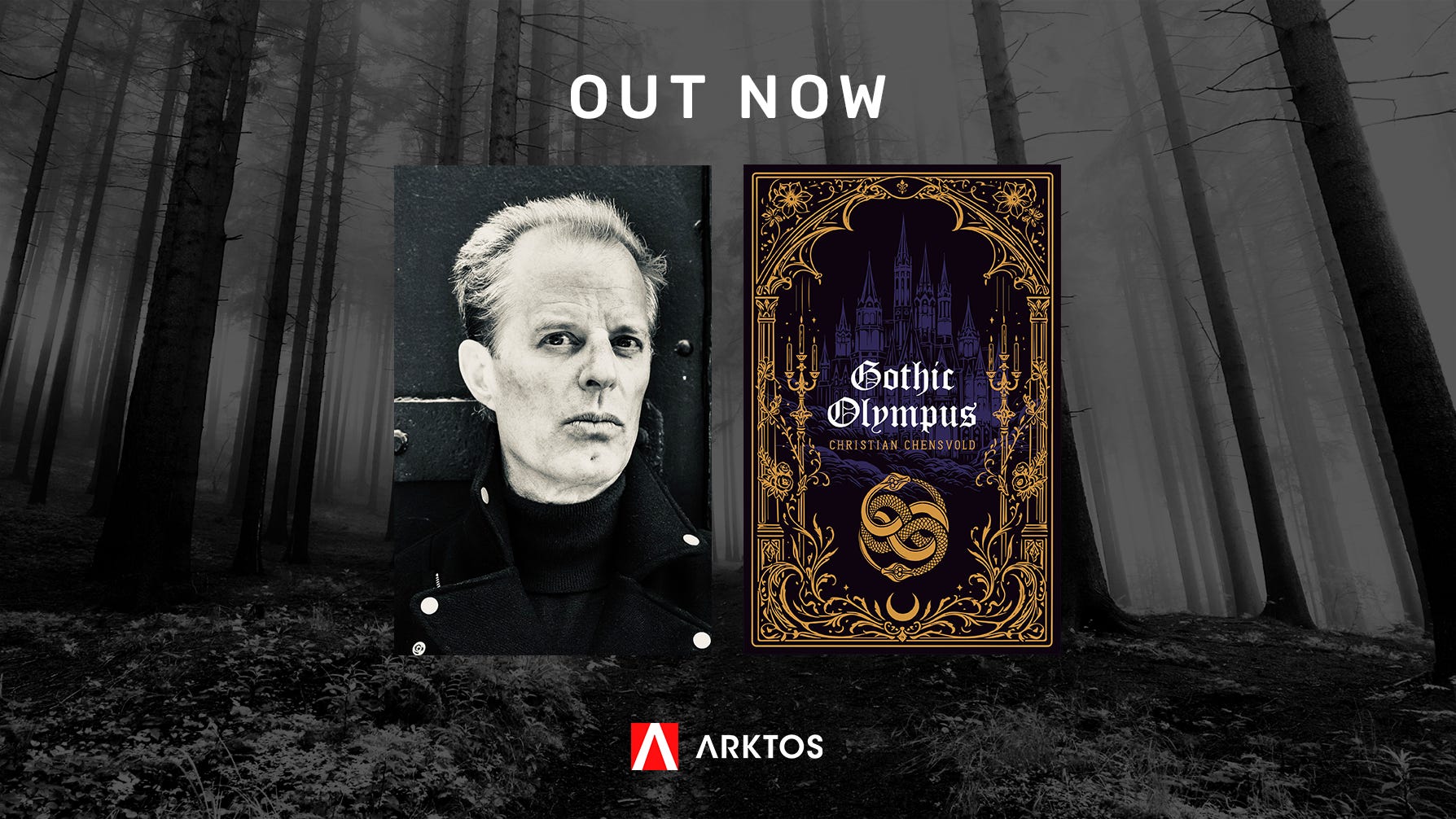
From Christian Chensvold, the author of the “Decadent Chronicles” series in Arktos Journal, comes the epic novel Gothic Olympus, hot off the press from Arktos:

When a mysterious inheritance leads Julien Stanwyck from the murky clubs of New York to the absinthe-soaked cabarets of fin-de-siècle Europe and the ruins of a family château, a drama of infernal torments and divine fury rattles the cage of the modern world.
Gothic Olympus launches the reader into the phantasmagoric odyssey of one man’s mission to reawaken the old gods and defy the onslaught of demonic collectivism and matriarchal tyranny. It follows Julien Stanwyck’s alchemical transformation from a pale, scrawny, angry young man into an Olympian sovereign who conquers death with the sword of Achilles, wins a goddess for a bride through initiation into the Mysteries of Sex, and travels through earthly and celestial realms to fulfill his destiny.
A mythopoetic allegory for the twilight of Western Civilization between the Belle Époque and the present dystopia, Gothic Olympus detonates the postmodern abyss through a pulse-pounding concoction of dark humor, occult wisdom, and virile spirituality, weaving Julius Evola’s revolt against the modern world with elements of steampunk, dark fantasy, and Decadence. Through the magic mirror of Stanwyck’s trials and adventures, Gothic Olympus is a riveting tale of heroism, a summons to metaphysical awakening, and a daring vision of the greatest force the world has ever known: European man’s imagination.
Excerpt from Chapter Six:
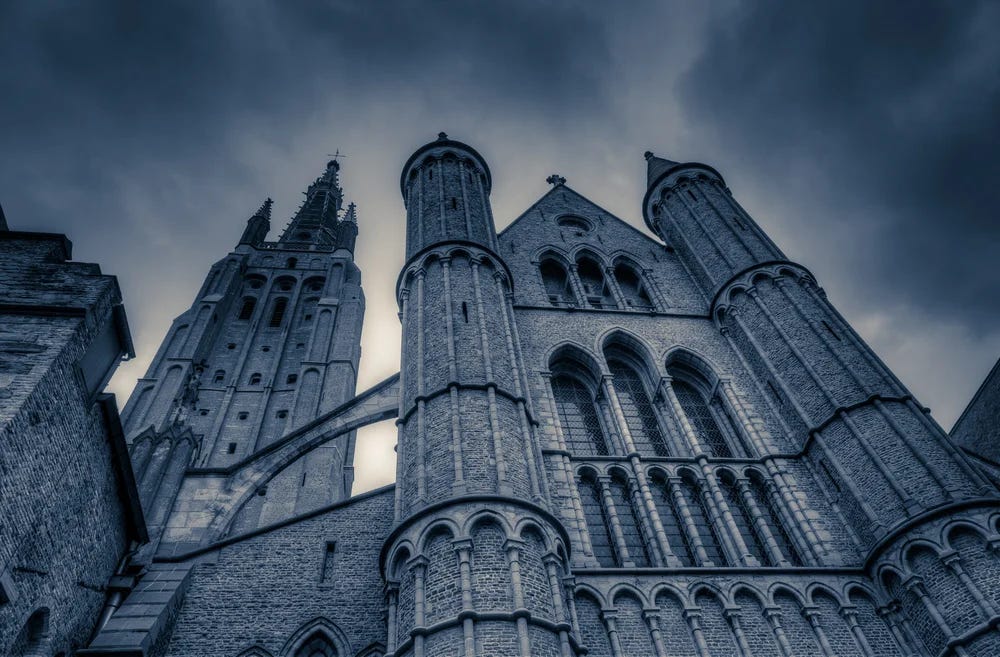
The Church of Our Lady was as quiet as the silent canals of Bruges. The sole sound was that of an organist practicing a piece by Franck with a single finger, filling the architectural masterpiece of the Medieval city with ethereal vibrations. Occasionally a holy man would pass through the empty church while Julien sat with his head bowed, inhaling a residue of incense many centuries in the making.
Then footsteps echoed through the church, followed by the sound of a person sitting down in the pew behind him. Over his shoulder Julien whispered the name of his contact, which the man confirmed, saying that he had come at great risk and could only spare a moment. Word of the king’s assassination and Julien’s fugitive status had spread through all the newspapers of Europa, with extensive descriptions of Julien’s conspicuous appearance, along with a warning that he was an anarchist seeking to take down every monarchy on the continent.
“What is happening?” Julien asked the man.
“The tide of the European people has reached its peak and has begun to recede into the cosmic ocean,” replied Rodenbach.
When Julien asked how to stop it, Rodenbach said that their enemy was neither a person nor a thing but a metaphysical force, and that if anyone knew the appropriate course of action, it was Zapfe.
“Who is this man Zapfe?” asked Julien.
“A magus of great power. He lives in a Hyperborean region. You could search forever and a day and never find his castle.”
The organ grew silent and three monks near the altar began speaking in low tones, their eyes aimed at Julien. Rodenbach warned that Julien had likely been recognized, and when the fugitive asked his contact to convince them of his innocence, Rodenbach brushed the request off as futile. “They are of a priestly nature, devoted to their savior from Bethlehem, and cannot be trusted to defend Europa from the evil that has befallen her, for they have not your regal spirit.”
“Then why did you choose to meet here?”
“Because it is a beautiful church,” said Rodenbach. “But it is beautiful not because it is a church, but because it is Gothic.”
He draped a hooded cloak over the back of Julien’s pew, instructing him to wear it as a form of concealment. He also set down a sack of provisions, money, and the address of the someone else who could offer refuge: Edvard Munch in Norseland. Julien slipped on the cloak and gave Rodenbach a letter to Zoe, along with the forwarding address.
In Oslo the artist took Julien to a cafe, where he explained the vision in 1893 that had inspired him to paint his famous bridge-bound screamer. “I could already see twilight falling across the continent,” said Munch, “and beheld a future in which society was no longer a living organism, but a collection of atomized individuals abandoned by heaven. They could no longer rely on the institutions they had created, which had turned against them as though demonically possessed. The response I saw to this existential situation was a terrified shriek, all the more horrifying because no one else could hear it.”
Julien visited the fjords and spent time in snowy solitude until he felt the call to disappear once again. Munch suggested he cross Scandinavia to Stockholm, and before Julien embarked a letter from Zoe arrived with sympathies for what had happened at the château. He replied:
Zoe:
I have become The Hermit of the Tarot, albeit of the fugitive kind. Write to me in care of August Strindberg in the Kingdom of Sverige, where I am now headed.
I neither feel like making music nor singing, but I wrote this sonnet for you, and offer it with my fondest wishes:
In the darkest year of my life, the end
  of a long-tossing inner tempest,
of stumbling along through crook and bend
  without a star to guide me from the forest,

I thought these sullen woods would ever be
  my mournful home, full of dragons wise
in torment, but which I came with time to see
  were mirages glimpsed through half-shut eyes.

And then, lo, there shone in the heavens an astral aide
  to guide me from gloom with glorious beam,
and I came upon a church, where inside was a maid

whom I’d seen before as if in a dream,
  with moon-washed skin and hair to blanket sorrow,
who spoke her name to me, and in doing so,

became real, though still like some damsel of yore,
and in my heart I felt open a long-closed door.
I hope to see you soon. Surely no one could find me in your mountain hideaway.
J.
In the Kingdom of Sverige Julien found the author having just published a novel titled Inferno, recounting his dark night of the soul. But Strindberg had emerged from inner turmoil only to find the outer world in crisis. “My mind’s eye has become obsessed with the breakdown of the family,” he said. “The cancer that will ravage individual households in the century about to dawn will infect all of society. Moreover, making men and women interchangeable citizens under the doctrine of equality will only drive them farther apart, their irreconcilable differences exposed once they become competitors in the capitalist arena instead of mutually dependent partners in accordance with divine order. All culture will perish under these conditions.”
Agreeing that Julien should stay on the run, Strindberg sent him to the painter Franz Von Stuck in the land of Germania. Hiding under his cloak and trying to be inconspicuous while he waited in train stations, Julien brooded over his morose tour of Europa. How majestic the Old World was, and yet Julien was forced to experience it in a constant state of fear, and all men spoke of was their sense of coming catastrophe. It was as if Julien were trapped inside some sort of Game That Must Be Played, and the name of the game was Decadence.
When he arrived in Munich he was given a letter informing him to meet the artist at Neuschwanstein in the Kingdom of Bavaria. There, in the most flamboyant castle ever extracted from the Gothic imagination, Julien was taken to the grotto where Ludwig II had dreamt away his kingship until 1886, when he walked into Lake Starnberg and never reemerged.
Julien found Von Stuck admiring the frescoes depicting scenes from Wagner’s music-dramas, and the artificial pond on which floated the bark of the swan-knight Lohengrin. The artist greeted Julien by explaining that the white swan was an ancient Hyperborean symbol associated with Apollo, god of the sun and lord of their people.
“I keep hearing of Hyperborea,” said Julien, after thanking the artist for giving him refuge. “Surely it was never real.”
“Perhaps in primordial times,” replied Von Stuck. “Now it simply endures as our spiritual wellspring, the place to which our race is returning after its long march through the annals of history. Do you know the philosopher Friedrich Nietzsche? He once wrote, ‘Let’s face it, we’re Hyperboreans.’ Somehow I know what he was trying to say. When a painting takes shape in my imagination, I feel I belong to forests and mountains and castles like this. But in my architecture, my creative work illuminated by the sun-god Apollo, I remain a neoclassicist. The Gothic and Grecian are but two streams flowing from the same Hyperborean fountain, inspirational forces of divine intelligence that live in eternity, in the infinite imagination of the Supreme Author.”
Von Stuck said he’d write to D’Annunzio at his home in the Florentine hills, the Villa della Capponcina, adding that the Italian might know a place on Capri or Lampedusa where Julien could find safety and cease his wanderings. The men shared a carriage ride through the mountains to the train station in Füssen, where Julien scribbled a letter, asking Von Stuck to post it right away:
Zoe:
I must see you. Everyone has been so kind in giving me sanctuary, but they want to make me an island castaway and I’d rather come to you in the Alps. For now, I’m off to Italia to meet the Superman Aesthete.
Yours,
J.
The tall, long-haired troubadour from the New World, clad in leather and velvet, and the short, bald Latin signore, dressed in a beige suit and sporting a preposterous boutonniere, did not vibrate on a harmonious frequency. D’Annunzio commenced an immediate tour of his property, recounting tales of the Villa della Capponcina as if speaking of his own ancestors.
As Julien Stanwyck had lost his mother, survived a maritime disaster, foiled an assassin, become a cabaret star, won and lost a noble estate, and was presently wanted for the death of the King of Gaul, he struggled to contain his impatience at the poet’s pontifications. D’Annunzio sniffed every flower in his garden, pronounced its Latin name as if eating a bon-bon, rhapsodized about the exquisiteness of its scent, and concluded with a scrupulous account of the flower’s rarity and cost. Julien pleaded fatigue from his travels and asked whether any letter had arrived. Indeed one had, replied D’Annunzio, whereupon Julien apologized and said that it was a matter of gravest importance that he read it immediately.
Dearest Julien:
Do not come here. Go to Venezia. In that town, you will find a discreet pensione called Hotel Ulisse. We’ll meet you there.
Zoe
It was the ideal excuse for a swift exit. As D’Annunzio summoned a carriage to take Julien to the station in Florence, he took the conversation in a different direction.
“All this talk of demonic possession spreading across Europa is just overwrought nerves,” he opined. “That said, I have recently had a recurring dream. The Epicurean sense of life to which I’ve devoted myself since 1889 with my novel Pleasure — I’m sure you’ve read it — has completely disappeared. To dress with dignity, daydream in the sunshine with a book of poetry, watching the birds and clouds and feeling part of an ordered cosmos — no one in the dream understands these things. They no longer fantasize, and with this has come the death of voluptuousness, or lovemaking pursued as an art form. Everything we take for granted — champagne and pastilles, perfumes mixing with our animal scents, fabrics and fashions and the decorating of bedrooms to entice the senses, the dance of seduction — all that is gone. What remains is only bestial coupling, which the people in this world eventually come to regard with disgust.”
Julien was repulsed by this diatribe and wished Signore D’Annunzio a swift end to such nighmares. But as he rolled through the Florentine hills, which were filled with fragrance and afternoon light, he meditated on his own erotic escapades and wondered whether he was a divinely inspired voluptuary or merely a crude beast. The cascade of memories rekindled his erotic appetite, and he vowed to head for the nearest brothel as soon as he reached Venezia.
But he left the Santa Lucia station only to discover the city wrapped in saturnine fog and pelted by rain. Clad in a black shroud, the gondolier was a caricature of Julien in his fugitive cloak as he rowed the visitor silently across the misty waters, filling Julien’s mind with images of Charon ferrying him across the river Styx. It was the time of the Festival of Redentore, which celebrated the end of a deadly plague in the 16th century. But since a new kind of plague had come to the city, far more sinister for its invisible origins, the festival had been canceled. Accustomed to purging supernatural energies during that time of year, the locals had donned their carnival motley and went about their daily lives in the rain with their faces covered.
…
READ FURTHER:

GOTHIC OLYMPUS awaits you: