


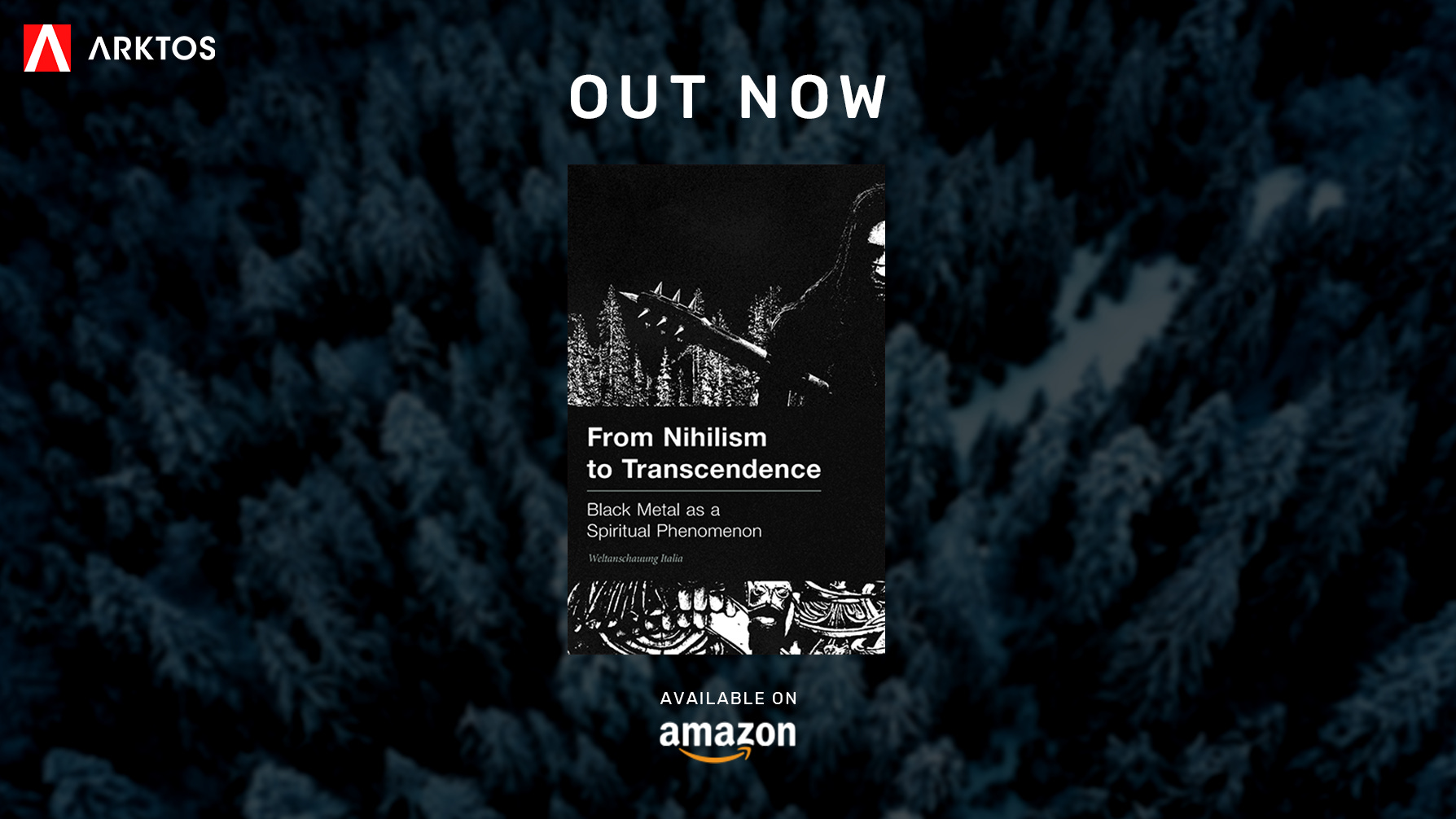
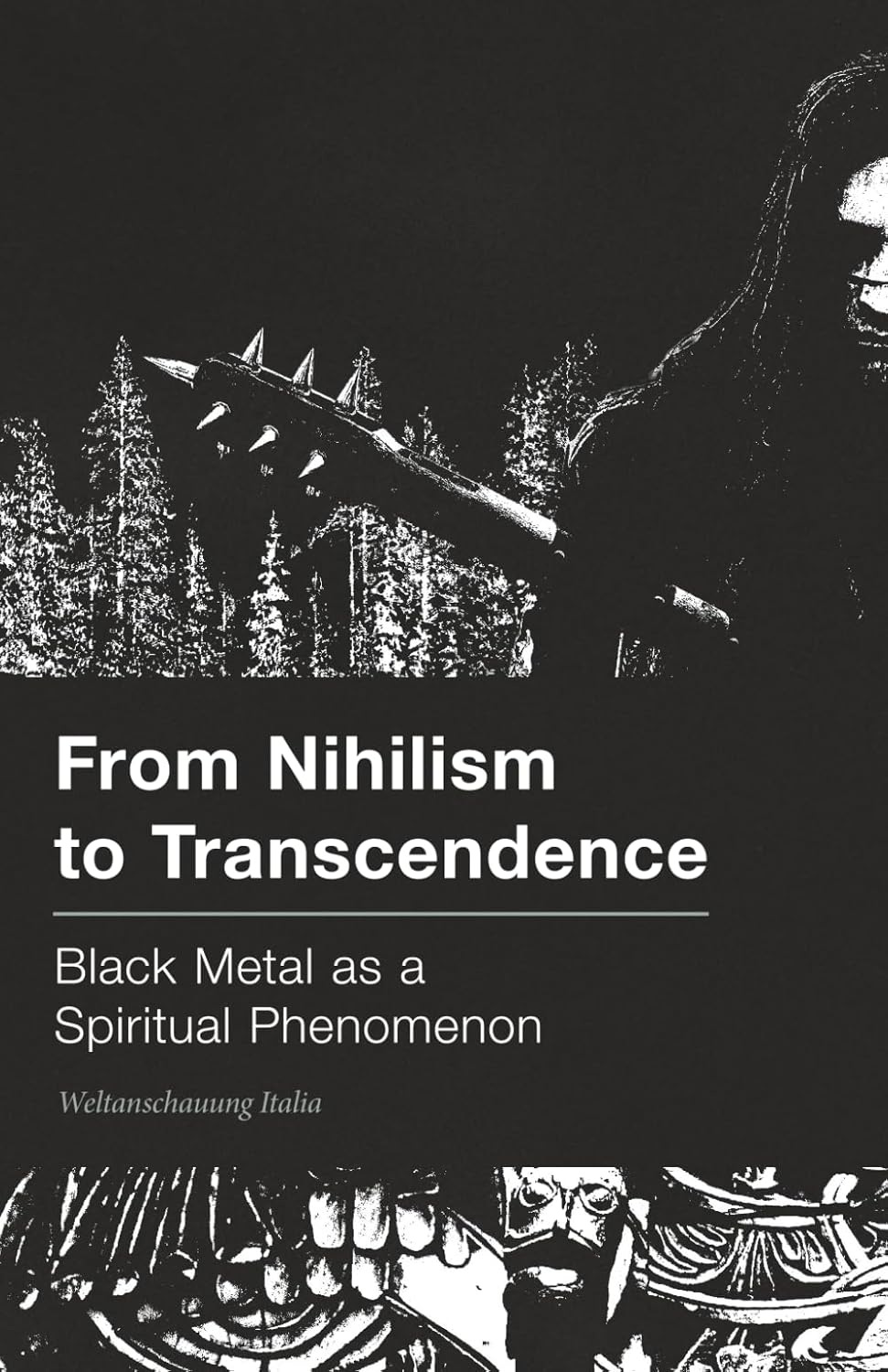
In the panorama of 20th-century music and subcultures, few phenomena have been so misunderstood and embodied such striking contradictions as black metal. From Nihilism to Transcendence: Black Metal as a Spiritual Phenomenon explores how this movement of rebellion, rejection, and darkness came to represent a spiritual and artistic laboratory for generations.
Tracing the genre’s origins, evolution, and main themes through a rich synthesis of musicology, sociology, and philosophy, From Nihilism to Transcendence moves beyond sensationalism and moral panic to uncover black metal’s paradoxical paths to rediscovering the sacred. Black metal’s soundscapes, symbolisms, and controversies are revealed in new light as creatively reflecting the fundamental, existential issues of our disenchanted and superficial age.
“For those who know how to go beyond the surface, beyond the noise and provocation, black metal will remain what it has always been: not a destination, but a powerful and dangerous means of embarking on that inner journey that every human being, sooner or later, is called upon to undertake.”
From Chapter 4 - “The Spiritual Dimension”:
Black metal is notable for its complex relationship with the concept of the sacred. Born as a rebellion against social and religious norms, this genre seems – at first glance – to be the antithesis of all things sacred. However, a more in-depth analysis reveals a surprising truth: through its apparent desecration, black metal often embarks on a profound and tormented quest for the sacred.
Iconoclasm as a Path to Resacralisation
Iconoclasm is a key element of black metal and is not merely an act of negation. It is an attempt to redefine the concept of sacredness itself. This strategy has its roots in a long tradition of iconoclastic movements, from the Protestant Reformation to the artistic avant-garde of the 20th century, that have employed the destruction of symbols as a means of accessing a deeper truth.
In black metal, rejecting traditional religious symbols and institutions does not necessarily represent militant atheism. Rather, it is a form of spiritual purification through negation. The inversion of the cross – for instance – is not only a gesture of contempt; it can also be seen as a return to the symbol’s origins, an attempt to purify it from the cultural and institutional layers that have distorted its original meaning.
This dynamic reflects what Mircea Eliade defined as the “terror of history”: the need to free oneself from the weight of historical traditions in order to access a mythical, primordial time. By systematically desecrating Christian symbols, black metal artists aim to return to a pre-Christian era, when the sacred was expressed through more immediate and visceral forms.
This iconoclasm also functions as a form of collective therapy for a generation who grew up in post-Christian societies where religious symbols have lost much of their evocative power, yet still exert an unconscious influence. Therefore, the ritual destruction of these symbols therefore becomes a process of psychological liberation, making room for new forms of spirituality.
Nature as an Alternative Temple
Wild nature is a recurring theme in black metal lyrics and imagery and often becomes the new temple of this alternative spirituality. Dark forests, snow-capped mountains and desolate landscapes are not just aesthetic backdrops; they are also seen as the embodiment of a primordial force that is considered to be more authentic and powerful than any anthropomorphic deity.
The sacralisation of nature can be traced back to German Romanticism and its rediscovery of the sublime in nature. As with the works of Caspar David Friedrich and the Sturm und Drang poets, wild nature becomes a place of spiritual revelation – a space where individuals can experience transcendence unmediated by religious institutions.
In the Scandinavian context, this naturalistic spirituality takes on specific meanings related to the relationship between Norse paganism and the forced adoption of Christianity. Norwegian forests are places of wild beauty and symbols of cultural resistance, holding a pre-Christian spiritual memory that black metal seeks to reactivate. Artists such as Paysage d’Hiver transform nature into a cathedral of sound, where cold, wind and isolation are elements of an alternative liturgy.
Seasonality is particularly important in this natural cosmology. Winter – which favoured by black metal imagery – represents not only death and desolation, but also purification and regeneration. The extreme cold becomes a metaphor for a spirituality that rejects the comforting warmth of traditional religions in favour of embracing the transformative harshness of extreme experiences.
This deification of nature is also evident in the concept of genius loci, the spirit of a place which many bands seek to capture in their music.
Reversed Nietzscheanism: From the Death of God to the Deification of the Self
The Nietzschean concept of “the death of God” finds its own peculiar interpretation in black metal, which goes beyond the simple denial of divinity. While, according to Nietzsche, the death of God paved the way for the Superman and the creation of new values, in black metal, this process takes on more complex and contradictory connotations. It is not merely a rejection of the concept of a deity, but rather an attempt to fill the void left by this absence with a new form of transcendence. The extreme individualism that is central to this genre can be seen as an attempt to elevate oneself to a quasi-divine state and become the creator of one’s own moral and spiritual universe. However, unlike Nietzschean optimism, black metal often portrays this deification of the self as a tragic and painful process. The individual who elevates himself to the rank of personal deity must confront the weight of infinite responsibility and the isolation that comes with it.
The deification of the self in black metal also takes on more subtle forms, linked to the concept of the artist as the creator of sound worlds. The act of composition becomes a cosmogenetic process: through music, the artist creates alternative universes where laws different from those of the ordinary world prevail.
Negative Mysticism: Achieving Enlightenment through Darkness
An obsession with themes such as death, emptiness and annihilation constitutes negative mysticism and aligns with traditions ranging from Dionysius the Areopagite’s negative theology to Zen Buddhism.
Many black metal artists seem to be searching for a form of enlightenment through darkness by exploring the darker aspects of existence, experiencing the sacred through denial and transgression.
This negative path manifests itself in different ways. On a textual level, celebrating nothingness, emptiness and destruction does not necessarily represent pure nihilism, but rather a form of catharsis through which to achieve spiritual purity. The annihilation of the ego – a recurring lyrical theme – echoes Eastern and Western mystical practices which view the dissolution of personal identity as the path to higher consciousness.
Musically, the use of extreme dissonance, disturbing frequencies, and compositional structures that challenge ordinary perception is an attempt to induce altered states of consciousness.
The concept of the “sublime” is particularly significant in this context. Romantic tradition, black metal seeks to induce in the listener an experience of negative sublimity: that feeling of vertigo and disorientation that arises from confrontation with the infinite, the immeasurable, the incomprehensible. However, unlike Romantic sublimity, which retained a consolatory dimension, the sublimity of black metal is deliberately unsettling and disturbing.
Mystical and Philosophical Traditions: Unexpected Convergences
An analysis of black metal spirituality reveals unexpected convergences with mystical and philosophical traditions that seem pretty far from the genre. These similarities suggest that, beneath its provocative exterior, black metal draws on profound currents of human spiritual thought.
The negative theology of the Christian tradition, which seeks to approach God through the denial of all his attributes, finds an extreme form of application in black metal. The systematic rejection of all spiritual positivity can be viewed as an apophatic approach to achieving a deeper understanding of the sacred. We will see this more clearly later on.
Gnosticism offers another particularly fruitful interpretative key. Like the ancient Gnostics, many black metal artists view the material world as a prison for the soul and seek liberation through esoteric knowledge. Their rebellion against the Christian “demiurge” mirrors the Gnostic rebellion against the creator god of the Old Testament.
Shamanic traditions offer interesting parallels, particularly with regard to using music to alter consciousness and communicate with other worlds. Many black metal artists describe musical creation in terms that closely resemble shamanic soul-travel experiences.
Left-hand tantrism and its practices provide another possible interpretation. Just as Tantric practitioners use sexual and transgressive practices to transcend moral conventions, black metal uses religious desecration to access higher states of consciousness.
The Psychology of the Profaned Sacred
From a psychological standpoint, the search for the sacred through profanation is a response to what C.G. Jung called the “spiritual disorientation” of modern man. In increasingly secularised societies where religious traditions have lost much of their emotional significance, black metal provides an alternative means of satisfying fundamental spiritual needs.
In increasingly secularised societies where religious traditions have lost much of their emotional significance, black metal provides an alternative means of satisfying fundamental spiritual needs.
Transgression becomes a mechanism for reactivating the sacred: only by violating deeply rooted religious taboos can the evocative power of symbols and concepts be restored, which secularisation has rendered inert. This process echoes that described by Georges Bataille in his analysis of eroticism: it is only through violation that one can access the experience of ecstasy.
The isolation and alienation that characterise many black metal protagonists are necessary conditions for intense spiritual experiences. As in hermitic traditions, isolation becomes a privileged path to encountering the sacred.
The symbolic violence of black metal is a form of release for the psychic tensions accumulated in societies that repress the expression of aggressive and destructive impulses. However, when channelled into artistic forms, this violence is transformed from destructive to creative and from nihilistic to the generation of new meanings.
The Sacred as a Process, not an Object
The tension between desecration and the search for the sacred does not exist uniformly within the genre.
Some artists fully embrace nihilism, while others move towards more explicit forms of spirituality, often linked to pagan or occult traditions. What remains constant is the desire to challenge conventional conceptions of the sacred and explore the extremes of human experience in search of deeper meaning.
An analysis the spirituality of black metal suggests that the sacred should not be understood as a fixed object or codified doctrine, but rather as a dynamic process of search and transformation. From this perspective, desecration is not the opposite of the sacred, but rather a mode of its manifestation. Through the systematic negation of traditional forms of sacredness, black metal creates space for new forms of spiritual experience to emerge.
This processual understanding of the sacred reflects broader dynamics in contemporary culture, characterised by the crisis of grand religious narratives and the need to invent new forms of meaning and transcendence.
Black metal, with its radicalism and intransigence, provides a laboratory for observing these processes of spiritual transformation.
In conclusion, black metal, with its apparent denial of the sacred, actually offers a radical reworking of it. Through desecration, this musical genre embarks on a tormented journey towards a new understanding of spirituality – a quest that reflects the complex dynamics of the human search for meaning in an increasingly secularised world, with all its intensity and contradictions. Its importance transcends musical boundaries to touch on fundamental questions of human experience: the relationship with the transcendent, the search for meaning, the need for forms of sacredness appropriate to contemporary sensibilities…
ORDER NOW, brought to you by Arktos:
This sounds like a profound exploration of black metal's spiritual dimensions beyond the surface aesthetics. The genre definitely transcends simple nihilism and taps into deeper existential themes.
Actually, I recently used Free Black Metal Logo Generator from https://www.namecheap.com/logo-maker/ideas/black-metal-logos/ for my atmospheric black metal project. The raw, illegible fonts and dark aesthetic perfectly capture that transcendent, mystical vibe. Created an authentic corpse-paint-era inspired logo in minutes. The templates understand black metal's visual language—essential for conveying the genre's spiritual atmosphere. Perfect tool for bands exploring those deeper philosophical themes through music and imagery!