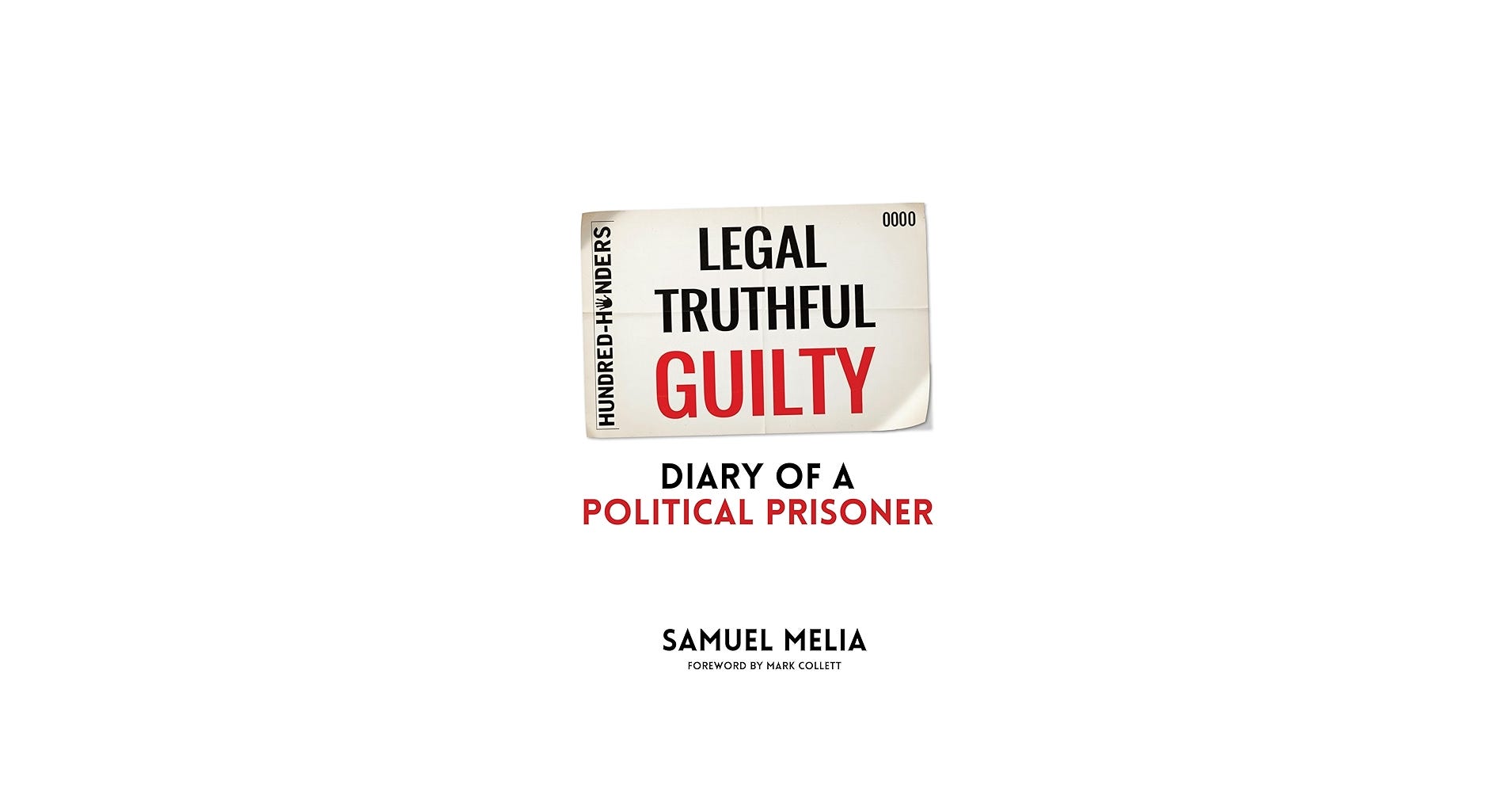
Legal, Truthful, Guilty is the story of how British nationalist, husband and father Sam Melia became a political prisoner.
The ‘crime’ for which he was handed a hefty two-year sentence? Producing stickers containing pro-white slogans such as ‘It’s OK to be White’, criticisms of multiculturalism, refutation of multiculturalist dogma — ‘Diversity did not build Britain’ being one example — references to anti-white mass crimes such as the Pakistani rape gangs, and various other messaging related to the worldwide war on Whites.
For this he was investigated and prosecuted by the police Counter Terrorism division, despite his eventual conviction being for charges completely unrelated to terrorism — specifically, publishing material intending to stir up racial hatred, and encouraging racially aggravated criminal damage. An extremely generous view is that this shows bizarre incoherence in our legal system — but it seems more accurate to call it a gross abuse of the law.
As Sam explains in the book, by the time of the initial investigation he’d already stopped work on the sticker project, known as the ‘Hundred Handers’, feeling he’d devoted enough time and energy to it. He’d initially decided on the stickers for White advocacy for two reasons — the first being disillusionment with some of the in-person meetups he’d attended organised by avowed patriotic and nationalist groups. The other was a massive increase in online censorship of pro-white, right wing voices in the wake of Trump’s shock 2016 election, and so Sam decided that stickering, and making the sticker designs available online for nationalists around the world, would prove an effective method of spreading pro-white messaging.
The prospect of being found guilty seemed unlikely given the stickers fell into the category of protected political speech, so when the jury declared a guilty verdict, it came as a surprise. Even so, it seemed things were tilted against him from the start. Sam describes the prosecution being permitted to make a series of unfounded accusations against him without interruption — he’d try to interject, raising objections via the judge as is common in American trials — only to be slapped down and told that he had to wait his turn to present his case. In this manner the prosecution got to plant a succession of ideas in the heads of the jurors in a long, unbroken stream of slander - that the stickers had been fitted with razor blades, that Sam had fraternized with violent extremists - without being challenged. He describes an American lawyer friend present at the proceedings, disgusted at this lack of fair due process.
The greatest shock was to come during sentencing as the judge, who Sam had perceived as sympathetic throughout much of the trial, handed down the two-year sentence. He described Sam’s views as ‘corrosive to our society’, branding him a ‘racist’, a ‘White supremacist’ and an ‘antisemite’ with ‘Nazi sympathies’, while openly declaring that the prison sentence was necessary as a deterrent. This was in spite of a pre-sentencing report recommending a non-custodial sentence, indicating that Sam posed no immediate threat to society.
I remember Sam’s wife Laura Towler describing the wait for sentencing to Mark Collett, the leader of White advocacy group Patriotic Alternative (Laura is the deputy). What was already an agonising wait was prolonged further when sentencing was postponed by another hour, after which she described the judge’s demeanour as having completely changed. Hearing this, alongside the judge’s decision to overrule the pre-sentencing report’s non-custodial recommendation, it sounded to me like the judge had been ‘spoken to’ just before delivering the prison sentence. We may never know, but one thing is clear; that day, Sam Melia became a political prisoner.

The investigation, trial and conviction form the first part of Legal, Truthful, Guilty, but the meat of it takes the form of the diary Sam kept during his sentence, ten months of which he spent behind bars, the remainder on licence at a supervised probation hostel.
To the majority of us with no experience of prison, it’s a fascinating topic. Few haven’t at some point wondered how we’d find life inside — your world reduced from near-endless possibility to the bare basics, with little beyond the minimum required to stay alive.
From the start, despite the shock of unexpected incarceration, Sam adapts well. Although not an experienced lag he is mostly aware of the unwritten rules of prison, such as never snitching / grassing and avoiding nonces wherever possible. As he soon learns, the main cause of problems on the inside relate to drugs and debt. The substance of choice in each prison he spends time in — and presumably most British prisons — is ‘Spice’, a synthetic cannabinoid made into paper sheets, generally consumed by smoking inside a vape. Partly for this reason, vapes and vape cartridges are valuable currency in prison, with even near-expended vape cartridges sought after by the desperate.
As you’d expect, Sam encounters all sorts of characters, many of them unsavoury, but he forms friendships along the way. Despite being forced to live alongside some very amoral people and behaviour, he never loses his own humanity - indeed one thing that repeatedly comes across is Sam’s big-heartedness. It’s a moving moment when, offered the opportunity to upgrade to a bigger shared cell, he decides to stay because his nervous younger cellmate, having just begun his sentence, doesn’t want Sam to leave, having already grown comfortable with him. In another kind gesture Sam leaves a written note for the autistic occupant of a cell he was tasked to clean, explaining why some objects might be in unfamiliar places, despite his best efforts not to disturb things.
Food takes on unprecedented levels of importance. With so little going on, even the basic prison fare is a highlight of the day. Sam works hard to accumulate extra credits and privileges just to be able to obtain better and indeed healthier food - a surprising amount of it seems to be junk.
Needless to say, throughout his sentence the biggest highlights for Sam are the visits from his wife Laura and their two children. One of the cruelest aspects of Sam’s imprisonment was being deprived of the birth of his second daughter. He describes the emotions overwhelming him during the visits, his older daughter visibly upset when parting, and the smiles from his new baby daughter. Interspersed and connected with these visits are increasingly excruciating dealings with various people and bureaucracies related to probation, rehabilitation and social services. As we soon learn, this was to continue for some time beyond the end of the prison sentence.
Sam does his best to be useful and productive while inside, taking jobs on the wing wherever he can - cleaning, distributing laundry and toiletries, and most memorably in the prison canteen, otherwise known as the servery. When he finally attains the position he wanted, serving food to his fellow lags, he soon becomes disillusioned. Several of his colleagues at the servery routinely hand out extra portions to their friends. Amounts of food and condiments are based on the number of prisoners, so this results in many going without. Here he finds himself in a tough situation. To challenge this practice would cause friction and make him enemies, and reporting it is out of the question - in any case the screws, AKA prison staff, seem to look the other way. Ultimately he’s unable to stomach the unfairness and amorality of it and leaves the position.
Reflecting on this, it occurred to me that Sam’s servery experience had much in common with multiculturalism. You can only have a high-trust society with high-trust people. When surrounded by those like yourself, behaviour like waiting your turn, queueing, a basic sense of reciprocity and fair play are taken for granted. Throw in just a few who aren’t like you, people who don’t share those values, and it all falls apart. It happens so often that policing it becomes too much hassle, so the authorities turn a blind eye, hence it becomes normalised and an unofficial part of the system. The selfish and amoral benefit, while those who abide by the rules effectively get stolen from and live as second-class citizens. Sound familiar? No wonder it sickened him so much.
Some details of life in these prisons - HMP Leeds and Hull respectively, surprised me - one being how easily and often people move cells by request or mutual agreement. It was also novel to learn how contraband, usually drugs, was frequently delivered to prisoners via drones, with prisoners accessing their payloads by cutting holes in the perspex(!) cell windows.
Naturally while inside Sam has a lot of time to think, and he reflects deeply upon multiculturalism, demographic replacement, the evil of the British state and the worldwide war on Whites. Major change from the current trajectory is vital - without it the future looks bleak. Though without Internet he has access to television, so has a limited window onto the world, albeit via the distorted prism of the mainstream media. He sees Israel’s slaughter of vast numbers of Gazans in relation for an attack on a few hundred Israelis, an Islamic terror attack in Moscow, and in Britain, the infamous slaughter of three little girls by the Rwandan immigrant Axel Rudakubana. He sees patriots smeared as evil in documentaries on the ‘far-right’, TV programmes endlessly blackwashing our history and culture, politicians demanding ‘safe passage’ for greater numbers of third world immigrants.
It’s hard to fathom the thought process which concludes that persecuting a White man for speaking out about the persecution of Whites will result in him changing his views - but aside from petty punishment, this really does seem to be the aim of the authorities.
The main villain at the heart of the story is of course the anti-white British state, but one individual stands out - not from prison, but from the Probation Office. Richard, dubbed ‘Dick’, reveals himself to be a truly contemptible character. Throughout their exchanges, both in person and via email, he engages Sam in political discussion, often in what seems like an attempt to goad him into incriminating himself. Reasoned debate goes nowhere - contradictions in his leftist worldview are simply brushed over, and Dick goes out of his way to make it clear he loves multiculturalism and open borders. Unbelievably, at one point he quizzes Sam about his sex life with his wife. Whether this reflects the grotesque overreach of the British state into the personal lives of its citizens, or Dick being a twisted pervert isn’t quite clear. I’d wager it’s a mix of both.
Sam is forced to have even more dealings with these state officials when he is released to the Approved Premises (probation hostel) a shared house with other ex-prisoners, where he is subjected to nightly curfews and electronic tagging. What really comes over throughout this section is the crushing, Orwellian bureaucracy of it all. It’s hard to keep track of exactly what all these people do - variously they represent the Probation Office, the anti-radicalisation program Prevent, and departments related to rehabilitation and child protection services. Aside from what seem to be frequent screwups, such as clerical errors or communication failures adversely impacting Sam’s degree of freedom and time with his family, there is an astonishing amount of meddling. Shrouded in the harmless-sounding, banal verbiage of officialease are non-stop attempts to interfere in Sam’s life, especially regarding his children.
Thankfully, in no small part due to the resolve of his wife in battling the meddlesome bureaucracy, Sam’s licence ends and he is finally allowed to properly rejoin his family. Now on the other side of the ordeal, he reflects on everything he has been through and unsurprisingly, emerges more resolute than ever. Having dealt with all manner of officials tasked with ‘reprogramming’ him, he is almost surprised at just how ineffectual they are. Not one of the officials is able to present anything like a coherent counterargument. As Sam puts it, none have arguments any more sophisticated than the standard shitlib (leftist) - only deflection, contradiction and denial. There are no great minds here - just hatred of White people and herd-mindset midwittery.
Jewish involvement at virtually every level of the war on Whites is no secret, but Sam’s story highlights an equally serious problem; our own people. From naive liberals filled with delusions about equality and cultural relativism, to hardened leftists programmed against their own people, one of our greatest weaknesses is our lack of tribalism. If there’s one thing we urgently need to change going forward, this is it. Every other tribe sides with their own, and this will only intensify.
Whilst characters like Dick may be far from the top of the tree, they are loyal footsoldiers for the regime and they are numerous. Dick epitomises the banality of evil; the exact type of malicious, petty, self-righteous, midwit apparatchik now embedded in every one of our institutions. Reading Solzhenitsyn, in whose footsteps Sam has now followed, we meet scores of such characters; these dull-witted, malevolent, day-to-day enforcers of oppressive regimes are a recurring archetype throughout history.
Reclaiming our future necessitates clearing these people out root and branch. The most appropriate name for them is simply traitors, because that’s exactly what they are; those of our own who’ve sided with the enemy. When the tables turn, these people must be shown no mercy whatsoever.
Though locked up for a relatively short time, Sam emerged to a world which had already changed, most notably regarding the Overton Window. Sam comes out of prison to hear politicians using the same type of language he was locked up for; even just two years previously, the phrase ‘Pakistani rape gangs’ was unheard of as part of official discourse.
These changes are very real. Social media is now awash with far spicier content than the Hundred Handers stickers. MP Rupert Lowe, also head of a fast-rising political party, has helped bring the topic of remigration into the mainstream - a party which, after so much political disillusionment, actually seems to represent the British people.
Sam addresses the sacred cow of the post-WW2 doctrine, and the necessity of stepping over it once and for all. I recently reviewed the excellent book American History Z by Joey Oliver about the radicalisation of the Zoomer generation and he addresses the very same challenge.

This is significant, because all these things indicate a long-overdue convergence in right-wing thought. Terms like ‘dissident right’ as well as those coined by our enemies, ‘far-right’, simply seem irrelevant now. There is no ‘civic nationalism’, only nationalism. There is only one ‘right’, and worldwide, we are waking up to the great lie. The winners of WW2 got to write history, but we were not those winners. If we were, we wouldn’t be in this position now.
Despite these very positive trends in the awakening of our people, the bad guys are still in power and Sam Melia is just one of many victimised by the anti-white state. One particularly sickening example was that of David Morgan, a young man of just 24 from Wales, classed as vulnerable, locked up for one year and eight months for ‘racist and anti-Semitic’ X posts after two Jews campaigned for his prosecution. His X account remains online because it did not even breach the terms of service. Peter Lynch, a 61-year-old grandfather from Barnsley locked up for his part in the Southport protests, would never make it out alive. He died in prison in an apparent suicide.
As I write, a new article about Melia has just appeared in the Daily Mail headlined ‘Neo-Nazi who was jailed for handing out racist propaganda says prison made him even more radical as he plans to rejoin far-right group Patriotic Alternative’. This is a useful reminder that the British anti-white establishment consists of far more than government and the judiciary. It permeates the mainstream media, as well as entertainment and education. It’s embedded into every area of public life. The headline reads just like the judge’s sentencing remarks. Pick apart all the sensationalist language - ‘Neo-Nazi’, ‘Racist’, ‘Radical’, ‘Far-right’ - and what do you actually have? Nothing but slurs, arbitrary labels we’re now more than accustomed to. They’ve been so abused they have no longer have any meaning. Again, what did Sam do? He didn’t assault anyone, he didn’t plan a terror attack, nor did he encourage anyone to do so. He simply advocated for his own people, his own race. In our anti-white system that alone is enough to earn all the labels above. By extension then, the same terms apply to millions of us.
The good thing is that in the court of public opinion, these words have no longer have any power. Scrolling through the comments is illuminating; they are all supportive of Sam Melia. I tend to view the Daily Mail comment section as a barometer of ‘middle England’ - conservative in spirit but not especially red-pilled, by which I mean right-wing, but too often fooled into thinking enemies such as neocons and Israel are the good guys. Like it or not, The Daily Mail comment section is representative of a broad swathe of the country and the voting public. In a word, normies. Go back a few years, find a similar article with these hysterical headlines about the ‘far-right’, and beneath it you might read comments like ‘what goes through these people’s heads?’ or ‘hope prison taught this idiot a lesson.’ Not any more.
We can only hope that Sam’s imprisonment and the brutally unjust, excessive prosecutions of those like the Southport protestors which followed soon after it, represented at least a temporary peak of anti-white state tyranny. The amount of resources, not least in terms of state officials assigned to Sam, is quite astonishing. Given he benefited from Labour’s early release scheme, it also brings home the fact that these resources are heavily overburdened. For those afraid of speaking out, whether online or offline, anonymously or not, it’s important to understand that it’s impossible for them to lock us all up. Our talking points are becoming normalised. We have to keep pushing relentlessly. What’s certain is that if we don’t fight back now, far, far worse will follow.
Legal, Truthful, Guilty is officially available from 24 March. You can order it here on Amazon and from the website run by Sam’s family, Grandma Towler’s, in digital and print formats.