


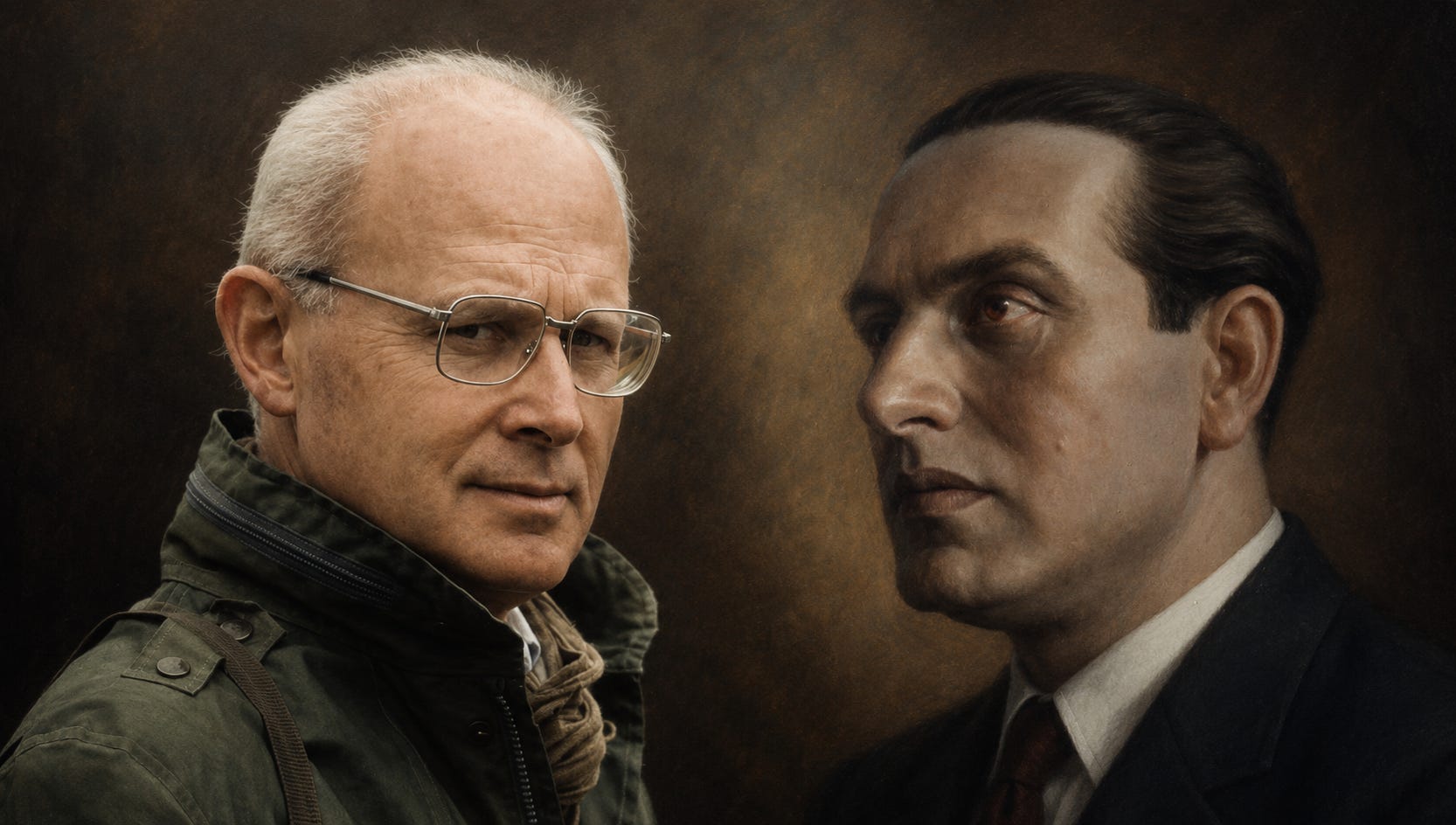
Considered by some to be “the greatest Traditionalist thinker of the West,” Julius Evola (1898–1974) always had uneasy relations with the Italian Social Movement (M.S.I.), while exercising a certain influence on the most radical circles, the Fasces of Revolutionary Action (F.A.R.), in its time, then Ordine Nuovo (New Order) and Avanguardia Nazionale (National Vanguard).1 Evola kept to the margins of Fascism throughout the Ventennio (1922–43). Despite his critiques, he would nonetheless remain in solidarity with the Italian Social Republic after 1943.2
Following both Nietzsche and Guénon at once, he cultivated, after the fashion of the first, a disdain for the plebs and a eulogy for the self-made overman. But he joined Guénon in his interpretation of history as a process of decadence and involution leading, according to the Hindu tradition, to the Kali-Yuga, the demonic age preceding the return of originary chaos. He was nonetheless ready to recognise that certain political forms, more or less in accord with his hieratic idea of Tradition, might delay that decline. Such was his interpretation of Fascism, to the degree that it might, through its attempt to rehabilitate heroic values, constitute a defiance against modern society and faceless mass man.
In the eyes of the militants and intellectuals of the young post-Fascist generation, Evola offered the advantage of beginning with a vigorous internal critique of Fascism, without ceding to antifascism. He offered a coherent and sophisticated worldview, pitiless towards modernity, against which he opposed a construction far more radical and absolute than that of Fascism. Condemning nationalism, for example, for its “naturalist” inspiration, Evola proposed instead “race of spirit” and “the idea, our true homeland” (Orientamenti [Orientations], 1950). What idea? That of a superior order, of which Roman antiquity, mediaeval chivalry, or Prussia were expressions. He proposed a lifestyle of severity, discipline, sacrifice, practiced as ascesis.
READ MORE — Evola’s Orientations is available in the volume A Traditionalist Confronts Fascism, brought to you by Arktos:

Evola was not a pure spirit. He’d served in the artillery during the First World War, and had been, in his youth, an excellent alpinist, author of the admirable Meditations on the Peaks. Upon his death, his ashes were deposited at the summit of Monte Rosa.
Around 1950, still believing in the chances of the M.S.I., Evola wished to give a warrior “bible” to the young militants of that movement: this would be Men among the Ruins, an essay prefaced by Prince Borghese. His hopes having been dashed, he distanced himself from the M.S.I. and from all political action after 1957. He published Ride the Tiger a little later (1961), a difficult work that contradicts the former. He essentially declares that in a world running to ruin, nothing is worthy to be saved, the only categorical imperative being to follow one’s interior way with a perfect detachment from all that surrounds one, but assuming what life offers to be tragic and painful.
This message roused a lively controversy among a group of those ironically calling themselves “Witnesses of Evola.” Some understood it as an invitation to retire from the world, others as an incitement to detonate decadent society. It was the latter part of the message that led the Italian adepts to that brutal activism which they manifested throughout the “Years of Lead.” Ride the Tiger reflected the disgust aroused among the most idealist activists by the mire of petty parliamentary politics in which the M.S.I. was stuck. But beyond that was the matter of the evolution of Italian and Western society under the thumb of consumerism and materialism.
In the course of the following decades, the proliferation of violence and left-wing terrorism had significant effects within the radical right that the philosopher influenced. The two principal extra-parliamentary organisations, Ordine Nuovo and Avanguardia Nazionale, had been dissolved in 1973, which provoked them to illegality; but this strategy was stamped out by repression.
However, a new generation went to work, which had given Evola a superficial read. Born after 1950, strangers to the historical memory of Fascism, they wilfully criticised the “veterans” of the M.S.I., and no less such fêted figures of rightist activism as Borghese, as well as their outmoded strategy of the coup d’état. The end of ideology and the primacy of action were announced with conviction. For this generation of rather young militants, confronted by the void of old, dead values, combat remained as an existential value.
“It is neither to power that we aspire, nor to the creation of a new order,” one reads in 1980, in Quex, the newsletter (bulletin de liaison) for political prisoners of the radical right. “It’s the struggle that interests us, it’s action in itself, the affirmation of our own nature.”
The influence of Ride the Tiger is evident. But what, with Evola, was meant to result from an interior ascesis, was here reduced to its most brutal reading, through an identification with the simplistic “warrior” myth. This tendency led to the ad hoc theorisation of “armed spontaneity” (spontaneismo armato) as much as to the retreat to an esoteric ivory tower.
Originally published in Nouvelle Revue d’Histoire no. 37 (2008)
Translated by F C
READ MORE by Dominique Venner, brought to you in English by Arktos:

OUT NOW: the first definitive biography of Julius Evola, Julius Evola: An Adventurous Life by Andrea Scarabelli:

[Translator’s note:] Venner glosses over complexities here. The F.A.R. (1945/6–7) antedated the M.S.I. (1946–95). Centro Studi O.N. split from the M.S.I. in 1956, to be succeeded by Movimento Politico O.N. in 1969 and Ordine Nero in 1974. A.N. split from the M.S.I in 1960.
[Editor’s note:] To the contrary, although he commended their fighting spirit, Evola was highly critical of the RSI and refused the offer of an official position. On this and other aspects of Evola’s critique of Fascism, see Andrea Scarabelli, Julius Evola: An Adventurous Life (PRAV Publishing & Arktos, 2026) and Evola’s comments throughout the volumes Fascism Viewed from the Right, Notes on the Third Reich, and A Traditionalist Confronts Fascism.
Venner's "30,000 Years of Identity" is going to be the book of the year. I can't wait until that comes out.