


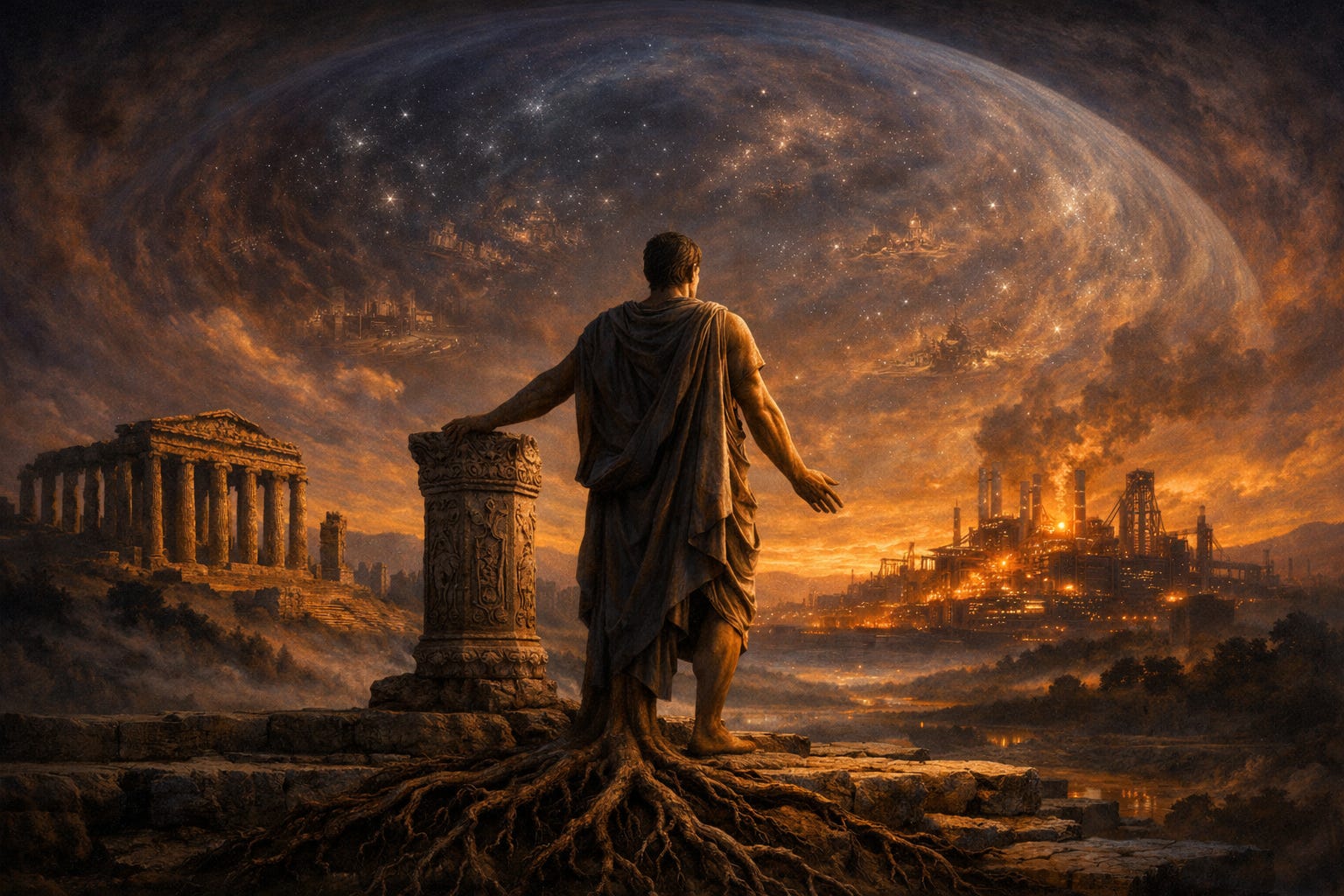
Robert Dragan, of Terre et Peuple, draws on the thought of Giorgio Locchi and Guillaume Faye to explore whether a revived "pagan spirit" can serve as the metaphysical foundation for a renewed European civilization. Moving through Nietzsche's diagnosis of Western nihilism and Heidegger's response to it, Dragan argues that neither Christian metaphysics nor Enlightenment rationalism can provide the cultural and spiritual grounding that European civilization requires.
As every civilization rests upon a metaphysical and religious foundation, it is essential, in order to reconstruct a durable political entity, to establish its rules.
Now, setting aside all purely religious questions, it is on the philosophical question of knowledge that Europe has experienced, at different periods of its History, a rupture. The Institut Iliade had the good idea of publishing a series of texts by and around the thought of Giorgio Locchi, the man who trained the cadres of GRECE at its inception. These texts illuminate the thought of Nietzsche and Heidegger. The former had the prescience that the salvation of European civilization required a philosophical revolution, a radical change of perspective. The latter took up the question of the philosophy of knowledge, less as a pure metaphysician (it is known that he taught Aristotle and retained an intact esteem for him1) than as an analyst of human acts.
The Ambiguities of the Rejection of Metaphysics
“Both Heidegger and Nietzsche identified the primary origin and cause of the nihilism of Western culture in ‘metaphysics,’” declares Giorgio Locchi. Aristotle affirmed the five principles of the origin and unity of the World, through rational but purely intellectual demonstrations: such is, moreover, the meaning of the word meta, beside, and phusis, the sensible world capable of being measured. What could be drawn from this? The thesis of an “immobile first mover, unmoved by any other mover” could lead to the idea of a Creator external to and distinct from Creation. By its very nature, it was impossible to know anything whatsoever about it. Of acts outside the World (outside time and space), in particular those of this Creator, it was — and remains today — impossible to know anything. And the Catholic Church arrived at the same conclusions: “God is infinite and incomprehensible” (Saint Pius X, Catechism). It was nevertheless, according to Guillaume Faye, the strength of our civilization to frame our relationship to the world in these terms: “the metaphysical world-view carried within itself, unknowingly, the Will to power: to think the world in terms of the universalism of essences was to manifest a prodigious will to master and dominate it.”
This enterprise produced two outcomes: the Christian religion and the ratio-scientistic hope of the Left.
“The biblical religion is based on revelation, not on nature,” Guillaume Faye specifies. If metaphysical questioning can prove to be a sound logical method, it does not lead to a total perception of reality. The Council of Trent affirms: “for our soul to be able to rise to God, it is absolutely necessary that it be entirely freed from the senses.” Without the support of faith, Man alone is despairing: if his question is good, the answer no longer suits him once “God is dead,” as Nietzsche says. Guillaume Faye specifies: “the death of God coincides with the ‘beginning of nothingness.’ Nihilism marks the end of the possibility of all value. The human is placed before the void, stripped of ‘a supra-sensible world with binding power.’”
Nietzsche thus depicts the “Last Man” — the Man of the decline of Christian civilization: he attempts to preserve the cultural treasures of past centuries (architecture, literature, music, art of living) but nihilism gnaws at civilization, and he is powerless to hold back the falling tree: the “Last Man” is the most unhappy of men.
Another seeker of the Universal, enemy of the first, is the modern Thinker, imbued with the principles of the “Enlightenment.” He is the father of the Left, which aspires to universal Truth through the overthrow of Christian civilization. But its laws — Humanism, Scientism, Universalism — are equally powerless to arrive at an explanation of the World or to create an ideal political order, insofar as its presuppositions also partake of “Revelation,” this time that of the “Enlightenment”: equality of men, myths of the “noble savage,” of the “invention of property,” of the harmfulness of “Society.” According to Guillaume Faye, “a world conceived as law, as a principle finding the reality of its essence independently of life and human action” can only lead to nihilism.
According to Giorgio Locchi, “the human person is always ‘I,’ and within the ‘I,’ represents itself.” For Nietzsche, “the human being is an animal ‘devoid of instincts’ and, from this point of view, ‘indeterminate,’ ‘sick.’ Man, unlike any other living being, has no ‘nature,’ which compels him, if he is to survive, to equip himself with a substitute for nature, namely a ‘culture.’” This is why, according to Guillaume Faye, if “the Platonic heritage means that the world has become a metaphysical, theological, and then scientific ‘image,’ it virtually creates another: the subject, who thereby becomes the ‘measure of all things.’”

Human reason nevertheless strives to understand nature, in the Aristotelian manner, “for the simple reason that nature is our environment, and we do not doubt it”: we attempt its “unveiling through enframing (Gestell — a Heideggerian term),” says Guillaume Faye. Thus, he takes as an example mathematics, which “do not ‘describe’ anything of nature, but are the expression of a human aim toward nature, ta mathèmata, in Greek meaning ‘the things known in advance.’”
The existentialism of identitarian philosophers is therefore not guided by a theory of knowledge affirmed as purely nominalist, but rather belongs to a pragmatic principle of action.
Giorgio Locchi notes that for Heidegger, “the substance of man is not the spirit, but rather historical existence.” Consequently, the “fundamental structure of the person is identified in ‘being-in-the-world’ (In-der-Welt-Sein). Man, in order to exist, must create himself and, with ‘culture,’ create his own ‘world.’” He joins Nietzsche, for whom Man is compelled to equip himself with “a culture within which ‘custom,’ supported by ‘institutions,’ plays the role of instinct.” Life is built not according to a disembodied absolute, but more modestly through insertion within a harmonious community. Death is transcended therein, not as in Christianity through its erasure, but through the certainty of seeing the community and the culture in which we were born and lived endure. Man thus measures the limits of his sphere, and it is the political that gives him that measure.
Metaphysical questioning is a method for building the law of logic. But it does not lead to a total knowledge of reality. It is not a matter of rejecting it but rather of freeing oneself from the illusion that it would provide an absolute answer.
From paganism, one must not ask more than it can give.
Da Sein, Spherical Time
Thus freed from our appetite for total knowledge, we refocus on the realization of our existence.
On this subject, Giorgio Locchi specifies that “we can only represent time, as movement, through the linear and within the linear, and the movement of history only in a linear manner, as a succession of point-like moments, and we do so ‘quite naturally’ by projecting historical time onto the ‘line’ of biological and macrophysical time.” To the one- or two-dimensional conceptions of linear, cyclical, or segmented time, Heidegger (in Introduction to Metaphysics) substitutes a “three-dimensional” conception inherited “not from Nietzsche, but from Sophocles and the Greek tragic poets from whom Nietzsche himself had drawn” (Guillaume Faye). For Giorgio Locchi, “each ‘moment’ can and must be considered simultaneously as beginning, as center, and as end”; for “at every moment being begins,” in each “now” history begins: “the center is everywhere.” Presence in the world — Dasein — “is always at the threshold of itself — and of history.” What is true in the physical world and in life is not so in history, where “past, present, and future are always simultaneously present, configured as their ‘intimacy’ by a ‘present’ that is none other than Dasein itself.” Mentally, we carry memory, and we project ourselves toward the future. The present exists only through action. This memory is history, not in the sense of Geschichte — the History of academics, made up of “a succession of facts, of narration, of scientific interpretation or explanation of facts” — but in the Heideggerian sense of Historie — History lived and integrated by the individual: for Locchi, the “essence of Dasein resides in its historial existence” (das Wesen des Dasein liegt in seiner Existenz), the adjective “historial” expressing this enframing (Gestell) of reality, necessarily subjective. It possesses four dimensions, one spatial and three temporal. The “sphere” is, according to Armin Mohler (Die Konservative Revolution in Deutschland 1918–1932), its best conceptual translation, better than the circle illustrating the Eternal Return, which implies that time would be cyclical, and therefore that, as in Hinduism, cycles once completed would return to their point of departure.
The decline and death of peoples derives, according to Guillaume Faye, from an “inauthentic conception of temporality (Zeitlichkeit). Man refuses to be what he is, a being-toward-death (Sein zum Tode), and numbs himself with the illusion of a desire for eternity that he believes he finds in daily worldliness. Such a conception of time rests on ideas of ‘the end of death.’” But with the death of God, we have entered “the piercing anguish of one who believed and no longer believes”: its dominant type on the right is Nietzsche’s “Last Man,” imprisoned within “the error of traditionalists and conservatives [which] is to think the content of what is transmitted as absolute.” A second type exists, the Left, which bets on a “linear end of history comparable to those found in the philosophies of ‘progress’”: it chooses the “consoling intoxication of facticity, or the nihilism of the modern world.”
Now, the past “is only the forgotten, fetishized result of past revolutions, of founding and creative acts, the choice made by some ‘founding hero’ among an infinity of possibilities.” According to Heidegger, “the beginning is still there. It is not behind us as something that was long ago, but stands before us.” Locchi shows that “it is each time a matter of destroying one past and constructing another. The ‘decision’ about the past is always — ‘co-originally’ — a decision about the future: it is the same decision. Thus is founded the historical freedom of man. And since Dasein is always overtaken by life, Dasein finds itself always at the threshold of itself — and of history.”
Toward a Historial Civilization
Values, from the Last Man to the Will to Power
If Nietzsche considers that our civilization is experiencing nihilation (Nichtung), Heidegger announces the post-nihilism.
It is not a matter of substituting a new “back-world” for Christianity. Still less of reinstating a “tawdry paganism,” as G. Faye calls it, such as a flight toward the Gods of ancient Greece. Nor is it a matter of preserving desacralized metaphysical values: the world of the “last men” paradoxically finds refuge in a kind of “morality of pleasure,” thus placing their “subversion” under the sign of bourgeois softness.
Heideggerian Dasein has no need of the lying myth of “victory over death” in order to act. Heidegger proposes to “suppress the very location of values, the supra-sensible as a domain, and consequently to posit values differently.” For Nietzsche, it is the “Will to power” that is the fundamental trait of life: values must henceforth be experienced as existence, not as essence. The struggle for the “dominion of the earth” is henceforth alone capable of restoring a sacred meaning to the existence of consciousness: “the man whose essence is that which is willed from the Will to power, that is the Superman (Übermensch), the one who must hold irresistible power (Übermacht) to accomplish his sovereignty,” says Heidegger in Off the Beaten Track.
To the logos of the metaphysicians is substituted the sacred and the mobilizing affectivity of muthos — myth: implicit values will no longer be words, but behaviors, a poïesis in the most authentic sense, a weltanschauung of which only poetic language can give an account.
Contemporary with the Conservative Revolution and ideally close to it, Heidegger was able to think further. “God is dead,” Nietzsche said. For superhumanism, man as a historical being can freely forge his own destiny. This requires first freeing oneself from one past and choosing another. “We must find the gods again,” Heidegger responds: the Greek recommencement is possible.
It is therefore indeed a kind of “paganism” that Heidegger assigns to modern times.
Technology as Expression of the Will
For Heidegger, the “men of happiness” deprive themselves of the only virtual form of modern spirituality: the Will to power in action within technological enframing. This is what G. Faye explains.
Modern technology seems to “cut us off” from nature, when in fact it brings us closer to it, for it brings us closer to its energy. In ancient Greek, energia moreover meant “presence.” This “unveiling of energy” belongs to the enframing (Gestell) of the world, the concrete expression of the Will to power. Against the noetic will to power (nous, “spirit”) of metaphysics, he opposes the path toward a poietic will to power. Téchnè is part of pro-ducing, of poiésis. Through an “audacious” project of a hyper-technicized world that wills itself as such, Europe, for Heidegger, will restore meaning to its “historial” existence. As soon as the technological age is inaugurated, this will to conceive the world, hitherto intellectual, unveils itself as reality: the human then takes the measure of his strength and can posit himself as value. Far from the devalorizing conception of nature, technical production must ultimately be understood as an unveiling, an unveiling that “the Greeks,” Heidegger writes, “called aléthéia, and which the Romans translated as veritas.”
Modernity brings, through scientific and technical power, a greatness capable of lastingly transforming mentalities. It offers the people a new “historial” mode of being-in-the-world, according to Faye drawing on Nietzschean categories, a “conscious and organized, Apollonian, spiritualization of the Dionysian will to power at work in technology.”
The Historial Community
The essential characteristic of every other living being is Arteigenheit or Artmässigkeit, the belonging to and conformity with its own species. Man is acted upon; he does not act. For reasons that are first biological: the community is rooted in the “physiological” being-in-the-world of the people, which transcends the separation between consciousness and nature, between thought and life. Then for cultural reasons: “the actual human person is ‘thrown at the origin into a common world already discovered by Others.’” According to Heidegger, “I am (sum) not I in the sense of my own Self, but I am (sum) the Others in the manner of the One (On).” For Locchi, “the existing man, Dasein, totalizes in his present the ‘having-been’ (Gewesenheit), which he assumes, and the ‘project’ (Entwurf) in which he participates in connection with his own. The conjunction of the past and the ‘ad-vening’ project renders the past present. The latter, like the future, is rendered present in the now. Individual existence confounds its ‘subjective’ temporality with the history of its community.” For Heidegger, civilization rests on the “care” (Sorge) that man has taken of his own life, as historial existence, by “civilizing” it within the framework of a “culture.” Each point-like “I” of “linear” (one-dimensional) time, by inscribing itself within tradition, thus makes available the totality of history, by ordering and determining it in memory as historical past-event, in action as historical actuality, and in the project of the future — as historical future. He who understands himself as situated within a three-dimensional historical time thus recognizes that his historical “decision” is always simultaneously a re-evocation of an epochally past origin — that is, one which is no longer present and therefore “lost” — a surpassing of a dominant and “decadent” present, and finally a project to be undertaken for a coming “superhuman,” one that has never yet been.
Locchi situates the stakes for us: to exist is to be in the world, and therefore first to live with others (Dasein ist Insein-Mitsein). But how to be-with-others? Certainly not by regarding others as humanity. The search for a community of destiny implies the re-creation of bonds of a spiritual nature between the individual and his people, between Dasein and the Volk. The “Hesperian” emergence of a “new Greece” must be thought as a historical rupture (Aufbruch). Heidegger names the new Greece the Abend-Land, translated as “Hesperia” (from the Greek hespera, “evening” — meaning the West, but which also and above all evokes the virtue of hope). Beyond the myth, Heidegger expressly reconnected the fundamental theme of all his philosophical reflection, the “question of Being,” to the “historical destiny of Europe.” And “in the most recent perspective of a future ‘Europe,’” “the UrSein, the originary being of Greek philosophy in Heidegger, in general,” must rest, according to Locchi, on “originary Indo-Europeanness.”
The Romantic author Hölderlin, in his poem To the Germans, expresses the bonds of the individual to his biological substrate thus:
Narrowly limited is the time of our life
We see and count the number of our years
But the years of peoples,
Did mortal eye ever see them?
Summary
The elaboration of metaphysics by Aristotle is indeed grounded in pure and therefore universally comprehensible reflection. But it leads to a dead end: no definitive knowledge of the order of the world emerges from it. It could serve as a philosophical basis for the Catholic Church, which supplemented it with the “revelation” of an imaginary supra-sensible world. Likewise, science has not delivered a key to understanding the order of the world: the “Enlightenment” of the “Revolution” owes its power solely to a moral dictatorship invented by Kant; this still serves today as the basis for the universalist coercive order of the political Left.
Since ancient pagan religion offers no greater answer to metaphysical questioning, a return to sacrificial practices as one imagines they were performed in Antiquity would constitute a ridiculous new-age sectarianism that would be politically counterproductive.
In announcing the death of God, Nietzsche announces the end of the crutch of the ultra-sensible world to which the “Last Man” stubbornly clings. It is in this context that Heidegger elaborates a philosophy for “being-toward-death (Sein zum Tode),” this man without an eternal soul. The latter must start from his senses in order to orient himself. The philosopher does not reject the logic of Aristotle — whom he admires — he does not lay claim to “idealism” in the sense assigned to it by the philosophy of knowledge, but he judges that metaphysical grammar alone is incapable of providing man with the conditions for his flourishing. Insofar as man is in “being-in-the-world” (In-der-Welt-Sein), his life and his culture depend in no way on him alone, but on the civilization (Kultur) he has received as an inheritance. He does not live in an evanescent eternal present, but in the inheritance of the past, and in the projection into the future, the only (three-dimensional) space within which his “will to power” can express itself. Finally, this “will to power” can only be concretized within a collective framework, inherited from the past — namely the civilization of the “people” — and in the enframing (Gestell) of the world through technology, a mediation in view of political greatness. The biological death of the individual is surpassed only in action and in the biological survival of the race, the genetic basis of the “people.”
Originally published in Terre et Peuple, no. 106, December 2025.
Translated by Alexander Raynor
R. Dragan, Quelle philosophie pour les Identitaires? Terre et Peuple no. 102, pp. 31–33.
Not correct . It's revived via cultural polytheism not a pagan worship . Christianity is about being fully conscious and having a freedom of discernment. A spiritual/psychological discernment