


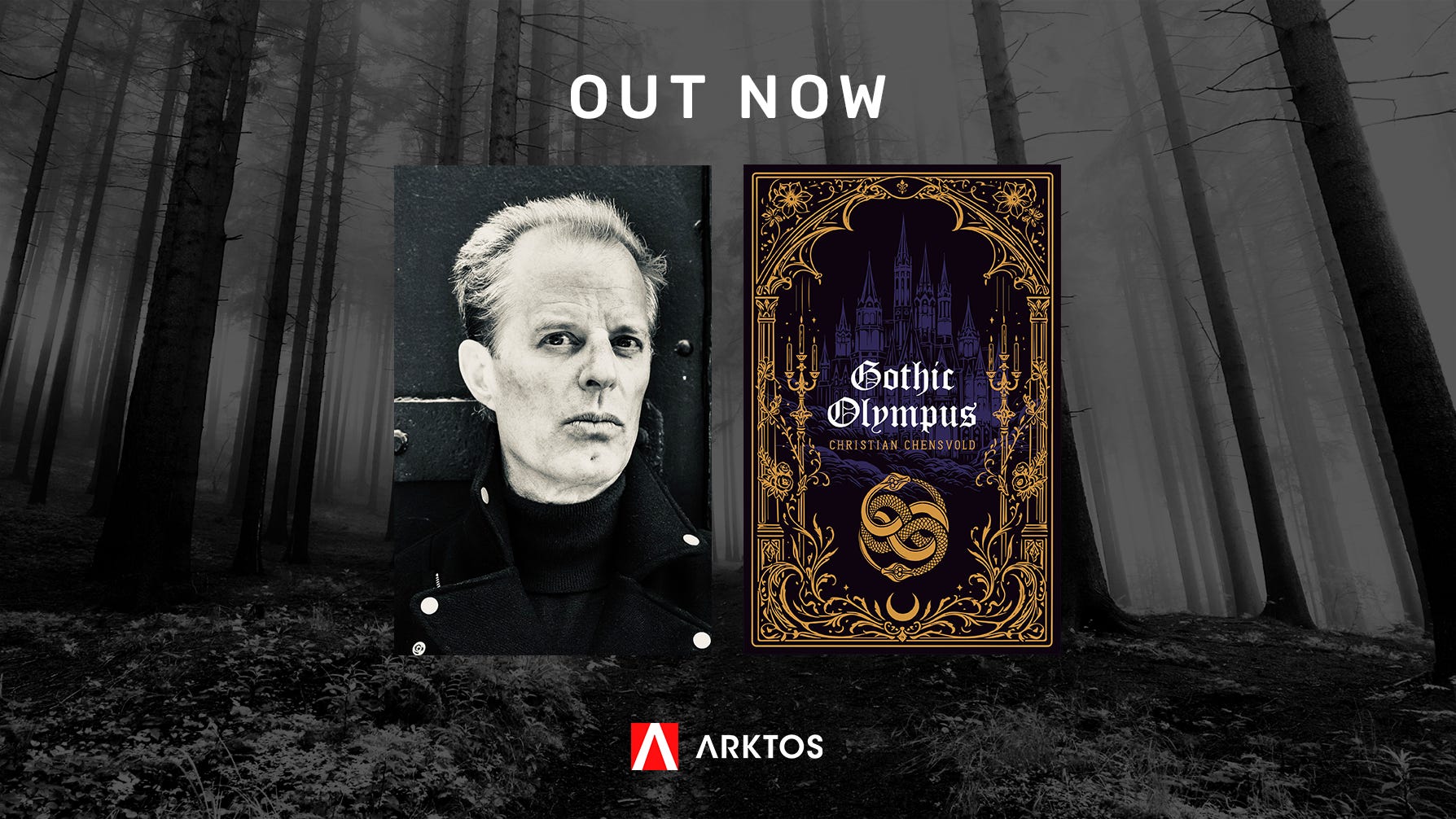
From Breizh-Info:
Between the end of the Belle Époque and the contemporary twilight, Gothic Olympus, published by Arktos, offers a mythopoetic fresco combining occultism, spiritual heroism, and a radical critique of modernity.
The author, Christian Chensvold, follows the destiny of Julien Stanwyck, a young American propelled from the mists of New York to European cabarets and the ruins of an ancestral castle on an alchemical quest to awaken the ancient gods in the face of what is described as the onslaught of the modern world.
Between Julius Evola, fin-de-siècle decadence, and epic imagination, this novel aims to offer much more than a fantasy tale: it is an invitation to take up what the author calls “heroic spirituality” in the heart of Western decline.

Breizh-Info: Gothic Olympus blends Belle Époque decadence with a contemporary “dystopia.” What personal experience or observation made you want to connect those two eras in a single mythopoetic arc?
Christian Chensvold: I learned so much about the creative process from the experience of writing this book, yet in the end I can barely explain it. Consciousness seems to be something that we access, and inspiration is something we receive rather than create within ourselves. The idea came to me one afternoon in the forest as a way of taking “revenge” on the modern world by writing an alternate version of history in which the Belle Époque never ended, with an occult “superhero” who would have to bend the wheels of time and fate in order to achieve that.
I grew up seeing the Superman film of 1978 when he flies around the world to turn back the clock of time. I immediately went to work on it, having reasoned that I should undertake the project, even though I had only this vague concept. I then used my will to begin writing, and my imagination to sculpt the possibilities of character and story. I thank Éliphas Lévi for his work in explaining to me these three divine faculties of man: reason, will and imagination, and how they work together in the service of creation.
Breizh-Info: Julien Stanwyck’s journey begins in New York and moves into fin-de-siècle Europe. Why did you choose that transatlantic trajectory, and what does each setting symbolize in the novel’s spiritual geography?
Christian Chensvold: As I began to work, I reasoned that the story should have an American hero, since that is the reality I grew up in, but that it should take place in the ancestral homeland of Europe. I am equal parts English, Norwegian and Swiss from Lausanne, which is the part I seem to have most inherited through various mysteries of the blood.
I also address the idea of a Gothic race in the book, which I do believe is a kind of spiritual race that has expressed itself in various ways over the past thousand years, from the Medieval period to the Gothic art and literature of the 19th-century Romantic period, all the way up to expressions today at the close of the cycle, in this very book.
READ MORE from Arktos:

Breizh-Info: The book frames modernity as an “onslaught” of collectivism and tyranny. How did you approach turning a polemical diagnosis into narrative tension without sacrificing ambiguity and character complexity?
Christian Chensvold: The polemical element — which is the relevance of the book to the crisis of 2026 — was woven into the plot, and characters discuss the situation at various points in the story. As the book functions as an allegory for where we are now and how we got here, I used an alt-history approach to have all the onslaught of 20th-century modernity all at once. And it’s uncanny how much of it was predicted by the Decadent authors of the Fin de siècle.
Breizh-Info: Julien’s transformation is described as “alchemical.” Which traditions (Hermeticism, ritual initiation, astrology, Christian mysticism, pagan myth, etc.) most shaped the stages of his metamorphosis?
Christian Chensvold: My previous book Dark Stars outlines a path of progress from knowledge to transformation, and from transformation to active powers. I don’t want to give away too much here. Consider that all the paths you mention, and many more, are like different petals of the same flower of sacred science. I’ll just say that the main doctrines explored in the book are the Ars Regia, Heroic Spirituality, and theurgy. I drew upon direct experience in the numinal dimension of consciousness, guided by the wisdom of Julius Evola and the 19th-century French Occult Revival.
Breizh-Info: You weave Julius Evola’s revolt against the modern world into steampunk, dark fantasy, and Decadence. What were the biggest risks of mixing those registers, and how did you keep the tone from becoming pastiche?
Christian Chensvold: I think the best answer to this is the concept of Decadence itself, as the Decadents of 1880-1900 expressed it, looking back to ancient Rome, and as scholars of the 20th century examined it. Decadence as a style and sensibility is characterized by its being late in the civilizational cycle, and wildly juxtaposes genres and elements. Huysmans laid the blueprint of this in 1884 in À rebours. So “mixing these registers” merely means expressing the very concept of Decadence itself, and that we are at a very late stage in the history of the European peoples.
Breizh-Info: The novel speaks of “infernal torments” and “divine fury.” Are these primarily psychological forces in Julien, metaphysical realities in the story-world, or deliberately both?
Christian Chensvold: The process of becoming, in the ancient Indo-Aryan tradition dvija, or twice-born, involves a dying to one’s lower earthly personality, and being “reborn” with the knowledge that the core of one’s being is made of spirit. Joséphin Péladan explicates this at great length in his 1892 book How To Become a Mage. This is a long and agonizing process with three major stages, as symbolized in the alchemy tradition. Julien goes through inner torments on his path to conditioned immortality, and shares the divine fury of the gods for the world man has wrought for himself.
Breizh-Info: The “Mysteries of Sex” and the “goddess for a bride” element suggest an initiatory erotic dimension. What do you mean by erotic initiation here, and how did you write it in a way that serves the spiritual stakes rather than mere provocation?
Christian Chensvold: Sexual energies as an initiatory path was known to all great ancient traditions, and Julius Evola explicates them all in his book on the Eros and the Mysteries of Love: The Metaphysics of Sex. The “woman of the mind,” “secret lady,” and “occult bride” also figure in the Heroic Spirituality tradition through the Grail legend. This is also something that germinated in me from my earliest memories. I also wanted to pay hommage to the astrological placement of Venus in Scorpio, which I personally have and gave to the character of Julien. This placement is in its detriment and operated unconsciously in me until the awakening process began nine years ago. Since then I’ve come to understand how this particular energy in my natal chart has been guiding and shaping my consciousness all along. Why? Outside of space and time, obviously because I would one day write a book in which this detriment placement turns out to be the path to enlightenment.
Breizh-Info: Achilles’ sword is an arresting symbol: why Achilles specifically, and what does the weapon represent in Julien’s conquest of death—courage, fate, heroic style, or something else?
Christian Chensvold: Achilles is remembered as the greatest warrior and comes from Ancient Greece, so he was the logical choice for the section that takes place in Hellas. We also know him from the portrayal by the actor Brad Pitt in the film Troy. During the writing of that chapter I spent much time alone in the forest with my training sword, and many experiences in the spiritual dimension of consciousness with the Achilles archetype. It was here that I received clearer understanding that the great spiritual battle is for the layer above us on the Great Chain of Being, not below. The people fight for their knights and heroes, who in turn fight for the king, who fights for the spirit and honor of his ancestors, which is tied to the gods, who are themselves beings in the mind of the Supreme Author. The sword as symbol of spiritual virility goes back to my childhood and earliest instincts.
Breizh-Info: Your background includes fencing, astrology, and long immersion in Belle Époque culture. Which of these shaped the book most concretely on the page (structure, imagery, combat scenes, cosmology), and where can readers “see” that influence?
Christian Chensvold: What I most enjoyed about the book was being able to weave in a highly distilled “cinnabar” version of my life of the Good, True and Beautiful — which includes the dark and “cool” — into the story. It has a little bit of everything I discovered on my earthly journey.
Breizh-Info: If you had to name the one “metaphysical awakening” you hope the reader experiences after finishing Gothic Olympus, what would it be — and what kind of reader do you think will resist the book the most?
Christian Chensvold: I believe the most important aspect of awakening to metaphysical reality that the book presents is the notion of Heroic Spirituality. This was embedded in me from the age of seven through the film Star Wars, in which Luke Skywalker feels called to learn the ways of the Force when no one believes in it anymore and the Jedi order is almost gone. This quest is intimately entwined with the sense of personal destiny and playing a role in the cosmic drama in the Mind of God, instead of being what are now called NPCs (non-playable characters).
The Meaning of the Penguin and the Coming of Gothic Olympus

A lone penguin who leaves his group to march into the unknown, heading out into the horizon towards distant mountains — this clip extracted from Werner Herzog’s Encounters at the End of the World has suddenly become a viral meme.
This is what I went through to reach a level of consciousness where I could produce a book such as this, and it is what Julien Stanwyck goes through. In a late period such as ours, when the Primordial Tradition is all but forgotten, you must go out and find the Spirit yourself.
As for what kind of reader will resist the book, that would be a staunch materialist who lacks the heroic qualifications of approaching the spiritual dimension of their own being, which requires passing through the “dragon” or Ouroboros, where all is possible and everything meets its opposite. In other words, all people lacking spirit, for whom physical life on earth — and whatever is happening in the present moment — is the only reality.
GOTHIC OLYMPUS awaits you:

https://rumble.com/v771cce-the-dark-night-of-the-soul.html
The Dark Night of the Soul
https://music.youtube.com/watch?v=8aFzVWtGdbI&si=8VVF9Cg3ZuQUv1nd