


In this interview, Alexander Markovics, author of the newly released book The Rise of the New Right, speaks with Belgian geopolitical thinker Robert Steuckers about the recently published book Against Russophobia — a posthumous collection of texts by the French philosopher Guillaume Faye. The two discuss the book's origins and the intellectual trajectory of Faye's thought on Russia and Europe.
OUT NOW: Against Russophobia

In a world dominated by headlines portraying Putin’s Russia as the clear and present danger to Europe, Guillaume Faye championed an altogether different vision: a “Eurosiberian” or “Euro-Russian” civilizational bloc stretching from the Atlantic to the Pacific, united by blood, culture, and unmatched geopolitical and economic potential. In the final year…
Alexander Markovics: The current political debate in Europe is dominated by the specter of Vladimir Putin and warnings of a Russian invasion of Europe. At the end of 2025, Arktos published the book Against Russophobia, which you edited and which contains a collection of texts by French philosopher Guillaume Faye on the subject of Russia. Why is a book entitled Against Russophobia being published just six years after Faye’s death? And what role does the Russophobia referred to in the title play in geopolitics as a US strategy that is directed not only against Russia, but ultimately also against Europe?
Robert Steuckers: This delay can be explained by several reasons: the site where Guillaume Faye’s texts were displayed disappeared after his death, which is a great shame. I had fortunately preserved a large number of them, especially those concerning Russia and desirable relations between it and Europe in general, and France in particular, since Guillaume Faye was addressing primarily a French audience. Then, the last publications of Guillaume Faye — who took no account of the ukases issued against him within the ranks of the “Nouvelle Droite, canal historique” (as he liked to say) — completely vanished from circulation. One of the publishers opted for quasi-Azovist and Russophobic posturing; another was a very loud and tedious braggart, who still naively believes that Guillaume Faye was a ‘defender of the West’ simply because he did not accept the disorders brought about by mass immigration: one might think that this latter publisher, a Gallic blusterer who would delight any stage director, had never informed himself about Faye’s actual intellectual itinerary.
Since the 1970s, Guillaume Faye had been arguing for European energy independence; in the 1980s, he had fully grasped that this energy independence, undermined by the nascent green movements, needed to be complemented by independence in all raw materials, and that only the expansion of Europe’s strategic space to include Eurosiberia (as he called it) would have made it possible to achieve and consolidate this. As his friends know, he left the small Parisian neo-rightist sphere between 1987 and 1998, so that virtually none of his writings from those years are available to gauge the judgment he might have passed on the collapse of Russia under Yeltsin. Having returned with great fanfare to the neo-rightist sphere in the spring of 1998 with his remarkable book entitled Archeofuturism, one can nonetheless see that he had perfectly understood the danger represented by the post-Soviet collapse of Russia and the anti-Serbian enthusiasm of NATO circles, who were preparing the disaster of the 1999 war. All of this is apparent in the addenda he would add to the reissue of his 1985 book, Nouveaux discours à la Nation Européenne (New Discourse to the European Nation).
READ MORE about the life and legacy of Guillaume Faye:

From 2000 onward, he endorsed the measures of imperial restoration undertaken by Vladimir Putin, joining his voice with that of Ivan Blot, a former GRECE member who had left Alain de Benoist’s circle as early as 1979 to co-found the Club de l’Horloge. The reproach directed at Alain de Benoist was that of “apoliticism.” Faye’s positions, which are legible from the very first texts written after his return to metapolitics in 1998, only sharpened over the years, up until Blot’s death in October 2018 and Faye’s own in March 2019.
Faye was thus able to observe the early Russophobic measures of the EU and NATO, but he did not live to witness their crescendo following the launch of the “Special Military Operation” in February 2022. Biden’s policy and the sabotage of the Euro-Russian energy artery that the Baltic pipelines represented clearly confirm that the objective of American thalassocracy is to sabotage all ties between Europe and Russia in order to collapse German industry, definitively weaken our subcontinent — which is Washington’s principal economic competitor — even at the cost of accepting that a Russia thus pushed away will turn toward China and India, which the United States, undermined by its internal contradictions, cannot absorb. Along with Europe, the Atlantic Rimland, the other country that must be neutralized — this time from the South Asian Rimland — is Iran, which could no longer, since the fabrication of the Khomeinist golem, trade in peace with Europe, ruining in particular projects such as EURATOM with German and French participation.
Markovics: For many patriots in Europe, Donald Trump was a beacon of hope, as he promised to put an end to American regime change operations and wars. However, the war in Ukraine has continued under his presidency, and he has also been responsible for bombing Iranian nuclear facilities, attacking Venezuela and kidnapping Nicolás Maduro. Furthermore, he has still not ‘drained the swamp’ in the US — Jeffrey Epstein being a prime keyword here. In light of this, how justified is Guillaume Faye’s statement that the US is the main geopolitical opponent of all Europeans striving for independence? Why do you think he has not yet dealt with the ‘three sisters’ in the US?
Steuckers: Those whom you call “European patriots” applauded Trump’s speeches and congratulated themselves on his election because he was putting an end to the ideological and wokeist jumble peddled by American Democrats, by Hillary Clinton in particular. The American population, across all categories, has had enough — especially since this was compounded by the BLM movement and the wave of “Cancel Culture” that was breaking or defacing historical monuments and traces of a past that this uncultured and hysterical American left no longer wished to own.
Foreign wars are not elements that allow for political mobilization during electoral campaigns: first, the vast majority of Americans do not know where to find the countries presented as targets to be struck. Basic geographical knowledge is virtually nonexistent, even among university graduates (and in Europe, once one ventures beyond the Mediterranean, one is no better off, even when it comes to the Black Sea, the Don, and thus Ukraine!). Then, in a country that does not organize a social security system as European states do, foreign wars are perceived by ordinary people as so many Danaids’ jars, swallowing colossal funds that could serve to improve road, rail, and other infrastructure on American soil itself, notably in the “fly-over States,” where Trump made a huge impact. The entire bellicose rhetoric of Republican and Democratic neoconservatives thus eventually wore down a public that rallied to the famous MAGA movement.
With the return of bellicose rhetoric under Trump and Rubio, the MAGA movement is falling apart, and we are back to square one. One may advance the hypothesis that the domestic services realized in time the popular weariness in the face of the conflicts in Ukraine and the Eastern Mediterranean, decided to take a pause of roughly a year, and then planned to push bellicosity back to the fore. The planetary geopolitics of the United States has been shaped by Admiral Alfred Thayer Mahan, by Halford John Mackinder (who had elaborated it for the British Empire), by Homer Lea (who is admittedly less well known today, but who nonetheless remains a determining reference when it comes to deciding upon direct or indirect war), by Nicholas Spykman (theorist of the mastery of the “Rimlands” to contain the “Middle Land” or “Heartland”), and finally by Zbigniew Brzezinski. The various practical applications of these geopolitical theories can be traced in the speeches and actions of all American governments, whether Democrat or Republican.
Nothing will change in this domain. One would have to be devilishly naïve to believe (or to have believed) otherwise. This disheartening naivety was detectable from the outset among nationalists or right-wingers of every stripe who went into a trance listening to Trump from his first term onward. One could certainly rejoice at seeing wokeism implode, or at watching the spectacle of Madame Clinton’s debacle — and I did rejoice at it — but this should not have led anyone to believe that the hegemonist and unipolar geopolitics of the United States would melt like snow in the sun and disappear permanently from our horizons.
And so, the war in Ukraine continues, support for Israel against its Arab surroundings is ongoing, and the will to bring down Shia Iran is still there, very much alive, because Iran is the linchpin of the “Rimlands,” the “hub” of the Eurasian geopolitical game. Few observers have noted that the anti-Iranian fury was reactivated by two infrastructural innovations: the implementation of the China-Iran rail link toward the Indian Ocean, and the completion of the last small section of the railway line connecting the Iranian coastline to the Caspian, Azerbaijan, and then Russia, doubling the international freight traffic that passes through the Suez Canal.
The Venezuelan affair can be explained by two motives: oil and withdrawal to the Western Hemisphere. Venezuelan oil could serve other commercial strategies than those imposed by the United States and the principle of the generalized dollarization of exchanges between powers. Venezuela already supplies Cuba and was supplying China: it could very well have supplied Europe in place of the Middle East or Russia.
But the struggle against China and Russia is risky and could trigger a backlash for the United States: so the team around Trump has apparently decided to play a different card; instead of globalism and the hegemonic unipolarity desired by Clinton in the 1990s, with the theoretical support of Fukuyama, who imagined a liberal “end of history,” a different card is being played — one that apparently accepts the multipolarity sought by BRICS, but by creating, while they still have the strength to do so, an American bloc encompassing all the regions of the Western Hemisphere that would allow, given their immense resources, a solid autarkic existence. This bloc, already imagined by American technocrats in the wake of the great crisis of 1929, included Mexico and all the small republics of Central America, Panama, northern Colombia and Venezuela (for its oil), and finally Canada and Greenland (and here we are!). This is the bloc Trump aims to constitute in order to render the United States autarkic, self-sufficient, and powerful in the future conflictual game of a world that has become multipolar.
Faye was conscious of the fundamental enmity that the United States bore toward Europe. At one point, he hoped for the advent of a Septentrion encompassing North America and Euro-Siberia, as certain American circles also imagine — circles one heard from again at the time of the Anchorage accords between Trump and Putin, accords that do not appear to have had any follow-through.
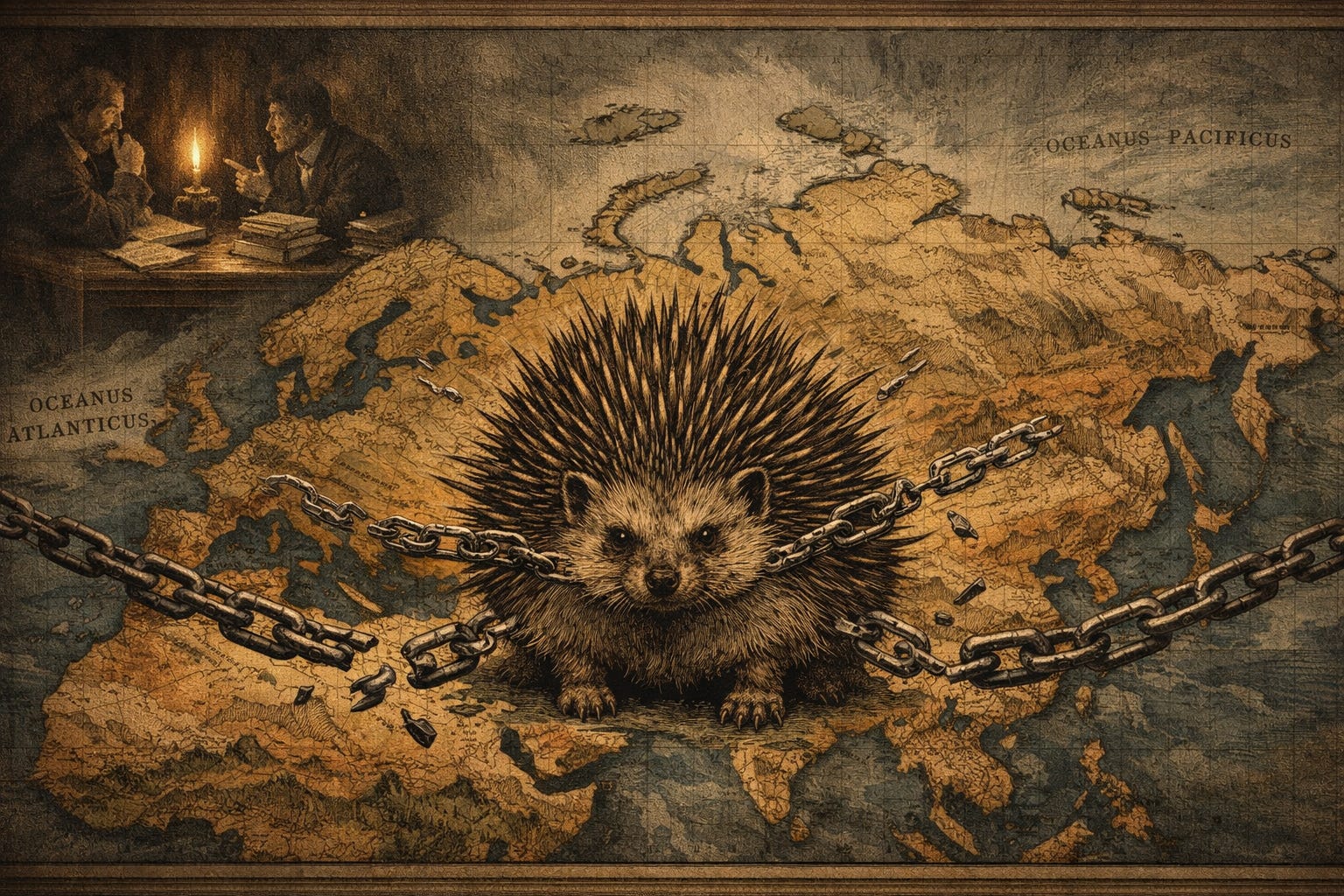
Markovics: In the collected texts, Guillaume Faye advocates the concept of a Euro-Russia stretching from Iberia to Siberia as an alternative to transatlanticism. He argues for a Russian-European alliance based, among other things, on the common ethnic and cultural origins and shared geopolitical interests of Russia and Europe, as well as the need for cooperation in the fight against mass immigration from the Global South. Faye also refers to your geopolitical work and the concept of the “great hedgehog” as a metaphor for an alliance between Europe and Russia. Some European representatives of the radical right, like the globalists in Brussels, consider this a betrayal of Europe and warn of a “neo-Stalinist Russia” and “Bolshevik Putin.” Neo-fascist representatives of the right in particular describe Europeans who advocate peace and cooperation with “Asian Russia” as “traitors to the white race.” Please explain the concept of Euro-Russia and the “great hedgehog” in more detail. What arguments would you put forward in favour of a Euro-Russian alliance, and how would you respond to those on the right who accuse you of betraying Europe by supporting this concept?
Steuckers: Faye spoke initially of Euro-Siberia, following a discussion the two of us once had about Yuri Semyonow’s book on Siberia, in which he described it as the “Schatzkammer Europas” (”treasure chamber of Europe”). Faye came to realize that Europe’s future was possible only if normal relations were restored with the USSR (at that time), since such relations would have given our subcontinent everything it needed. The Yalta duopoly, in his view, was an anomaly that only deprived Europe of its only potential reserve of highly important raw materials.
This position, at odds with those of the conventional right, led him to another conclusion: every form of neo-colonialism in Africa, more precisely in “Françafrique,” proved to be a dead end. Indeed, while French-speaking Africa obviously contains enormous riches useful to European industries, the management of a colonial or neo-colonial empire would be far too costly, whereas the territory of the USSR already offered all the necessary infrastructure without any need to carry out population transfers in either direction (settlement colonization in wealth-generating zones, immigration toward Europe, an overly variegated omnicitizenship, etc.). Population movements within a “Euro-Siberia” would have been limited to technical elites and would generally have been temporary. They would also have taken place between more homogeneous population groups.
Later, in the early 2000s, Faye came to Flanders to give several lectures: there he met the Russian author and professor Pavel Tulaev, who pointed out to him that Siberia was merely a geographical concept, still rather vague, and that the only subject of history in that immense region stretching to the shores of the Pacific has been Russia. Faye therefore agreed to henceforth speak of Euro-Russia.
The notion of the “great hedgehog” comes from the heated debates that took place in Germany and the Benelux countries at the beginning of the 1980s over the affair of the American missiles that NATO intended to deploy on West German territory. At that time, the notion of neutrality for Central and Danubian Europe, as well as for the three small Benelux states, came back to the table. For this neutrality to be viable, it had to be stripped of all bleating pacifism. The armies of the countries that would return to neutrality would therefore need to be organized along the Swiss and Yugoslav models. In Germany, General Jochen Löser had theorized this possibility in his work Neutralität für Mitteleuropa. In Austria, a certain General Spanocchi, and in France, General Brossolet, had drawn up plans to create “armed nations” on the Swiss model, but ones that would also and above all have been adapted to local geographical configurations — which is no easy matter in flatland regions. In Flanders, the cartoonist Korbo had drawn a charming little hedgehog advancing with a smile, saying: “Vreedzaam maar weerbaar” (”Peaceful but capable of defending myself”). Stickers featuring this drawing on a green background were printed: hence the theory of the “great hedgehog.”
The Russophobes of the system, or of the far-right space, still reason in the terms of the Second World War. Operation Barbarossa was launched hastily, without preparation for a potential winter campaign, and despite its lightning initial successes, it first became bogged down outside of Moscow in December 1941. The Vormarsch (”advance”) of the summer of 1942 to reach the Caucasus and its oil was staggering, but ran up against the immensity of the territory: while it managed to take Rostov-on-Don, it did not reach the Caucasian oilfields and could not control the banks of the Volga.
With the aid of the Anglo-Saxon thalassocratic powers, the Red Army held out by being supplied from Murmansk and Archangelsk via the fleets crossing the Atlantic (which explains Trump’s current interest in Greenland) and via the route departing from the Indian Ocean and using the trans-Iranian railway (built by the Germans and the Swiss during the interwar period!!), the Caspian, and the Volga river traffic. The Axis was unable to cut this line running from the Arctic to the Indian Ocean coastline. This line is reconstituted today by the International North–South Transport Corridor, which evades American control — which also explains the current anti-Iranian rage, as the hegemonic thalassocracy no longer controls its key sites in the Persian Gulf. Operation Barbarossa was justified by the National Socialist authorities of the time as a necessity for acquiring the Ukrainian wheat and Caucasian oil that had previously been supplied to Hitler’s Germany by the USSR — and not solely by virtue of the clauses of the German-Soviet pact of August 1939.
Soviet deliveries had made possible the rapid victory against France in May–June 1940: without them, no victory of that kind, nor any defense of the conquered Gallic territory, would have been possible. The Second World War teaches us that all the territories over which fighting took place — at an exorbitant cost in human lives — have become a single strategic space in which a repetition of those confrontations is no longer possible, or at the very least no longer profitable. To return to wheat and oil, one must recall that, already under the Weimar Republic, German-Soviet economic ties were solid.
After 1991, the year of the USSR’s dissolution, economic ties between Germany and Western Europe on the one hand, and between Germany and Yeltsin and Putin’s Russia on the other, were perfectly reestablished — especially following the gas contracts, in which Gerhard Schröder played a key role. The restoration of these economic ties ruled out any repetition of a new Operation Barbarossa, in whatever form. Those who dream of it are living in delusion: they do not reason on the basis of real facts, attested by recent or ancient history, but from moral categories disconnected from reality and instrumentalized by the hegemonic powers through the media (Carl Schmitt had warned us of this deviation…!). Or from anachronistic nostalgia.
Emotion prevails in this type of discourse, exactly as in the ranks of the antifa movement, also manipulated for unspeakable operations and very often orchestrated by the same masters of manipulation. As for the so-called “betrayal of Europe” supposedly perpetrated by peaceful Russophiles, it lies solely with those who adulate the hegemon and its transmission belts — a hegemon that does everything to bring about our ruin — or with those who, under apparently different pretexts, ultimately conduct a policy that favors the American deep state, the system, or one or another of its pawns placed and then sacrificed on the international chessboard.
Markovics: The EU and the mainstream European media denigrate Russia as the “evil empire”, portraying Vladimir Putin as a second Stalin or Hitler, depending on the mood of the day. In the texts collected in the book, Guillaume Faye pointed out that the EU considers conservative Russia under Putin, who has been advocating a multipolar world order instead of unipolarity since his Munich speech in 2007, to be an ideological threat to its globalist project. To what extent do you think Guillaume Faye’s assessment from back then is still relevant today, and is there anything you would like to add?
Steuckers: Many of the analyses once put forward by Guillaume Faye remain, mutatis mutandis, valid in the international context. His recent work, published posthumously and entitled Against Russophobia, attests to his visionary and predictive capacities. Guillaume Faye developed a rational and well-grounded Russophilia — supported by concrete facts such as the necessity of harmonizing exchanges of energy, raw materials, manufactured goods, and high-technology know-how.
Guillaume Faye is a disciple of Clausewitz by way of reading the two volumes that Raymond Aron devoted to this Prussian military thinker of the early 19th century. Access to Clausewitz came through Aron for the French of Faye’s generation. Aron worked to provide theoretical foundations for the national system put in place by De Gaulle in the 1960s, immediately after the tragic Algerian events that had brought France to the brink of civil war. In order to understand that era, ought to reread Armin Mohler’s texts on De Gaulle’s France, which he viewed as a model for other European states — in the very least, if they wished to emancipate themselves from American tutelage, then Germans.
Let us also recall that in a concise, very short manifesto, written in English and entitled “Chicago Papers,” Mohler had provided all the paths to be taken in order to free Europe from the slow constriction being imposed upon it by the American anaconda. These “Chicago Papers” are included in his collection of articles bearing the title Von rechts gesehen. Those who have internalized these clear watchwords can only laugh with great commiseration and fierce sarcasm when they hear the discourses of the system and of the Russophobic far right on Venezuela, Iran, China, or Russia. Faye grasped very well the tenor of President Putin’s speech in 2007, as did Günter Maschke who, in order to shock and unsettle the parrots of every feather who repeated the mainstream media’s discourses, proclaimed in his stentorian voice that he was not only a “Putin-Versteher” (”one who understands Putin”) but, above all, a “Putin-Anhänger” (”a supporter of Putin”).
READ Guillaume Faye’s Against Russophobia, brought to you by Arktos:
