


Hermann Göll provides an in-depth exploration of the Germanic creation myth, detailing how the world and its beings emerged from the primordial chaos.
This is an excerpt from Hermann Göll, Illustrierte Geschichte der Mythologie (Illustrated History of Mythology), 1884.
Read part one here.
The Creation of the World
Our ancestors conceived the origin of the world in the following way: From the CHAOS or ‘yawning abyss’, they believed that two worlds initially emerged: to the north, NIFFELHEIM (Mist-Home), and to the south, its opposite, MUSPELHEIM (Fire-Home). In the centre of Niffelheim, however, the well Hvergelmir opened, from whose fermenting cauldron twelve rivers of icy water flowed. The water froze into ice floes, and these moved towards the abyss and gradually filled it.
From Muspelheim, however, a hot wind blew and melted the ice. This caused life to emerge in the frozen mass, and from it grew the terrible giant Ymir or Oergelmir, from whom the frost giants or Hrimthursar descended. In the thawing waters, the cow Audhumla (the Richly Abundant) also came into being.
Ymir and his kin were nourished by the milk from Audhumla’s udder. She herself licked the salty ice blocks due to a lack of pasture, and lo, under her tongue gradually appeared a handsome man named Buri. He had a son named Bor, who took the giantess Bestla as his companion, and she bore him three sons, Odin (Spirit), Vili (Will), and Ve (Sanctity). These were the first Aesir, who immediately turned against the primordial giant and slew him, causing a flood in which all the frost giants perished except for Bergelmir, who became the progenitor of a second race of giants.
The body of the giant Ymir was then used by the Aesir for further creations. From his flesh, they fashioned the earth, from his bones the rocks, from his hair the trees, from his blood the sea, and from his skull the sky. From his eyebrows, they made the dwelling place of human children, Midgard, in the middle of the earth.
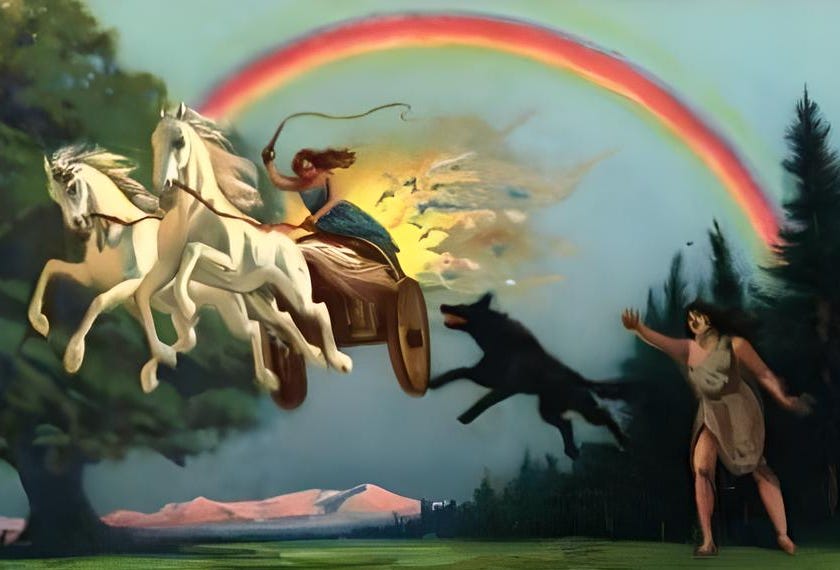
However, there was neither sun nor moon, nor stars in the sky; only wandering sparks from Muspelheim flickered above. The Aesir transformed these sparks into stars and gave them their fixed places. The sun and moon came into the world in the following way: Night, a giantess, had a son named Day with her third husband, Delling (Dawn), and both were raised to the sky by the All-Father, where Night received the black horse Hrímfaxi (Frost-Mane) for her journey across the sky, and Day received the white steed Skinfaxi (Shining-Mane). The Aesir then abducted the lovely Sol and the handsome Mani from their earthly father Mundilfari (the Time-Turner), who had boasted excessively about his children. They built the sun chariot from the sparks of Muspelheim and harnessed it with the steeds Arvakr (Early-Wake) and Alsviðr (All-Swift). Sol drives the sun chariot across the sky, armed with the shield Svalinn to protect heaven and earth from the sun’s flames. Mani, on the other hand, steers the moon chariot behind the night, accompanied by the two children Bil (the Waning) and Hjuki (the Waxing), representing the waning and waxing moon, whom he once took up because he saw them unable to carry their heavy water buckets any further. The spots on the moon were explained by the ancients as either a man who stole wood on Sunday and now stands on the moon with a bundle of twigs or an axe, or as a girl who spun thread in the moonlight and now sits with her spindle above. Two fierce wolves, Skoll and Hati, chase after Sol and Mani, and when they get close to the celestial bodies, the sun and moon grow pale, and mortals call this a solar or lunar eclipse.
After the creation of the celestial bodies, the preconditions for the emergence of mankind were also given. As the Aesir Odin, Honir, and Lothur once walked along the seashore, they saw two trees lying there, an ash and an alder. From the ash, they created the man Ask, and from the alder, the woman Embla; Odin gave them soul and life, Honir gave them intellect, and Lothur gave them blood and a healthy complexion. All human races descend from Ask and Embla, the ash and the alder.
From the tiny worms that wriggled in the flesh of the primordial giant Ymir, the Aesir created the race of dwarfs or elves. These fell into two classes: the black elves, who burrowed in the darkness of the earth for ores, hammered metals, and frightened and tricked humans with their mischief and deceit; and the light elves, who were good and beautiful beings that showed favour to mortals, akin to the elves of fairy tales.
At the northern end of the sky sits the enormous giant Hrasvelg (Corpse-Gulper) in the form of an eagle, stirring his mighty wings to send devastating storm winds across the earth. Equally fierce is the giant Vindsval (Wind-Chiller), who controls frost and snow in his domain and is the father of winter. However, his reign alternates annually with that of the gentle Swasud (Mild South), whose offspring is the blossom-rich summer. The ash tree Yggdrasil (Dread-Carrier) spreads its branches over the whole world and holds it together. One of its powerful roots extends to Niffelheim, beneath which lies the dark realm of the shadow queen Hel; the second root reaches to Jotunheim, the home of the giants (Sotune or Joten, meaning Eaters); and the third to Midgard, where human children dwell. Under each root of the world ash tree, which stretches its top into the heavens, a significant spring bubbles up. Under Niffelheim is the aforementioned Hvergelmir. Under Jotunheim is the well that is guarded by the giant Mimir, whose waters grant insight into the workings of things. Finally, in Midgard, the holy water of Urd’s well springs forth, where all wisdom is stored, and two snow-white swans circle its calm surface.
By the well sit the three Norns in solemn silence: Urd (That Which Has Become), Verdandi (That Which Is Becoming), and Skuld (That Which Should Become = Future), the sisters of fate, who spin the unbreakable threads of life for the newborn, cast the lot of death, and with their eyes pierce through all dimensions of time. Due to the purity and sanctity of the place, the Aesir gather there and hold court under the shade of the world ash. However, the holy tree suffers much damage from various creatures that populate it. In Asgard, the heavenly abode of the Aesir, the goat Heidrun grazes at its summit, providing mead from her udders to the gods and their guests. The five stags Eikthyrnir, Dain, Dvalin, Duneyr, and Durathror feed on the leaves and shoots of the tree.
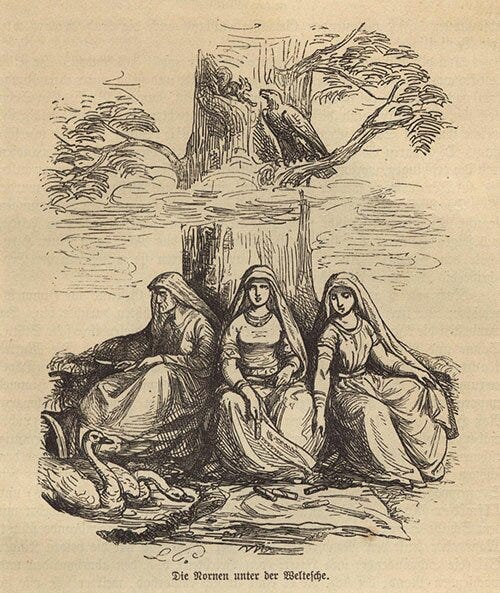
An eagle resides in its crown, while the dragon Nidhogg gnaws at its root along with countless other worms. Finally, the squirrel Ratatosk scurries up and down the enormous ash, acting as the messenger of quarrelsome words exchanged between the eagle and the dragon. Despite the damage Yggdrasil suffers, it does not wither or decay, for the Norns draw water daily from Urd’s well and water its roots with it.
If we gather once again the individual parts of the universe, the world ash actually shadows nine distinct worlds. In the centre is thought to be the human world, Midgard or Mannheim (House of Men). Below this lies Schwarzalfenheim and even deeper the realm of the dead, Helheim. Then, to the side are Niffelheim, Muspelheim, Jotunheim, and Vanaheim, the home of the aforementioned Vanir.
High above the other worlds, the Aesir established a glorious home, radiant with gold and precious stones, Asgard or Asenheim, where, like on the Greek Olympus, the individual gods reside in separate palaces, such as Thor in his 540-storey house Bilskirnir. Asgard and Midgard were connected by the strong bridge Bifrost, built from three colours, the rainbow. In Asgard also stood Valhalla, the hall of blessed heroes with its 500 gates. The residence of the goddesses was called Wingolf (Hall of Joy).
Just as in Greek mythology the Titans and Giants resisted the new world order created by the Olympians and rose against their rule, so the Germans conceived of a hostility between the noble Aesir and the race of giants. These giants always brooded over revenge for the murder of their progenitor Ymir. Loki had joined them, formerly an Aesir and a demon of beneficial fire, now wedded to the dreadful giantess Angrboda (Fear-Bringer), who bore him three gruesome offspring: the wolf Fenrir, the serpent Jormungandr, and the dreadful Hel.
(translated by Constantin von Hoffmeister)