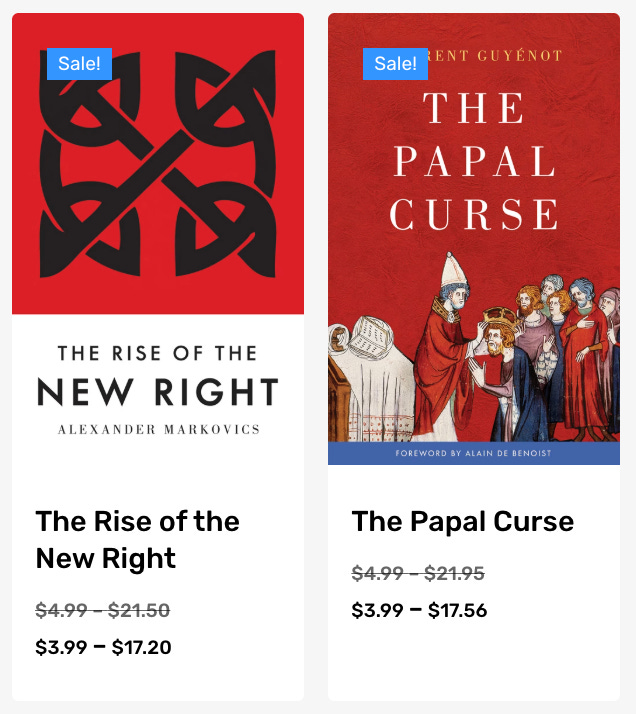
Alexander Markovics, author of The Rise of the New Right, interviews Laurent Guyénot, the author of The Papal Curse: The Medieval Origins of the Western Syndrome, recently released by Arktos.
Alexander Markovics: Dear Mr. Guyénot, The Papal Curse is the first of your books published by Arktos in English. You’re a renowned historian with a PhD in Medieval studies and a Master in Biblical studies. Before you published already several books in French and English on geopolitics, European history, the Middle East, but also on American hegemony, such as The Unspoken Kennedy Truth and From Yahweh to Zion: Jealous God, Chosen People, Promised Land. Please introduce yourself, especially to those readers who might not have read your books so far and tell us what motivated you to write about this “Papal Curse”, what place this book takes in your work, and what exactly motivated you to write it!
Laurent Guyénot: The way that led me to write this book is a long and winding road. In 2008, I finished my PhD in Medieval Studies, on which I had worked for quite some years, and it took me a couple more years to turn my thesis into two books, one about the supernatural in medieval poetry, the other about the Grail literature. But in 2011, I suddenly and completely switched my interest to contemporary history, after I became aware that the official narrative of the 9/11 attacks was a scam. I went on researching what may be called the “conspiracy history” of the United States, focusing on the two major crimes that remain unsolved: the Kennedy assassinations and the 9/11 attacks. This research led me to the conclusion that both crimes were orchestrated by Israeli agents for the benefit of Israel (the arguments can be found in my books The Unspoken Kennedy Truth, and The 9-11 Triple Cross).
This in turn led me to question and research the very nature of Israel, and my main conclusion was that the criminal profile of Israel is the product of the Hebrew Tanakh, which to this day Zionist Jews see as the foundation of their national narrative. I developed this argument in two books: From Yahweh to Zion, and “Our God is Your God Too, But He Has Chosen Us”. That is my contribution to what used to be called the “Jewish Question,” and has now morphed into the “Israeli Question.”
But in the course of this research, I could not avoid noticing that this question has a flip side: the Christian Question. It may be put like this: How has Christianity made Gentile nations vulnerable to Jewish Power? It seems obvious that the Christian sanctification of ancient Israel has played a key role in the creation of modern Israel, and that, more generally, the Old Testament has acted as a Trojan horse of Jewish Power. By accepting it as God’s Word (as opposed to simply the Jews’ book), Christians have paid tribute to Israel as a unique people in God’s Providence, with an eternal destiny.
This was my main motivation to go back to the Middle Ages, with a focus on the development of the Church as a political institution and as a soft power. Like many other aspects of the Middle Ages, this is a field that is being profoundly revisited by recent historians, and I became absorbed in that research for a few years, until I could form a coherent perspective that I felt was worth publishing as a book. As I suspected, one of the conclusions of my research was that the political history of Europe is very much driven by the Old Testament God, rather than the spirit of Christ.

Markovics: During the first chapter of your work you focus on the Sonderweg or special development of the Western church, starting with the Gregorian Reform, which you describe as a coup d’état of the monks inside the church and the growing estrangement between the Western church and Orthodoxy. What are the differences in doctrine between the Orthodox church and the Western church? Why did the Western Catholicism beget modernity, individualism (and some authors argue even capitalism, via the monasteries focused on economic production, and Protestantism) whereas Orthodoxy didn’t? And why did the West invest so much energy in falsifying the history of the true Roman empire (called the Byzantine Empire in the West), that you even argue for the necessity of historical revisionism in the favor of Byzantium?
Guyénot: There is no significant difference between Orthodoxy and Catholicism in terms of doctrine. But there are profound differences in the way doctrine is used. Before even thinking of those differences, we need to be reminded that the Roman Church, as a separate entity, is the result of a series of schisms that started in the 8th century and culminated with the Gregorian Reform of the 11th century. That is when the Roman Church and Latin Christianity really took a very distinct character from the original Eastern tradition.
It is often said that Latin Christianity puts more emphasis on dogma and belief, while Orthodoxy allows for wider access to faith and salvation. Consequently, there is nothing in the history of Orthodoxy comparable to the way heretics have been treated in the West. Because Byzantium never renounced its role as the custodian of Hellenic and Hellenistic culture, Orthodoxy has also kept a more peaceful relationship with philosophy, and retains a strong Platonic flavor, whereas Catholics turned to the quasi-materialism of Aristotelianism. In a Platonic perspective, symbols and art are efficient forces on man’s soul.
Apart from that, I see two obvious structural differences that have often been underscored by Orthodox thinkers, whether Greek or Russian. The first difference is that, because the papal reformers of the 11th century were monks, they imposed celibacy on the priests. This created an ontological separation between churchmen and laymen, and changed radically the meaning of “the Church”. In the words of the Russian theologian Aleksey Khomiakov, as a result of the Gregorian Reform, “the Christian was no longer one of the members of the Church, but one of her subjects.”
The second major difference, which derives from the first, is that the Roman Church started to assert itself as the supreme political power, to the point of binding many kings by ties of vassalage and demanding tribute from them. This was a departure from the Orthodox tradition of symphonia between the Empire and the Church, and this is what Dostoevsky meant when he wrote that Roman Catholicism gave in to the Devil’s temptation of the kingdoms of the world (Matthew 4).
Both these betrayals of the original tradition were denounced by the Protestant reformers as well, of course, but Protestantism departed further from the Eastern tradition in other ways.
Markovics: In your book you write about the “Crusader Spirit” conjured by the Roman pope and how it influenced the development of the modern West up to the human rights imperialism of (post-)modernity. What were the core beliefs that led to the Crusades, what kept them alive, and why do you think these military campaigns were detrimental to the development of European civilization? And most importantly: Can this Crusader mentality also be used to explain the current US-Israeli war on Iran and the Evangelical/ “Christian”-Zionist support for Israel?
READ MORE from Arktos:

Guyénot: The crusades are the popes’ wars, and as such, they are a manifestation of the political ambition of the papacy. They are unthinkable in Orthodoxy. By the crusades, the popes mobilized the military class of France, Germany, England, and other kingdoms into wars of its choosing. In exchange, the Church promised a ticket to heaven to anyone who would kill or die in its holy war. It is no exaggeration to say that the crusades became a new religion, a new way of salvation, accompanied by their own mythology, iconography, and rituals.
The crusades are also a manifestation of the Old Testament spirit that took hold of the Roman Church. Recent historians emphasize the enormous influence of the crusades on the imagination and the character of European Christendom. Through the unprecedented amount of narrative versions it gave rise to, the First Crusade became for Westerners what the Trojan War was for ancient Greeks, as Oswald Spengler remarked.
Not only did crusading ideology later become a core element of colonialism, but it has determined the way the West views the world and its role in it. It is quite obvious that the Crusade idea of saving the world by war is deeply ingrained in the mind of the American hawks of every age. Just think that the current “Secretary of War” is the author of a book titled American Crusade. And, of course, the crusade idea works especially well as propaganda for wars against any Muslim nation, such as Iraq or Iran.
Another lasting effect of the crusades is Europe’s obsession with Jerusalem. The popes convinced the European elite class that the cradle of their civilization was a city at the eastern end of the Mediterranean, and asked them to fight for it as if the salvation of their civilization (in addition to their own individual salvation) depended on it. There cannot be a project more contrary to the organic growth and interests of Europe.
This obsession with Jerusalem has played a central role in the European involvement in the Middle East up to recent times. In 1917, when British General Edmund Allenby entered the city in a solemn procession, he proclaimed “the end of the Crusades.”
It is likely that the support of Christian Zionists for Israel and their enthusiasm for the slaughter of Muslims is affected by the crusade narrative. But more generally, as I said before, I think it is the centrality of ancient Israel in the Christian worldview that is the key factor. When Western nations agreed and cooperated with the rebirth of Israel, it was not only out of guilt for the “Holocaust”; it was also under the influence of its religious imagination. It was, in some way, the fulfillment of the prophetic vision of a new Jerusalem coming down from heaven.
Markovics: Coming to the question of religion, you discuss the Chinese example with Confucianism as a wisdom tradition instead of a religion. For Europe you suggest adopting the Stoicist philosophy as a wisdom tradition analogous to China. Have you been influenced by thinkers of the Nouvelle Droite or National revolutionary thought like Dominique Venner and his Samurai of the West in this regard? Please elaborate further on this!

Guyénot: It is not always easy to know what past reading has influenced your present thinking. Sometimes, you can have some idea that you think on your own without realizing that something you had read a long time ago planted the seed of that idea. So I may have been influenced by some authors of the Nouvelle Droite, even though I am not very familiar with this intellectual movement. I had read a long time ago some books by Alain de Benoist, who is an intellectual celebrity in France, and I have occasionally read his magazine Éléments. I have also read and appreciated Guillaume Faye’s book Archeofuturism. But I have not read yet Dominique Venner’s book Samurai of the West. I have actually just started reading your book The Rise of the New Right in order to get better acquainted with this tradition, with whom I now find myself in communion on several issues, especially on the prime importance of Europe as a civilization, as opposed to the narrow chauvinistic nationalisms that contribute to nurturing old grudges between neighbours, and to making Europe a failed civilization-state.

When I realized that the papacy’s political ambition was the single most important factor in Europe’s failure to build its political unity under the Germano-Roman Empire (this was something of an epiphany for me), I suddenly became a fervent Europeanist. That is why I am extremely happy with Alain de Benoist’s foreword to my book. That and being published by Arktos are for me signs of adoption into that family—even though I am well aware that my deep hostility to the psychopathic nation-state may be seen by some as a lack of manners.
As for my interest in Stoicism, it was born from my recent readings in Greco-Roman philosophy. Stoicism is a wisdom tradition that fulfils my spiritual needs. It has a cosmic, non-anthropomorphic concept of the divine and an ethical teaching based on a holistic vision of the human community. I cannot help but wonder what the world would have become if, instead of converting to Christianity, Constantine had made Stoicism some kind of official philosophy of the Empire, as had almost been the case under Marcus Aurelius.
It is possible to speculate about this because Stoicism is comparable to Confucianism. China never needed a state “religion”, allegedly based on a direct revelation from God. China built its civilization-state on Confucianism as the basic curriculum of every civil servant, while letting the people practice whatever cults and rituals they wanted (and actually encouraging ancestor veneration). Like Alain de Benoist, who has been described as a modern-day Celsus, I tend to see Christianity as the greatest catastrophe that happened to Europeans. That is one reason why I think we have so much to learn from China.
Markovics: Thank you very much for the interview!
Laurent Guyénot’s The Papal Curse and Alexander Markovics’ The Rise of the New Right are available from Arktos for 20% off during the Arktos Summer Sale!