



The metapolitics of language involves, among other things, removing from the public sphere, in a more or less discreet manner, those useful modes of thought and perception that might facilitate the process Steve Sailer calls “noticing.”
Certain concepts help us recognize patterns: compare terms such as “anarcho-tyranny,” “class,” and “cuckservatism.” Those that don’t want these patterns to be noticed, by extension, also do not find it in their interest that such concepts be spread.
One such concept, with a long history, is decadence, used not only by fascists and reactionaries, but historically by everyone from communists such as Karl Marx to conservative politicians such as Arthur Balfour. In passing, we may also mention the Swedish troubadour Dan Berglund’s 1979 song Dekadensen (”The Decadence”) as an example of how strongly this term was once associated with the upper classes even within the radical Left.
The precise definitions of decadence have varied, as have the explanations for it. Where de Gobineau focused on racial mixing and Auster on the loss of faith, Marxists have tended to emphasize more material factors.
One worthwhile analysis is offered by the Traditionalist Julius Evola in “The Problem of Decadence.”
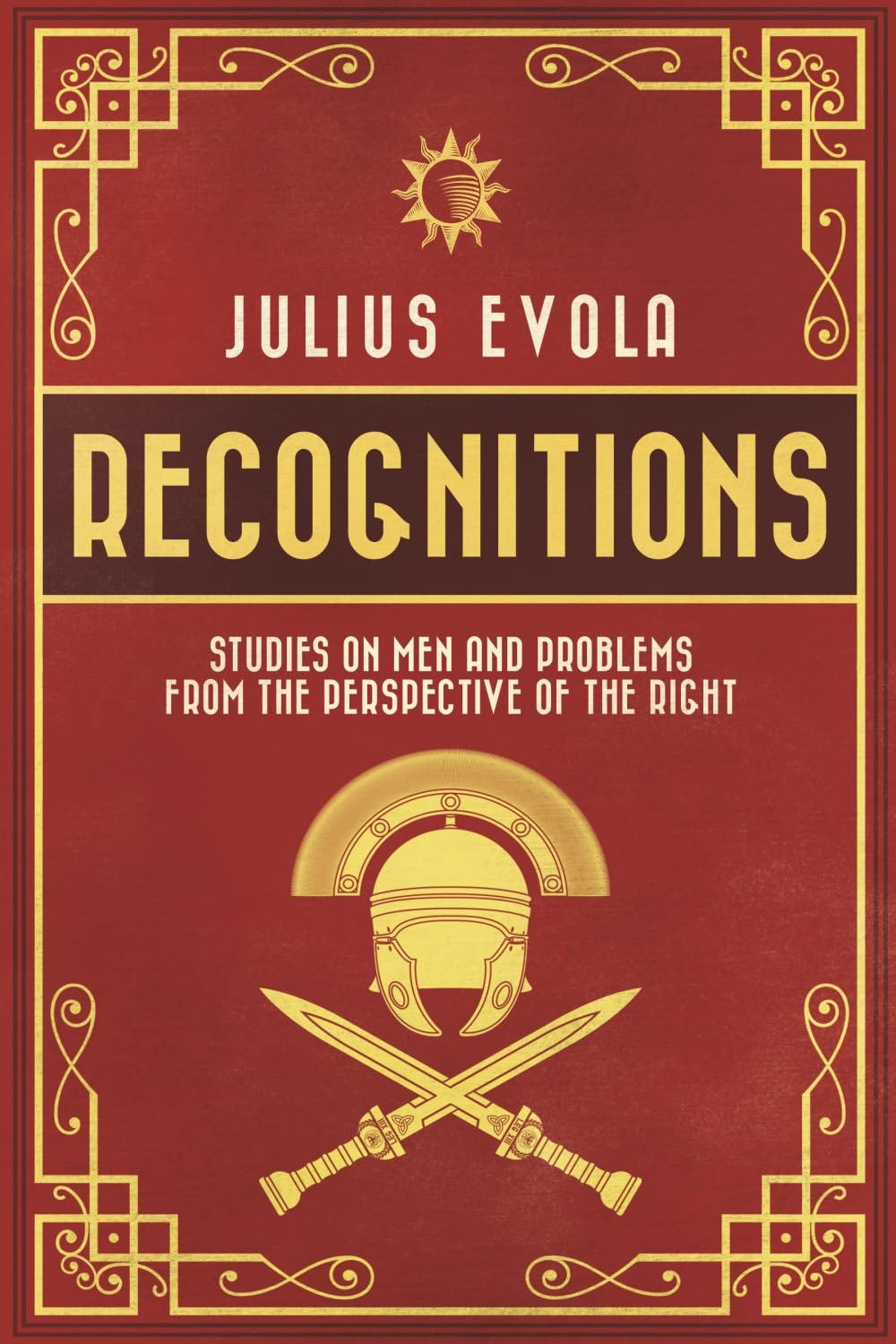
Evola’s “The Problem of Decadence” is included in the volume Recognitions — brought to you in English by Arktos:
Read an excerpt here.
In this short essay, Evola addresses the question of how the traditional world could be replaced by the modern world, despite the latter being inferior—first in the West and then across the globe. His view of history differs from the liberal one in that he begins not from the idea of “progress” but, on the contrary, from that of “decline.” Yet his distance from the liberal worldview goes deeper than this.
Evola sees traditional society as founded on sovereignty rather than violence. He speaks here of
“the ‘Olympian’ attribute of true authority and sovereignty […] its way of directly affirming itself, not by violence but by presence.”1
Further, he notes that
“adhesion and recognition on the part of the inferior are rather the fundamental basis of every normal and traditional hierarchy. It is not the superior who has need of the inferior, but the inferior who has need of the superior.”
The perceptive reader will likely notice a certain affinity here with anarchism, albeit of a non-egalitarian variety.
In a traditional society, some individuals embody admirable qualities in such a way that others recognize them and follow them voluntarily: in popular culture, compare the relationship between Splinter and the Turtles, or Yoda and Luke. On this point, Evola writes elsewhere:
“tradition is to us the victorious and creative presence in the world of what ‘is not of this world’, that is to say of spirit, conceived of as something stronger than any purely material and simply human force.”2
And:
“The antithesis between spirit and power, the opposition between strength and authority is only, once again, a characteristic of ‘modern’ thought.”
In many respects, Evola functions as a necessary “anti-Marx,” although he also observed that in a sufficiently decayed society, the unflattering theories and view of human nature advanced by Marx and Freud will indeed describe large segments of the population.
From this starting point, Evola goes on to explain how traditional civilizations could collapse in more or less sudden revolutions. This did not necessarily mean that their core had degenerated; rather, it was a consequence of free will. In “The Problem of Decadence,” he compares this to the stories of the Fall of Man and the rebellion of the angels:
“The revolutionary commences by killing the hierarchy in himself, mutilating in himself those possibilities which correspond to the interior foundation of order—and he then proceeds to demolish the order outside himself as well.”
This sets in motion a process that may culminate in the collapse of hierarchy, often leading to regicide or the murder of emperors, as in Russia and Ethiopia. But, according to Evola, this is fundamentally an inner process whose early stages often go unnoticed:
“Without a preliminary interior destruction, no revolution.”
As can be seen, it is not unreasonable to supplement Evola’s traditional analysis of decadence with thinkers such as Gobineau and Marx. Regardless, his emphasis on non-material factors and processes remains valuable.
Decadence is, above all, an unwillingness and an inability to even perceive any higher aspects of existence. It is therefore fought mainly through personal discipline and inner work, the goal of which, according to Evola, is
“absolute adherence to truth, uprightness, ability to subordinate the person to the work, inflexibility and rigour of the idea, indifference towards any outward recognition and any material benefit.”3
READ MORE:
Julius Evola: An Adventurous Life, by Andrea Scarabelli, is available in hardcover, paperback, and ebook editions from Arktos and PRAV Publishing:

Julius Evola, “The Problem of Decadence” in Recognitions.
Julius Evola, “On the Secret of Degradation.”
Julius Evola, “The Order of the Iron Wreath.”