The idea of progress and treating the world as ready-to-hand is bound up with several archetypal figures or gestalts — to use Ernst Jünger’s terminology — which became leading icons in European culture over the Modern and Postmodern eras. They inspire both supporters of liberalism and Marxism — a priori progressive ideologies — as well as proponents of the so-called “Third Way” and conservatives. These figures are used to lend the Modernist paradigm apologetics drawn from Antiquity, constructing a false narrative of “objective linear progress” and the “special role of modern man, who creates development and civilization in this world.”
In their own time and context, some of these figures represented marginal figures and stories of titanic failure inevitably followed by punishment; others illustrated transitional moments in modern history. Through their examples, we can trace how archetypes of inferiority and failure which are based on hubris (ὕβρις, presumptuous encroachment upon the Divine Order), have been established and normalized along with corresponding ideologies and value systems. Thus, we see how the genuine heroism of Achilles and ecstatic or ascetic sacredness have been replaced with thoroughly modern, manufactured archetypes and simulacra.
Prometheus
The first figure in this series is Prometheus along with his humans.
The name Prometheus means “thinking ahead” or “foresight.” Prometheus is the brother of Epimetheus, “the one who thinks afterward,” “with hindsight” —the son of the Titan Iapetus and the Oceanid Clymene, according to Hesiod. In his Theogony, Hesiod expounds a later tradition of stories connected with Prometheus and the regression of human generations (known as the succession of metaphysical ages).
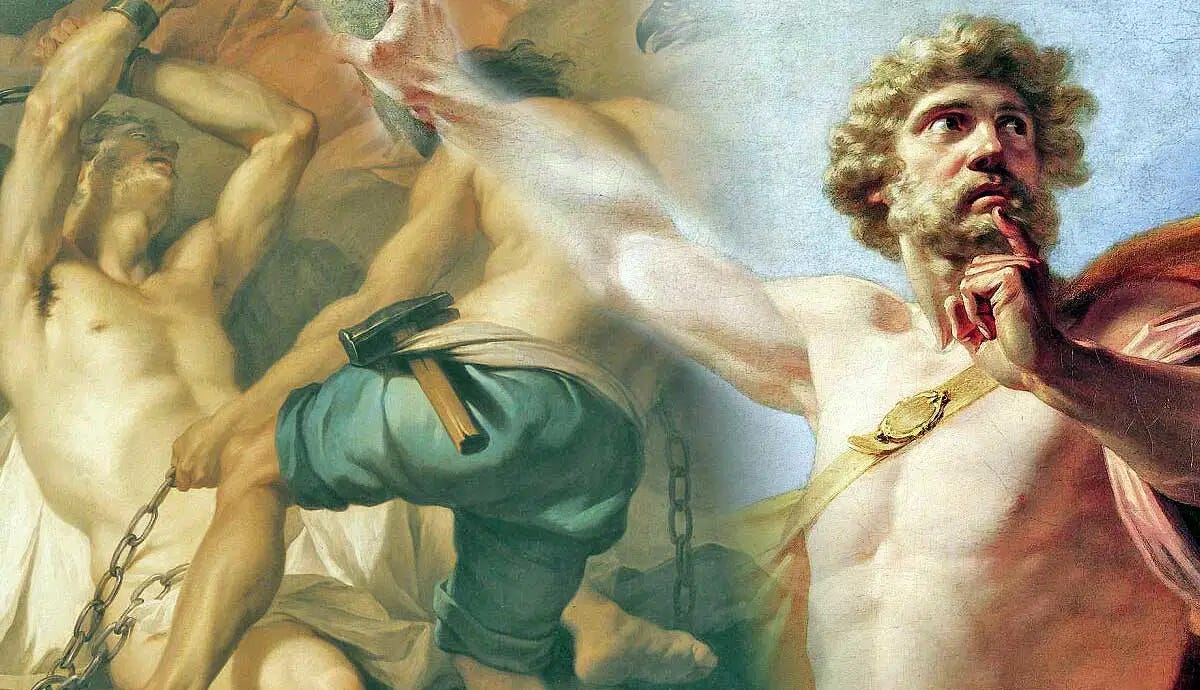
Prometheus, who fought on the side of the gods in the Titanomachy, was sympathetic to humans and decided to deceive Zeus during the dividing up of the carcass of the sacrificial bull at Mekone. Through cunning, he forced Zeus to choose the worst parts — the bones and fat — leaving the meat hidden for the people. For this deception, Zeus deprived humans of fire, which Prometheus later stole and gave to humans, defying the will of the Thunderer.
Here we encounter a violation of the sacrificial order, a refusal to give to the heavenly father, Zeus, what is due to him according to the sacred order — the best part of the sacrifice. And in this, Prometheus foreshadows the figure of the bourgeois with his hatred of sacrifice — as described by the French sociologist of religion Georges Bataille. For the bourgeois, the sacrifice of a pig — which is a matter of routine for the peasant — is conceived as a mad act, as an irrational, foolish waste, for by killing the pig, he kills capital. The pig can give birth to piglets; they will multiply the herd, thereby generating capital — so the bourgeois thinks. But sacrifice abolishes this, wipes it out “into nothingness,” and is thus branded by the bourgeois as a “foolish act” and something that must be abolished. The idea of sacrifice is repugnant and unthinkable to the bourgeois, and this stance toward sacrifice is already anticipated by Prometheus in his crime.
In the Protagoras dialogue, Plato retells this story in the following way. Prometheus’ brother, Epimetheus, distributed qualities and gifts to all living beings, but out of a misunderstanding he gave the wrong lot to man. Prometheus then stole fire and the skills of Hephaestus and Athena, and gave the knowledge of crafts to people. But he could not give them the law of living together in community which Zeus processed. Seeing the increasing lawlessness and quarrels between men who could not live together, Zeus sent Hermes to establish truth and shame among men to strengthen their relations and become law.
Athena and Hephaestus’ skill and Zeus’ truth together made people complicit in the Divine lot. Prometheus’ sympathy for mankind is revealed in the story of the origin of the last (fifth) human generation with whom Hesiod wished he did not have to spend his time. According to this myth, after the flood that destroyed the previous generation, Prometheus created people out of fire, earth, and clay, but they turned out to be defective and imperfect. Athena or Zeus then breathed Spirit into them, thereby finally making them into humans, hence their twofold nature and the name of their generation, “Promethean.” Prometheus loved and cared for this mankind (the “last people”), but his rebellion against the law and will of Zeus for humans’ sake only caused them more suffering. For the theft of fire, Zeus sent Pandora and instructed Hephaestus to chain Prometheus to a cliff in Colchis, where an eagle pecks at his liver every day.
Prometheus’ punishment is the subject of the famous tragedy by Aeschylus, Prometheus Bound, which radically differs from the Greek’s predominantly solar-Divine orientation versus anti-divine Titanism. Aeschylus sings praises of Prometheus and exalts his feat, but remains silent on the grief that he brought to people. Aeschylus therefore differs radically from Hesiod, in whose work Zeus sees Prometheus’ tricks in advance.
Hesiod’s story is a story of the fall, whereas Aeschylus is optimistic about progress and Prometheus’ gifts to people:
One short word sums up all you need to know:
all human arts derive from Prometheus.
Prometheus continues to taunt Zeus and predicts his fall — as the Seer, he knows this secret. For refusing to give it up and for his impudence towards Hermes, Zeus casts Prometheus into Tartarus, whither he falls while uttering words typical of a genius of deceit and lies:
This onslaught from Zeus
comes at me openly
to fill me with fear.
O my revered mother,
O sky, whose encircling
light we all share,
you see:
how unjustly I suffer!
The figure of Prometheus, his message of rebellion against the supreme authority of the heavenly deity Zeus, and his closeness to human suffering, gained popularity during the Enlightenment. In his book Western Eschatology, Jacob Taubes writes: “In the shadow of Christ, Prometheus rises.”
Later, the dynamism of German idealism became the foundation for a new mythological conception of Prometheus, and Schelling unambiguously called Prometheus a symbol of philosophy. Taubes emphasizes: “Is it not evident that the tendency to posit the infinite in the finite and the secondary in the primary prevails in all philosophical discourse and inquiry? In the realm of Prometheus, the name of the Antichrist even becomes an honorary title.”
Thus, Prometheus became a symbol of struggle against tyranny and authority, including religion. Prometheus was seen as a humanist, the giver of reason (ratio), Modernity, and the patron of progress. He was praised by Percy and Mary Shelley, and Byron’s “Prometheus” depicted the idea of the light of rational reason and development leading humanity to prosperity:
Thy Godlike crime was to be kind,
To render with thy precepts less
The sum of human wretchedness,
And strengthen Man with his own mind…
Here, the Titan’s gift of crafts to man are identified with progress in the field of technology and the Industrial Revolution. Enthusiasm for Prometheus was also expressed by Karl Marx, who went on to author a thoroughly materialist philosophy. Praising Prometheus, Marx called him the “saint of the philosophical calendar.”
Prometheus was also proclaimed to be a role model by Adolf Hitler, and in the United States of America the figure of his brother Atlas became the personification of the radical liberal-capitalist ideas of Ayn Rand’s objectivism. According to Friedrich Georg Jünger, Prometheus is the eternal instigator, the embodiment of incessant, active becoming and the desire for the new (as in the spirit of Gilles Deleuze’s “desire-machines”)
The Titan’s prophecy of Zeus’ fall is often interpreted as the onset of the “Gestalt of the Worker”, to use Jünger’s term, that is the era of machines in whose Titanic noise the Divinities do not dwell and from which they withdraw: “Where there are no gods, there are Titans,” writes Friedrich Georg Jünger. He adds:
Compared to his father Iapetus, Prometheus appears an innovator. He stands out from his circle and he stands alone. Although he belongs to the Titans, he advises Zeus in the battle waged against him. He moves way from his Titanic essence in its original form, diverges from it. But he is just as distant from the Divinities, and in connection with this stands the fact that he appears a loner; from all sides he is illuminated by light.
Prometheus is the adversary of the Olympians who inspires humanity to push its gift to the limit in the form of reason and modern technology. Thus, according to Martin Heidegger, humanity finally drives out the Divinities.
Daedalus and Icarus
Another figure of this sort from Antiquity was the great master engineer and craftsman Daedalus, the creator of the labyrinth in Crete where the bastard son of King Minos, the Minotaur, was imprisoned. Languishing in captivity at Minos, Daedalus decided to flee the island to his native Hellas. “The heavens are free, let us fly aloft them!”, the master exclaimed as he proceeded to create something unprecedentedly new: wings made of wax and feathers in the likeness of birds. Having crafted the wings, Daedalus instructed Icarus on how to fly with them:
“Let me warn you, Icarus,
to take the middle way,
in case the moisture weighs down your wings,
if you fly too low,
or if you go too high,
the sun scorches them.
Travel between the extremes…”
Daedalus and Icarus successfully leave Crete, and while flying over the other islands, people mistake them to be unknown Divinities. Winged and inspired, Icarus violates his father’s order to stay in the middle space and, playing too far, rises steeply up towards the sun. The fiery disk of Apollo burns his wings and melts the wax that holds the feathers together, and Icarus falls into the sea.
The story of Icarus, the son of the great artisan Daedalus, is very revealing. Firstly, it emphasizes that people belong to the middle world. Even while in flight, Daedalus instructs his son to keep to the mid space and not descend to the water (the hypochthonic level) or ascend too far up to the sun.
Secondly, for the Greeks, the sun was the face of Apollo. The Neoplatonists interpreted the Greek name Apollon, Ἀπόλλων, to be α-πολλα, that is “not-many”, or the One, ἕν.
Thirdly, Icarus’ tragic case shows us how fascination with artificial wings, which are otherwise appropriate and function in the world of people as long as they are not taken to overstep limits, leads a person to approach excess and blindly attempt to rise to the Sun-Apollo. It is not artificial wings that ascend to the Divinities, but ecstatic inspiration of the mind and spirit.
There is divine potential within man that no technology is capable of revealing, for technology is deeply rooted in the chthonic depths. In some sense, man ascends to the One only naked, i.e., cleansed of material aberrations and attachments. The illusory power of technology is fraught with deceit. For being entranced by technology, mankind pays with scorched wings and a grave in the depths of waters.
Faust
The third figure takes us to the Middle Ages.
The legends of Dr. Johann Faust outstripped the real figure already in the Reformation, around which time they became part of German culture and were often mentioned by diverse authors. But the story of Faust found its most complete and famous form in what would be the opus magnum of Johann Wolfgang von Goethe. Goethe himself is also reflected in Faust as a person who expressed his era and its contradictions.
Like Johann Wolfgang himself, Goethe’s scientist Faust is seized with passion over progress, the rigorous sciences, and the new picture of the world, but at the same time he is well-versed in alchemy, a connoisseur of grimoires, and even practices the invocations of theurgic magic. Thus, he correlates with the paradigm of the “Rosicrucian Enlightenment” described by Frances Yates, who attributes to the “founding fathers” of the natural sciences and Modernity a dualism of interests and aspirations, a state of transition and/or rift between the occult-mystical Renaissance and secular Modernity. The story of Faust illustrates man’s final liberation from nostalgia for the past and how he finally comes to stand on the side of the New Time of Modernity.
At the beginning of Faust, the doctor is depicted as a man who has become “jaded” with knowledge, whom little satisfies anymore. In yet another attempt to overcome his apathy, Faust takes on translating the New Testament into German, and it is in this fragment of the work that the changes in the thinking and worldview of Enlightenment man are fully revealed. In the spirit of the deism of Naturphilosophie, Faust begins to not simply translate Scripture, but to correct it in the spirit of the times.
It is written, “In the beginning was the Word. “
How soon I’m stopped! Who’ll help me to go on?
I cannot concede that words have such high worth
and must, if properly inspired,
translate the term some other way.
It is written: “In the beginning was the Mind. “
Reflect with care upon this first line,
and do not let your pen be hasty!
Can it be mind that makes all operate?
I’d better write: “In the beginning was the Power!”
Yet, even as I write this down,
something warns me not to keep it.
My spirit prompts me, now I see a solution
and boldly write: “In the beginning was the Act.”
This passage reflects the shift in perceptions of the sacred (in this instance, in the context of Christianity) from philosophical and priestly (word and thought) to martial (strength) and, finally, artisanal (deed). Faust’s interpretations echo the first steps of Ernst Jünger’s “Worker”, who is enraptured by the affairs of production and interprets everything else through this lens.
The doctor is distracted from further translating Scripture by an obsessive spirit, whose advice Faust follows to invoke Mephistopheles. Goethe portrays the Devil in this figure, but he also bears the markings of the Enlightenment. He enters the room dressed as a student, and he is slippery and not as omnipotent and unstoppable as some of the Titans. The Mephistopheles of Goethe’s Faust is closest of all to a human and acts as a complete double of Faust himself. Mephistopheles introduces himself thusly:
I am the Spirit of Eternal Negation,
and rightly so, since all that gains existence
is only fit to be destroyed; that’s why
it would be best if nothing ever got created.
Accordingly, my essence is what you call sin, destruction,
or — to speak plainly — Evil.
Mephistopheles appears as the embodiment of nihilism: the line “spirit that is always used to denying” speaks not about the completion of negation at some point, but an endless process of negating and denying again and again, an eternal “no.” Here the Devil mirrors the Titanism of becoming in the process of the nihilation of the beingful world, its taking-into-nothing.
Mephistopheles proposes Faust a deal: the spirit promises Faust the fulfillment of all his desires, which are different from the dreams of ordinary people, but on the condition that he is to play this game forever. Faust and Mephistopheles agree that death will overtake the doctor at the height of his fame as soon as he exclaims “Moment, stop!” But the evil genius of nihilism knows no pauses and stops. Only the Divinities, who reside in eternity in heaven, far from the world of becoming, do. Man, freezing for a moment, is destroyed by the flow of time descending into the abyss. The connection between Mephistopheles and the New Time of Modernity is emphasized by the fact that, having changed his appearance, he instructs a student who accidentally looks at Faust on how to comprehend science, and at the same time explains how, in general, such is a pointless engagement. At the end of the conversation, he leaves the thirsty student an autograph that is a quotation from the Book of Genesis: “And you will be like God, knowing good and evil.” Mephistopheles thus equates the science of the Enlightenment with the apple of the serpent of Eden.
Faust and the Devil embark on journeys to the edges of the world, visiting countries and eras and meeting along the way different people, mythical beings, Divinities, demons, emperors and kings. Over the course of their wanderings, Faust loses the nobility for which he had been revered by ordinary people at the beginning of the story, and indulges in deceit, adultery, lies, and so on. By the end of the drama, we meet already our contemporary Faust, who says of himself:
I wish to rule and have possessions!
Acts alone count — glory is nothing.
Faust is already obsessed with pure action and realizing the will to power and property — fully in the spirit of the Protestant ethics of capitalism. He calls himself not a “likeness of God”, but a “king of nature” who has rejected the desire to get rid of boredom in an impulse towards God, opting instead to remain within the element of matter. The combination of positive and negative will is resolved by the latter’s victory, as the doctor closes himself off to Being, with which phase begins his fast track to death. Faust embraces the industrial idea of conquering the forces of nature. Watching the ebb and flow of the waves — a “useless waste of strength” — the spirit of the Arbeiter says:
It can be done! - Although the tides may flood,
when there’s a hill they gently press beyond it;
however arrogant their motions,
the slightest mound confronts them proudly,
the slightest depth attracts them to itself.
And so I quickly worked out plans,
resolving to obtain a precious satisfaction:
to bar the shore to the imperious sea,
narrow the limits of the ocean’s great expanse,
and force the waters back into themselves.
I’ve worked out every step within my mind;
this is what I want, what you must help me do!
Faust adventurously acquires for himself some coastal lands, where he unfolds a grandiose construction site to remodel the coast. Mephistopheles’ servants, which are lemurs (an image Ernst Jünger used in his books to depict the Gestapo and SS) build a huge palace, drain the swamps, and construct a dam. Faust is delighted by the sounds of shovels and the sight of crowds of workers, all the while as Mephistopheles has already given the order to dig his grave. Looking over his achievements, Faust pronounces the last dithyramb for man free from everything and capable of achieving happiness on earth by his own will.
Wishing to stop the highest moment, Faust drops dead. In Goethe’s Faust, with God’s permission, angels save Faust’s soul from Mephistopheles. Goethe’s drama thus reflects the spirit of the times: for his merits as a worker wishing to ennoble a person with will and freedom, angels save him from the Devil. This unthinkable substitution of sin for virtue in Goethe’s work is sanctioned by the God of deism and rationalism. Having lost the dispute over Faust’s soul, Mephistopheles in fact won all of humanity.
Man aspired to become God, but was content to be the king of nature. Negative will wins out, opening the way for Modernity and its strategies. But the modern Faustian man is not quite yet the “last one”, despite his anti-theistic struggle and progressism. He dreams of grand projects and transforming the natural world in accordance with his own (albeit Titanic) will. This is the proportionate antithesis to the Divine transfiguration. Faust is still struggling with boredom, still trying to inspire his being with engineering projects.
But when it comes to the contemporary man of the 21st century, we can recognize how he has largely lost the spirit of Faust and his passion. The last global projects of humanity, largely fueled by the worker ideology of socialism and the property of capitalism, ended with the first explorations of space. Thereafter, man gradually stepped back from global projects to local concerns with the “lifeworld” (Alfred Schutz). Even the space programs are already commonplace relicts. The world of media, virtuality, social networks, and the “Internet of things” (the third and fourth industrial revolutions) are today more important, more powerful, and more significant than the ideals of the second “classical” industrial revolution.
Active negative will dissipates into negative lack of will, or “willessness.” Postmodern man is a tired Faust; he has not yet died, but the boredom has overcome him. The routine of daily operations, messaging, Internet surfing, and consuming signs constitute his familiar and cozy, meaningless world in an endless stream of news feeds, pics, quote fragments, and reposts.
In retrospect, we cannot imagine Faust abandoning his engineering vision and his own militant way of transforming nature for the sake of a new TV series, or exclaiming “Stop, moment!” when his pic or post on Facebook gets 1000 likes. This is inconceivable and does not match his scale, but it is completely complementary to the last humanity that Mephistopheles wins and inherits. His eternal spirit of negation becomes embodied in the endless streams of social networks and media and infinite generations of AI-slop.
The Faustian spirit of insatiable desire for knowledge and transformation became a kind of archetype of the man of Modernity, who turned the beingful world into ready-to-hand raw materials. This was remarkably described by Oswald Spengler in the following words:
“The peasant, the hand-worker, even the merchant, appear suddenly as inessential in comparison with the three great figures that the Machine has bred and trained up in the cause of its development: the entrepreneur, the engineer, and the factory-worker. Out of a quite small branch of manual work - namely, the preparation-economy - there has grown up (in this one Culture alone) a mighty tree that casts its shadow over all the other vocations - namely, the economy of the machine-industry. It forces the entrepreneur not less than the workman to obedience. Both become slaves, and not masters, of the machine, that now for the first time develops is devilish and occult power.”
The enlightened creator type, that of the engineer and science expert who transforms the world and revels in progress, has penetrated the European mind so deeply that today even conservatives of various kinds, including those among the “New Right” and Traditionalists, right-wing anti-globalists, or even such parodies as the virtual Alt-Right all strive to preserve this figure and somehow revive it.
Exalting praise for machines and man’s fusion with automata could already be found in the Italian futurism of Marinetti as a common feature of the obsession with technology prominent in early 20th-century aesthetics and culture. This line was continued by the apologetics for the Faustian spirit expounded by Alain de Benoist’s former student, Guillaume Faye, the theorist of “Archeofuturism”, who proposes to “saddle” the beast of technology and affirm a compromise between pagan values and the ancient understanding of tekhne on the one hand, and modern technology, transhumanism, and futurism on the other. The same lines are continued today by his epigones like Jason Reza Jorjani and Constantin von Hoffmeister, who exploit the trashy aesthetics of 1970s–’90s pulp fiction horror, right-wing web-punk and vaporwave, and “esoteric metapolitics.” In the same vein are Alexander Dugin’s recent calls for “retrofuturism,” the creation of “Orthodox AI,” and other forms of “techno-traditional sovereignty.”
Lack of consistency and due depth of reflection on one’s own history and “evolution” hinders the the so-called “(new) Right” from calling into question the spirit of Faust and the allegedly positive role of Prometheus. From this follows the obvious fact that modern conservatism (which as a term and phenomena is already extremely ephemeral) is rooted in the paradigm of Modernity and cannot step beyond it; it is not able to take the one more fundamental step towards greater consistency and authenticity in defending the interests and values of the world of Tradition.
Contemporary Rightists are right to reproach, expose, and fight the absolute adepts of progressism — the cultural-Marxist Left, the feminist episteme, and partially the propagandists of technological singularity — but their positive program de facto does not mean overcoming the discourse of Modernity and progress, but rather returning to earlier positions within the same linear-progressive paradigm. Whereas, in truth, what both contemporary radical Traditionalists and right-wing conservatives do not like is, in essence, a refraction of the same Promethean and Faustian aspirations and platforms, only on other planes. Let us recall that Prometheus was an exemplary figure for all three of the political theories of Modernity.
This is comparable to a beam of light which, falling into a prism, is scattered into a wide spectrum of shades. Therefore, calls to discard, for instance, radical social constructivism, gender theory, and cultural Marxism in the social sphere and values, are all well and good, but, at the same time, we hear calls to emphasize and support scientific-technological progress at every turn, whether it be Elon Musk’s techno-utopian nonsense, the outright dictatorship of Peter Thiel and Palantir, or China.
The resultant situation is nothing more than a contradictory compromise that will once again take us back to square one due to the inevitability and irreversibility of progress, which always touches and affects all spheres of human life. It is worth remembering that Faust concluded his pact with the Devil, a point which should be especially relevant to those on the Right who consider themselves champions of Christian values. Indeed, “eschatological-conservative” Iran has been the leader in sex-change operations and plastic surgery. Whenever technology “neutrally” proposes possibilities and solutions, conservatives’ values always end up being flexible.
From the point of view of classical Antiquity and pagan traditions, we are dealing with Titanic theomachy, with unbridled hubris. In other words, casus Faust-Prometheus boils down to the question: the Divinities or the Titans? The Sacred or the Gestell? Rejection or capitulation? This is Europe’s great problem, for Europe has opened Pandora’s box with its own hands.
I like Professor Jiang and find his work interesting, but I disagree with his interpretation of “Faust” as unironically glorifying the Frankist-influenced message of the Illuminati. Goethe grew disillusioned with Illuminism after the Jacobin terror in France, and “Faust” is intended to ambivalently satirize Illuminism rather than straightforwardly glorify it. (Schiller - who, unlike Goethe, had never been seduced by the Illuminati - had already earlier scathingly satirized it in the 1780s Gothic novel “The Ghost-Seer.”)
This misses and misrepresents an essential aspect of Hesiod’s tale of Prometheus and Zeus. While indeed Prometheus attempts to deceive Zeus, Hesiod clearly states that Zeus sees right through the ruse, yet chooses the ‘inferior’ pile anyway, and then uses that as an excuse to punish humans. (My book Hermes Runs the Game details this.) As far as the ritual sacrifice goes, this pile is actually ‘better’ for the gods as the scent is stronger and that is what Olympians imbibe. So what follows based upon the error in this piece might just be askew. The whole tale is quite complex, including the question of why Zeus would deprive humans of fire, and thus the gods receive no food via sacrifices. I risk the wrath of Mars conjunct Hermes if I say more…




I like Professor Jiang and find his work interesting, but I disagree with his interpretation of “Faust” as unironically glorifying the Frankist-influenced message of the Illuminati. Goethe grew disillusioned with Illuminism after the Jacobin terror in France, and “Faust” is intended to ambivalently satirize Illuminism rather than straightforwardly glorify it. (Schiller - who, unlike Goethe, had never been seduced by the Illuminati - had already earlier scathingly satirized it in the 1780s Gothic novel “The Ghost-Seer.”)
This misses and misrepresents an essential aspect of Hesiod’s tale of Prometheus and Zeus. While indeed Prometheus attempts to deceive Zeus, Hesiod clearly states that Zeus sees right through the ruse, yet chooses the ‘inferior’ pile anyway, and then uses that as an excuse to punish humans. (My book Hermes Runs the Game details this.) As far as the ritual sacrifice goes, this pile is actually ‘better’ for the gods as the scent is stronger and that is what Olympians imbibe. So what follows based upon the error in this piece might just be askew. The whole tale is quite complex, including the question of why Zeus would deprive humans of fire, and thus the gods receive no food via sacrifices. I risk the wrath of Mars conjunct Hermes if I say more…