


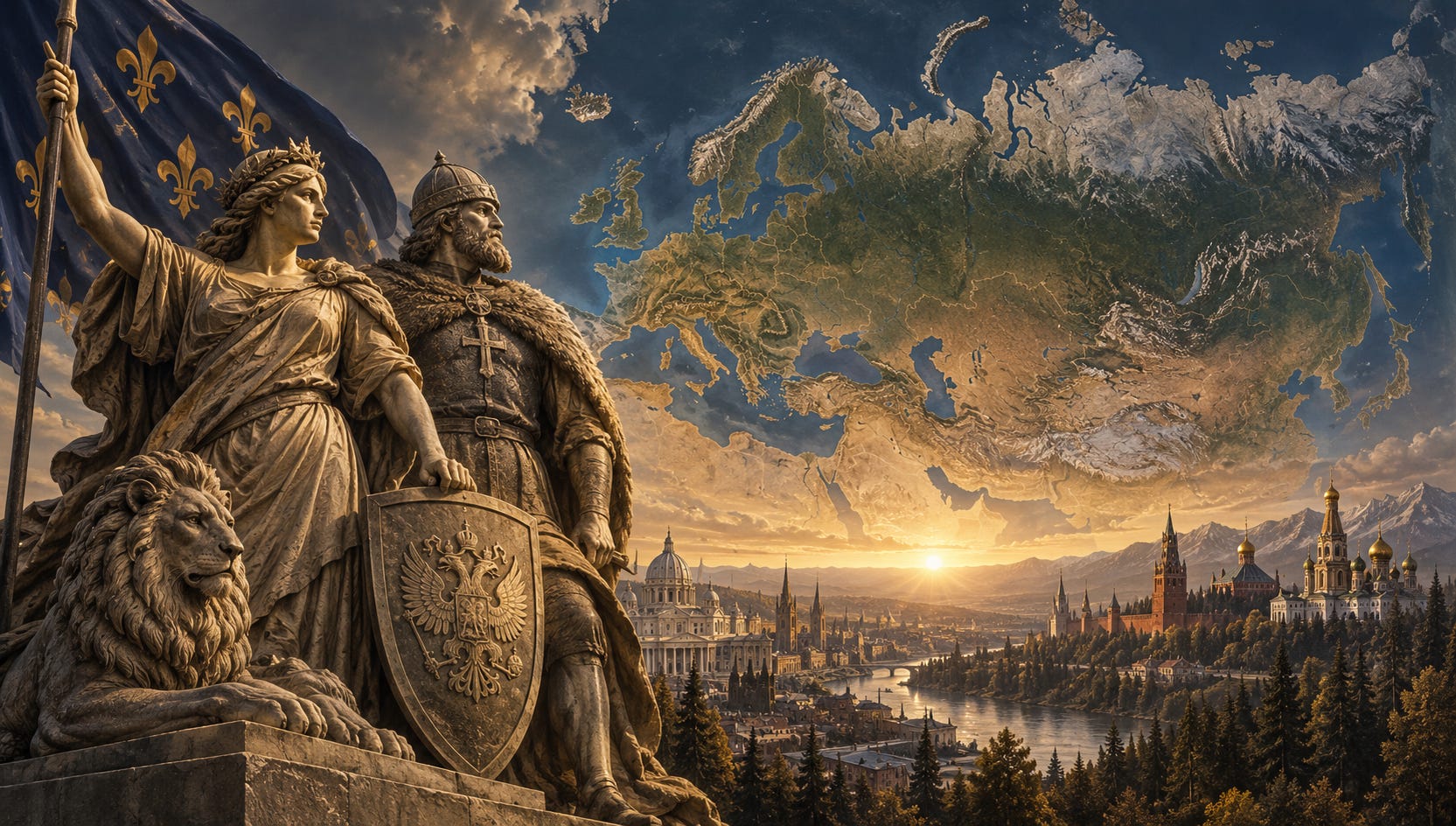
I had named the idea of a continental union between all peoples of European origin, from France to Russia, from the Atlantic to the Pacific, “Eurosiberia”. And my friend Pavel Tulaev discreetly pointed out to me that it would be better to speak of Euro-Russia, because Siberia is fundamentally a geographical term and Russia an ethnic and historical term. I think he was right. It’s better to speak of Euro-Russia for this project.
The Euro-Russian imperial confederation: a mobilizing project for the 21st century.
Such an idea is obviously not intended to be pragmatically applied within the next 10 years! It is a matter of a “positive utopia” or the construction of an “acting myth.” In the 19th century, the idea of the Union of Western Europe took shape and was finally realized (with formidable imperfections); in the 20th century, the founders of the Zionist idea succeeded in achieving the creation of the State of Israel. The Founding Fathers of the United States of America in the 18th century succeeded in their gamble. Similarly today, the idea of an imperial and federal Union of Western Europe, Central Europe and Russia must be envisaged, to serve as a model for future generations who will have to realize it.
This project both extends and transcends the European Union, which, in my opinion, was an important dialectical moment in history but has reached its limits and proves to be, in my view, a failure today. Why a failure? Because the European Union has not been capable of asserting Europe’s sovereignty as a great power vis-à-vis the US, because it has been incapable of preventing the invasion of Europe by populations from the third world and Islam. Worse still, the European Union today is coming to deny and destroy the very idea of Europe through the project of including Turkey in it, or even for other irresponsible politicians, the countries of the Maghreb. Nevertheless, I repeat, the European Union was dialectically important (in the Hegelian sense), but it must now be transcended, overcome and extended, both negatively and positively, by the Euro-Russian Union.
The idea according to which European peoples are extremely different from one another and that Russians are even more different from the others must be subjected to a sort of critical relativism. The idea of divergence between peoples of European stock will be less and less true during the 21st century. This century will see an increasingly great opposition emerge between peoples of European origin and all the others. And we are all going to progressively become aware, from the shores of the Atlantic to Siberia, that the Euro-Russian ensemble forms a relative homogeneous unity of civilization, culture, history, mentality and genetic potential. A native Breton or Catalan, a Bavarian, and a Russian from Karelia are much closer to each other on the genetic, mental and behavioral level than they are to a Chinese person. The cultural, artistic, historical roots of France or Italy are much closer to those of Russia than they are to francophone Africa.
If one reasons in terms of ethnopolitics as much as geopolitics, the Euro-Russian ensemble appears as a vital necessity in this 21st century world which will see both the clash of civilizations and the necessity of regrouping into large blocs.
Minds, one will say, are not ready for such a revolutionary project. But with the upheavals of the 21st century, things could evolve much faster than we think. The great concrete principles are as follows:
What political and constitutional organization? Imperial confederalism.
It is impossible here to imagine in detail the internal political and constitutional form of a Euro-Russian union, but one can nevertheless establish its fundamental principles. They are extremely far from those of the current European Union which is nothing but an impotent and vague technocratic aggregate, which combines all the disadvantages of bureaucratic centralism and anarchy.
A strong and lean central State is needed, a decision-making center, like a brain, which possesses the monopoly of foreign policy and diplomacy, general economic policy, monetary policy, armed forces and control of common external borders; and which is the guarantor of the great principles.
The different peoples and nations must possess the greatest internal autonomy. The “States” composing the Euro-Russian Union may be the current States or result from the dismemberment of some of them into regions, which will thus be new States. Any State must be able to leave the Union when it wishes and recover its sovereignty. It is free to possess the institutions it wants, free in its constitutional, judicial and educational system, in its fiscal and internal economic policy. But it must, unless expelled from the Union, respect the great fundamental principles which will be discussed later and not harm the other member States.
Solidarity between States must be ensured by financial compensations organized by the central State.
This model is partially inspired by the constitution of the United States of America, which is the oldest in the world and which functions quite well.
But it must be immediately specified here that, initially, this Euro-Russian Union will not necessarily take the form of a confederal State, but rather a sort of consultation, understanding between European States and Russia, a “union of nations”. Things must be built progressively and pragmatically. And why this word “imperial”? Because the idea of Empire, if properly understood, is the free association of peoples related by culture, civilization, racial proximity and geographical continuity. Heterogeneous ensembles always end up collapsing. The common House must be built step by step, progressively, but nevertheless urgently.
What foreign policy? Power neutralism.
The Euro-Russian confederal alliance will confront three main threats: one is the third world under the banner of Islam, through its will to conquest via mass immigration. The other is the Washington government, which sees any Euro-Russian alliance as a nightmare and which tries by all means to weaken us, to divide us, to encircle us. The third is China, which nurtures a global hegemonic will and which moreover, is currently working to surreptitiously populate Russian Siberia.
We must put an end to NATO, which is nothing other than a structure of the subjugation of Europeans by the US, and build, initially, an integrated military alliance of all European countries and Russia.
On the level of nuclear deterrence, it will be necessary to couple French forces and Russian forces. Great Britain will only be able to participate if it frees itself from its enslavement to the United States, which is not currently the case.
The foreign policy of Euro-Russia must be that of a “giant hedgehog,” with this double imperative: no imperialism vis-à-vis the outside, no interference from foreign powers in our vital space. This neutralism is justified by economic self-sufficiency. We have all the resources, all the raw materials, and we don’t need the others. We don’t need to go wage war on others and imitate irresponsible American imperialism, but we cannot tolerate others coming to impose their law in our vital space. Unlike what the United States practices, it is not a question of threatening others but of ensuring the rigorous defense of our integrity, our security and our interests.
Vis-à-vis the United States, it is not a matter of manifesting hostility, but mistrust. The objective is to convince Americans that their current foreign policy is erratic and stupid. Our conviction must be that Americans will only be our friends if they admit that they are not the masters of the world. American arrogance is immature, infantile, because it only leads to failures. But, from the moment a Euro-Russian confederal ensemble exists, we would be quite willing to cooperate with Americans if the latter renounce their imperialist tradition.
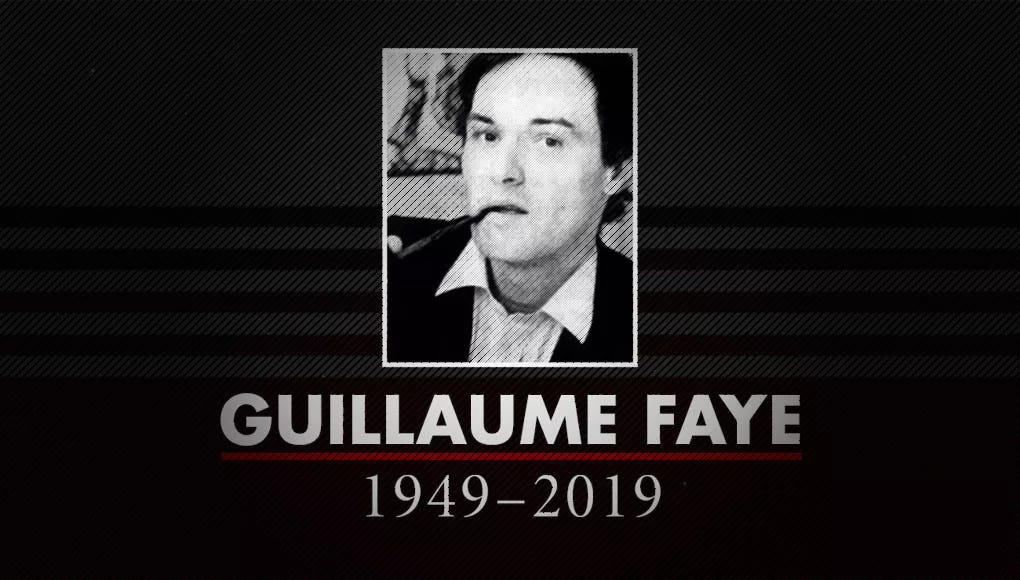
This is an excerpt from Guillaume Faye’s Against Russophobia, brought to you by Arktos:
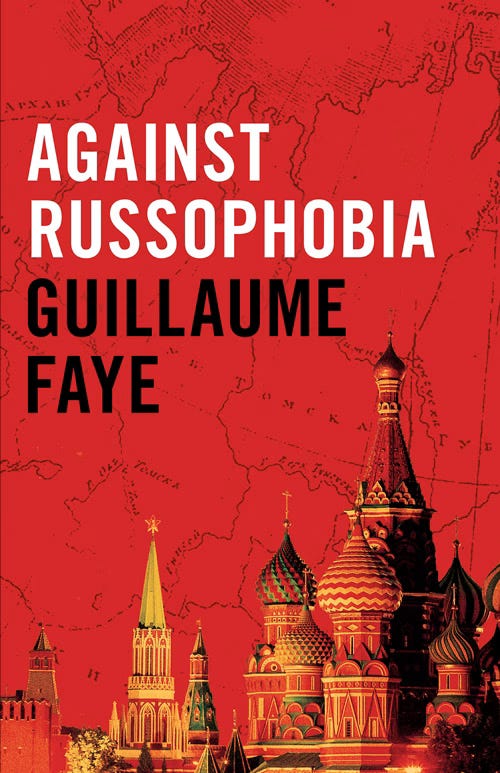
In a world dominated by headlines portraying Putin’s Russia as the clear and present danger to Europe, Guillaume Faye championed an altogether different vision: a “Eurosiberian” or “Euro-Russian” civilizational bloc stretching from the Atlantic to the Pacific, united by blood, culture, and unmatched geopolitical and economic potential.
In the final years of his long-running career as a dissident intellectual and metapolitical activist, Faye increasingly turned his scope towards the crisis of Russian-European relations, stressing the need for a tactful synthesis of sober analysis and visionary daring.
Against Russophobia, the first and definitive collection of Guillaume Faye’s writings on Russia, stands out as a critical guide for a new kind of European diplomat: the diplomat of a Europe that thinks in terms of continental longevity and the global chessboard instead of ideological hysteria and divisive stereotypes.
For Faye, only together can Europe and Russia balance their strengths and weaknesses, face down the onslaught of the Global South, restrain globalist warmongering, and meet the economic and technological challenges of the 21st century. At once historic and timely, Against Russophobia is a bold shattering of one of the most daunting Overton window-frames of our days.
We must also put an end to this inconsistent “religion of human rights” which serves the current European Union as foreign policy. Similarly, “aid to the third world”, useless and unproductive, must be called into question. The presence of Islam on the territory of the Euro-Russian Union must initially be curbed and secondly drastically restricted. Vis-à-vis the Israeli-Arab conflict, the position must be one of neutrality. No military participation in any UN intervention outside our borders can be admitted.
What economic organization? The autarky of large spaces.
We should not be inspired by state socialism, in its internal organization — ineffective — nor by current globalist speculative capitalism. A new economic model could be built, founded on principles that I have developed for a long time by drawing inspiration from the French Nobel Prize in economics Maurice Allais and the late Prof. François Perroux, of the Collège de France, under the general theme of organic economy which is a third way between socialism and globalized capitalism.
Rejection of the principle of global free trade (which is catastrophic for all humanity) with the establishment of customs barriers and economic quotas protecting the Euro-Russian space, self-sufficient in all areas, the first economic space on the planet.
On the other hand, we need a single market, a common currency, internal free trade in the Euro-Russian space, a rejection of assisted, socialized, rigid economy, as practiced in France. An internal free capitalism, which will form a powerful dynamic, given the gigantic size of the Euro-Russian ensemble, such is the choice that must be made.
The central State can only intervene in the economy in a political, legislative, planning manner, and no longer financial. The sovereign function must not substitute for enterprises, but define major axes of economic policy. We must draw inspiration here from the very effective model of the US where the State supports firms without entering their capital.
No majority stake in the capital of large companies of the Union can be possible on the part of investors foreign to the Union. On the other hand, financial transfers and equity stakes within the Euro-Russian space are free.
Rigorous respect for the environment, development of nuclear energy, active policy of research and high technology, particularly on renewable energies, integrated space policy, construction of large strictly Euro-Russian aeronautical and military centers, systematic preference for firms of the Euro-Russian space in all major industrial markets (calls for tenders, but also in terms of trade in agricultural products; prohibition for States to go into debt for operating expenses, but only for investment: these are some of the economic principles that the central State and member States must imperatively respect.
What axes of domestic policy? Ethnocentrism and natalism, social justice and collective discipline.
General principles of domestic policy must be contractually defined for all member States, failing which they cannot enter the Union or must leave it.
Euro-Russia, cradle of White peoples, today severely threatened in their demography, must be founded on the ethnocentric principle of ethnic homogeneity. There is nothing immoral in this, since this principle is applied by the majority of non-White countries in the world: China, India, Japan, Africa, etc. This presupposes the following constitutional principles imposed on all member States: refusal of any immigration of workers from outside the Euro-Russian space (except, by quotas, senior executives and highly qualified personnel); prohibition of family reunification and the right of asylum; effective and administrative expulsion without appeal of all illegal immigrants; impossibility for foreigners outside the Union to receive the slightest social or health benefit (end of “suction pumps”); exclusion of any foreign national outside the Union from elections; immediate and definitive expulsion of any foreigner to the Union guilty of the slightest offense; abandonment of birthright citizenship in favor of blood right (end of naturalizations); progressive return to their country for all third world immigrants; possibility of free immigration and naturalizations only within the Euro-Russian space, for its citizens, according to the legislation of each State. The ethnic criterion must be at the center of the constitutional project of internal organization. White ethnic homogeneity is the foundation of the Euro-Russian project, just as black ethnic homogeneity is the foundation of Africans who want, rightly, to unify their continent. Ethnic homogeneity is the very bedrock of social peace and public freedoms, a common sense truth that Aristotle perfectly understood.
Given the dramatic demographic decline of the peoples of the Euro-Russian space, each State will be required to implement a natalist policy, which will only benefit nationals of the Union.
Other constitutional principles that all States of the Union must respect and that they will implement according to their own legislation and traditions: social justice, meritocracy, disciplined and selective education, equality before the law, eradication of poverty, merciless repression of criminality, family policy, prohibition of unions and adoptions between homosexuals, etc.
It is simply a matter of uniting to confront the increasingly threatening outside world.
And above all, it must be recognized that what divides, in mentalities, cultural habits, historical memory, the Russians from Western Europeans is much less important than what unites us all. And this will be increasingly true during the 21st century. Crucial question: can Russian nationalism feel wounded and dispossessed by such an imperial project of Euro-Russian union? No, insofar as this Union would not be constraining, but voluntary and associative, and where the benefits for Russia would be considerable.
I was told that the “Russian soul” felt divided, even torn between Europe and Asia and that Russia was therefore not truly European. Which is what the symbol of the double-headed Eagle would signify, looking both toward the Orient and the Occident. But I think that this is a geographical sophism. Russians have nothing of a “semi-Asian” people in them; they are a European people who conquered a part of geographical Asia and appropriated it. The opposition between Russians and Eastern Slavs on one hand, and other Western Europeans on the other hand, is much stronger than one believes. We all belong to the same genetic, ethnic and civilizational stock, to a great family, whose differences are less important than the similarities.
I will be reproached for not having spoken of “democracy.” This is intentional, because we no longer know at all what this term, employed by all political regimes worldwide, means. In the European Union, where the people are totally dispossessed of the major decisions concerning them (notably in matters of immigration, uncontrolled opening of borders, economic policy, etc.), leaders boast of representing the superior world model of democracy and worship of “human rights”. However, freedom of opinion is not respected there, since, for example, one cannot denounce the invasion by Islam and the third world without being criminalized as “racist” by a legislative arsenal and a neo-totalitarian judicial system. The concept of democracy, as it is used in the West, is quite similar, in simulacrum and semantic lie (but more subtle and “advertising”), to Soviet communist propaganda. The European Union, as it currently functions, with a powerless Parliament and a non-elected but omnipotent technocracy, cannot claim to respect the will of the peoples. It has invented the practice of soft tyranny. Similarly, it is in the name of its crusade for the famous “democracy” that the Washington government has sown indescribable disorder in the Middle East and is currently trying to encircle and weaken Russia and practice interference in its internal affairs.
This is the reason why, in this Euro-Russian Union project, it is out of the question to unify under the same model the institutional practices and internal law of member States. Simply, the latter, and the central State, if it exists one day, must respect the following three principles: rule of law, free elections by universal suffrage, referendums and absolute respect for the decisions of the people. By people, we obviously mean the “native people”. In reference to the only true democracy, which is neither Western-American, nor socialist or communist, but of Greek and Athenian origin. Let us draw inspiration from Pericles and the spirit of Athena.
I am well aware that such a Euro-Russian Union project is very complex. All this presupposes a reversal of mentalities, the Umwertung of which Nietzsche spoke, who was also an adept of “grand politics.” But this reversal, this mental storm will come with the catastrophes that are looming. These catastrophes are dialectically positive — and here, I invoke Hegel and his “pursuit of Reason in History”. Except that Hegel understood an implacable mechanism without seeing its meaning. This “reason” is not a transcendence, but the possible union of a great implacable historical tendency and an exceptional political will that uses and overturns the chaos created to metamorphose it into a new order. The fatalists, the materialists (whether they are Marxists or liberals, they are exactly the same philosophically), the traitors, the narrow nationalists, the false sages, the depressed and disappointed of History, the progressives clinging to their false prophecies, the hallucinated optimists, the nostalgic conservatives, the calculating decadent politicians, the intellectuals in their ivory tower have never understood that the destiny of men and peoples was never written in advance, that nothing is ever necessarily lost or won.
Two difficult questions to resolve arise now: first of all, what federal capital for the Euro-Russian Union? It could not be Paris, Berlin or Moscow, because then one would suspect materialist calculations. I propose — as Brazil or the US have done — to create from scratch a new capital, which would be as much a political as an architectural work, in the image of Saint Petersburg; but it obviously remains to determine in which country.
The second question that arises is: what dominant working language? What will be the language of the central and federal State? The current multilingual system of the European Union is very costly, anarchic, and results in fact in a domination of English, which is not a good thing. We must not create an artificial language, like Esperanto, that never works. It cannot be a major language, like Russian, German, or French, at the risk of offending other peoples. I am going to make a surprising proposal: why not Breton? It is a living, spoken, modern, very structured language, which the political elites of the Continent could easily learn. Another suggestion that is intended to make its way…
For the moment, minds, whether in Western Europe or in Russia, are not yet ready for such an upheaval of perspective. I have always been reproached for my utopian mentality. French intellectuals think that I lack wisdom, but I think they lack courage. But also lucidity. We must have confidence, because we observe that today history resembles a horse running at a gallop. We must teach the next generation the following reality: from Brest, at the tip of Brittany, to Provideniya, on the Bering Strait, exists the vital space of the same people: ours. Marx said: “proletarians of all countries, unite!”. Let us rather whisper: “Whites of all countries, unite!” Around the Euro-Russian imperial confederation. And let us reflect from today on its future organization, because ideas make their way in History like worms in ripe fruits.
READ MORE:
Guillaume Faye’s Against Russophobia is available from Arktos and on Amazon
