


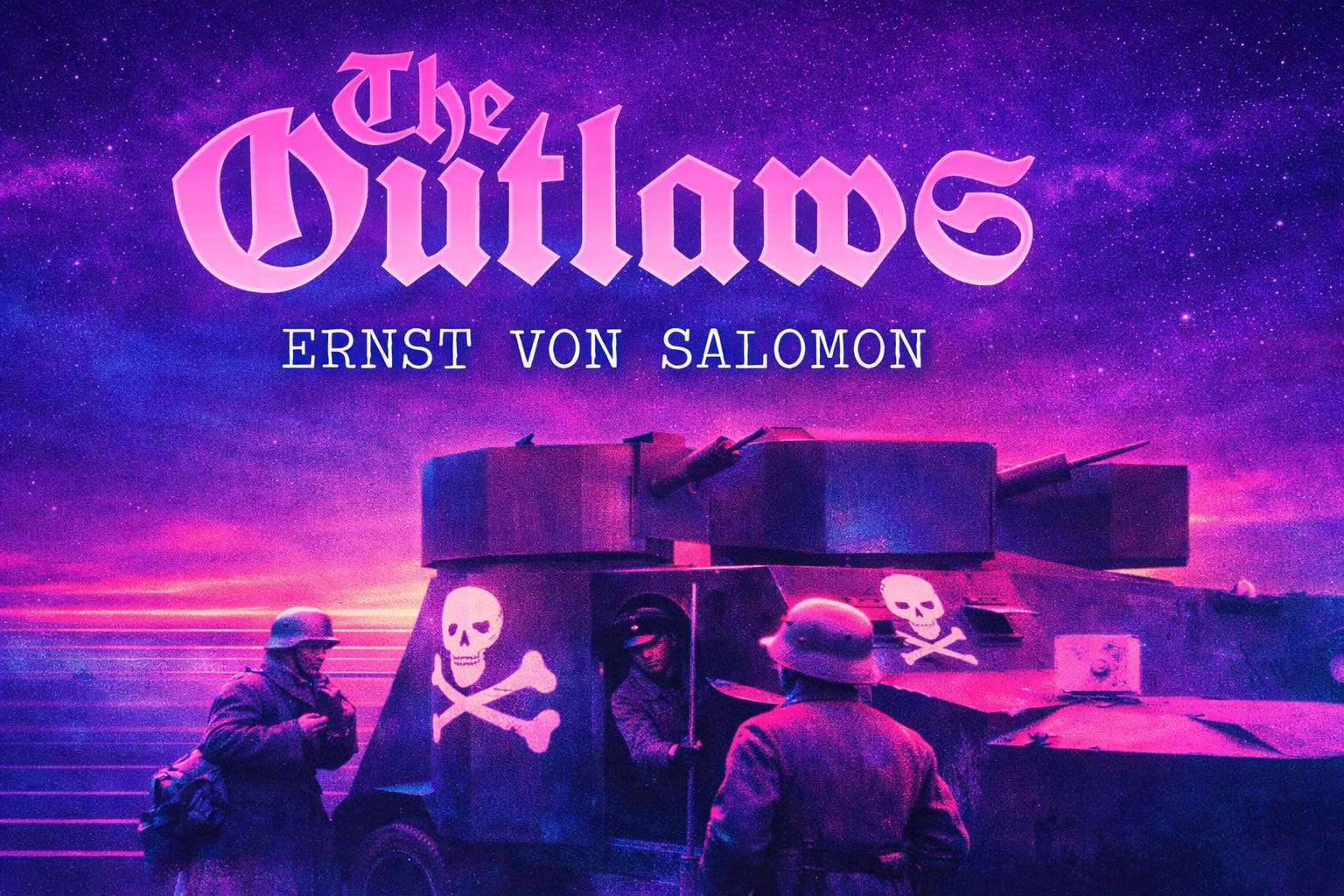
In this interview for Écrits de Rome, Robert Steuckers offers a wide-ranging reassessment of Ernst von Salomon, the Freikorps veteran, national-revolutionary, and author whose work has been published in English by Arktos.
EdR: Ernst von Salomon is generally regarded as an author of the Conservative Revolution. To which branch of that movement can he more precisely be connected?
RS: Ernst von Salomon and his work fall squarely within the category of the “national-revolutionaries,” in the terminology established by Armin Mohler, or, at times, within that of “soldierly nationalism.” Dominique Venner, in his books Baltikum and Un fascisme allemand (A German Fascism), as well as in his preface to Histoire proche (Recent History), would serve, over a long period, as the defender and interpreter of this “soldierism” that powerfully speaks to romantic temperaments.
Yet insufficient account is taken of the positions Ernst von Salomon adopted after the Second World War — particularly during the 1960s — when this former radical opponent of the “reparations” policies imposed by the Treaty of Versailles in 1919, and of every form of alignment and subordination to the Western powers (France, the United Kingdom, the United States), transformed himself into an equally uncompromising militant, hostile to the policy of alignment with Washington within the framework of NATO. This anti-American stance led him to express solidarity with certain left-wing pacifists, which intrigued Venner, who paid him a visit six months before his untimely death in June 1972 (most likely due to sleep apnea).
The logic that animated Ernst von Salomon throughout his eventful life was a vehement rejection of Western models — characterized as “bourgeois” or “mercantile” — devoid of that Prussian or Teutonic sense of service, of the Kantian sense of duty (in which Kant is not perceived through the habitual lens of the “Enlightenment”), and of the sense of national continuity (wherein the ideology of Western democracies is seen as a machine for rendering peoples amnesiac).
In this respect, given the current crisis of Europe — ideologically Westernized, even in its Eastern regions — the thought of Ernst von Salomon is more contemporary than ever: the rejection of the ideological hodgepodge of the parties in power, everywhere in Europe, is a vital necessity; the rejection of all subjugation to the United States and to the political and anti-diplomatic practices of the United Kingdom and Macronist France is likewise a vital imperative for all European peoples, without exception.
EdR: If the other Ernst — Jünger, of course — is widely known, von Salomon is far less so: for what reasons? What were the ties between the two men?
RS: This question strikes me as somewhat idle. The reason for Jünger’s wide renown is essentially that he lived and worked intensely for 26 years longer than Ernst von Salomon. Yet other reasons besides Jünger’s exceptional longevity may be invoked: Jünger, who was a few years older, had fought in the regular army during the First World War, received the Pour le Mérite decoration, and was promoted by the cadres of the defeated army after 1918 — not as an active-duty officer (which he no longer was), but as a military writer of the highest order.

Nevertheless, both Ernst Jünger and Ernst von Salomon expressed a rigorous, highly uncompromising nationalism — at least until 1926 in Jünger’s case, and between 1927, the year of his release from prison, and 1933 in von Salomon’s — particularly in the wake of the great crisis of 1929 and the peasant revolt against the authorities of the Weimar Republic in Schleswig-Holstein. Neither wished to adhere to any form of nationalism aligned with the electoralist criteria of Weimar parliamentary politics. The historian of the Freikorps, Hansjoachim W. Koch, cites in this connection Ernst von Salomon (though one can find similar texts written by Ernst Jünger and his brother Friedrich-Georg): to break the subjugation to the Western powers, every development leading toward mass-oriented tendencies must be avoided, for such tendencies would drive the national movement to seize power by using the adversary’s own means — that is, by becoming a “party” (by adopting the “party-form”), by becoming an “organization” with no purpose other than to contest elections. Consequently, Ernst von Salomon (and Ernst Jünger in turn) held that “their own means must be different.” For Ernst von Salomon, this had meant, in the early 1920s, engagement in the famous Organisation Consul (OC), which organized the assassination attempt against Minister Walter Rathenau — a man who, nonetheless, by concluding the celebrated Treaty of Rapallo in 1922 with the young Soviet Union, had created the ideal conditions for escaping the economic grip of an Occident hatefully hostile to all European political forms arising from different religious or ideological matrices — much as, mutatis mutandis, former Chancellor Schröder did in the early 2000s by sponsoring the delivery of Russian gas to Germany.
Any reference to Ernst von Salomon is therefore not merely an expression of the vapid romanticism of those who dream — in a reverie — of one day playing at toy soldiers, but reflects a high-level political pragmatism — all the more so since Ernst von Salomon later admitted that the Freikorps campaigns in the Baltic states and the assassination of Rathenau had been indirectly assisted behind the scenes by British intelligence services, anxious to extend Lord Curzon’s “cordon sanitaire” in Eastern Europe and to close the Baltic to the Soviets, without having to commit English or Canadian troops.
EdR: Can one say that the experience of the Freikorps was for von Salomon the “founding experience” of his thought, as the war was for others?
RS: Clearly, the Freikorps experience is formative for Ernst von Salomon, since — unlike Ernst Jünger — he did not serve in the ranks of the German Imperial Army during the First World War. In an article of 1928 entitled Geist des Nationalismus (The Spirit of Nationalism), cited by his biographer Gregor Fröhlich, Ernst von Salomon wrote that, for every man of quality, personal experiences — which cannot be transmitted to any other, and least of all to some anonymous soul lost in the crowd — are always the paramount criterion of any genuine capacity to judge things and events correctly. He thereby rejected the conventional bourgeois nationalism of a Thomas Mann (often pertinent in certain of his observations), for that nationalism is a “contemplative nationalism,” remote from all lived bodily experience, bringing only “suffering” to the committed man — as Ernst Jünger also declared at the same period. This “contemplativism” of Mann, for von Salomon, is typical of a writer embedded in Zivilisation, where verbose discourse takes precedence over living expressions drawn from cruel experience and endured suffering.
These literary figures of “Western Zivilisation“ have thus turned their backs on the royal road toward the real world, and their intellectualism amounts to “spiritual sterility” — which, he added, constitutes “treason.” This intellectualism, he continued, must be rejected in the name of pure, unadulterated action, free of pusillanimity or prevarication. In this same article — judged capital for understanding Ernst von Salomon, according to Fröhlich — our former Freikorps fighter distinguishes “patriotism,” of the old stamp, predating 1914, a relic of the 19th century, from “nationalism.” Patriotism is the foolishness of the apolitical man who avoids decision and refuses to make “distinctions” (which would permit the identification of the enemy, and the sorting of wheat from chaff). These positions explain why Ernst von Salomon rejects the national-conservatism of the numerous veterans’ associations and a conservative fraction of the German bourgeoisie (which would align itself in 1933 with Hitler’s NSDAP).
As for the term “Nation,” in the Ernst von Salomon of 1928, it is not synonymous with a specific “state construction” but expresses a “mystery” in the process of revelation — without it yet being known whether it will ever be fully revealed. In this sense, nationalism must be the minority and elitist political force that participates in the unveiling of this “mystery,” thereby conferring upon it a permanent and fertile dynamism, which is also revolutionary, for it admits no fixed form and no sterilizing immobility. What is fixed, or already fixed, must be swept away, for it constitutes a disabling ballast.
The forward march of such a mystical nationalism, according to Ernst von Salomon and Ernst Jünger, must be a constant that never ceases. The German defeat of 1918 must not justify any refusal of this inexorable forward march of this young and intrepid nationalism, despite the dead weight brought by the masses — who lack will and are quick to accept all manner of betrayals. This nationalism does not oppose the idea of the State as such, but combats the State (the institutional jumble) as incarnated by the republican politicians who have taken it hostage for personal gain.
EdR: Lacking a systematic philosophy, von Salomon proposes a “worldview” composed of a certain number of intuitions. What are the principal ones?
RS: For Ernst von Salomon, the central idea of his nationalism proceeds from an acknowledgment of “Germany’s particular path” (the Sonderweg Deutschlands). This particularity distinguishes Germany radically from the West — Jacques Pirenne, in Belgium, would demonstrate how Central Europe, but also Spain, Italy, the Polish-Lithuanian space, and Russia, are not part of the French-absolutist or English-liberal Occident, and have not been since the 17th century.
Western liberalism aims to replace the organic character of every Polity or imperial space with societal constructions and artifices in which the economy is no longer embedded within social relations but, on the contrary, in which social relations are kept captive and enfeebled within the economic sphere. The result is the erasure of the political in favor of the economic.
This slide toward the apolitical and the all-economic means that the State no longer pursues genuinely political ends, but instead imposes a technical and rationalist order that — in theory — is supposed to bring individual happiness to all and financial prosperity to the materially better-off citizens. In the end, this amounts to stripping individuals and citizens of all meaning in their existence, plunging them into a lamentable banality — the antechamber of a probable physical disappearance, as our present times give us abundant reason to foresee. The maximization of profit — rather than the heroism of action — now occupies the center of the preoccupations of a declining humanity; and worse still, the promotion of such anti-values becomes the principal motive of the wars planned by the West (one would say today by its “Deep State”), or by Westernized polities.
EdR: The very embodiment of the Warrior, or the Hero — in Werner Sombart’s sense —, Ernst von Salomon seems to belong to a forever vanished age. What of him and his work do you nonetheless think must be retained for today?
RS: We have already seen what vision Ernst von Salomon held of the political soldier within a state framework organized by incompetent and contemptible politicians. The eras of the Wilhelmine German Empire, the Weimar Republic, and National Socialism are indeed gone — as are those of the Third Republic and the interwar period in France, where the Fifth Republic is likewise seen to be dying slowly. It is nonetheless worth recalling what Ernst von Salomon’s ideas were between 1945 and 1972, the year of his death. Under the Weimar Republic, von Salomon’s positions could be characterized as anti-Western and anti-liberal. In the new Federal Republic, proclaimed in 1949 and whose tutelary figure was Konrad Adenauer — champion of subjugation to the structures of the Atlantic world and promoter of Franco-German reconciliation — Ernst von Salomon was regarded as a crypto-communist, or even outright as an agent of the GDR. To this he replied in the columns of the neo-nationalist weekly Deutsche National-Zeitung (The German National Newspaper) (no. 20, 1954): “How could I be a Communist? Simply because I can’t stand the Americans? I would like, if the mood took me, to travel from Cologne to Wuppertal, from... all the way to Posen (today Poznań) without ever being impeded or blocked by any ideology or practice brought in by the occupiers...”

The rejection is thus twofold: rejection of the ideology imported by America, and of the abstruse schemas of Soviet Communism. Philosophically speaking, Ernst von Salomon never adhered to dogmatic communism, but by the late 1950s he had also ceased to belong to what may be called the “right” (especially if that right was to be conflated with a Christian Democracy knowingly subservient to the United States). Ernst von Salomon then advances a particular reading of the major theorists of the international left then in vogue: Mao, Marcuse, and above all Gramsci.
The idea of a “Solomonian Gramscianism” deserves our particular attention. Von Salomon’s reading of Gramsci, as Fröhlich recalls (p. 365), gives rise to a self-critique of his own activist trajectory — a period during which he had not understood that political and institutional hegemony is prepared through cultural struggle (the “long march through the institutions,” the better to subvert them). For Ernst von Salomon, the aim — through a metapolitical action of Gramscian inspiration — is to restore in Germany a genuine national feeling, which had to begin with the emergence of a “solidarity among all the declassed” (these constituting a new category, the logical sequel to that of the “outcasts”). This gathering of the “declassed” must be organized in opposition to the cultural domination imposed by the Western powers — a viewpoint he shared with Wolfgang Venohr and Armin Mohler, with whom he corresponded.
This solidarity among the declassed was to be simultaneously “revolutionary” and “conservative” — and, in that sense, “Prussian,” beyond whatever state forms Prussia may have taken in the course of German history: the Prussian spirit, according to von Salomon and Venohr, transcends such forms, which invariably become fixed at some point and are necessarily, therefore, transitory. Within the framework of these new positions — at once Gramscian and revolutionary-conservative — Ernst von Salomon, for the first time in his life in 1961, called for a vote in favor of a party: the Deutsche Friedensunion (DFU — German Peace Union), a small party advocating a transversal strategy uniting Communists, Socialists, neutralists, and nationalists, who were all to combine their efforts against the integration of the FRG into the Western, Atlanticist, and Americanophile machinery, and to pursue the reunification of the two German republics from a standpoint hostile to the United States.
This enthusiasm, however — which has not been entirely extinguished in Germany today — would prove to be a flash in the pan, for the authorities of the GDR, representing a rigid, if not caricatural, and highly unappealing form of communism, decided in August 1961 to build the Berlin Wall. The circles of the DFU then dwindled away in interminable ideological discussions of a Marxisant cast, entirely marked by sterility and devoid of political punch. Ernst von Salomon would leave this assembly of talkers, who in any event garnered only 1.9% in the elections of September 1961. In another register, the evolution of military technology — with the atomic bomb and intercontinental missiles — ruined the soldierly vision of Ernst von Salomon: for the boundaries of a nation no longer extend as far as the geographical points to which the strength of its men, as soldiers, carries them. Soldiers are therefore no longer the bearers of the Nation. We have entered the era of the omnipotence of technology, driven by a destructive fury (Ernst Jünger would arrive at similar reflections).
Von Salomon writes: “The degeneration of the phenomenon of war concerns in the first instance not the ordinary man, not the people, but the warrior himself. This degeneration devalues his mission, strips him of honor, confiscates all those virtues for the preservation of which the soldier fought” (Interview for the ORTF, 2 July 1972). The former warrior Ernst von Salomon becomes hostile to war — not because war is an anthropological constant, but hostile to any “just war” in the sense the Americans give it.
READ MORE from Arktos: the new expanded edition of Julius Evola’s Metaphysics of War is hot off the press.

This ius ad bellum, endlessly invoked by Washington, now serves only to advance the claims to universality of liberalism, which demands the unconditional submission of those designated as “enemies” — with whom no peace is ever made — and exacts their complete self-transformation through forced conformity to the canons of the West. Peace, once conceived as the horizon of every conflict, can, in the context of generalized Americanization, no longer ever be attained. Without the prospect of peace, the sacrifice of the soldier on the field of battle is henceforth devoid of meaning.
Westernization is thus a process that perpetuates a state of war emptied of all meaning, since the liberalism of the West strips men of every meaning in their existence. One could not be more timely in light of NATO’s evolution and the war against Iran.
Interview conducted by Louis Furiet
Translated by Alexander Raynor
READ MORE: Ernst von Salomon’s The Outlaws is available from Arktos in paperback and audiobook.

"The Outlaws" is an amazing memoir and could not be more highly recommended. I'm hoping Salomon's later work on so-called "de-Nazification" and the Allied occupation will be newly translated and published, as it's been out of print for years.
Wow. Excellent article. The Outlaws was a fantastic read and Salomon seems like a very interesting man. Keep up the great work. 👍