


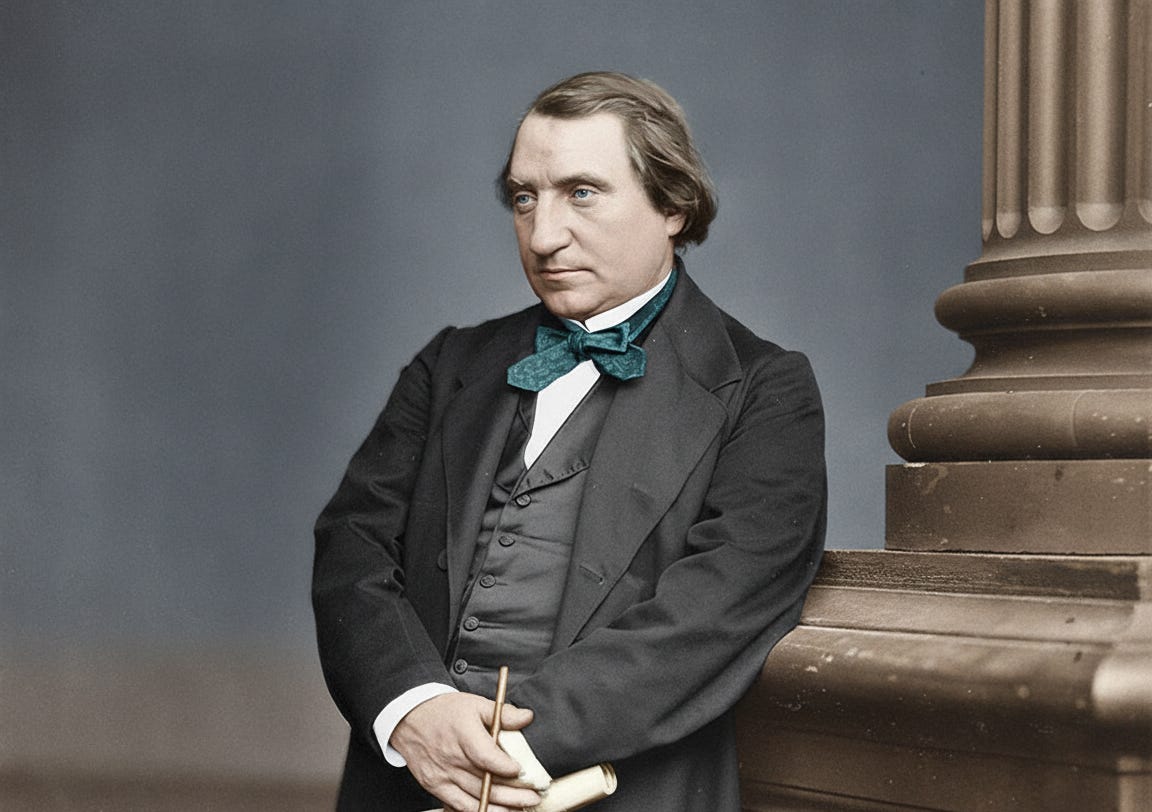
Antoine Dresse (“Ego Non”) rescues Ernest Renan from the reductive clichés that have long obscured his thought, whether as militant anticlerical or proto-civic nationalist. The real Renan, Dresse argues, was a self-described "legitimist" ill at ease with democracy, who rallied to the Third Republic only out of opposition to clericalism, never out of egalitarian conviction.
Ernest Renan (1823-1892) is one of those immense minds of the past who are now frozen in images d’Épinal—clichéd pictures designed as much to celebrate them as to spare us from actually reading them.
For a long time, the image we retained of Renan was that of the rabid anticlerical and resolute adversary of religion. Nowadays, when Renan is cited, it is almost exclusively to draw upon a biased and anachronistic reading of his text What Is a Nation?, supposedly justifying a kind of civic patriotism. Renan’s work and thought are, however, too precious to let them be reduced in this way.
As Léon Daudet would note in The Stupid Nineteenth Century, with a touch of irony, from roughly 1875 to 1905, Renan was “the god of the Third Republic.” And he barely exaggerates. Yet Renan’s adherence to the Republic was far from self-evident. In 1878, at the age of 55, he confessed: “I am indeed a republican of the day after.”
And indeed, Renan had never been a particularly republican author before that decade, and even less a democratic one. According to Zeev Sternhell, Renan belongs, along with Carlyle and Taine, to the second generation of the anti-Enlightenment—those who no longer advocated a return to the Ancien Régime but strove to deconstruct the political principles inherited from the Enlightenment. His 1871 masterpiece, The Intellectual and Moral Reform of France, proves this. If he rallied to the Republic, it was due to his distrust of religious dogmatism, particularly in higher education. But in truth, he would confess: “I am by essence a legitimist; I was born to serve [...] a dynasty or a constitution held as uncontested authority. Revolutions have made my task difficult.1”
A Paradoxical Legitimist
His rallying to the Republic is thus explained as a reaction to the rise of clericalism and not as an adherence to the democratic ideal. To the very end, he would think that “the conscience of a nation
More than a particular political regime, it is the principle of the oligarchy of intelligence that Renan defends against all odds.
resides in the enlightened portion of the nation, which leads and commands the rest.” In truth, more than a particular political regime, it is the principle of the oligarchy of intelligence that Renan defends against all odds. Among the readings that marked him, we find, for example, Tocqueville’s Democracy in America, and he was seized with horror at that universal triumph of equality that Tocqueville announced.
But more than equality itself, it was its corollaries—stupidity and mediocrity—that he feared above all, under the name of pamboeotia. As he would write in his Souvenirs: “A formidable pamboeotia, a league of all follies, spreads a leaden lid over the world, under which one suffocates.2”
From The Future of Science (1848), one of his earliest writings, until his death, Renan remained convinced that “all the evil of humanity comes [...] from a lack of culture.3” This is why he would always distrust democracy and the principle of universal suffrage, believing that “stupidity does not have the right to govern the world.4” It follows that someone must assume the “guardianship of the masses”: this is the function of aristocracy, which plays a major role in his political thought.
READ MORE by Antoine Dresse:
The Superhumanist Myth

Antoine Dresse (“Ego Non”) explores Italian philosopher Giorgio Locchi’s radical reinterpretation of Martin Heidegger’s work, positioning it as the philosophical culmination of what Locchi calls the “superhumanist myth” that rose with Wagner and Nietzsche and dared to envision a new beginning for European history and thought.
What makes Renan’s thought original is that it combines both the elitist ideal of liberty of a Tocqueville and the political lessons of counter-revolutionary thought. If Renan is often described as a “liberal” thinker, he is indeed so in the manner of an Edmund Burke. His liberalism is fundamentally aristocratic and pairs rather poorly with any form of egalitarianism. Here, in fact, is how he defines it in Philosophy of Contemporary History:
“The true liberal cares rather little that there exists above him an aristocracy, even a disdainful one, provided that this aristocracy lets him work without obstacle [...] In his eyes, there is only one solid equality: equality before duty.5”
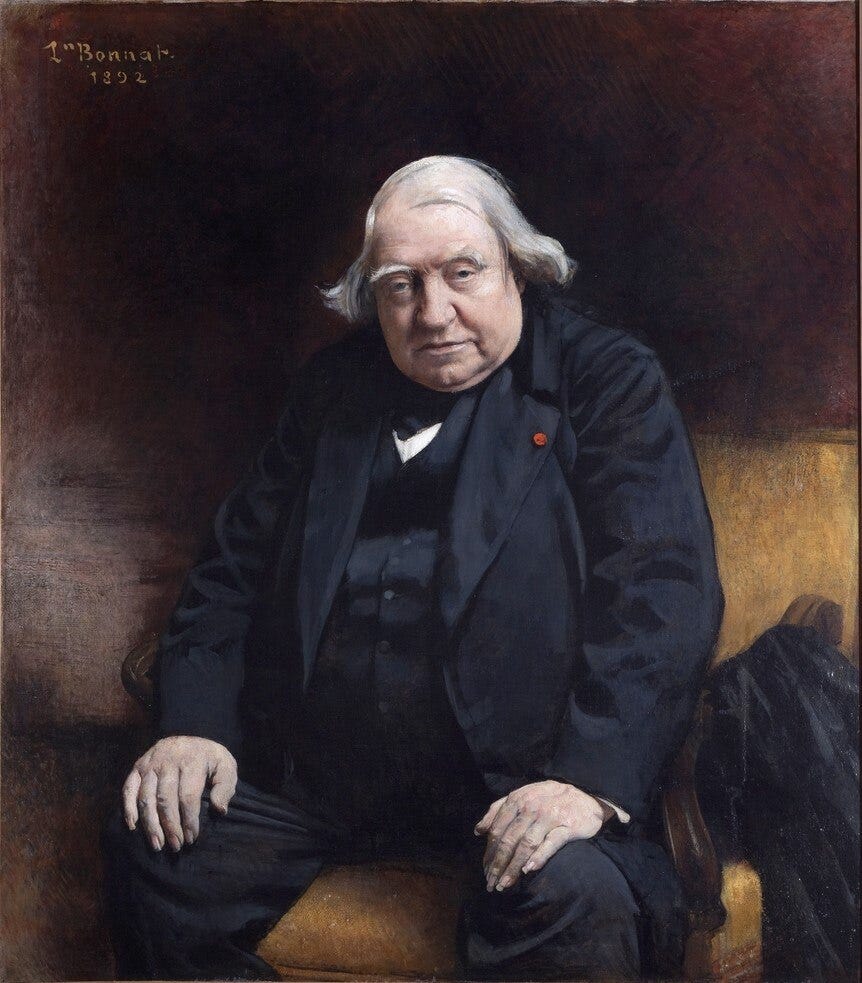
Thus, Renan does not retain from liberalism the philosophy of “natural rights” that we have seen develop since John Locke at least. What he retains from it, along with Tocqueville, is the idea of limited power, especially in the intellectual, scientific, and economic domains.
Thus, the liberty he defends is not a natural right that every man would possess simply by virtue of being human; it is the liberty of aristocracy, of excellence, whether this excellence be of birth or merit. The purpose of life is not enjoyment, he explains in The Future of Science; the purpose of society is not happiness, neither of all nor of a few, nor is it even material well-being, but “intellectual perfection.” And from this perspective:
“A society has the right to what is necessary for its existence, whatever apparent injustice may result for the individual.” It follows that “inequality is legitimate whenever inequality is necessary for the good of humanity.6”
Decivilizing Democracy

Antoine Dresse (“Ego Non”) explores the thought of libertarian philosopher Hans-Hermann Hoppe, who has upended centuries of liberal thought by arguing that democracy is not the natural ally of individual freedom, but rather its structural enemy—a “decivilizing” force that incentivizes short-term thinking and erodes social capital.
For anyone willing to see it, this Renanian ideal is present in every part of his work. But it is undoubtedly in the third of his Philosophical Dialogues, “Dreams,” that these principles are expressed most clearly. Through the mouth of Theoctistus, who presents his obsessions in radical fashion, Renan opposes egalitarianism and progress:
“To elevate all men is the first duty of society; but to elevate all men to the same level is impossible [...] It must be admitted that we can hardly conceive of high culture reigning over one portion of humanity without another portion serving it and participating in a subordinate capacity. The essential thing is that high culture establish itself and make itself master of the world, making its beneficent influence felt upon the less cultivated portions [...] What does it matter that the millions of limited beings who cover the planet ignore the truth or deny it, so long as the intelligent see it and adore it? [...] It is not necessary, for the full existence of reason, that the entire world perceive it. In any case, such an initiation, if it were to happen, would not come about through base democracy, which seems destined instead to bring about the extinction of all difficult culture and all high discipline [...] The principle that society exists only for the well-being and liberty of the individuals who compose it does not seem to conform to the plans of nature—plans in which the species alone is taken into consideration and in which the individual seems sacrificed. It is greatly to be feared that the final word of democracy thus understood (I hasten to say that it can be understood otherwise) may be a social state in which a degenerate mass would have no other concern than to taste the ignoble pleasures of the vulgar man.7”
The Nobility of the Spirit
What matters, then, is the production of great men formed by knowledge:
“In sum, the end of humanity is to produce great men; the great work will be accomplished through science, not through democracy. Nothing without great men; salvation will come through great men [...] What is essential is less to produce enlightened masses than to produce great geniuses and a public capable of understanding them. If the ignorance of the masses is a necessary condition for this, so be it.8”
In an egalitarian democracy, even mediocre minds will experience a foolish vanity and refuse to recognize a culture superior to their own.
Rare are the texts that assume the aristocratic ideal with as much radicality as this dialogue by Ernest Renan. Paul Bourget, in his Essays in Contemporary Psychology, spoke of “Mr. Renan’s aristocratic dream” and saw in his dialogues the fruit of a profound reflection and a doctrine that absolutely had to be studied. Such frankness seems hardly utterable today. Yet we cannot help but ask ourselves this question, following the sage of Tréguier: what if there could be no great culture without an oligarchy of intelligence?
For further reading:
Ernest Renan, Questions contemporaines, Paris, Michel Lévy frères éditeur, 1868.
Ernest Renan, Histoire et parole. Œuvres diverses, “Troisième dialogue philosophique,” Paris, Robert Laffont, coll. “Bouquins,” 1984.
Ernest Renan, L’avenir de la science, Paris, Flammarion, coll. “GF,” 2014.
Originally published in Éléments no. 217, December-January 2026
Translated by Alexander Raynor
READ Antoine Dresse’s book, Political Realism, brought to you by Arktos:

Ernest Renan, Discours et conférences, “Discours à l’association des étudiants. Le 15 mai 1886,” Paris, Calmann Lévy, 1887, pp. 242-243.
Ernest Renan, Souvenirs d’enfance et de jeunesse, Paris, Calmann-Lévy, 1923, p. 56.
Ernest Renan, Œuvres complètes, vol. 3, “L’avenir de la science,” Paris, Calmann-Lévy, p. 997.
Ibid., p. 1000.
Ernest Renan, Questions contemporaines, Paris, Michel Lévy frères éditeur, 1868, p. 21.
Ernest Renan, Œuvres complètes, vol. 3, “L’avenir de la science,” op. cit., p. 1030.
Ernest Renan, Histoire et parole. Œuvres diverses, “Troisième dialogue philosophique,” Paris, Robert Laffont, coll. “Bouquins,” 1984, p. 663.
Ibid., pp. 664-665.
Grazie.
Antoine, a magnificent essay. Merci, LM