


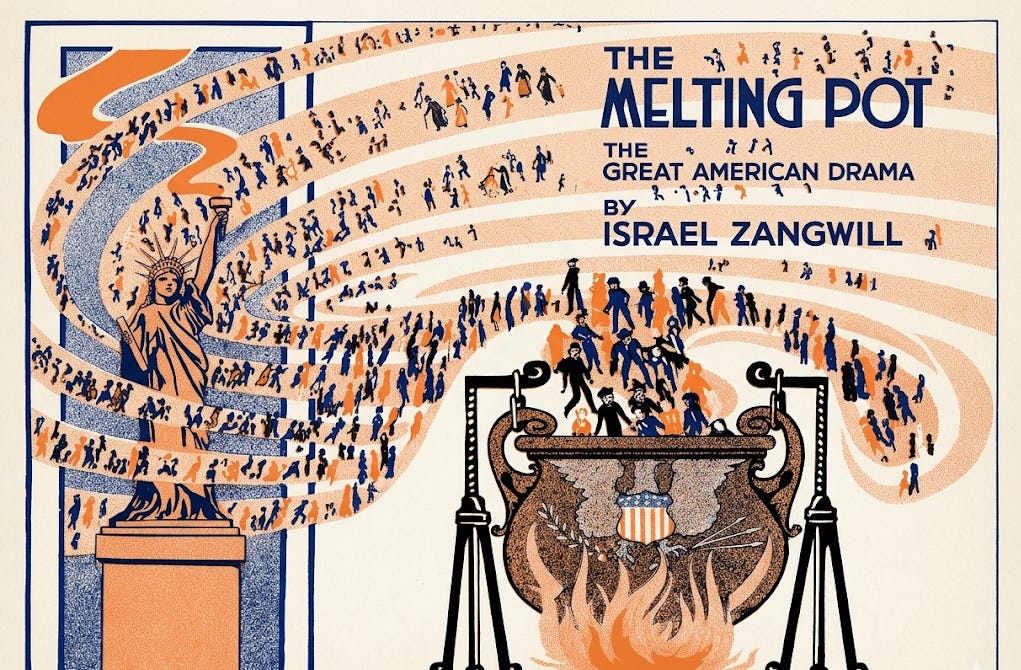
Alain de Benoist draws a sharp distinction between diversity — the natural plurality of peoples, languages, and cultures that has defined humanity for millennia — and "diversity," the ideological program that traffics under the same name in contemporary liberal societies.
Mathieu Bock-Côté often speaks of “diversitarian”1 ideology to designate the ideology at work in the “multicultural” or “inclusive” society — a fitting extension of the “open society” dear to Karl Popper. He does so rightly and as a good Québécois, for it is in Canada that former Prime Minister Justin Trudeau prided himself, following the recommendations of the 2008 Bouchard Report, on having made his country the first “diversitarian nation” — that is, in his own words, a vanguard laboratory of “happy diversity” (on the model of “happy globalization”), which consists in changing peoples so as to eliminate from within them any trace of a specific social and cultural personality.
In this cult of “diversity,” Bock-Côté sees at once the mark of a “falsified universalism” and a tool of social engineering meant to secure acceptance of the change of people in the name of universal human rights, of the “mixist”2 imperative, and of the cult of minorities: newcomers no longer have to adapt to the society that receives them; rather, it is that society that must transform itself to accommodate the ever-growing demands of individuals or groups “of diverse background.”
To condemn “diversitarian” ideology — is this also to condemn diversity? No, of course not. Why? Because there is diversity, and there is “diversity.”
Genetic diversity is the rule among all living things: it is what makes evolution possible. The diversity of species, the diversity of languages, of peoples, and of cultures is humanity’s great wealth. The safeguarding of biodiversity must therefore extend to the different cultures, so as to guarantee their right to historical continuity.
“The opposite of diversity is not exclusivism but uniformity. Diversity means variety, plurality; “diversity” means generalized hybridization, the mixing that makes variety disappear.”
A diversity of cultures and peoples, each with its own personality — such, precisely, has been humanity’s normal state for millennia. One lived then in a heterogeneous world of relatively homogeneous, rooted peoples. The “diversitarian” system produces exactly the opposite: an increasingly homogeneous world of peoples rendered ever more heterogeneous, to the point of being no more than aggregates of individuals drawn from everywhere — who, moreover, come to resemble one another more and more, which renders them interchangeable. It is this great upheaval — this passage from a heterogeneous global world to a homogeneous one, and from relatively homogeneous peoples to heterogeneous aggregates — that allows us to understand how “diversitarism” brings about the disappearance of differences, that is to say, of true diversity.
The opposite of diversity is not exclusivism but uniformity. Diversity means variety, plurality; “diversity” means generalized hybridization, the mixing that makes variety disappear. “Diversitarism” is a form of cosmopolitanism that tends to make diversity between cultures vanish by introducing it to excess within cultures. The “diversitarian” regime favors individual “diversity” the better to abolish collective diversity.
The aim is to work toward the indistinction of cultures and peoples: to champion the “diversity” of origins within a single society in order to secure its disappearance on a global scale. The example of Quebec may be taken up again here: by subjecting it to “diversity” — treated as an end in itself — what is sought is to make vanish that element of real diversity which the historical Québécois identity represents within Canada.
“Why live in common if we do not share the same culture?” Bock-Côté further asks. An excellent question, for one can only “live together” insofar as one can rely on a common foundation. The common is the natural support of diversity. Since “mixism” inevitably brings about the disappearance of the cultures called upon to mix, they end up all being the same. The common melts like snow in the sun amid a plurality of belongings within fragmented societies. Mixism reduces the share of the common to the point of making it disappear.
‘The Ideology of Sameness’: A Critique of Egalitarianism

Alexander Raynor reviews Alain de Benoist’s recent work, The Ideology of Sameness (Arktos, 2022).
“The mistake of our elites,” says Chantal Delsol, “is to believe that diversity suffices on its own to produce a common life.” This belief is obviously false. The more heterogeneous a people is, the harder it is to govern (the law can no longer rely upon shared mores). The more “diverse” it is, the less it possesses a singular personality. The more heterogeneous it is, the less those who live within it are able to recognize themselves in those they rub shoulders with. The result — confirmed by numerous empirical studies — is the collapse of trust. Everyone mistrusts everyone, which accelerates the war of all against all. One need only travel the world to see it: multiracial societies are above all multiracist societies.
The dissolution of peoples entails, likewise, the dissolution of democracy, since it tends to abolish the distinction between citizens and non-citizens on which the principle of popular sovereignty rests. The dissolution of collective memory, and of the symbolic imaginary that accompanies it, is the ultimate consequence of the ruin of the very notion of the common. “Diversity training” policies are techniques of propaganda: they are, in reality, trainings in the acceptance of the dissolution of peoples.
Let us note, to conclude, this revealing paradox, well observed by John Mearsheimer: liberalism prides itself on defending pluralism in domestic politics while opposing it with all its might on the global scale, since it holds that capitalism and liberal democracy are the only regime that ought to apply to every country. As soon as foreign policy is concerned, variety is no longer admitted: every people is enjoined to adhere to the same “universal values.” True diversity, by then, is no more than a memory.

ORDER NOW from Arktos or on Amazon.
Translated by Alexander Raynor
Originally published in Éléments on no. 219, April-May 2026
TN: “Diversitarian” is rendered from the French word diversitaire, a coinage on the word diversité, meaning “diversity.” Another coinage derived from the same word appears later in the essay: Diversitarianism/diversitarisme.
TN: “Mixist” is derived from the French word mélange, meaning “to mix.” Benoist uses the word mélangiste to describe a person whose ideology (mixism/mélangisme) treats ethno-cultural mixing as a moral good in itself. This is a term coined by Benoist.
Old regimes understood ceremony because ceremony makes power visible. Modern regimes prefer invisible power, which is why their rituals look like bad meetings.
A brilliant and illuminating analysis by one of the most under-appreciated intellects of our time. I felt like the only one to sufficiently admire the man's Nietzschean interpretation of paganism in what seems like a previous incarnation, but the same critical precision and comprehensive breadth are here applied to a topic more suitable for mass appeal. This is a prime example of an examination so penetrating that it could be admired even if the conclusions were erroneous, but they are not.