


Poland’s Pagan Face
When one speaks of the Polish political tradition, it is almost always Catholicism that first comes to mind, and with good reason. A nation many times invaded, dismembered, and subjected to the domination of neighboring Protestant and Orthodox powers, Poland has largely forged its historical identity in a powerful and at times intransigent Catholicism, to the point that one would almost take the words “Polish” and “Catholic” for synonyms.
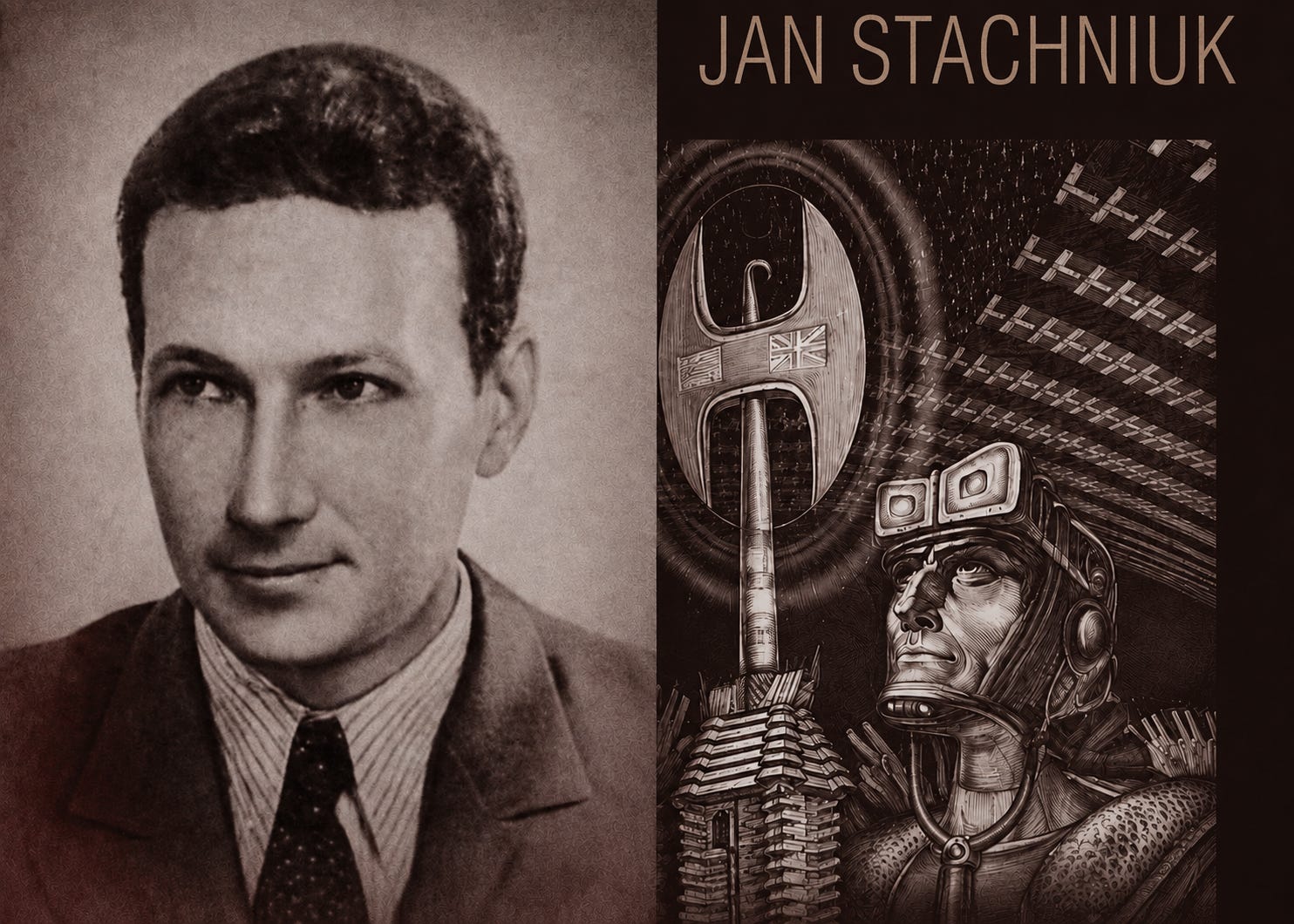
It would nonetheless be a mistake to believe that this vision has always commanded unanimity, for there existed, in the 20th century, a contestation of rare virulence against this bond held to be self-evident, in the person of Jan Stachniuk.
Jan Stachniuk belongs to those subterranean figures of European intellectual history whose radicalism long condemned their work to the margins. Born on January 13, 1905 in Kowel, in Volhynia (Polish: Wołyń), into a family of railway workers, he belonged to that Polish generation which reached adulthood at the moment Poland recovered its independence. He pursued his studies in Poznań between 1927 and 1930, took an active part in student life, and very early on established himself as a mind of rare intransigence.
But what would secure Stachniuk a singular place in the history of Polish ideas is the founding of an original neo-pagan current, Zadruga, of which he was at once the doctrinal inspiration, the animating spirit, and the principal theoretician.
For a Historico-Creative Myth
Stachniuk is sometimes likened, not without pertinence, to what Armin Mohler called the Conservative Revolution. Like the German thinkers of that family, Stachniuk was profoundly influenced by Nietzsche and situated himself resolutely beyond the cleavage between routine conservatism and modern progressivism.
READ MORE:
The Conservative Revolution as a Worldview

Nearly thirty-five years after its first French translation — long since impossible to find — Armin Mohler’s La Révolution conservatrice en Allemagne (1918–1932) (German original: Die konservative Revolution in Deutschland 1918–1932) has at last been reissued by Éditions Ars Magna, in a new edition enriched with a previously unpublished preface and afte…
He wanted neither simply to restore the old order, nor docilely to accompany the march of the modern world, but to refound from top to bottom the spiritual conditions of a historical renaissance for his country and, more broadly, for the whole Slavic world.
And it is from this ambition that Stachniuk would come to develop a devastating critique of Christianity. Among his books, the most important are undoubtedly Dzieje bez dziejów (“History Without History” or “History Without Events”) in 1939, Mit słowiański (“The Slavic Myth”) in 1941, and Człowieczeństwo i kultura (“Humanity and Culture”) in 1946.
Stachniuk’s central thesis, as befits a good Nietzschean, is that man is not first of all a being destined for comfort, for rest, for passive salvation, or for the mere conservation of self; he is a being of creative power, called to transform the world and to transform himself. This creative movement is what Stachniuk calls, in a particular sense, humanism (humanizm). Man is distinguished from the rest of creation by a “creative genius.” Man does not content himself with living in nature: he reconstructs it, reorganizes it, and subjects it to new forms. His essence is therefore not mere biological life, but the capacity to bring forth a human world.
True “humanism” here is thus not gentleness, philanthropy, or the abstract dignity of the person; it is the creative élan of the human race straining toward the reconstruction of the natural given. In other words, man is truly man only to the extent that he creates, organizes, invents, and surpasses the raw state of the world. But this creative vocation collides with what Stachniuk calls the “dualism of man.” In man there coexist two contrary directions: on one side, the creative, heroic, expansive drive; on the other, the aspiration to mere organic security, to “physiological happiness,” to the repetition of a life closed in on itself. It is from this tension that the drama of human history is born.
Hence, for Stachniuk, culture is not refinement, the fine arts, or erudition. It is the organization of the world’s energies. This is why he speaks of kulturowytwory, which one might render as “objectivized cultural formations”: everything that creative activity has fixed in works, institutions, techniques, symbolic forms, or collective habits. These formations objectivize human energy and permit its transmission. The real human world is therefore not raw nature, but the accumulated ensemble of these cultural objectivations.
From then on, the question is how to intensify culture. For Stachniuk, it is not enough to have scattered talents or isolated inventions. What is needed is a synthesis capable of ordering the available forces. It is here that his capital notion of the historico-creative myth (mit dziejotwórczy) intervenes. Myth is for him not an archaic fable or an irrational illusion; it is an organizing vision that inflames human energies, unifies values, indicates a historical direction, and transforms a latent power into collective action. The myth is at once affective ferment, plan of action, principle of organization, and system of setting-into-motion. Without myth, the creative forces remain scattered; with it, they become history.
From this derives Stachniuk’s very strong conception of heroism. Heroism is not, first of all, any spectacular military exploit; it is the act of converting the substance of one’s individual life into an enduring work, of letting one’s existence be absorbed and transfigured by a higher design. The contrary of heroism is a life consumed in the “eternal return” of the biological: to be born, to enjoy, to suffer, to endure, to die, without carrying anything beyond oneself. The hero is he who breaks this circle by making himself the material of a higher creation. True creative culture is therefore that which increases heroism in society.
But at the opposite pole of culture stands what Stachniuk calls wspakultura, which one may imperfectly translate as “inverted culture,” “anti-culture,” or, more exactly, “culture turned against its vocation.” Wspakultura is not the absence of culture; it is the degeneration of culture, its diseased survival, its reversal. It takes up the products of culture, but detaches them from the creative élan that had engendered them. It absolutizes remnants, ruins, side effects, and erects them into supreme values.
Now, for Stachniuk, universal history must be reread as a battle between culture and wspakultura. He says explicitly that the axis of the centuries is neither the struggle of classes, nor the struggle of races, nor the war of God and the Devil, but the struggle of these two currents for the possession of man. Every individual is traversed by this war, and every civilization as well. Culture increases the power of life, the density of existence, and creative objectivation; wspakultura produces arrest, regression, self-destruction, and the valorization of the lie.
It is precisely as wspakultura that Stachniuk interprets Christianity and especially Polish Catholicism. The latter is not, in his eyes, the supreme form of national identity, but the spiritual matrix of historical abdication. It is therefore in Polish Catholicism that Stachniuk would ultimately recognize the principal adversary. Not because he had rejected his Polishness, but on the contrary because he wanted to restore to Poland what he held to be its lost vocation, namely the élan of a creative power to become historical once again.
Poland has certainly not lacked courage, intelligence, or moral virtues, but Christianity, and still more the victory of the Counter-Reformation, he judges, little by little broke the very organ of historical life in her. The Church is said to have shaped what Stachniuk elsewhere calls the “good Pole”: a pious, moral, at times sentimental being, but one fundamentally ahistorical, incapable of converting his forces into creative power. Poland certainly does not cease to exist — on the contrary, she continues to endure, to pray, and to suffer — but she ceases to produce history. She enters into what Stachniuk calls bezdzieje, the “history-less” or “non-history,” that is, a paralyzed duration in which the nation no longer surpasses itself and in which tradition transmits nothing more than a sanctified impotence. It is in this precise sense that Catholicism appears to him not as a bastion of Polishness, but as the profound cause of its historical withering.
Poland before Rome
Hence, as counterpoint, the importance of Slavic myth. In Stachniuk, it is not a question of a mere romantic taste for pagan folklore, nor of a collector’s archaism. Rather, in his eyes, Slavic myth designates the buried point of departure of another Polish possibility: that of a community still attuned to the forces of life, of nature, of growth, and of collective destiny, before Christianity diverted these energies toward the beyond.
In this sense, Slavic paganism counts not so much as a religion of the past, but rather as a symbolic reserve for the future. Stachniuk was therefore not seeking servilely to restore the ancient cults; he wanted rather to forge, out of this old pre-Christian stock, a new historico-creative myth capable of restoring to the Poles a terrestrial, heroic, and collective horizon. And it is perhaps here, at the foundation, that Stachniuk’s ultimate ambition resides: to wrest Poland from the Catholic identity it has given itself, in order to lead it back toward a myth of power older than itself and newer than the modern world.
Originally published in Éléments no. 220, June-July 2026
Translated by Alexander Raynor
For an alternative perspective on the Catholic legacy and Polish national thought, check out Jan Mosdorf’s Yesterday and Tomorrow, brought to you in English for the first time by Arktos (available on Amazon):

Published just before the outbreak of the Second World War that spelled the tragic death of its author, Yesterday and Tomorrow is one of the forgotten gems of twentieth-century Polish thought. Now recognized as the foremost Polish nationalist treatise of the 1930s, Jan Mosdorf’s Yesterday and Tomorrow presents a vivid picture of the interwar drive to reread the past, reshape the present, and reimagine the future.
Part study and part manifesto, this immense tour de force, authored by one of the leaders of the new generation of Polish nationalist youth following Poland’s regaining of independence, takes the reader on an ambitious trek to understand the character and fate of the Polish nation in the broader context of the crisis of European civilization and the challenges of technological modernity.
Artfully integrating history and psychology, socio-economics and philosophy, politics and theology, Yesterday and Tomorrow remains an enduringly relevant exposition of the drama of nations in the modern world and the bold thinking that seeks to rekindle the European spirit and civilizational creativity through national renaissance.
READ MORE from Antoine Dresse: Political Realism is available from Arktos and on Amazon

Une figure très intéressante ! Merci pour cette découverte!