


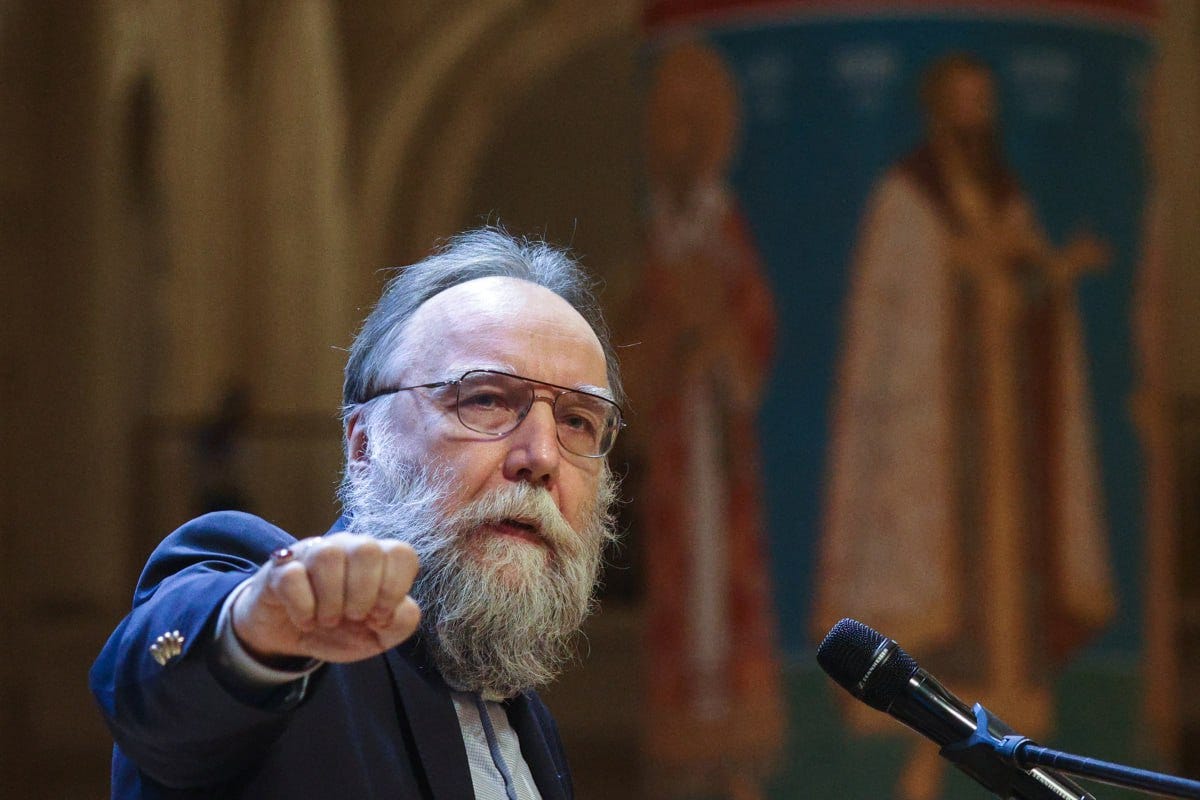
On the Escalation show of Radio Sputnik, Alexander Dugin describes the ongoing negotiations over Ukraine as a temporary and uneasy compromise fraught with collapse, behind which looms a new era of great powers shaping world order through both spirit and force.
Radio Sputnik, Escalation Host: Over this past week, the news was dominated by both the negotiations with Europe and America, and the meeting in Berlin. What can you say about these negotiations? We have heard rumors that Merz has left the negotiations. The United States does not seem to believe that Europe is ready for peace at this time. What can we expect from these negotiations in the future?
Alexander Dugin: These negotiations that are currently underway are a very complex system. In this system, there can be constant shifts in the balance of power, different forces, and different centers of influence. And it is precisely how individual players behave within this system that will ultimately determine the final outcome — whether there will be a ceasefire or not.
Let me remind you what we are dealing with in these negotiations. Russia has put forward the conditions under which it is prepared to stop military operations in Ukraine. These conditions are, if you will, the absolute minimum for us, because even if they are all accepted, all without exception, it is by no means certain that this can truly be considered a victory. It certainly should not be considered a victory. In other words, it is a kind of compromise, a kind of postponement of the decisive and probably inevitable aspects of the military conflict. But, for a number of serious reasons, we are ready to stop the conflict on these terms. And I am absolutely convinced that this will only be a temporary solution, despite the fact that we assume that the causes will be eliminated. But neither America nor Europe, of course, will go along with really eliminating the causes of the conflict. That would mean returning Ukraine to us in a more or less controlled status. No one will go along with that. Accordingly, this remains a euphemism.
But, nevertheless, our conditions are such that, if they are met, we will be able — with great difficulty and with very serious and painful consequences for us — to consolidate this unfinished war. Of course, this is not a defeat, but it is not a victory either. I don’t think this is really what we sacrificed so much for. Nevertheless, we have put forward certain conditions which, despite being our own conditions, we are not very happy or satisfied with. And what is to be done next, if they are met after all, is a rather big and troublesome question.
Trump, finally focusing on this conflict and this problem, paid some attention, strained himself, and understood what we meant. What is especially important is that he understood that even our own conditions are not very advantageous for us. And he decided to say coldly and calculatingly: okay, let’s go along with the Russians’ terms now, save Ukraine, and then we’ll see. In essence, Trump’s plan is precisely that: to save Ukraine by accepting our demands — all our demands, because our demands are quite moderate and quite acceptable to Trump precisely from the point of view of saving Ukraine.
And now we see two poles: Russia, which has formulated its principles and demands, and Trump, who has realized that these demands by and large do not mean victory for Russia, but save Ukraine and leave room for the next step — that is why he supports them. He supports our demands because they are beneficial in the long term to the West, rather than to us. This is a very important point.
And here comes the third factor. It’s as if we have two poles. Why does it seem that Witkoff understands everything so well about the talks with Putin, why does Kirill Dmitriev find mutual understanding? Because, in principle, we are not discussing our victory here. Of course, it is a humiliation for the West, a humiliation for Ukraine, but it is still an unfinished war. And we agree with that. We agree, in general, to a strategy that is rather questionable from the point of view of our long-term strategic interests. Trump has grasped this, he understands it. And he is trying to support it in every way possible.
But there is a third player here: the European Union as a whole and Zelensky, who are not interested in Trump’s strategic and long-term project, but are only interested in continuing this conflict as it is now, for what I would call tactical reasons. If the Western elite admits that it will accept the plan as it stands, it means that it will be admitting its complete inadequacy. And I think they will be overthrown, because after spending so much time stirring up this hysteria about Ukraine, and then agreeing to this plan, which is humiliating for the European Union and completely smears the EU, it means admitting their own incompetence. Then it’s all over. In this case, Macron, Merz, and Starmer will be out with impeachment. And it will be the end for Zelensky as well, because if he accepts these principles, which are unacceptable to Ukrainian society, heated up by Russophobia and neo-Nazism, he will be swept away, killed, or forced to flee, and no one will elect him again.
And so it turns out that, tactically, Zelensky and the European Union countries are interested in everything continuing as it is now, so that under no circumstances will there be a truce on the terms on which it may be concluded. Trump understands that a truce can be concluded on our terms and on no other. Because all it takes is to add a single comma, some other twist to these agreements, and that’s it. We simply say: wait, this is unacceptable to us. I’m not even sure we really want these agreements. We follow certain rules, we demonstrate our willingness to negotiate, our rationality. But the issue is that we’re no longer really interested in this. Trump is interested in this, thinking about saving Ukraine as a sovereign entity, independent of us, while it’s completely dependent on the West. That’s not bad for him. But he understands that this can only be done if our demands are strictly met. Because our demands already contain a compromise. This is not a very good plan for us. We will also have to explain to our society why it was accepted after such sacrifices. I think this will cause a lot of internal, rather disturbing problems. That is why we need victory. We are moving towards this victory. The President has said many times that this is our main plan. Trump wants to stop this war and, in fact, he wants to thwart our victory, if we speak in strategic terms. He understands that this can only be done by stopping us now, when we are on the offensive.
But the European Union and Zelensky do not understand anything at all; they have no strategic plans. These are people of the moment, ephemeral political figures who understand that if they agree to this plan now, if they accept it, it will be the end for them. Not the end for Ukraine, but the end for these specific figures. It will not be the end for Europe. It is only the end of Macron, Starmer, and Merz, and, in addition, the end of Zelensky. That is, we are already talking about the most crude part of the globalist elites, who found themselves on the most dangerous political field of the struggle between globalism and the multipolar world represented by Russia and therefore became hostages to the situation and the projects they signed on to and are promoting.
Another thing is that Trump now has a very negative attitude towards Europe precisely because they are getting in the way, because these people, saving their own skins, are slowing down Trump’s more meaningful project. They are behaving like absolute schizophrenics and maniacs, caring only about themselves with no intention of pursuing any strategy. And this really annoys Trump. And we are watching this, I think, with very cautious hope: maybe the Ukrainians and Europeans will manage to sabotage these agreements themselves. Well, then they will have to deal with Trump, their daddy, and we will move forward with our planned strategy.
That’s how I see the situation. It’s possible that I’m not aware of some nuances, but this is simply an analysis based on open sources with some analytical studies of certain aspects in a little more depth. Of course, this is far from the ultimate truth, but it is simply a balanced geopolitical analysis.
Host: This is also confirmed by the public statement that has reached us. German Defense Minister Boris Pistorius says that the people coming to us from America are not the negotiating delegation we would like to see. At the same time, Witkoff says that a 20-point plan has been discussed. To be honest, I’m confused: how many points are there in this plan, which ones are they deleting, which ones are they adding? — which, again, does not give us any certainty on this issue. Let’s continue with the topic related to Europe. Donald Trump recently issued a statement about an alternative to the G7, which caused a real stir: a new global five that will decide the new world order. How realistic is this option, when we abandon something as seemingly unshakable as the G7 and move to this core five?
Alexander Dugin: The G7 is not an unshakable thing at all, but simply a club of globalists who get together. They can continue these meetings and decide their issues within their narrow circle.
The fact is that the C5 project currently being discussed by the US leadership (Trump has not yet made any official statements on this matter) is purely a MAGA project. This is the Make America Great Again movement that supported Trump and brought him to power. It is their project. And it is a project that I call the “order of great powers.” This phrase has also become established.

What is the project of great powers? It is multipolarity, but not in the future, as in BRICS, where we take readymade civilization-states — such as Russia, China, and India — and those civilizations that are yet to become full-fledged poles of a multipolar world, which already exist but are not yet fully consolidated: the Islamic world, African civilization, Latin American civilization. They are represented in BRICS as if for the future. If they carry out integration processes in their large spaces, they will also become poles like us. And we would like multipolarity to be exactly that — for all civilizations to be represented evenly, in balance, and as subjects. This is the humanistic, future-oriented project of multipolarity.
But now MAGA — Trump’s supporters, not the neoconservatives or globalists, but rather staunch adherents of the idea of making America great again — believe that there is no need to involve those states and civilizations that have yet to become great. We need to take those that already exist. And there are five of them, according to American MAGA strategists. Four are unconditional: the US, Russia, China, and India. These are unconditional civilization-states. And in order to balance or strengthen their positions, they are bringing in Japan, which was also named a civilization-state in Samuel Huntington’s project — as a pillar of Japanese-Buddhist civilization, essentially to balance the number of such global vectors. There is the vector of Russia and China, and no one doubts our solidarity, our alliance. Now there is the US with the conditional Japanese civilization, which has yet to realize the role that is now being offered to it — and this after decades of complete subordination to the US, but Japan has the prerequisites for this, albeit in an embryonic state.
And, most importantly, there is India, which in this picture becomes a kind of hinge, if you will, a kind of lever, because India has a great attitude towards us, a very good attitude towards America, but at the same time is following its own direction.
This is how we get a configuration that the world really views realistically. In today’s world, these are the centers of power that exist today. And the C5 project proposes to recognize them. This is not a multipolarity directed toward the future, like BRICS, but simply a fixation of the current status quo. There is quite a lot of antagonism in this group of five, as each of them is sovereign, except for Japan, which is less sovereign. This, of course, is the destruction, the completely fixed end of globalism and the unipolar world, the affirmation and recognition of multipolarity, the oblivion of the globalist elite of the Europeans who have been left out of this project. Of course, this is a rather revolutionary approach.
And it is very important that this is not a neoconservative project at all. Because neoconservatives are another version of right-wing globalism, which also affirms the need for a unipolar world, also affirms the need to promote democracy and Western values. It’s the same as globalists, only with force. The difference between globalists and neoconservatives is that they want to build a global empire, a world government, using different methods. Some — more economically and ideologically, through the spread of all kinds of extremist movements banned in Russia, such as LGBT, illegal migrants, feminists, and so on — are left-wing globalists. Right-wing globalists and neoconservatives propose relying on the Pentagon, direct armament, and military bases. Both neoconservatives and globalists are radically opposed to the C5 core project, which not only abolishes the G7 but also belongs to a different order of reality. C5 is what exists, and the proposal to build a model for discussing the world’s most pressing problems in this configuration is actually a way to truly solve these global problems, since fundamental security issues on all continents now really depend on America, Russia, China, India — well, okay, let’s add Japan, so that they’re not disappointed.
The fundamental security questions on all continents really depend on them. These are the world powers, and they must decide the fate of the world among themselves. And what is Europe in this context, what are the globalists, and what are all the others — by and large, no one is interested in that. We are interested in this, actually, but Trump is less so. Therefore, in this case, we in the C5 would be representatives of all of humanity, of all of BRICS, together with India and China — after all, we created BRICS together with them. At first, it was simply called RIC — Russia, India, China. Then Brazil was added — BRIC; then South Africa — BRICS. That’s how we started. And this is very important and very fundamental. America will have to deal with the West on its own. What is this Pistorius about? Germany’s military machine has not existed since 1945. It’s just part of NATO, just a NATO recreation base, and NATO is the US. Germany and Europe simply don’t exist. In this sense, NATO is practically just the US, plus a little bit of Turkey regionally, and everything else is just zero. If someone there is dissatisfied, some Pistorius or maybe Zelensky, these people are not even being asked.
So, let’s see how successful MAGA supporters will be in pushing this project. It’s all ahead of us. In the near future, I think we can do it.
Host: I would like to touch on one more news item before moving on to the next big topic. It pertains to the recent statements, including those from Zelensky and various Western mainstream media outlets. We are talking about various points of the peace plan. In particular, Ukraine is already technically ready to recognize that it will not join NATO if there are clear and unambiguous guarantees from Europe and the US. In this regard, I have a question. Are we really going to move forward in this way? First of all, why is this being done? Is it just a trivial delaying tactic? Why are such statements being fed to the press?
Alexander Dugin: In reality, the war in Ukraine is being waged between us and the United States of America, which the Europeans are serving, and the instrument is the Ukrainian population, which has completely lost its human form and has been turned into golems, into some kind of frenzied optimus robots. These are drones, not people. They have lost all sense of what they are fighting for and who they are fighting against. The Ukrainian population has effectively been totally taken over, biohacked.
And, of course, against the backdrop of this war, which American globalists have unleashed on us and provoked, there are various echelons of intermediaries and accomplices. Zelensky is also one of these figures and cogs, one of the algorithms of this process, nothing more than a mechanism. Accordingly, Trump now wants to get out of this war. And if Trump withdraws from it, we will win this war fairly quickly, because war with America is a very difficult and very serious matter, as America remains a very powerful military, economic, and political force. But without America, we will win this war not so easily, but much more easily. And Ukraine will become part of Russia without any agreements.
If Trump understands this and wants to stop it, then Zelensky probably understands it too. After all, he understands that it is not he who is fighting, but America. And he simply cannot say, “Trump, I don’t want to stop fighting because it will be the end of me.” He must somehow appear before him as his servant and vassal, his hired client for carrying out certain operations.
And here, I think, Zelensky has to do something impossible. On the one hand, he has to show Trump that he agrees with his peace plan and that he is, in general, obedient. How can he not obey when this is his immediate superior a few steps above him? On the other hand, he understands that this will be the end for him. So his task is to disrupt the peace agreements in such a way that it is not him who is responsible, so that he is not the one to blame. And I think he is aiming to disrupt these negotiations. He is setting all kinds of conditions everywhere, which seem to follow from a certain logic. But the point is to disrupt them in such a way that it is not him, but, for example, Moscow or the European Union. Now, I think, he is about ready to shift the blame onto the EU.
If Trump decides to fight the European Union — and he is already beginning to hate it, since they are his ideological opponents just like the Democrats and globalists in the US itself — then Zelensky will try to wriggle out of it and continue this war. Keeping America as his main power is vital for him. Without it, he is definitely finished.
I believe that he really understands that, apart from the PR effect of European support, in the current circumstances, with Trump in the White House, nothing critical depends on him anymore. But it is important psychologically — in order to continue biohacking his crazed, completely deranged drone population, these biorobots. But by and large, everyone, including him, understands perfectly well that it is America that is at war. And that is why he cannot say: I am giving you an ultimatum. But if he issues an ultimatum, support for the war will end, the war will end, and Ukraine will end.
That’s what it all boils down to. Zelensky is trying to save himself, but he has limits that he cannot cross. And Trump doesn’t want to end this war either. He wants to save Ukraine and achieve his goals. Quite rationally, by the way. Many say he is erratic. Sometimes he really does behave inconsistently. But there is still some logic in his actions, if you take a step back and look at them from a distance. Yes, he vacillates, but he vacillates around certain vectors. He may stray far from them, but we still see that he can just as abruptly return to his previous positions.
Waging war in Ukraine without the involvement of the United States is a perfectly feasible task for us, and our victory in such a scenario is virtually guaranteed. The only question is the timing and the costs. However, the continuation of the conflict with the full involvement of America in Ukraine is a qualitatively different, more complex situation. In this case, we are also capable of fighting, we are doing so, and we will certainly prevail, but this is a completely different level of confrontation. Undoubtedly, the cost for us will increase significantly.
I believe this reflects our position. We see Zelensky’s position to the contrary: he defends the current status quo, but at the same time he is limited by certain boundaries that he cannot cross. We tend to demonize him. Of course, Zelensky is a figure who brings evil, but by and large his actions are quite rational.
He strictly fulfills the tasks set by his curators. Presently, of course, there are difficulties in this leadership center: there has been a change in the chief arbiter of the entire Western world. The new leader has his own views, while his predecessors and subordinates remain in place and may show some disorientation. Let us recall Obama’s recent visit to London for talks with Zelensky and Starmer; this is also an attempt to manage his European agents and clientele, who have already lost Donald Trump’s trust. The situation is deeply systemic and extremely complex, and Zelensky is behaving rationally in it. He is rational for himself personally, he is rational for his employers, and he is, in essence, trying not to irritate Trump unnecessarily. Overall, he is fulfilling his assigned function. However, he also has his limitations.
I believe this is precisely why we proposed a truce. Why did we put forward a proposal that we ourselves are not entirely happy with? Because we have no desire to go to war with America. It would be extremely difficult for us to fight America in Ukraine. We would certainly win, but there is a huge risk of sliding into a nuclear exchange of blows at any moment and provoking a kind of Armageddon. Everyone is well aware of this: both our opponents and us. At the same time, there are certain vital goals that neither side is prepared to give up. That is the complexity of the situation. We do not want to fight America. As for Europe, of course, we could ignore it and leave it alone if it did not behave the way it does now. But for us, Ukraine is a matter of vital importance. It is of absolute significance. For Russia, the question of “to be or not to be” depends directly on the question of being or not being together with Ukraine. Without Ukraine, there will be no us. Everything will collapse. It is an integral part of us, our organ, without which we cannot exist in the current geopolitical conditions. And they are trying to take this organ away from us. This is the source of such a dramatic and tense struggle.
Overall, I believe that this whole situation revolves around the figure of Trump. Some are trying to push him in one direction, others in another. For our part, we are consistently implementing our original plan. Without Ukraine, there will be no us, and without us, there will be no one in the world. These are, roughly speaking, our boundary conditions. And we are moving towards this goal consistently, confidently, and clearly without regard for the cost, as has always been the case in the era of all genuine wars of the Russian people.
Host: Speaking of the cost of this conflict, or more precisely, one of its aspects, it should be noted that today we commemorate the Day of Remembrance for journalists fallen in the line of duty. Since 2014, more than 30 Russian war correspondents have lost their lives in the current combat zone. As someone who recently graduated from the journalism department, I still remember well what we were taught in lectures about working in a conflict zone. We were told about the need for special equipment and clothing. According to international norms, a journalist is not a combatant and, in principle, should not be exposed to fire. The treatment of journalists should be fundamentally different from the treatment of those who are on the battlefield with weapons in their hands. However, as I understand it, in today’s reality, this principle does not seem to be fully working.
Alexander Dugin: You are right, of course, it isn’t. Moreover, in the current conditions, a journalist is a figure on the front line of both defense and offense. He stands in the front ranks because he is a face, he is the word. And we are now waging a war of the spirit. Consequently, their words, their image, their courage, their message — all of this can critically change the course of the conflict. In today’s information space, this is perhaps one of the most important resources.
However, journalism is not only about information, it is also a deeply personal destiny. A person who dares to express and formulate their thoughts can only do so if they sincerely believe in them. If it is just a game, it will not have the desired effect, and this will be obvious to everyone.
Therefore, the people whose memory we honor today — and today is also the birthday of my daughter, Dasha Dugina, who in a sense was also a war correspondent, and was undoubtedly a journalist, intellectual, and philosopher — have become for me a symbol of that tragedy and heroism. Dasha would have turned 33 today, but she was killed. Ukrainians killed her — not on the front line, not while covering the events unfolding there, but near Moscow, in Zakharovo, when she was returning from the peaceful Tradition Festival. They killed her in a cowardly, dirty way, right before my eyes.
That is why, for me, today is both Dasha’s birthday and a day of remembrance for fallen military journalists, all war correspondents and journalists who have died in combat — it is a personal tragedy. It is a day of mourning.
In a sense, she has become a symbol of a generation, a symbol of those ordinary Russian girls and boys who, at the right moment, stood on the sharpest front lines — in spirit and in idea. Dasha was a philosopher, a thinker; she left behind a magnificent legacy. We have already published five of her books. They contain her journalistic writings, reflections on her trips to Novorossiya, to our historical lands, thoughts on the frontier, on Ukraine, on the fate of our state, and on the fate of her generation.

Some even say that now the generation of zoomers is Generation Z, but the smart zoomer, the zoomer who reads Plato, knows Florensky, Orthodox theology, and studies Greek, is Generation D, the generation of Daria Dugina. This is a generation of zoomers with books, with philosophy, with education, with deep immersion in the world of ideas. This is a new Russian generation that is being forged, developed, and created right now, redeemed in the crucible of the complex and dramatic situations in which our country finds itself. And it doesn’t matter whether these people are now on the front lines, helping him, or staying in the rear — they have let this war into themselves, let in its meanings, its goals, its causes, lived through its depth. And many of them have given their lives for their ideals.
That is what an Idea is. Strictly speaking, when you die for your Idea, then the Idea begins to live your life.
I was struck by the story of the journalist Rostislav Zhuravlev, a remarkable man who knew Dasha. He came to Melitopol, where our great artist Alexei Belyaev-Gintovt created a huge mural on Daria Dugina Street.

Rostislav stood in front of this mural and said: “I swear, Dasha, that your work will be continued. I am going to the front line, I will follow in your footsteps, I will be faithful to your feat, your ideas, your smile, your sincerity.” And he also died.
One sacrifice inevitably leads to another. One feat, one act of holiness ignites the fire of another act of holiness, making another feat possible. This is extremely important.
When Charlie Kirk was killed in America, some American journalists said that Kirk would become what Dasha Dugina had become: if Dasha had become a moment of awakening for Russian youth, who realized who they were, what their homeland, Russia, heroism, Orthodoxy, and loyalty to ideas meant. Kirk, they claimed, would also awaken a thousand other Americans, also forcing them to think.
Kirk was also a conservative, and their views were somewhat similar — both were supporters of traditional values. Dasha was also an active supporter of traditional values and supported the relevant Decree.
But in America, nothing came of it. Then began the story about who was financing the Turning Point USA movement, who was involved, who turned out to be Kirk’s internal enemy. In other words, the whole story with Charlie Kirk, which caused a stir and awakened American conservatives, quickly fizzled out. Now people are even wondering: where is he buried? Everything fell apart because, despite the fact that Charlie Kirk was undoubtedly a good person, anything that is not done from the heart, anything that is done merely formally, does not last long. The death and murder of even such a good person as Charlie Kirk led to nothing.
But Dasha’s death led to something. It led to the awakening of a significant part of our people. This blow that we received was felt by all our people, our entire nation. No one remained indifferent to this tragedy.
Although, of course, there are people who seem beyond redemption. But I have not lost faith. You see, we are all created by God, and there is probably still something human left in us. Therefore, I believe that one can have different attitudes even towards the Special Military Operation, but the death of this young, beautiful, inspired girl, who never took up arms and did not participate in hostilities, is something that could not fail to affect a decent person, a person with a conscience and a soul. It affected absolutely everyone, from the President to ordinary people.
As proof of this, the President awarded Dasha the Order of Courage. And ordinary people, when they meet me, still express their condolences. Three years have passed, but the memory of her lives on. And the memory of each of our heroes, journalists, and soldiers lives on in our hearts. And this is a powerful force.
Ideas matter. And ideas washed in blood matter even more. They move the world.
That is why a journalist is really more than just a person who reports or informs. A journalist is a warrior, a person who goes on a mission, goes into battle, into battle in the realm of ideas. If someone notices that he is not sincere, that he is working for some kind of program, he will instantly lose trust, he will simply cease to be who he should be.
So let us remember the fallen war correspondents on this day: the wonderful Vladlen Tatarsky, who was a friend of Dasha’s, and Rostislav Zhuravlev, and everyone else, and our colleagues who died back in 2014. And let us also remember those who are still alive. May God grant them long life.
After all, for a Russian person, for an Orthodox Christian, simply living is not an end in itself. Surviving is even less so. One must live with dignity, one must live according to one’s conscience, one must live with honor, with depth, one must live humanely. One must live for Christ, for the Church, for the Motherland. That is, one must live not just for the sake of living, but for something. And if people have a problem with this higher purpose in life, then such people become pitiful. Then their life is not a life, but simply a meaningless, routine existence.
But for those of our heroes who have burst into flame and ascended to Heaven, they have secured Eternal Life for themselves, they have secured Salvation for themselves, they shine like stars, their souls are immortal. These are not just words, this is the Truth of religion, this is the Truth of faith, this is the Truth of our history. For otherwise, there would be nothing: no state, no Church, no culture, none of us would exist if our ancestors had not had a goal higher than mere self-preservation or survival.
The Russian people are moving towards their higher goal. Perhaps we do not fully realize it, but we all intuitively feel it. And so our journalists and our soldiers who have fallen on this path constantly illuminate this path for us with their existence, their presence, their immortality. Dasha is one of them.
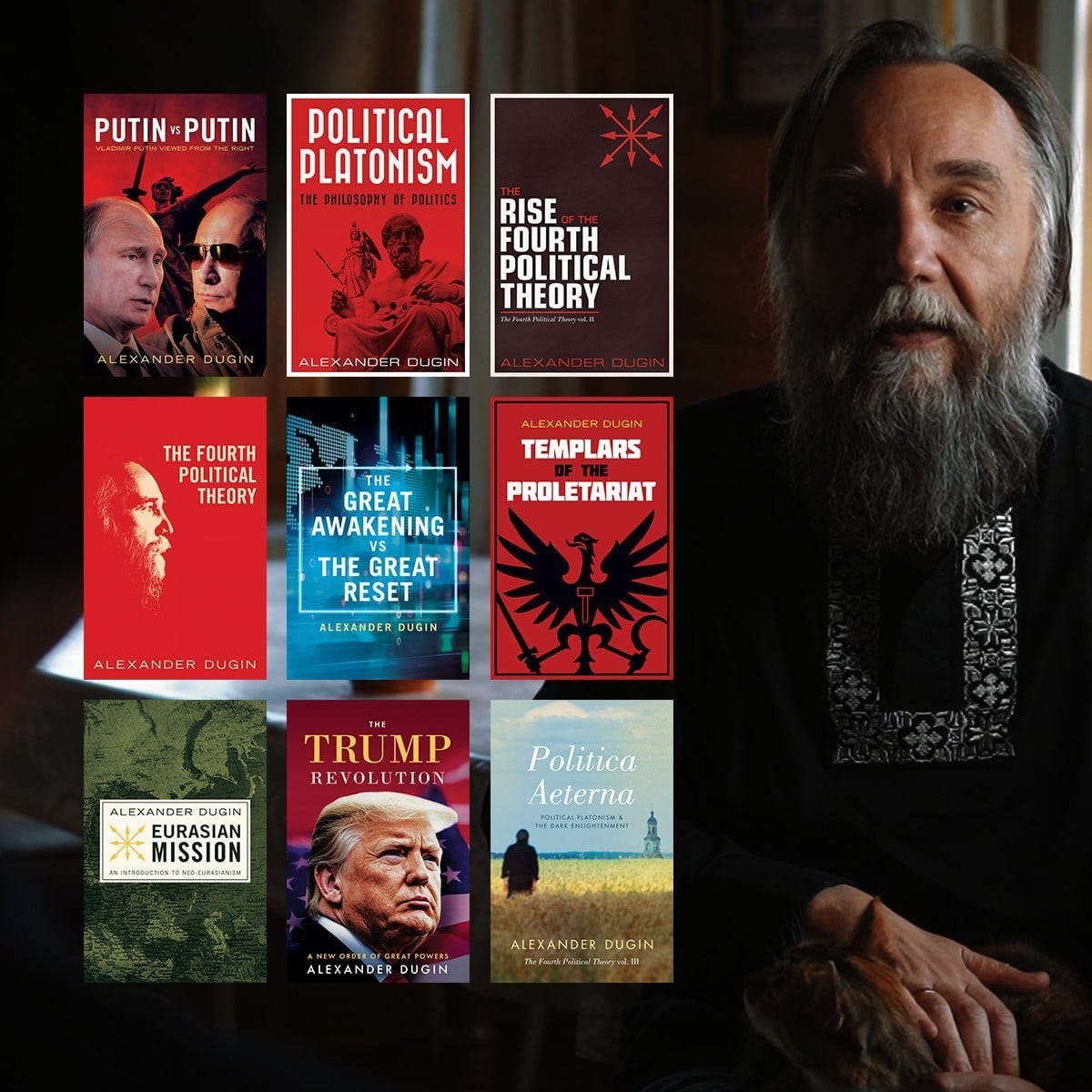
READ MORE by Prof. Alexander Dugin, brought to you in English by Arktos:
You’re right.
I’m not negotiating.
You’re a dead man walking
and the mafia state you shill for is also dead.
Couldn’t agree more