


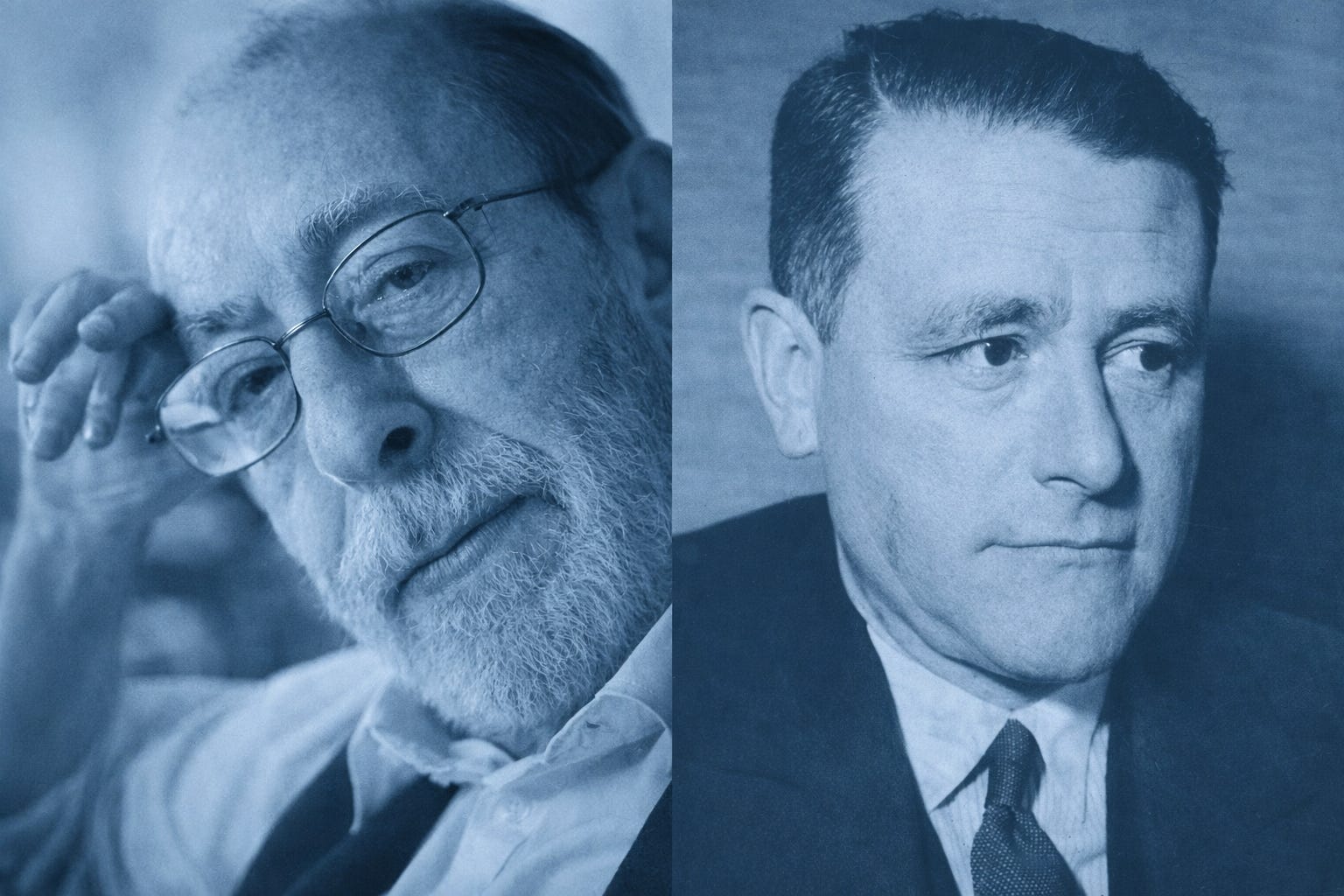
In this interview, Alain de Benoist reflects on the enduring intellectual legacy of German jurist and political theorist Carl Schmitt on the occasion of a new 300-page issue of Nouvelle École devoted to his work.
Issue 75 of the journal Nouvelle École, edited by Alain de Benoist, is devoted to Carl Schmitt, the “last of the great classics of legal and political thought,” whose ideas (such as the friend/enemy distinction, the Nomos of the Earth, the state of exception, the theory of the partisan, etc.) shed light on contemporary crises: asymmetric wars, multipolarity, the end of universalist liberalism. In this interview, Alain de Benoist discusses the various aspects of the dossier and the relevance of Schmittian thought today.
Éléments: In your introduction to this issue of Nouvelle École, you write: “Carl Schmitt was never a Nazi.” What allows you to be so categorical in the face of this oft-repeated accusation leveled at the German thinker?
Alain de Benoist: Simply the fact that his ideas diverge from Nazi ideology on essential points. Carl Schmitt rejected biological racism, social Darwinism, the notion of “total war,” and the concept of the “absolute enemy.” His antisemitism derives from Christian anti-Judaism. In 1932, a year before Hitler came to power, he was calling for a ban on the NSDAP. The reasons for his joining the Nazi party in May 1933 remain debated, but opportunism appears to have played a significant role. The ambiguity was shattered in 1936 when Schmitt was ferociously denounced by the SS journal Das Schwarze Korps. He was accused, notably, of being a representative of “political Catholicism,” of having supported the Schleicher government, of being in reality a “friend of the Jews,” and of defending a conception of “great space” (Großraum) which entirely differed from the National Socialist idea of “living space” (Lebensraum). He immediately lost all of his positions within the party and retained only his teaching post at the University of Berlin. He was then very close to the conservative Johannes Popitz, who would be hanged in February 1945 following the assassination attempt against Hitler in July 1944. Arrested by the Americans, Carl Schmitt was released in 1947 without any charges having been brought against him. Schmitt’s adversaries have always focused on the three years of his complicity with the Hitler regime, which spares them the need to try to refute him. Those who actually read him know that the heart of his thought lies above all in what he published under Weimar and after the war, beginning in the 1950s.
Éléments: What, in your view, makes Schmitt particularly relevant in 2026, especially for thinking through current conflicts and tensions?
Alain de Benoist: More than 800 books to date have been devoted to Carl Schmitt, which is sufficient to demonstrate his importance — but also his continued relevance. His work as a jurist and constitutional theorist, his methodical critique of liberalism and legal positivism, has not aged in the slightest. His definition of “the Political” [das Politische] (as opposed to politics — see, in Italian, the contrast between il politico and la politica) through the lens of the friend-enemy dialectic continues to generate passionate debate among political scientists the world over.
The wars of decolonization were anticipated in his Theory of the Partisan. His two books on Political Theology (1922 and 1969) shed decisive light on the phenomenon of secularization. The ongoing emergence of a multipolar world connects quite naturally to what he wrote on “great spaces” (Großräume) and the crisis of the nation-state in what is no longer a universum but a pluriversum (the “multiverse”). His geopolitical theory of the historical antagonism between the powers of the Land and the powers of the Sea (see his book Land and Sea) is more valid than ever. His critique of “discriminatory wars” finds an echo in the proliferation of “humanitarian” wars which, breaking with the Westphalian conception of enmity, mark a return to the essentially theological and moral idea of “just war”, in which the enemy is regarded not as a momentary adversary, but as a criminal and a culpable party who may rightfully be placed outside of humanity. The same holds for the return of the state of exception now flourishing virtually everywhere, which reminds us that sovereign is he alone who decides in the exceptional case — that is, at the moment when the collapse of norms makes purely procedural governance impossible. One could multiply the examples. This is precisely what I did in 2007 in my book Carl Schmitt Today (Arktos, 2013).


Éléments: Must one already be familiar with Carl Schmitt’s work to approach this issue of Nouvelle École, or can it serve as an entry point into it?
Alain de Benoist: It is always preferable, when reading a book about an author, to have already read one or two of his works. That said, the latest issue of Nouvelle École can very well serve as an occasion to discover Carl Schmitt’s thought. The table of contents makes this abundantly clear: this 300-page issue contains not only previously unpublished texts by Carl Schmitt, as well as excerpts from his correspondence with Italian political scientist Norberto Bobbio — unknown in France — but also substantial articles: “Constitution and Constitutional Law in Carl Schmitt,” by Agostino Carrino; “Carl Schmitt and Joseph de Maistre,” by Graeme Garrard; “Carl Schmitt and the Telluric Element,” by Jerónimo Molina; “A Schmittian Monument: The Nomos of the Earth,” by Martin Motte; “Carl Schmitt and Eurasia,” by Massimo Maraviglia; “Carl Schmitt and Samuel Huntington’s ‘Clash of Civilizations,’” by Joseph W. Bendersky; and more. Added to these are various documents, including a letter from Carl Schmitt to Jean-Pierre Faye, a dossier on Schmitt’s remarkable influence in contemporary China by Flora Sapio and Daniele Perra, and many other texts the reader will discover for themselves — among them a critical reflection I wrote on the friend-enemy pair as a criterion of the Political, as well as an article by Julius Evola on Schmitt and Thomas Hobbes.
At the end of the issue, readers will find the first complete bibliography of Carl Schmitt’s entire opus currently available in French, and also, in the “Varia” section, a curiosity: an article by the young Ernst Jünger devoted to Trotsky’s memoirs!
Éléments: Schmitt is today invoked by very diverse currents, from the “right” as well as the “left”: Russian multipolarity theorists, post-liberal sovereignty thinkers in the United States, critics of international humanitarian law. Do you think we are witnessing a total “normalization” of Schmittian thought?
Alain de Benoist: It is not, strictly speaking, a phenomenon of normalization, but rather proof that the most diverse intellectual traditions can find in Carl Schmitt something to nourish their thinking. To put it differently, it is proof that Schmitt has by now been firmly established as a classic: any serious scholar is obliged to reference Carl Schmitt just as they must reference Aristotle, Machiavelli, Hobbes, Locke, Rousseau, Hegel, Max Weber, and so on.
Éléments: Since Operation “Absolute Resolve” in Venezuela and Trump’s declarations about the American “sphere of influence” in the Western Hemisphere (Greenland, the Panama Canal, etc.), some commentators have explicitly invoked Schmitt’s Großräume as a framework for interpreting the foreign policy of Trump 2.0. Do you think this administration is implementing, consciously or not, a contemporary form of the “Schmittian Großraum“ — a multipolar order of hegemonic zones rather than a universalist one?
Alain de Benoist: No, I do not think that Schmitt — any more than Leo Strauss — is the “secret inspiration” behind Donald Trump, who has in all likelihood never read him. What can be connected to Carl Schmitt’s prophetic insights is the ongoing emergence of a multipolarity in which “great spaces” correspond more or less to these new actors in international relations known as “civilizational states.” Trump is sensitive to this movement, but accepts it only halfway, for he knows full well that multipolarity will necessarily limit American hegemony, which runs directly counter to the MAGA slogan (”Make America Great Again!”). One can see quite clearly, moreover, that far from retreating to the “Western Hemisphere” alone, he does not hesitate to intervene everywhere in the world (Iran, Yemen, Nigeria, the Middle East, etc.) in order to defend what he considers to correspond to his country’s interests — which means he does not shrink from asserting his sovereignty at the expense of others’, particularly Europeans. On the other hand, his passion for trade wars, as well as his alliance with the “techno-futurists” of Silicon Valley, makes plain that for him the Political is soluble in the economic and the commercial, which is not very Schmittian…
Interview conducted by Xavier Eman
Originally published on Éléments on February 23, 2026
Translated by Alexander Raynor
Order Alain de Benoist’s Carl Schmitt Today, brought to you by Arktos:
READ MORE:
Here is the link. https://www.revue-elements.com/categorie-produit/revues/nouvelle-ecole/
Very useful interview. Does anyone know where I can find the latest issue of Nouvelle École? I’d be very interested to read it!