


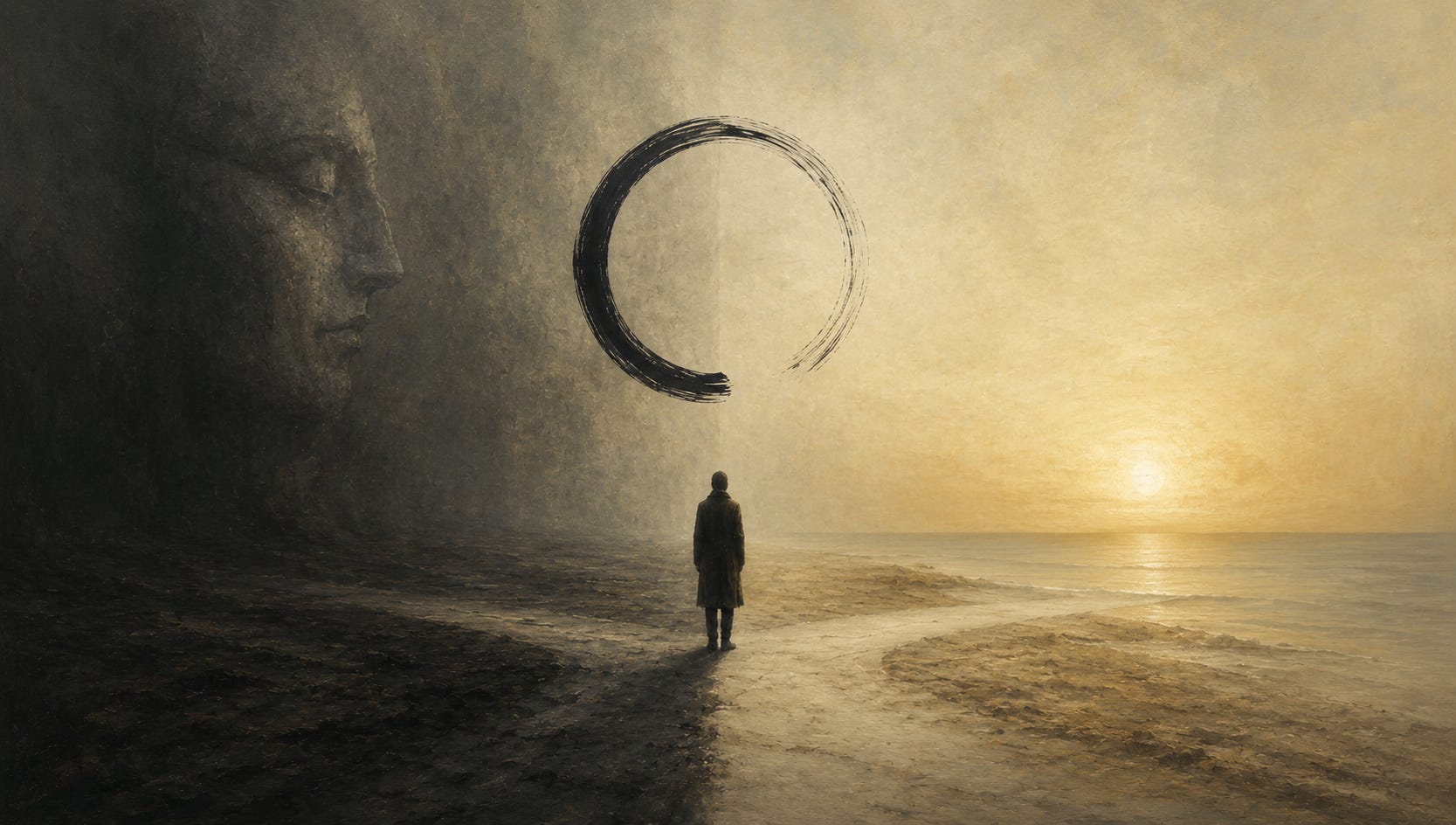
And tell me if there still remains any torture
For this old soulless body, dead among the dead!
— Charles Baudelaire
Le Mort joyeux (The Joyful Corpse)
Humor me for a little thought before I get to the real action — war, death, Ernst Jünger, das Recht. After all, you are here for the answers that action brings, and I aim to please.
∞ • ∞
Since man compartmentalized the psychopathy he calls consciousness into ideological bins of left, right, and center, we have heard tales of this or that thinker’s no doubt heroic journey into one of those bins. But the bin is a cage, and the man who embraces it lacks the experience to recognize it. This is my opinion, as I grapple with my own bout of consciousness. But like this consciousness, my opinion has been imposed upon me; it is something completely beyond my control. Here we wait for the legions of Free Willers to lay siege to my fatalistic fort — all of us compelled to think and act as we do, imagining the emotions that seize our limbs and shake us into action arise from distinct choices and not lifetimes of conditioning and causal chains that are tethered endlessly backward and forward in time, upon which we move like clothes on a dry-cleaning carousel.
Most modernites adopt their left-right-center bin from their view of justice — that nebulous fantasy driving the actions of every rajasic fool ever struck with the paroxysm of life, which is to say, all of us. But here we are, all struck smart (not dumb) by the chain upon which we hang — where one man’s genocide is another’s self-assertion; where one woman’s terrorism is another’s fight for freedom; where one crusader’s Just Cause is another’s Devil. All of us are correct, of course — even those who vehemently contend that it is quite impossible for all to be correct, that only one way can be correct. We nevertheless all end up in the same abandoned grave — if not now then ten or twenty generations from now, after centuries of breeding and freedom-fighting have moved the conveyor belt far enough along the very free causal chain of consciousness.
I am under no illusion that those unfree souls compelled to disagree with me will miraculously counter their compulsion. Agreement in life is impossible; agreement is nonexistence — that utopian (because it does not exist) state of sat-cit-ānanda.1 Yet, life has a way of making some more right than others; the beauty of correctness, however, is that it could not possibly matter; if it did, all would recognize It and adhere, attracted like moths to the flame, leaving us nothing but utopia, which is nothing but nothing. The question is, In a world full of correctness, how might one really-truly-correctly — be correct? How do “stones reveal themselves in the skin of the sea”; how does ice stand against fire?2 The answer is in the thought that leads to impossible inaction: Oh, how the rajasic are riled at the thought — perish the thought! But life is not rajasic, nor is it sattvic, nor tamasic3 — but it is all of these, wailing, gnashing, loving, embracing, fighting, and silence. And the bins of consciousness are too small to hold what encompasses all. In the end, psychopathy is simply missing the point, which has always been life.
Now to the action.
∞ • ∞
Days before my unit was to leave Iraq, a handful of my comrades were killed by indirect fire while at the gym. We had already handed the mission off to our replacements and were just waiting to leave. Fifteen months before this, I was part of a platoon-sized element of newcomers that arrived to the unit just a few weeks after it had left. Over the course of our rapid pre-deployment preparation, the daily casualties our distant comrades sustained were announced at morning muster; we would spare a moment of silence for those killed in action and then get to work. Feelings of vengeance and curiosity accompanied the most mundane tasks: equipment issue, ranges, medical screening, casualty-care training, ordnance identification, chow, recreation, sleep, muster, reports of the dead and wounded. We wondered at the unknown fate awaiting us in that foreign land. But we weren’t dead or maimed yet, so we enjoyed the time we had. Perhaps all of it was fabricated to fill time and space; perhaps it still is. Nonetheless, it is difficult to imagine being mere days from returning to your loved ones after nearly 16 months away — only to be snuffed out in an instant. Of course, this is only a problem for the survivors.
Years later, driving a non-tactical vehicle in Kabul near Massoud Circle,4 I found myself behind one of the city’s omnipresent Toyota Corollas packed with military-aged males; the back row noticed what did not belong and locked eyes with me. We shared something primal in the exchange — something that would have been familiar to any Crusader in a far-off land. Our cars kept moving, but active eyes made note of the route. Days later, a few minutes after my team passed the place of the primal exchange, a VBIED5 knocked out another unit’s convoy. Missions began, ended, and endured from that single act. Perspective is all that matters; yet, given its nebulousness, contingent as it is on proclivity — frivolity — intensity — subjectivity — humanity, it hardly seems that even perspective matters.
Months before this ancient exchange of life and death, my contractor counterpart and I met a couple of Czech “operatives” in the early dark of Kabul; they were to give us a familiarization tour of the city as we developed our unit’s movement plan. The flamboyant Czech driver, sporting an East German leather jacket and slicked-back hair, got out of his car and came to my window; grinning widely, he said, “Good morning, sexy boys — are the Americans ready for a drive?” We were. “Okay, let’s go!” We followed his car through the empty streets, zigzagging past points of interest, noting which were the ones to avoid from our tour guide’s radioed suggestions. Avoid, embrace, or observe — the perspectives of a living, breathing war.
Near the end of that same tour, I watched from a short distance as ISIS-K6 militants, armed with rifles and Khyber knives, attacked the Afghan National Army hospital. Bedridden soldiers made makeshift ropes from sheets to escape the carnage. Many did not escape. But some did, climbing-jumping-falling from windows that transformed into escape hatches. Undoubtedly, on the inside, some valiantly opposed their attackers. And some survived, to endure in the society that made them, just as some of their subdued attackers were to live on, at least for a while, in a society that didn’t make them.
Being born into a society is like being born on a ceaseless train: one is a passenger long before the destination is known. You are one with the machine before noticing that you are moored to the intimacy of another’s identity. Invader and defender are each products of their machine, which are themselves products of the Machine.7 Passion — that primal fire — comes from being anchored in elusiveness: one constantly expects the surety of a fixed position, apparently unaware that the nature of any position is its fluidity. Position and passion: two sides of a rajasic coin we all pocket.
We tend to pocket more of the coin when we are young. I-I-I believe in something, says the youth — and good for him or her. May their choices be fruitful; may their choices be good — and they will be, which leads to elders making the fruitful and good decisions to send the youth to war. It’s for glory, not for profit, to be sure. Fight for justice, fight for freedom — you deserve both but will find neither, as long as you live. Oh, they’re out there, somewhere; you just won’t find them, because that’s life.
∞ • ∞
I was twelve years into my military career when I discovered Ernst Jünger. Storm of Steel was my introduction to the great German. Of all the youthful vigor and contemplative profundity in his war journal, one thing resonated with me more than anything else: the war hero’s observation of birds amidst the chaos of war.
It was strange ... to hear at night the cry of the partridges from the waste fields, or at dawn the careless song of the lark as it rose high above the trenches. Did it not seem then that life itself was speaking out of the confidence of its savage and visionary heart, knowing very well that in its more secret and essential depths it had nothing to fear from even the deadliest of wars, and going its way quite unaffected by the superficial interchange of peace and war?8
The contrast between the life indifferent to war and man’s indifference to life was striking and something I had noticed before. In some, chaos sparks contemplation; and in lowlight hours, it is birds that are often harbingers of deeper ponderings. What else can one ponder but the reason for our being there, in that space and time, making that which we are made to, bringing form to the void of our aimless existence, fulfilling the deepest drives of the “essential depths”? Jünger articulated what I had felt — from his youthful exhilaration on finding meaning amidst the devastation to his hints at a more forlorn future.
It was odd that the birds in the forest did not appear to be in the least put out by this hundredfold clatter. They sat peacefully above the swathes of smoke in the shattered branches, and in the brief intervals of silence we could hear their love-calls and untroubled songs.9
Why should simple birds be so untroubled while complex man frets and fights to the bitter end? It is consciousness that leads us to the richtige bins, the psychopathy of our fated state. And still we fight, generation after generation, each following their path to the left-right-center, each oblivious to the meaninglessness behind the all-important meaning.
But, too, there is meaning behind the meaninglessness. None of us — we products of the system10 — can be the final arbiter of life’s purpose (or lack thereof). We can only live as the causal chain demands: and here some will find meaning where others find void. What is it that separates form from the void? Time, space, causality — yes. But this is only the form of our experience, fated though it is. There is a form within the form, which is the experience that differentiates young from old, savage from sage. The difference between them is not just letters, but the nature of their being: He who finds meaning amidst the void fights for it and thus ushers void into form — this is what it means to be youthful and journeying to the fated bin; conversely: He who has seen the void amidst the meaning ceases all fighting and thus ushers form into the void. This is a simple formulation that only experience can offer.
∞ • ∞
Later in life, during the Second World War and on his way to more clearly articulating the anarch, Jünger commented on seeing action for the first time since his Storm of Steel days: “We jumped into the foxholes for cover and let the storm pass over... I have long since passed the age, or better said the condition, when I find such things amusing...”11 It was not just physical age that changed the man, but the experience that often accompanies contemplative living. The glorification of war (i.e., the indifference of man) is only something those who haven’t experienced it can do; and if they have experienced it, then the stubbornly warlike are only bearers of the void, savages intent on imposing their meaning. Dominique Venner attempts to capture Jünger’s sentiment at the time: “His warrior mentality and political radicalism ... had now been shed like a serpent’s skin....12 [He is convinced] that action ... always remains on the surface of things. It is a bearer of pipe dreams and catastrophe.”13
READ MORE from Arktos:

At the outset, we quoted Baudelaire’s “The Joyful Corpse”: “And tell me if there still remains any torture / For this old soulless body, dead among the dead!” But Jünger himself quoted this line in Der Kampf als inneres Erlebnis14 (Struggle as an Inner Experience, 1922). He was merely continuing the contemplativeness his writing career started with in Storm of Steel (1920). For despite its flirtations with nationalistic flair in the 1924 edition, Storm of Steel has endured precisely because it transcends the corruption into which nationalism inevitably descends. This is why, after a brief interwar period, Jünger distanced himself from what he saw and what Martin Heidegger described as “something fabricated.”15 Jünger ends the nationalistic 1924 version of Storm of Steel with a rousing flourish:
We — by this I mean ... the youth of this land who are capable of enthusiasm for an ideal — will not shrink from them. We stand in the memory of the dead who are holy to us, and we believe ourselves entrusted with the true and spiritual welfare of our people. We stand for what will be and for what has been. Though force without and barbarity within conglomerate in somber clouds, yet so long as the blade of a sword will strike a spark in the night may it be said: Germany lives and Germany shall never go under!16
This spirit never died in Jünger; what overcame it, however, was the realization that something so pure and heady always devolves into sordid institutionalization — the tyranny of bureaucratic profiteering, which is unavoidable as long as man exists in political modes. Hence we see in Jünger’s later writing more explicit detachment: What’s the use of aligning oneself with politicized movements when all that is being espoused is the collective ambition of cretins? The Jüngerian anarch is not a walking corpse, but a Zen lunatic hiding in the shadows of a corporate monstrosity and reflecting, at intervals, its fabricated light.
Jünger sought to be like the “background” life — the birds and insects — one encounters so often amidst the havoc of war, where “in its more secret and essential depths [life] had nothing to fear from even the deadliest of wars, and [goes] its way quite unaffected by ... superficial interchange[s].” In this way, man is a spiritual island, free to reckon with the self that might very well be God; this, of course, would be the only worthwhile pursuit amidst the relentless, superficial mayhem that we pretend is meaningful life. To be repulsed by late-stage Jünger is to be lost in an illusion. But such is life.
“We children of the times have become so tired of the bare facts,” Jünger writes in Der Kampf als inneres Erlebnis, “So tired.”17 Exhaustion comes from witnessing the charade. It is perhaps not the case that, as Venner said, Jünger’s “warrior mentality ... [was] shed like a serpent’s skin”; instead, it is certain that the warrior remained, though he trained his sights inward — to the only place where lasting change can finally be effected. One must ask: Who can know death but those who have seen it firsthand and in vain while living? For here death comes not once but twice. This knowing closes the loop on life and turns one into the bearer of a profound mystery. Such knowing, inexpressible to the uninitiated, comes only with experience. When you are new, you head to the bunker at the sound of incoming; in time, this urgency dissolves into resignation. Fate has its own way — especially for those blown to bits in the bunker. Ah, at least they fought like hell to survive! yell the uninitiated. But that’s just it — they didn’t: He who finds meaning amidst the void fights for it and thus ushers void into form. The uninitiated perpetuate the tyranny of beyng,18 which is the deepest death.19
Perhaps in the end, the anarch came to be because war, the father of all, made him so. Damning revolutionaries and partisans by ignoring them is not turning one’s back on the struggle, but finally truly embracing the struggle, which was only ever inward; it is not pacifism, but the realization that exoteric warring is a fool’s errand at best and a psychopathic wet dream at worst. What do you hope to win by winning the world? Certainly not your soul.

∞ • ∞
Heraclitus revealed his pessimism when he said that war is the father of all things — not because war had become an industry, a racket to widen the gap between rich and poor and satiate the bloodlust of born sadists. Instead, the ancient Greek saw that war, as Jünger later reflected, “is the song of life devouring itself. To live is to kill.”20 That is, war is simply life, a destructive recursivity; but life is illusory, not because its traumas are not real — for all intents and purposes they are — but because it is a product of time-space-causality, which is change. Change is illusory because there can be only one changeless thing. But this is to say that change is māyā, the byproduct (emanation) of beyng, the Formless Absolute. (I discuss the metaphysics of the Absolute — that there is but one thing which must overcome itself by becoming two — in my Arktos trilogy, so I leave this matter aside here.) Thus, Heraclitus simply said that illusion is the father of all things. Indeed, and such is the position of Advaita Vedānta.21
Heraclitus’ arkhē (beginning) was plasmatic fire — and not just fire (pür) but ever-living fire (pür aeizōon)22; his “one thing” was dynamism. This was in supposed contrast to Parmenides, who held Being as the arkhē: There can be only Being or Nonbeing; that there is Being at all precludes Nonbeing; thus, there is only Being. Of course, we see varied instantiations of this “Being,” which is where Heraclitean fire presents: If change is all we see, then change must be fundamental; this change is most purely manifest in the protean flame. But fire must obviously be a symbol for the ultimate reality, the arkhē, for not all is aflame. Here, however, we confront a similar conclusion to Parmenides: there is clearly but one thing whose distinct manifestations are illusory. And so we creatures of time-space-causality are left with the struggle (Kampf) of an illusion.
Illusion always follows the same recursive arc, whose distinctions are only ever a matter of perspective for one positioned within it: beginning, middle, and end — or birth, life, and death. In the one thing’s protean form, what is true in one position is untrue in another; in its absolute state, truth and untruth are meaningless. It is only the faint pulse of existence that threads together our growth and decline. But a faint pulse is a pulse nonetheless, and much blood has been spilt to keep it pumping. Illusion is indeed our progenitor.
∞ • ∞
Jünger’s anarch maintains a thready existence throughout his written work — from his days as a contemplative memoirist and vivified nationalist to the disillusioned entomologist and death’s-door Catholic convert. What is striking, however, is that as his life waned — or his disillusionment grew — the anarch manifested all the more strongly. As an author, Jünger is perhaps most remembered for his profound Storm of Steel and interbellum brashness. As his later cynicism shows, however, he cannot be faulted for his naïve brashness: he simply did not know better. Brilliant and receptive man that he was, experience led him to the more refined position of anarchian detachment.
Nowhere is the anarch more clearly described than in the meditative Eumeswil (1977), written when the author was eighty-two years old. Jünger was unique among men — living through and participating in two World Wars and unparalleled sociopolitical upheaval; displaying unquestionable bravery; possessing, along with spiritual depth, rare combinations of physical, mental, and emotional intelligence; being disciplined enough to record his experiences and literary enough to make them worth reading; applying tremendous curiosity and observational power in constructive ways; affirming the life he was given but remaining doubtful of its ultimate value; and so on. Of these, it is the healthy skepticism that kept him grounded and provided the nexus of his uniqueness. So many, because of their intoxicated desire to “have meaning,” affirm life (i.e., their choices) to the inescapable point of becoming predatory — a telltale sign of psychopathy, if not just being all-to-human. One must remain self-reflective, doubtful of oneself, in the face of life’s unmitigated affirmation; this is what makes one spiritual, contemplative, and a barrier against the biological massism pervading the illusion23; this is what made Jünger so unique. Because Eumeswil is essentially a study of the anarch, the concept is described at various points throughout the novel; nevertheless, its clearest formulation is perhaps here:
As an anarch, I am determined to go along with nothing, ultimately take nothing seriously — at least not nihilistically, but rather as a border guard in no man’s land, who sharpens his eyes and ears between tides.... This is the final refuge of the conservative who has lost all political and religious hope. To him, a thousand years are now small change; he bets on cosmic cycles. Some day, Paraclete will appear, Emperor Frederick Barbarossa will rise from his enchanted sleep and step forth from the mountain.24
He bets on cosmic cycles — One waits for the end of the Kali Yuga. Or — laughably — should one wait for any spiritual awakening among the material constructs of the temporal world? If the latter, one could only be the Walking Void, the perpetuation of parasitical beyng, the embodiment of unconscious consciousness.25 Barbarossa sleeps in the Kyffhäusergebirge, exalted in silence, waiting for the impossible and eventual return of his beginning. There can be no allegiance to the forms of the fallen age (Fellachentum). The anarch’s guiding principle exists, but it manifests only inwardly.
It is at once inconceivable and completely expected that the masses could misapprehend the meaning of Jünger’s anarch. Inconceivable because initiates see its obvious import among the ruins of modernity; expected because the masses are the fellah-like, exquisite cogs in a routinized and globalized existence. “The fellahin not only lack a destiny, but they also resent any claim to one wherever they sense it; consequently, the very word is viewed with suspicion”26: These are hardly the thoughts of one who has shed his warrior mentality like a “serpent’s skin.” Rather, they reveal a position disgusted at the current, rajasic state of grit-and-grind and sophisticated enough to know there is nothing meaningful to be done about it: “The more reasonable an idea, the more hopeless its realization.”27 And yet the dupes keep hoping — not for something real, but for something different, something that can be kept safe on a generational journey to an ideological bin. Youth isn’t wasted on the young; it’s a hurdle to be overcome, lest one morph into the next version of the thing one currently despises. The anarch is one who realizes that hope exists only in the place that is most neglected.
The anarch does not surrender or die; quite the contrary: he asserts his actual self28 like few have done before — it is only that now he knows the situation, and before undertaking any mission one must know the situation. But how would anyone who has not lived this know it? One might as well, as Nietzsche offered, drink up the sea. The true Kämpfer learns how to navigate a crushing hostility that here feigns hospitality, there unreservedly ends you: “A basic theme for the anarch is how man ... can defy superior forces — whether state, society, or the elements — by making use of their rules without submitting to them.”29 This fight is asymmetric and, more importantly, not meaningfully external; one would be — not a fool to think otherwise, but complicit in the cause one attempts to thwart. The anarch makes use of superior forces’ rules in support of the personal ethos that allows for a passing of the “great cycles” of time necessary to endure the fellah-like age of Kali Yuga. “This,” avows Jünger, “is the recipe for anyone who cares more about the substance of the world than its shadow — the philosopher, the artist, the believer.”30 Tell me: What believer has given up? It is only that the anarch is the first believer to have any idea about the situation confronting us; every other so-called believer is an accomplice to the injustice they pretend to oppose.
Left, right, center — each plays the game they are allowed to play by the system that commands their action: Quite stupidly, they dream of changing the system by voting or subtly “appropriating” its levers. Since this has proven to be quite effective up to this point in human history, there is no need to wish them luck in their continued efforts. Anarchists, meanwhile, who imagine themselves “outside” the system they oppose, “will be destroyed by it after damaging it more or less,” for they seek freedom “in the collective.”31 All fail to see that the problem is inward, not outward; and thus all will fail — time and again — until the last sun dissolves over the final horizon.
Anarchs have “appropriated authority”32 — not the institutions of a fallen age — and “seek freedom in themselves.”33 What use has he for dupes and dopes? He has fallen for the fallen age many times in his youth and has learned, painfully, heuristically, that there is no other way but to cease all fighting and thus usher form into the void. “Any man who swears allegiance to a political change is a fool,” the wise anarch affirms, “The most rudimentary step toward freedom is to free oneself from all that. Basically each person senses it, and yet he keeps voting.”34 Nearly five decades later, another echoed the sentiment: “Why are we in a world where people we know ‘vote’? Or ‘vote’ for satanic ‘leaders’? One cannot vote oneself out of this really hopeless situation. Voting is a fool’s game — a vote is only consent to ... tyrannical rule...”35 Yet here we are, five decades into the Age of the Anarch — or millennia into it if we rightly interpret Vedānta — and we all still prattle on about “change” and carefully carry our false selves to very appropriate ideological bins.
∞ • ∞
One can only hope that, by this point, the reader has seen that the journey to Nothing — i.e., the separation from modernity’s useless and active prattle — is certainly not nothing, and that it is, in fact, the only something one can hope to achieve. Though, as Jünger held, “The more reasonable an idea, the more hopeless its realization.” In the end, the anarch has no use for even hope — i.e., hope in anyone else’s recognizing anything remotely reasonable. This is because, as we have seen, even of those exposed to the conditions of their awakening, few among them possess the requisite disposition to assimilate the experience. Jünger tells us what’s required: “The special trait making me an anarch is that I live in a world which I ... do not take seriously. This increases my freedom; I serve as a temporary volunteer.”36
The anarch simply waits for the end of the End — the Nothing that is the only something.
EXPLORE MORE by J. R. Sommer, brought to you by Arktos:

The third and final installment of J. R. Sommer’s philosophical trilogy, Supreme Being: The Spiritual Foundations of Multipolarity, is forthcoming from Arktos this year.
NOTES:
1 Existence-Consciousness-Bliss (of Vedānta).
2 Sommer, The Electric Will (Arktos, 2026), “The Jewel God.”
3 See Vedānta or Supreme Being (Arktos, forthcoming).
4 Once named after the Taliban’s bitter enemy, Ahmad Shah Massoud, the roundabout was renamed to “Public Health Square” with the Taliban’s assumption of power.
5 Vehicle-Borne Improvised Explosive Device.
6 Islamic State of Iraq and Syria-Khorasan.
7 See Sommer, The New Colossus: Heidegger and the Will-to-Machine, The Electric Will, and Supreme Being: The Spiritual Foundation of Multipolarity (Arktos, 2025, 2026, forthcoming, respectively).
8 Jünger, Storm of Steel (H. Fertig, 1996), xi (Author’s Preface).
9 Jünger, Storm of Steel, 25.
10 See Sommer, Supreme Being.
11 Entry from December 16, 1942 (The War Journals, 1941-1945, Hansen translation).
12 Venner, Ernst Jünger: A Different European Destiny (Arktos, 2024), 138.
13 Venner, Ernst Jünger: A Different European Destiny, 144.
14 Baudelaire is quoted in Der Kampf als inneres Erlebnis (Mittler & Sohn, 1926), “Grauen,” 15; author’s translation.
15 Heidegger, Black Notebooks 1931-1938, V.3, 230. See also my discussion of this in The New Colossus, Part II, §8 and §9.
16 Storm of Steel (Fertig, 1929), Creighton translation, 318-319.
17 Der Kampf als inneres Erlebnis (Mittler & Sohn, 1926), “Grauen,” 15; author’s translation.
18 See my Arktos trilogy and several essays published across Arktos Journal and PRAV Perspectives, which discuss this “tyranny of beyng.”
19 Sommer, The Electric Will, “Deep Dying.”
20 Ernst Jünger, Der Kampf als inneres Erlebnis (Mittler & Sohn, 1926), 37; author’s translation.
21 Sommer, “Knowledge, Gnosis, and Jñāna,” Arktos Journal, Jan. 2026.
22 Heraclitus, Fragment 30: “This world, the same for all things, has not been made by any god or man, but it always was, is, and ever shall be an ever-living fire, kindling itself by regular measures and going out by regular measures.” This follows Vedāntic cyclicality exactly and, again, points to the shared Āryan history of these ancient philosophies.
23 Sommer, The New Colossus, The Electric Will, and Supreme Being.
24 Ernst Jünger, Eumeswil (Telos Press, 2015), 67.
25 See again my Arktos trilogy.
26 Jünger, Sämtliche Werke, Vol. 16, Fassungen III.
27 Jünger, Eumeswil, 263.
28 See my Arktos trilogy.
29 Jünger, Eumeswil, 189.
30 Jünger, Eumeswil, 97.
31 Jünger, Eumeswil, 196, 238.
32 Jünger, Eumeswil, 196.
33 Jünger, Eumeswil, 238.
34 Jünger, Eumeswil, 268.
35 Martin Friedrich, Hitler Avatāra (Clemens & Blair, 2023), 128.
36 Jünger, Eumeswil, 86.
I've often told right-wingers that Junger is a very worthy read since he retains some right-wing core insights on hierarchy and Heraclitean philosophy while not falling for Perennialist 'regressivism' or ontotheology.
Ah, life, life. As Don Cupitt puts it.