


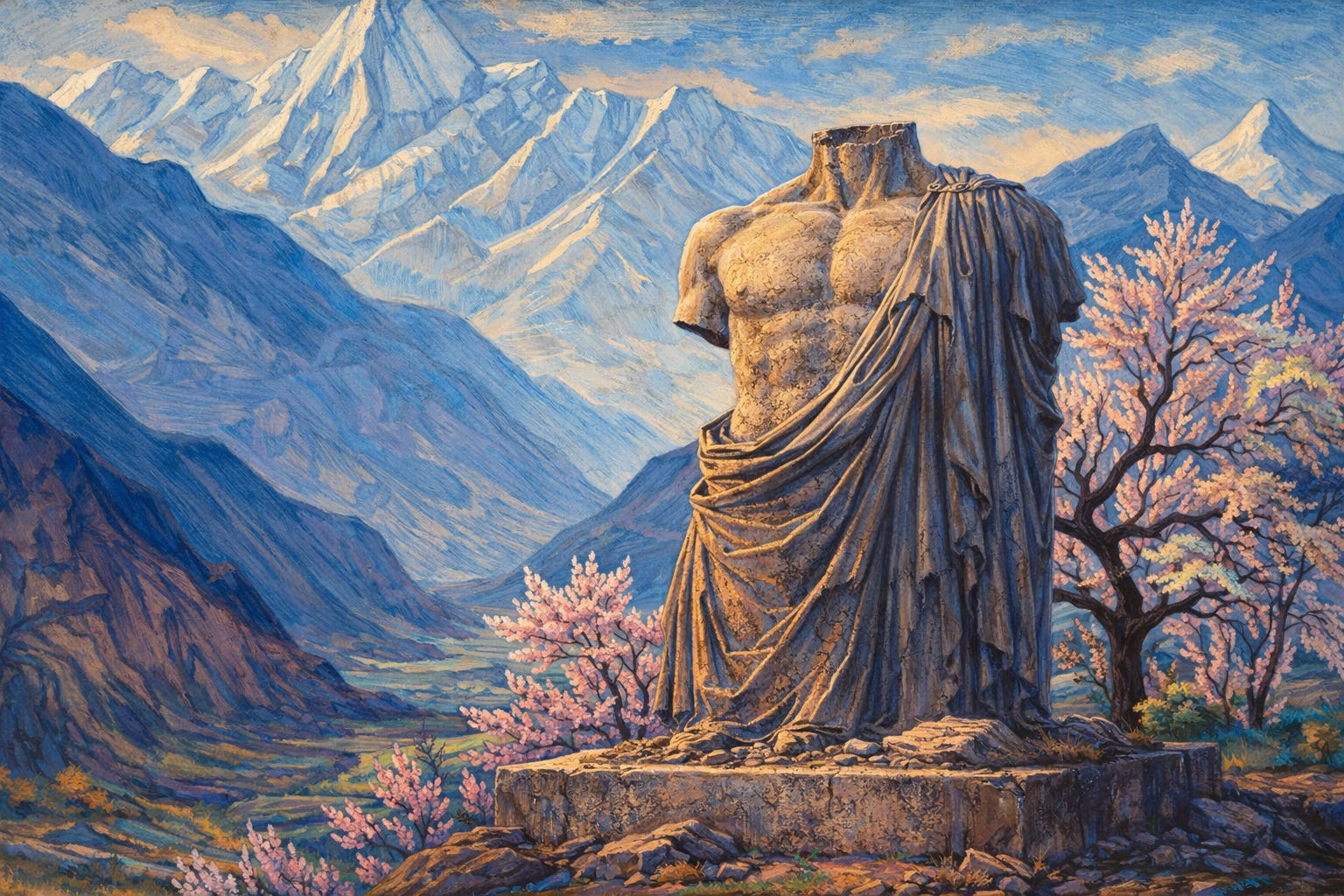
A Review of J. R. Sommer, The New Colossus: Heidegger and the Will-to-Machine (Arktos, 2024):

In The New Colossus: Heidegger and the Will-to-Machine, J. R. Sommer compels us to re-live the events of human decline: the development of slave-morality, the emergence of the unthinking herd, of the mass man; the Christianity that gave us universalism, internationalism, liberalism: the guillotine and the hammer and sickle. This re-living inspires the reader to engage in the taboo of questioning modernity and all its assumptions. The outline of ideology in The New Colossus made me recall this quote and consider its implications:
“The communist revolution will begin again, by recognizing these facts and granting them their full importance. The proletariat will reconstitute itself as class and thus as party, in this way superseding the cramped limits of all class societies. The human species will finally be unified and form a single being.”
— Jacques Camatte, The Democratic Mystification
Called forth under the conditions of the intense pressures of an exponentially changing society in the 20th century, this example of ideology explains millennia of efforts to destroy traditional order. Running through the Gracchi, the Ebionites, the Diggers, the Grand Lodge of London and Westminster, the Society of the Friends of the Constitution, the International Workingmen’s Association, and on and on, is this same ideology, only in different forms. These were the vanguards of the mass man. Sommer, channeling Nietzsche, characterizes this unity of the vanguards and the mass man as “a bastard ideology, born of the virginal, primeval whining of the bungled and the botched” (The New Colossus, p. 20).
This desire to unify human beings into a single being is what underlies the values of universalism, internationalism, and liberalism. They worship the State because the State prefigures this unification; the State’s claim is that it is representative of all beings. In the modern era, the fascination of these vanguards with capital has been all-consuming. Capital is the autonomization of the production of value; value that creates new value. As such, it was the force that succeeded in generalizing this ideology, because capital owes no allegiance to any peoples, cultures or gods, and subsidizes its movement toward dehumanization with material comforts. Its autonomy is expressed in its independence from the control of human beings. Marx and Engels marvelled at this:
“The bourgeoisie, by the rapid improvement of all instruments of production, by the immensely facilitated means of communication, draws all, even the most barbarian, nations into civilization. The cheap prices of commodities are the heavy artillery with which it batters down all Chinese walls, with which it forces the barbarians’ intensely obstinate hatred of foreigners to capitulate. It compels all nations, on pain of extinction, to adopt the bourgeois mode of production; it compels them to introduce what it calls civilization into their midst, i.e., to become bourgeois themselves. In one word, it creates a world after its own image.”
— Karl Marx and Friedrich Engels, Manifesto of the Communist Party
Capital was the vehicle for the mass production of the mass man, first in the West, then globally. The struggle of the vanguards is one for the universalization of the mass man, devoid of all connections to traditional order; his agglomeration into an internationalized, undifferentiated unthinking herd, represented by an all-consuming State; and for this State to be wielded to autonomize the entire technical apparatus summoned by capital. Sommer calls the triumph of this effort humanity’s end. What could be more fitting than the dialectical resolution of the problem of the unification of human beings into a single being than the negation of humanity?
We’re reminded that it is too late. The will-to-machine is inevitable: it is the content of our time. But the will is raised for the first time here — a conquering will that seeks the impossible by standing against time:
“What is the impossible? It is standing resolutely, successfully against the time fated to engulf all.”
— J. R. Sommer, The New Colossus, p.140
Ortega y Gasset’s mass man, Nietzsche’s last man, those personifications of Heidegger’s category of thrownness, predominate. They have no past and no future, they are only creatures of the present: and they demand your compliance, if not your participation. Recalling Nietzsche’s allegory from The Joyous Science (§ 125), Sommer writes:
“The madman in the marketplace is mocked because he seeks God – it is the Mass Man who mocks… The Mass Man mocks because he has sunk into the average and become incapable of belief. To him, God is an inconvenience that obstructs the way to a technicized future. The madman seeks because he is mad and mad because he seeks… In view of the Mass Man, the seeker – i.e., one who seeks to poetize the technologized and rebalance being in beyng – can only be mad, for he upends the conditions of man’s trajectory.”
— J. R. Sommer, The New Colossus, pp. 136-137
Standing against time is the path to the opening of the seekers’ encounter with the last god under these conditions.
A highlight of the book is Sommer’s clearer and more succinct formulation of being and beyng than can be found in Heidegger’s Black Notebooks. This formulation is first introduced in a footnote in the Introduction and considered further in a separate essay:
“‘Beyng’ might be understood as ‘existence’; for clarity, ‘beyng’ is used throughout the text to distinguish it from ‘being,’ which could be understood as ‘consciousness’. Each of these words is meant in a deeper way than might be initially considered: ‘beyng’ is not mere existence; it is its root; ‘being’ is not mere biological consciousness; it is awareness of one’s participation in beyng”
— J. R. Sommer, The New Colossus, p. x
“We have seen and described the substructure of both reality (being) and unreality (beyng)”
— J. R. Sommer, “The Hidden God Who Offers Meaninglessness”
These categories, in view of this formulation, are in continuity with Heidegger but are able to be wielded effectively outside the limits of the forms of philosophy to which Heidegger showed fidelity. This expanded utility is evident in their use throughout the book.
This is a contribution worth reading in these times. J. R. Sommer’s latest book, The Electric Will, continues to develop the work begun in The New Colossus.
Heidegger and the Will-to-Machine, by J. R. Sommer, presents the idea that modern man is not driven by ideology or progress but by an impersonal will that turns humanity into its instrument. Liberal and conservative alike serve the same machine of money, surveillance, and technics. Drawing on Heidegger, Sommer presents genuine thought as resistance and insists that to possess the will is to stand against it.
Christianity did not give us internationalism, liberalism: the guillotine and the hammer and sickle. All that comes from the PERVERSION and undermining of the traditional Christianity which gave us the cathedrals, music and art of High Europe, individualism (for all its faults), rule of law, science and technology. One can say it comes from the masonic revolution, but of course that in turn is but a modern-era iteration of a much older and darker evil.
That apart, great stuff!
Christianity did not necessarily give us internationalism or liberalism per se, though I understand the impulse behind such an undertaking. The idea that there is a desire to unify human beings into a single being so to speak is what many believe may have underlined the values of these 'isms'. Yet it is also important to recognize the logic of '“emancipation” that drives them. For instance, it was the will to emancipate that derived the logic of liberalism and then binded it with a broader international order. In modern political thought, it is this idea, that has often been perceived as a necessary condition or even a driving force of a dialectical progression. Christianity on the other hand was seen as a coercive force that historically restrained or tamed what was perceived as a necessary movement.