


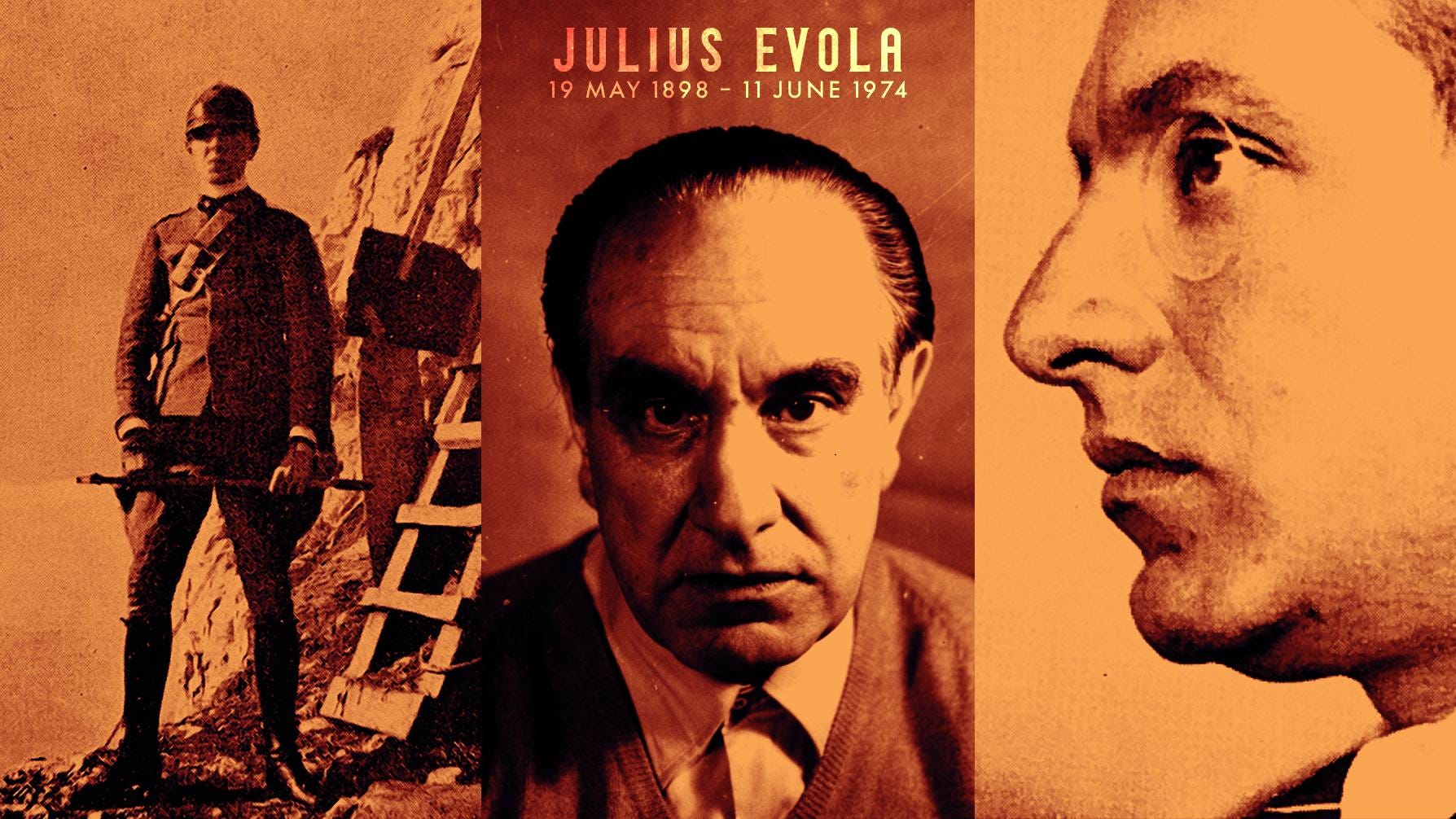
Gomery Kimber reviews Andrea Scarabelli, Julius Evola: An Adventurous Life (PRAV Publishing & Arktos, 2026).
“A Dadaist dandy with a monocle; an apolitical avant-gardist; an occultist ‘magician’ and ‘idealist painter’; a lover of pseudonyms; a friend and later enemy of the Pythagorean Arturo Reghini; a dissident Steinerian; an oppositional Guénonian with Kshatriya tendencies; a pagan denounced as a ‘Satanist’; an ‘a-Fascist’ Fascist; an enemy of ‘progress’ in all its forms; a metaphysician of Tradition; a defender of imperial Ghibellinism; a mountaineer; a theorist of race hostile to biological racism; an explorer of the Left-Hand Path; a champion of apoliteia…”
So begins Alain de Benoist’s foreword, and it is as good an opening as any biography could wish for. Julius Evola (1898–1974) was, as de Benoist observes, a man impossible to compare to anyone else. He has been neither forgotten nor adequately understood. Scarabelli’s book, the result of years of meticulous archival work, now goes a long way toward correcting the latter deficiency.
I came to Evola relatively late, and by an oblique path. My primary esoteric reference point has always been G.I. Gurdjieff, and it was the Gurdjieff Work that shaped my sense of what inner development might mean. Reading this biography, I was therefore struck by a slender but suggestive thread connecting the two traditions: the figure of Philippe Lavastine, a pupil of the Caucasian mystagogue and owner of one of the largest esoteric libraries in Europe, who attempted to sponsor French translations of Revolt Against the Modern World and The Mystery of the Grail in wartime Paris and published a long, attentive review of Evola’s writings. The correspondence between Lavastine and Evola is not extant, but its trace remains. Evola’s own 1972 essay on Gurdjieff is characteristic: appreciative, reserved, granting the diagnosis of man-as-machine in full, yet maintaining the aristocratic hauteur of a differentiated man who finds perhaps something too chaotic in Gurdjieff’s method of shock and disorder. The two figures are, I think, genuinely complementary. Evola provides the vertical map, the ontology of real difference, the lost hierarchy; Gurdjieff works on the ruined engine that is too fragmented to read the map. Lavastine, moving between the two traditions without apparent syncretism, embodied the possibility of engaging both.
It was this complementarity, and Evola’s reputation as a difficult and combative personality, that drew me toward the biography — as well as the fact that I had already incorporated a fictionalised version of him, under the name Baron Andrea, as an antagonist in my novel The Nazi Alchemist, the first in the Wyvern series. Scarabelli’s book has enriched my understanding considerably, and I intend to make further use of his subject in a subsequent volume set during the ‘Years of Lead,’ the period of social and political turmoil in Italy that began in the late 1960s.
The biography is monumental by any standard: nearly 800 pages, with close to 2,000 scholarly notes and a full index. Scarabelli, having served as a secretary of the Julius Evola Foundation and currently the head of the Philosophy division of the Italian GRECE, brings to the task both institutional access to Evola’s archive and the genuine sympathy of a committed Traditionalist. De Benoist is right to note that no prior work compares to it. Evola often appeared haughty and distant in public, a calculated projection of what he called “active impersonality,” but Scarabelli reveals a man who enjoyed numerous romantic adventures (including with the writer Sibilla Aleramo), travelled extensively, quarrelled prolifically, and cultivated relationships ranging from Carl Schmitt and Mircea Eliade to Gottfried Benn and, improbably, Federico Fellini. He preferred to travel sine impedimenta, had no love for family life or children, and was constitutionally unsuited to monogamy. However, Evolamaniacs may be surprised to find he was not the complete misogynist, writing articles in defence of single mothers and of the rights of prostitutes.
READ MORE — Julius Evola’s The Woman Problem is hot off the press from Arktos:

Among the most illuminating sections are those devoted to the early Evola: his Dadaist period, his experiments with absolute individualism under the influence of German Idealism, Nietzsche, and Max Stirner, and the esoteric magazine Ur (later Krur), described by Scarabelli with a wealth of previously unpublished detail. The subtitle of Ur, Rivista di indirizzi per una scienza dell’Io (”Journal of Orientations for a Science of the ‘I’”), points toward what Evola himself called the “systematic and definitive exposition” of his doctrine: the Teoria e fenomenologia dell’Individuo assoluto (“Theory and Phenomenology of the Absolute Individual”), a work that has still not received the attention it deserves in the Anglophone world. My novel’s character, Justin Martello, who appears in three metaphysical thrillers, is himself a student of Evola’s Science of the ‘I’.
The question of Evola’s baronial title is handled with characteristic thoroughness. The conclusion is unambiguous: the title was not inherited, not registered, and not legal. His Sicilian family was bourgeois, and as Scarabelli notes, “there is no trace of the title of baron in his family.” The rumour appears to have originated as a Dadaist blague in the 1910s. Even Tristan Tzara referred to Evola as baron, but the persona proved useful in ways that outlasted the joke. In the aristocratic and conservative circles Evola frequented in interwar Germany and Austria, notably the Herrenklub in Berlin, noble lineage carried considerable social currency. He never denied the title, eventually painted himself a coat of arms, and had it stamped on his letterhead for correspondence with, among others, the son of the Austrian philosopher Othmar Spann, a letter intercepted and photographed by the Italian secret police. When an interviewer in the 1960s pointed out the absence of any Baron Evola in the Almanach de Gotha, Evola simply declined to answer. For a philosopher who held that true aristocracy was a matter of inner orientation rather than bureaucratic registration, the self-assumed title was, in its way, entirely consistent.
I have speculated on Substack about the heraldic symbolism of his self-designed coat of arms: two unsheathed swords, two cypress trees, and a diagonal black band running from right to left, which in the strict grammar of heraldry constitutes a bend sinister, historically associated with irregular lineages.
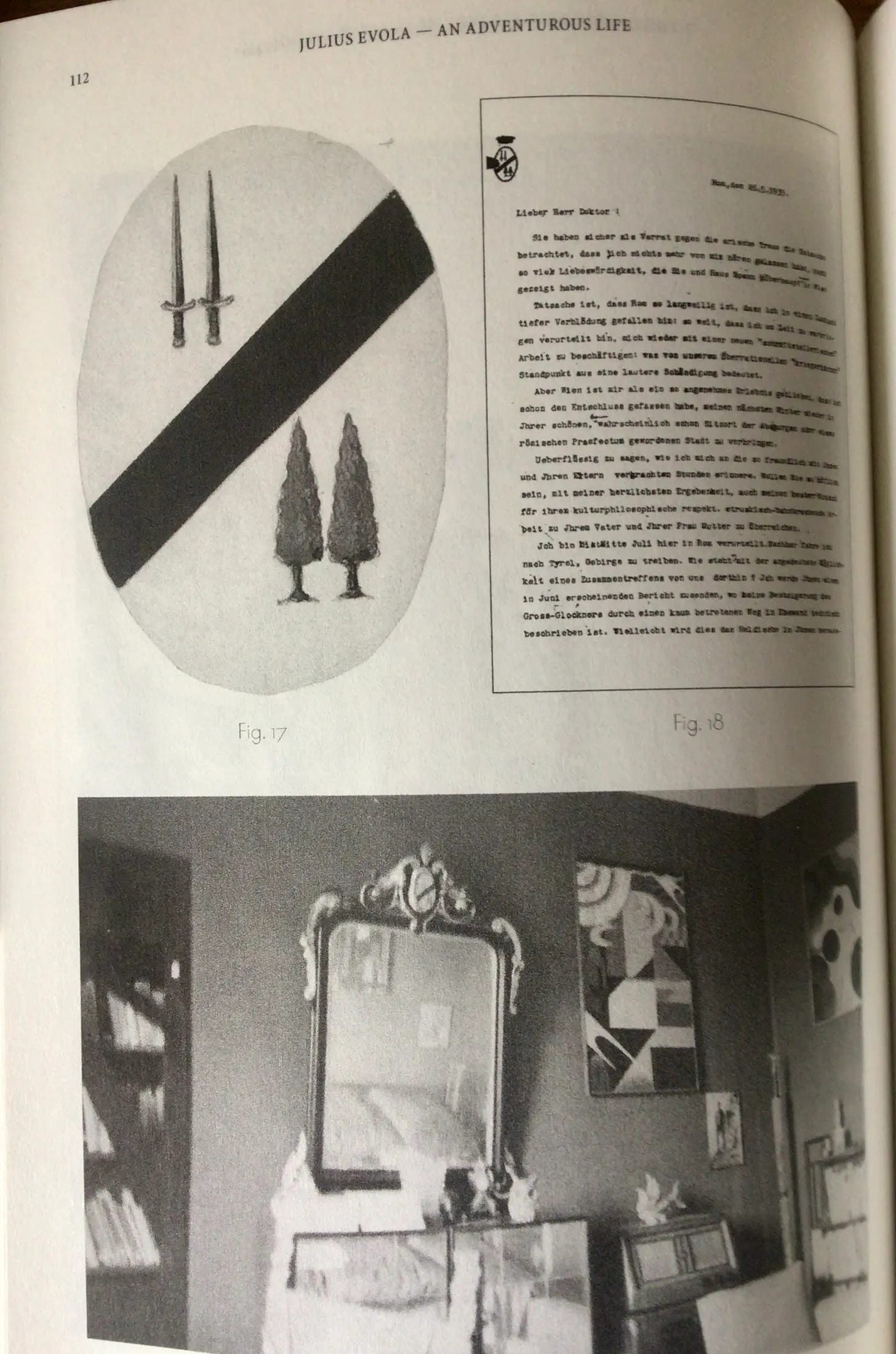
Whether Evola was quietly signalling to those with eyes to see that his title was indeed self-conferred, or whether the black diagonal carried primarily alchemical and Left-Hand Path significance (sinistra, after all, being Latin for left), I leave to the reader’s judgement.
Scarabelli is equally illuminating on Evola’s mid-1920s contributions to Lo Stato Democratico, an anti-Fascist newspaper founded by Duke Giovanni Colonna di Cesarò. This episode is easily misread. Evola’s opposition to Fascism was not democratic: it was rooted in his contempt for Mussolini’s movement as spiritually shallow, populist, and culturally rootless. “The movement had no cultural and spiritual roots whatsoever,” he wrote; “it tried to invent them later.” He contrasted this with what he believed was required: a metapolitical intellectual élite capable of actualising Traditional principles above the partisan fray. “Let a spiritual group be constituted,” he argued, “then the path to the true solution of the greatest economic and political problems will open up of itself.” Observers have called this stance “aristocratic anti-fascism,” and it is precisely the right description. Evola later worked to suppress these pages, perhaps because they were inconvenient; Scarabelli restores them to their proper place.
On the chapter devoted to racial doctrine, I confess I moved quickly. Evola’s “spiritual racism,” whatever philosophical structure he constructed around it, is not a territory I find productive or congenial to explore at length, and readers seeking a detailed engagement with that aspect of his thought will find more in other studies. What Scarabelli makes clear, and what matters historically, is that Evola consistently opposed biological reductionism and was viewed with suspicion by the Nazi establishment for precisely that reason. SS assessments of his work were dismissive; his influence on policy, marginal.
The later Evola, crippled by a USAAF bombing raid on Vienna in 1945 and thereafter largely confined to his flat in Rome, continuing to write, correspond, and exert influence over post-war esoteric and radical-right circles, is in some respects the most instructive. Men Among the Ruins and Ride the Tiger were not the products of a defeated man, but of a philosopher who had never measured success by historical outcomes. Worldly failure in the age of the Kali-Yuga was always already expected. What mattered was fidelity to principles, the achievement of inner differentiation, and readiness for future cycles. Whether one regards his Tradition as profound wisdom or repulsive reaction, the consistency of the posture commands respect.
One of the pleasures of a biography of this length and depth is the accumulation of anecdote, and Scarabelli’s book is richer in this regard than one might expect. Evola’s public persona was famously glacial, but the book reveals a man capable of dry wit and sardonic amusement at the absurdities of the world he inhabited. The account of his 1951 trial, in which he was charged with glorifying Fascism and inciting political violence, is particularly entertaining. Evola used his defence to deliver a philosophical lecture, citing Aristotle, Plato, the Dante of De Monarchia, Metternich, and Bismarck as fellow travellers in the dock. His lawyer Carnelutti interrupted to observe, to general hilarity, that the police had also gone in search of these people. A diligent officer, faithfully noting down the names as they were uttered, had apparently been recording them as dangerous neo-Fascists to be promptly put in handcuffs, unaware that he was compiling a list of ancient philosophers, a poet, and nineteenth-century statesmen. Evola was contemptuous of the prosecution throughout, observing that the trial was being conducted by people entirely unfamiliar with the ideas under scrutiny, and that the official report betrayed ignorance of what “esotericism” even meant. He was acquitted. It is a scene that would not be out of place in a comic novel, and Scarabelli does it justice, as he does every aspect of his subject’s life.
Julius Evola: An Adventurous Life is the biography the baron has long required and I recommend it to you.
Gomery Kimber is an award-winning British novelist, the author of The Big Shilling Trilogy, the Wyvern series of historical novels (espionage & esotericism), and the metaphysical Justin Martello adventures (”A New Kind of Hero”). He styles himself ‘not your average thriller writer.’ His books are available from Amazon and you can connect with him on Substack.
Julius Evola: An Adventurous Life, by Andrea Scarabelli, is available in hardcover, paperback, and ebook editions from Arktos and PRAV Publishing.
